Posted on 10/14/2025 6:47:10 AM PDT by Red Badger
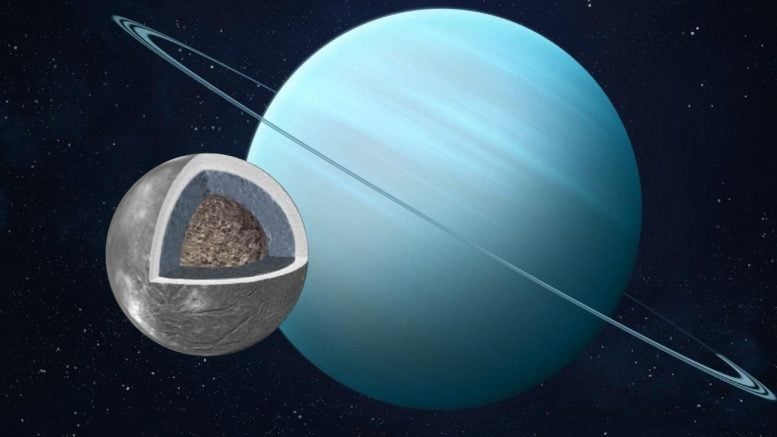
New research suggests that Ariel, a moon of Uranus, might have once harbored an ocean about 100 miles (170km) deep. Credit: NASA/JPL-Caltech/PSI/Mikayla Kelley/Peter Buhler Evidence points to a long-lost ocean beneath Ariel’s icy crust. Tides and orbit shifts may have cracked its surface billions of years ago.
Growing evidence indicates that a deep ocean may lie hidden beneath the icy exterior of Uranus’ moon Ariel. A new study published in Icarus examined how this subsurface ocean might have formed and evolved, revealing that it could once have reached depths of more than 100 miles (170 kilometers).
For comparison, Earth’s Pacific Ocean averages only about 2.5 miles (4 kilometers) deep.
Ariel’s surface and its mysteries
“Ariel is pretty unique in terms of icy moons,” said paper co-author Alex Patthoff, a Planetary Science Institute senior scientist.
Ariel, Uranus’ brightest and second-closest moon, measures roughly 720 miles (1,159 km) across (about the distance from PSI in Tucson to Salt Lake City, Utah). It is the fourth-largest moon in the Uranian system and displays a striking mix of ancient and youthful features. According to first author Caleb Strom, a recent graduate of the University of North Dakota, Ariel’s surface combines heavily cratered areas with smooth plains likely formed by cryovolcanism. The moon’s landscape also contains large fractures, ridges, and grabens—sections of crust that have sunk below surrounding terrain—on scales greater than nearly anywhere else in the Solar System.
This complex terrain led scientists to investigate Ariel’s internal and orbital history. The team aimed to determine how its inner structure and orbital eccentricity, or the degree to which its orbit deviates from a perfect circle, could have produced the patterns seen today. Both factors affect the stress placed on the moon’s crust, which can fracture as Ariel is pulled and stretched by Uranus’ gravity.
“First, we mapped out the larger structures that we see on the surface, then we used a computer program to model the tidal stresses on the surface, which result from distortion of Ariel from soccer ball-shaped to slight football-shaped and back as it moves closer and farther from Uranus during its orbit,” Patthoff said. “By combining the model with what we see on the surface, we can make inferences about Ariel’s past eccentricity and how thick the ocean might have been.”
The power of tidal stress
The researchers determined that Ariel once had an orbital eccentricity of roughly 0.04, about 40 times greater than it is today. Although this number may appear small, even slight increases in eccentricity can significantly intensify tidal stress. At that level, Ariel’s orbit would have been four times more elongated than Jupiter’s moon Europa, whose surface is continuously fractured by powerful tidal forces. Despite this, Ariel’s path around Uranus would still have looked nearly circular to the eye.
“In order to create those fractures, you have to have either a really thin ice on a really big ocean, or a higher eccentricity and a smaller ocean,” Patthoff said. “But either way, we need an ocean to be able to create the fractures that we are seeing on Ariel’s surface.”
Connecting Ariel to its sister moons
What’s more, this is the second in a series of papers investigating the past subsurface of Uranus’ moons. Last year, this same team published a paper on Miranda with similar results.
“We are finding evidence that the Uranus system may harbor twin ocean worlds,” said co-author Tom Nordheim of Johns Hopkins University Applied Physics Laboratory and principal investigator of the NASA Solar System Workings grant that funded the Miranda and Ariel studies. “Unfortunately, we’ve only seen the southern hemispheres of Ariel and Miranda. But our results can give us predictions of what a future spacecraft might see on the moons’ unimaged northern hemispheres, such as the location of fractures and ridges there. Ultimately, we just need to go back to the Uranus system and see for ourselves.”
Researchers still aren’t sure exactly how long ago this deep ocean might have existed; however, this work will provide an important input for future research that investigates the behavior of outer Solar System oceans over time.
Reference:
“Constraining ocean and ice shell thickness on Ariel from surface geologic structures and stress mapping”
by Caleb Strom, Tom A. Nordheim, D. Alex Patthoff and Sherry K. Fieber-Beyer, 22 September 2025, Icarus.
DOI: 10.1016/j.icarus.2025.116822
This research was also funded by the North Dakota Space Grant Consortium.
Uranus is two billion miles from the sun. If it had a large body of water, seems it would be an ice cap, not an ocean.
Thanks Red Badger.
· join · view topics · view or post blog · bookmark ·
· post new topic · subscribe ·Google news searches: exoplanet · exosolar · extrasolar ·
Two words: Fusion fuel.
Water ice and liquid this far out in the solar system is original solar system formation water from the super nova that forged all the heavy elements which means it’s loaded with deuterium.
Deuterium is the base of a host of fusion cycles if you have plasma at temps for deuterium + deuterium fusion you have plasma for all the fusion reactions of its fusion products. You need 300 million C for D + D. By the time humans are mining a ice giant moon we will have the tech for 300 million K.
Deuterium(D) + deuterium(D) =
50% neutron + helium3(H3)
50% proton(hydrogen) + tritium(T)
Then the products can fuse too.
D + T = neutron + helium4
D + H3 = proton + helium4
H3 + H3 = proton + proton + helium4
Ultimately you end up with protonium and stable helium 4
The moon has helium3 in the top 2 meters of the regolith holds a million tonnes.
One kg of deuterium from earth’s ocean plus one kg of helium 3 from the moon plus 100 million K = 190,000 gigawatt hours of energy. He3+D is 1/3 the temp of D+D fusion and we have have achieved 100 million K.
This is the way...ion accelerators not magnetic bottles. Humans have accelerated gold and lead to 7 trillion degrees K the path to 300 million K is exactly what this company is doing they plan on D + He3 first or D+T.
https://www.helionenergy.com/technology/
Here in the USA a company achieved 217 million C for 24 hours if true. Then that’s also 217000273K... China and Korea both exceeded 100 million C. The Chinese just held for more than 1000 seconds above 100 million K.
[Helium-4 fusion requires a temperature of approximately 100 million Kelvin to overcome the positive charges of the helium nuclei and initiate the triple-alpha process. At this temperature, three helium-4 nuclei fuse, with two first forming an unstable beryllium-8 nucleus, which then fuses with a third helium-4 nucleus to create a stable carbon-12 nucleus, releasing energy. ]
He4+He4 = beryllium8
Beryllium8+He = Carbon12
https://www.yahoo.com/news/us-firm-sets-record-plasma-213547664.html
This is as far as humans likely will ever get. Carbon is the end of the line for fusion without massive gravity wells or artificial gravity if humans ever master gravitons.
“Uranus is two billion miles from the sun. If it had a large body of water, seems it would be an ice cap, not an ocean.”
Same as Jupiter’s moons Europa and Ganymede the surface is ice crust miles thick. Tidal heating flexes the moons interiors and friction keeps the deep oceans liquid under intense pressures. You would have to melt down miles likely 20+ to reach liquid water. For humans we just need the solid ice it’s water ice [ hydrogen(protonium,deuterium),oxygen + salts] and CO2 ices every one of those elements is needed for human life these are mining stops. Hydrogen is also fuel for ion engines and fusion engines too.
A moon of Uranus
Redundant
Uranus has 29 moons. Make of that what you will, I’m only here for the comments anyway.
I miss Frank.
L

Too much Taco Bell can cause an ocean like slurry.
There are five “major moons” that were discovered by telescope before the space travel era. Titania and Oberon were also discovered by Herschel (who first spotted the planet Uranus in 1781) in 1787; Ariel and Umbriel were discovered by Lassell in 1851, and darker and smaller Miranda not seen until 1948 by Kuiper), and of those, Ariel is second closest to the planet, with an orbital period of 2.52 days. Only Miranda is smaller than Ariel, and also only Miranda is closer to the planet. Umbriel is almost the same size and both Titania and Oberon are around one third larger in diameter. The orbital order of the moons is Miranda, Ariel, Umbriel, Titania and Oberon, whose orbital period is almost fourteen days.
In 1985 during the first Voyager fly-by, an intermediate sized moon, Puck, was discovered in an orbit closer to the planet than Miranda, and by 1999, 23 other smaller satellites, some of which are apparently ring shepherds, and also a few small satellites further out than the five major moons, were detected.
It is a mental nightmare trying to visualize the system, Uranus rotates every 17 hours 14 minutes in a retrograde direction (relative to its north pole, it goes in the opposite direction to most other planets) but the planet is also spinning on its side relative to its orbit. The major moons and most of the smaller ones orbit in a prograde direction like all major satellites in the solar system except for Neptune’s Triton.
If you were on the earth’s moon looking at the earth at full moon, you would see mainly the darkened night side of earth and any light from thunderstorms or urban areas on earth would appear to be moving left to right, but if you could be an observer on the surface of Ariel, and there were any distinct features on the cloud tops of Uranus, those would appear to be moving (quite rapidly) right to left. If you were on closer moon Puck its orbital period (0.76 days) is almost the same as the rotational speed of the planet (0.72 days) but in the opposite direction, so every 17 to 18 hours you would see the same portion of the planet spinning below quite rapidly from right to left, any visible features would take six to nine hours to rotate all the way across its disk as seen from that perspective.
Disclaimer: Opinions posted on Free Republic are those of the individual posters and do not necessarily represent the opinion of Free Republic or its management. All materials posted herein are protected by copyright law and the exemption for fair use of copyrighted works.
