Posted on 10/14/2025 6:37:39 AM PDT by Red Badger
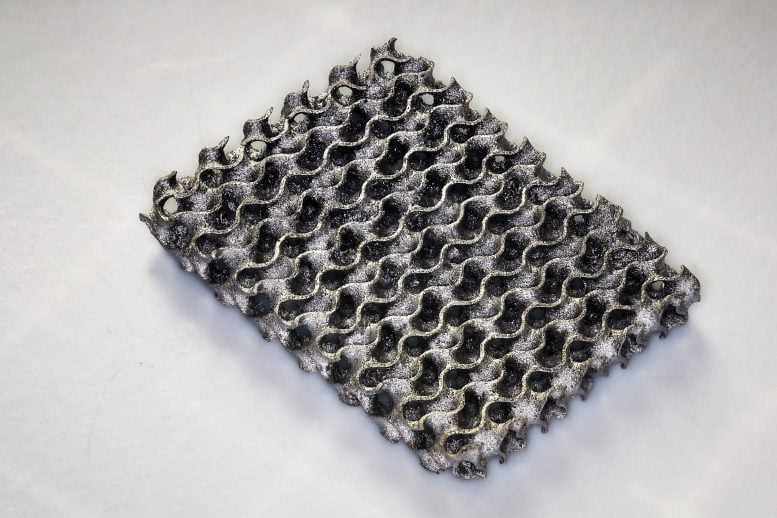
Large iron gyroid (1.3 x 1.0 cm). Credit: ALCHEMY EPFL CC BY SA EPFL scientists have created a breakthrough 3D printing method that uses hydrogels as templates to produce ultra-dense, durable metals and ceramics.
The process builds a gel scaffold that is later infused with metal salts and converted into nanoparticles, then heated to reveal the final solid form. The resulting materials are stronger and less prone to warping than those made with traditional methods.
Unlocking the Potential of Vat Photopolymerization
Vat photopolymerization is a 3D printing process where a liquid resin that reacts to light is poured into a container and then solidified layer by layer using a laser or ultraviolet light to form a 3D shape. However, this approach is limited because it only works with light-sensitive polymers, which restricts the types of materials that can be produced.
Some 3D printing techniques have tried to overcome this by transforming printed polymers into metals or ceramics. Yet, according to Daryl Yee, head of the Laboratory for the Chemistry of Materials and Manufacturing at EPFL’s School of Engineering, these materials often fall short in quality.
“These materials tend to be porous, which significantly reduces their strength, and the parts suffer from excessive shrinkage, which causes warping,” he says.
A Hydrogel Breakthrough for Metal and Ceramic Printing
To solve these challenges, Yee and his team developed an innovative method described in their paper published in Advanced Materials. Instead of curing a resin that already contains metal compounds, the researchers begin by 3D printing a framework made from a simple, water-based gel called a hydrogel. This blank structure is then soaked in metal salts, which are chemically transformed into tiny metal-containing nanoparticles that spread throughout the gel. The process can be repeated several times to increase the concentration of metal within the material.
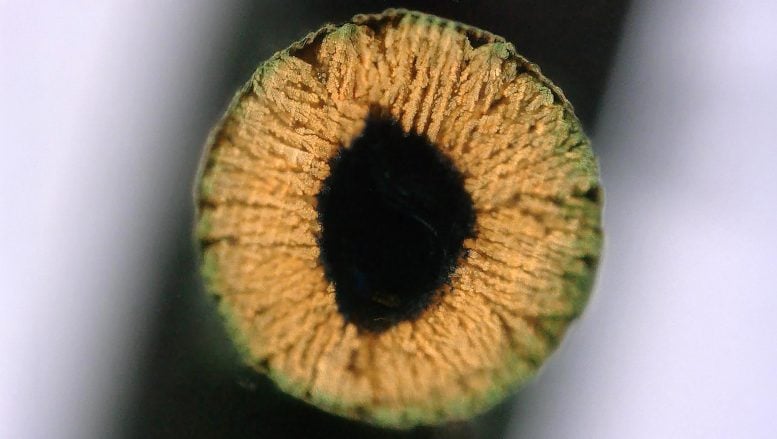
Cross-section of a copper-infused hydrogel. Credit: ALCHEMY EPFL CC BY SA
After 5-10 of these “growth cycles,” the remaining hydrogel is removed through heating, leaving behind a metal or ceramic structure that perfectly replicates the original gel’s shape. The result is an exceptionally dense and durable object. Because the metal salts are introduced only after the printing step, one hydrogel model can be converted into a variety of metals, ceramics, or composite materials.
“Our work not only enables the fabrication of high-quality metals and ceramics with an accessible, low-cost 3D printing process; it also highlights a new paradigm in additive manufacturing where material selection occurs after 3D printing, rather than before,” Yee summarizes.
Targeting Advanced 3D Architectures
For their study, the team fabricated intricate mathematical lattice shapes called gyroids out of iron, silver, and copper, demonstrating their technique’s ability to produce strong yet complex structures. To test the strength of their materials, they used a device called a universal testing machine to apply increasing pressure to the gyroids.
“Our work highlights a new paradigm in additive manufacturing where material selection occurs after 3D printing, rather than before.”
Daryl Yee, head of the ALCHEMY lab
“Our materials could withstand 20 times more pressure compared to those produced with previous methods, while exhibiting only 20% shrinkage versus 60-90%,” says PhD student and first author Yiming Ji.
Applications in Energy, Sensors, and Biomedicine
The scientists say their technique is especially interesting for the fabrication of advanced 3D architectures that must be simultaneously strong, lightweight, and complex, like sensors, biomedical devices, or devices for energy conversion and storage. For example, metal catalysts are essential for enabling reactions that convert chemical energy into electricity. Other applications could include high-surface area metals with advanced cooling properties for energy technologies.
Looking ahead, the team is working on improving their process to facilitate uptake by industry, notably by further increasing the density of their materials. Another goal is speed: the repeated infusion steps, while essential for producing stronger materials, make the method more time-consuming compared to other 3D printing techniques for converting polymers to metals. “We are already working on bringing the total processing time down by using a robot to automate these steps,” Yee says.
Reference:
“Hydrogel-Based Vat Photopolymerization of Ceramics and Metals with Low Shrinkages via Repeated Infusion Precipitation”
by Yiming Ji, Ying Hong, Dhruv R. Bhandari and Daryl W. Yee, 24 September 2025, Advanced Materials.
DOI: 10.1002/adma.202504951
Denser metals means less oxidization. It also means we can make metallic materials thinner.
For those who believe that Chinese people cannot innovate, please observe the listed names.
I’ll take the home version
They didn’t say what hydrogel was used, but my guess is was acrylic acid based, or perhaps carboxymethylcellulose based.
This was done tried with alginate fibers back in the 90s to make thermally insulating alumina fibers. (back when I was in graduate school)
You have metal salts and an anionic polymer (alginate, CMC, polyacrylate) and the metal cations from the salts bind the polymer.
But unless you have a high anionic charge on the polymer you don’t get full density.
Finally, a stronger boxing material for us males to put our feelings.
You should start one. About time you had a ping list, slacker! 😊 You post a lot of articles on health and diet... actually, there may be such a ping list already... 😷
Oh great, now the TS1000 has entered the chat.
There is a 3D printer list already, I just can’t remember who has it!..............🤔
Some FReeper named Red Badger has posted a bunch of 3d printing topics, and may know who. 😁
https://freerepublic.com/tag/3dprinting/index
Strong and lightweight. Sounds like a good product for Areospace applications.
NASA...use one story printer to create a reentry craft skin shell with no joints using high temperature ceramics. (Several onion skin layers deep? Or, creating aircraft high temperature turbine blades, or, high strength aircraft structural parts, struts and air frames.
Imagine combining this with the already low strength to weight ratio of Titanium, or layering this with the rigidity of Beryllium. Ultra lightweight aircraft ? Space elevator cable?? Funny little flying tik-tacks and other Skunk works products?
Wonder how this works in salt water and if there are any ship building applications? Not sure if this would make a good Tokmak (sp?) shell.
(Humm....Better a red badge than a Red shirt!)
My daughter’s fiancé prints a lot of little things, mostly using plastics or composite materials. Mostly kids’ toys. Simple stuff. He made my wife a flower vase. He also printed an egg holder for the refrigerator. He’s expert in computers, he’s an IT professional at a college.
Great, have they also invented a drill bit to make holes in it?
In 3D Printing, you print the holes.............
Absolutely, but this study is out of Switzerland. Chinese (the country/institutions) have been dumping bad science studies and buying their way in to science journalism.
I have been using the Autodesk AI design tools. Enter in the parameters (strength, flex, etc) then enter the limitations (space, Area, obstacles) etc and after a while their servers spit out a dozen possibilities. The problem is what is produced can not be produced cheaply or easily so the information is used as a base to design something that can be manufactured with current tech. 3D printers have been around but the strength and predictability of the materials is not too easy to control. Line me up to buy one of these.
Ceramic engines? Complete fuel burn? Water vapor exhaust?
Disclaimer: Opinions posted on Free Republic are those of the individual posters and do not necessarily represent the opinion of Free Republic or its management. All materials posted herein are protected by copyright law and the exemption for fair use of copyrighted works.
