
Posted on 11/27/2023 9:31:07 AM PST by Red Badger
This story originally was published by Real Clear Wire
U.S. Energy Secretary Jennifer Granholm gave Americans an unintended glimpse of the future during her road trip this summer touting the wonders of electric vehicles. Her public relations misadventure in Georgia involved one of her staff in a gasoline-powered vehicle blocking off a coveted charger in advance of her arrival, leading to frayed tempers and a local EV owner calling the cops. It was an illustration of the challenges drivers could face as governments push the public to embrace plug-in vehicles.
Hyped as technological marvels, EVs are boobytrapped with a host of inconveniences and tradeoffs. By now many people have heard about range anxiety, exploding lithium-ion batteries, and the environmental destruction caused by global mining for battery minerals.
But more challenges are in the offing as the federal government and the states pump in billions of dollars to build a massive national infrastructure of charging stations to power the EVs.
EV sales are creeping up, but nowhere near the ambitious targets set by the policy experts, accounting for under 8% of new car sales in the third quarter, and rising to nearly 10% in September. California stands at the vanguard of the nation’s EV transition, with more than 1 million electric vehicles among the state’s 31-million-plus registered vehicles, and EVs accounting for about 25% of new car sales in the second quarter.
At some point, EV experts promise, the kinks will get worked out, and EVs will become as convenient as smartphones. But at present, the EV industry has a classic chicken-and-egg problem on its hands. The current demand for EV charging does not economically justify rapidly expanding the nation’s charging infrastructure, but without an expanded charging infrastructure in place, most people won’t buy EVs for fear of being stranded.
Despite California’s massive infrastructure investment, now totaling nearly 94,000 public chargers, the state has fallen behind its goal of 250,000 public chargers by 2025 – and potentially 10 times that number by 2035, when the ban on new gasoline-powered cars takes effect.
There’s no consensus on the amount of public chargers that will be needed. According to a California Energy Commission assessment, California will need more than 2.4 million public chargers to accommodate about 15.5 million electric cars, trucks, and buses by 2035. That breaks down to 2.11 million chargers (including 83,000 fast chargers) to support 15.2 million electric cars, as well as 256,000 depot chargers and 8,500 public chargers for 377,000 trucks and buses.
The 2.4 million chargers would serve only half the registered vehicles in the state. Many more will be necessary to complete the second half of the transition, from 15.5 million EVs to more than 31 million EVs by mid-century. Those chargers will have to be installed at curbsides, parking lots, parking decks, grocery stores, restaurants, convenience stores, big box stores, office buildings, strip malls, shopping centers, movie theaters, and other locations so that drivers always have ready access to plug-in.
By comparison, California now has about 11,000 gas stations, convenience stores, and other businesses that sell gasoline, which translates to about 110,000 individual gas nozzles, according to an estimate by Jeff Lenard, vice president of Strategic Industry Initiatives at the National Association of Convenience Stores. That means the transition from fossil fuels to electrons will require California to install at least 20 EV charging ports for every gas nozzle by 2035.
Not all chargers are equal, so the new EV infrastructure will require significant changes in driving habits. While so-called fast chargers can bring a battery to 80% of capacity in under an hour, most of the new public chargers will be cheaper, Level 2 technology, which provides between 5 miles and 60 miles of range for each hour of charging and isn’t practical for charging up quickly on a road trip.
Chargers are expected to lose money until there are enough EVs on the road to justify the investment. The cost of building a fast-charging station with four or more charging ports can range from several hundred thousand dollars to more than $1 million. Reliability remains a persistent problem, one that will shadow the industry as chargers are built out in remote areas, low-income areas, and other out-of-the-way places.
In the meantime, Analytics firm J.D. Power says that 20% of all EV drivers reported visiting a charger that did not or could not charge because it wasn’t working or there were long lines. The dissatisfaction rates ranged from 12% in the Cleveland-Akron-Canton area to 35% in South Florida. The firm said the trend is moving in the wrong direction: as more people buy EVs, “overall satisfaction continues to decline.”
This year, a Los Angeles Times columnist declared she’s ready to trade in her EV because charging is such a hassle. She wrote that chargers are sometimes blocked by cars that aren’t charging, exposed to blistering sunlight, charging at lower levels than advertised, or “it may shut off mid-charge with no warning or reason.”
The frustration seems to have no expiration date. And it includes a problem not caused to technology or economics but by human nature: vandalism. As Jonathan Levy, EVgo chief commercial officer, told the New York Times last year: “Where there’s a screen, there’s a baseball bat.”
This article was adapted from a RealClearInvestigations article published October 24.
This article was originally published by RealClearPolicy and made available via RealClearWire.
Everything JennyGran touches turns to crap.
Well you’re just one person.
You should do what my friend does. She charges her EV at the grocery store where it’s *free*, so saves her money from charging at home (in her solar-powered detached garage).
Perfect! Our government in action!
“Where there’s a screen, there’s a baseball bat.”
This is why we can’t have nice things in this country anymore.
Is there a ‘home heating oil’ dealer nearby?...................
Korean EV work fine last long time, GI...............
I'm 100% with conservatives in the hatred of the Dims forcing or subsidizing EV's onto us. But I'm saying our argument needs to be correct on facts. Thus, one thing we shouldn't say is that EV's are more expensive to drive than ICE cars because that's not the case (if you charge at home and drive at least 12K miles per year).
The facts we should use are:
1) Broke, corrupt government ain't got no business telling us what we can and can't drive or much anything else in life.
2) The grid can't handle everyone charging EV's even if the Dims weren't forcing power utilities to shut down coal plants and natural gas fueled plants and depend on solar and wind.
3) EV's aren't good for everybody. Some people can't charge at home. Some people just bought a good ICE car and ought to get their use out of it. Some people drive long trips through charging deserts. Some people just like ICE cars and ought to be able to drive what they want.
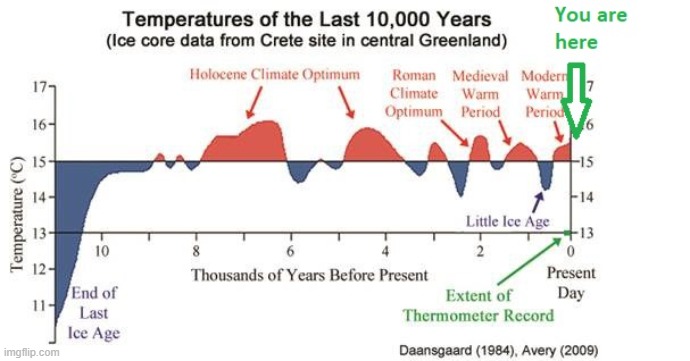
4) EV's don't save the world. There's no global warming crisis anyway except in the minds of cult Dims. Our Modern Warm Period is no different than other warm periods we've had since the ones Jesus lived in and Moses lived in.
The Left has made it their mission to make people SUFFER
Ford, Chev, VW-Porsche-Audi and Toyota have all said they are scaling back or elmimating their EV roadmap.
VW said the future of their company is on the line.
Chrysler is the only major manufacturer not saying anything.
The truth is Tesla is the only one able to mass produce them with a profit and even they are feeling the pressure.
My mother in law lives about 700 miles away. We got home from there last night after a 12 hour drive. We’re going back a week before Christmas and decided to take the Blue Highways route. (No interstates). That should be about 20-24 hours. Or 2 weeks with an ev.
The EV will revive the restaurant and hotel industry.....
And as mentioned, Toyota just said their most popular sedan will be all hybrid, due to Gov't mandates.
So how does the contradiction get resolved between users who can't afford or don't want EVs, and woke Government central planners who do?
The new infrastructure will be expensive and will hike the price of electricity to levels we only can guess. For the demands on it, every connection will have to be checked and repaired. Transformers will blow out and have to be upgraded for higher power demands. Area under sagging, overheated transmission line will have to get the undergrowth cleared to prevent the fires. The economic demands on the electric companies will drive them to bankruptcy. The government will take over the electric companies. Then, the cost of electricity will have no limits.
current price for scrap copper cable $2.50/lb.
Embrace the libtard suck
EV’s can be easily charged at home and will be
Disclaimer: Opinions posted on Free Republic are those of the individual posters and do not necessarily represent the opinion of Free Republic or its management. All materials posted herein are protected by copyright law and the exemption for fair use of copyrighted works.