Posted on 05/05/2023 11:51:56 AM PDT by Red Badger
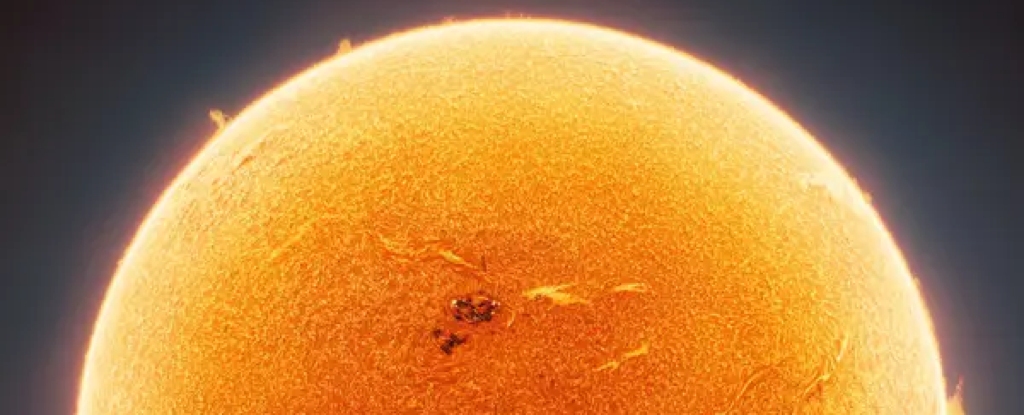
Close Up Of ISS And Sun The Sun (Andrew McCarthy)
The Sun is incomprehensibly massive, turbulent, and violent. It erupts high-energy radiation into space, some of which slams into the International Space Station rocketing around Earth.
The ISS circles our planet 16 times a day. With the right telescope, from the right location, you can see it passing overhead. And for just a few precious milliseconds, the astronaut-staffed space laboratory will occasionally zip across the face of the Sun.
Photographer Andrew McCarthy recently captured that split moment in a stunning portrait that took 12 hours to compose, three telescopes to capture, and two blown-out tires along the way. It may look like a single photo, but it's actually a mosaic of thousands of images.
So, can you spot the space station in this portrait?
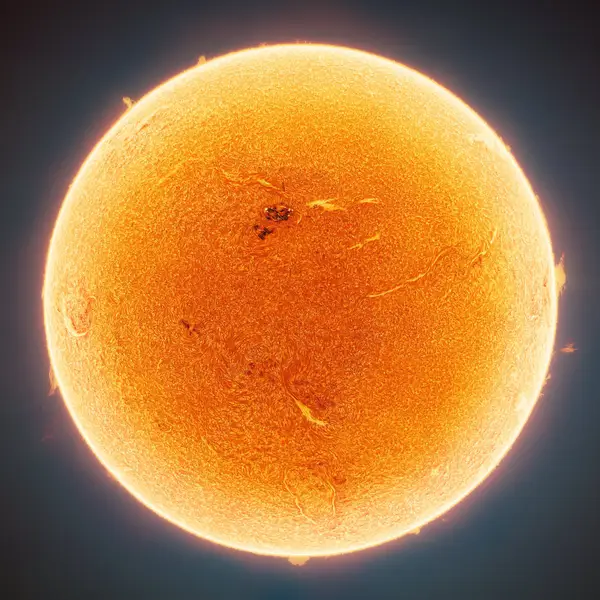
A close up of the sun with a small dark spot visible near the top left. The space station transits the Sun, as seen from Arizona. (Andrew McCarthy)
Here's a hint: The space station is next to a sunspot – a region of the solar surface that appears dark because it's colder than the surrounding area.
"It almost gets lost in the sunspot," McCarthy told Insider.
It looks like the station is on the surface of the Sun, but that's just because it's so far from us: 250 miles (402 kilometers) above Earth.
Still don't see it? Let's zoom in a bit.
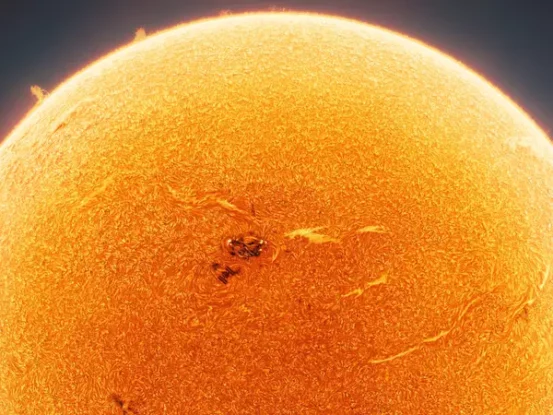
A closer image of about half of the sun, showing the darker area (sunspot) a bit more clearly.
The space station is near this sunspot. (Andrew McCarthy) It's right here:
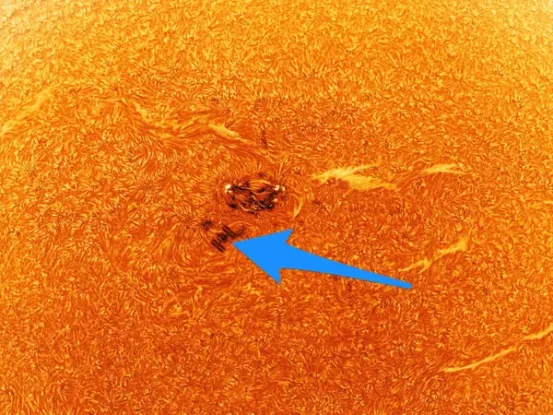
An even closer image of a small section of the sun, showing the darker area (sunspot) and the International Space Station (indicated by a blue arrow). There's the space station! (Andrew McCarthy)
The space station is just an unassuming silhouette against the Sun's roiling plasma.
As the Sun grows more active, that ultra-hot material has been shooting into space more frequently, sometimes toward Earth, in eruptions called solar flares or coronal mass ejections.
In March, solar eruptions caused the Northern Lights, aka the aurora borealis, to make an unprecedented appearance as far south as Phoenix, Arizona. But they can also knock out power grids, black out radio signals, push satellites out of orbit, confuse GPS, and even damage technology on the space station.
McCarthy didn't experience any tech issues from solar eruptions, but he did have his own problems capturing this image. It required a balance of perfect timing, precise physics, and a lot of persistence.
Stranded in the desert in pursuit of the space station The space station passes between Earth and the Sun frequently, but to get a good photo McCarthy needed it to be directly overhead.
"Otherwise the space station's lower on the horizon and smaller," he said.
He noted the dates and exact times when it would pass overhead in the Arizona desert about two hours from his home. At the first opportunity, he loaded hundreds of pounds of equipment into his car and drove out to the precise spot he had calculated. He set up his telescopes. The skies were clear. He was poised to snag the photo.
At the moment of the space station's transit – less than half a second as it crossed the Sun – a rogue cloud bumbled past and blocked the view.
McCarthy tried again another day. On the drive out, his tire exploded. Another attempt to snag the space station and the Sun had failed. But he wasn't deterred.
He replaced the tire, hoped the rest of them would hold out a bit longer, and returned to the desert for the next transit.
The space station zips across the Sun like a fast-moving needle in a haystack It was 100 degrees that day, McCarthy said. He pulled over and set up his equipment on the side of the road. The telescopes' field of view was small in order to get lots of detail, so he had to take hundreds of little snapshots of each portion of the solar surface. He would stack and stitch them together into a mosaic for the final picture.
"Under the bright Sun I'm looking at this laptop screen and just trying to figure out, on a fairly featureless sun, where I'm supposed to point my telescope," McCarthy said.
He used the sunspots as a visual cue, knowing the space station would pass in front of them.
"I'd plotted my position on Earth based on where the [International Space Station] would transit that particular sunspot," he said. "So long as I could get that sunspot in my field of view, I would also get the ISS."
In the background, McCarthy wanted to capture the fiery drama of the Sun's chromosphere, the thin layer of plasma between its visible surface (the photosphere) and the outermost layer of its atmosphere (the corona). In this layer, the Sun's plasma reaches broiling temperatures upwards of 10,000 degrees Fahrenheit (5,538 degrees Celsius) – so hot that its hydrogen emits a reddish light, according to NASA. That's the chromosphere light McCarthy wanted to capture.
In chromosphere images, the Sun looks like "a hairy ball" because of all the plasma movement, McCarthy said.
But the space station shows up in visible light. That's why McCarthy needed three telescopes. One captured the "hydrogen alpha" emissions of the chromosphere. The other two captured optical light to resolve the space station, since its shadowy silhouette stood out against the uniform light of the Sun's outer atmosphere.
His telescopes snapped about 230 images per second.
"If I wasn't shooting at a very fast rate, I would've actually completely missed it," McCarthy said.
But he snagged dozens of raw photosphere images of the space station, like the one below, so he could stack them to get the clearest possible snapshot of the big satellite.
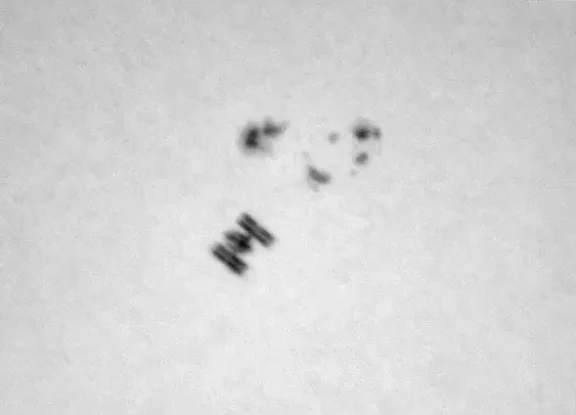
A raw image of the space station shown as a small shadow among some other small dark areas against a lighter gray background of the sun. One of McCarthy's visible-light images of the space station passing near the sunspot. (Andrew McCarthy)
Meanwhile, the hydrogen alpha telescope captured tens of thousands of close-up images across the Sun's surface, to stitch together like a quilt.
As McCarthy drove back from the desert, another tire blew out. This time, when he got home he replaced all three old tires.
"Thankfully it didn't happen on the way there," he said. "At least I got the shot this time."
Though it's fun to search for the space station in this image, McCarthy doesn't like how much it blends in.
"From a composition standpoint, I think I can do better as an artist in how I framed that final shot. So I'm going to go after another one and I think it'll be even better," McCarthy said.
Where’s Waldo ping......................
There’s a Mighty Host in there?
Looks like the sun gave itself skin cancer.
Looks like a melanoma.
Yep. That’s a host if I’ve ever seen one.
Human-caused solar-warming?
Maybe the Space Station can dump some water to cool off that hot spot on the sun. (What I imagine Camilla Harris would say}
See the post before yours.
If you can see it, it isn't concealed and/or hidden (duh!).
Hehehe. A TIE fighter. On May 4th.
That’s no space station it’s a TIE Fighter
Face of a child:-)
Among other things.
You’re getting baked while in space.
Helios, and his chariot?
or a worm hole in an orange
I didn’t know they sent that thing to the sun. But I’ll tell you what, those guys at NASA are getting dumb. They should have sent it at night.
I spotted it right away. It says a lot about the photographer’s abilities and equipment to get that shot.
Is that a host in the sun? Compliments of CGEB!
I just couldn’t help it.
A flock of migrating geese?
Disclaimer: Opinions posted on Free Republic are those of the individual posters and do not necessarily represent the opinion of Free Republic or its management. All materials posted herein are protected by copyright law and the exemption for fair use of copyrighted works.