Posted on 04/21/2023 7:05:08 AM PDT by Red Badger
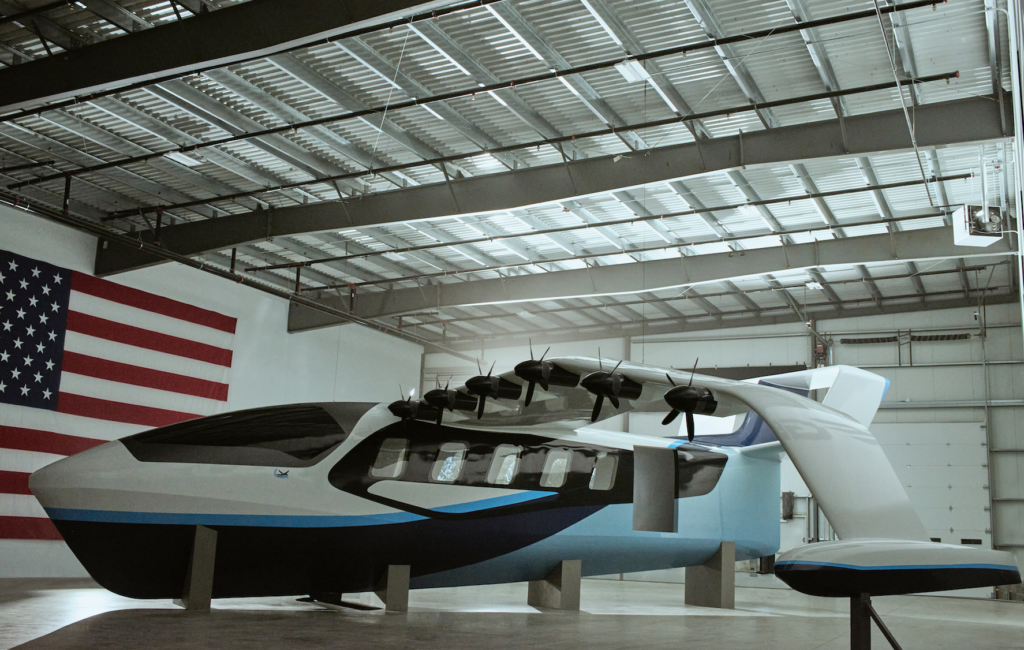
REGENT has revealed the full-scale mockup of its seaglider, an all-electric passenger vehicle with a range of 180 miles. (Photo: REGENT)
The company REGENT, which is developing a new kind of electric maritime vehicle called a seaglider, revealed the full-scale mock-up of its seaglider prototype today. REGENT also announced plans to expand its global headquarters for new manufacturing and test facilities. The expansion has the potential to enable fulfillment of $8 billion in commercial orders by 2025 at the headquarters in Rhode Island.
Last September, the company announced that its quarter-scale seaglider technology demonstrator completed its first flight. According to REGENT, its seaglider is the first vehicle to take off from a controlled hydrofoil to wingborne flight.
Billy Thalheimer, cofounder and CEO of REGENT, shared additional information about the company's progress in an interview with Avionics this week.
Avionics: What considerations related to safety and regulation are taken into account in the development of the seaglider?
Billy Thalheimer: Our first vehicle is projected to operate under Coast Guard jurisdiction, and we have been working closely with the agency to establish regulations for our vessels including design approval, inspection, construction and crewing. Our design basis agreement with the Coast Guard is in process, and we maintain a close line of communication with both the Coast Guard (Office of Engineering Standards) and FAA (Emerging Concepts & Innovation group).
The full-scale seaglider is designed with multiple redundancies in its all-electric distributed power system and automated flight software and sensor systems to provide operators with full situational awareness for navigation, object detection, and flight conditions.
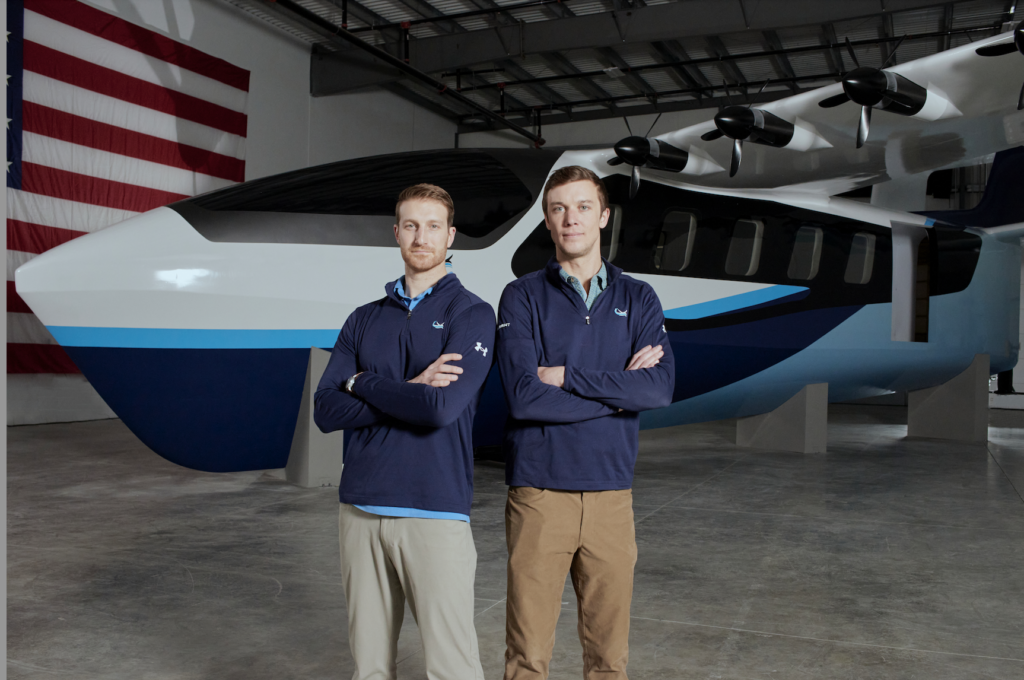
REGENT co-founders Billy Thalheimer and Mike Klinker, pictured above, unveil the full-scale model of the all-electric seaglider. (Photo: REGENT)
Avionics: How has the $50 million in funding been used to advance the development of the prototype?
Thalheimer: These investments have significantly accelerated technological advancements of our human-carrying prototype—including building and flying the first ¼-scale seaglider prototype to prove out the float-foil-fly mission. We have also tested sensor systems in real environments on helicopters to validate flight operations. The cumulative learnings from more than a year of flight testing was used to inform the design of the full-scale seaglider.
As a result, we are on track to deliver our product to market by the mid-decade. These resources have proved instrumental in enabling us to tailor our vehicles to meet the diverse needs of our customers, including commercial transport, supply chain and logistics, and military defense applications.
How would you describe the current state of the industry and how REGENT’s seagliders fit into the competitive landscape?
40% of the world’s population live in coastal communities, and are in dire need of a fundamentally new method of transportation to efficiently move people and cargo through coastal routes. Through our seagliders, we aim to revolutionize sustainable, maritime transportation in these regions by offering a fast, efficient, and emission-free solution.
We see seagliders as a complementary addition, rather than a replacement, to traditional modes of maritime and airline transportation, which can be seamlessly integrated into our customers’ existing fleets. Our studies, based on publicly validated data, show that our seagliders serve an $11 billion market that we project to swell to as much as $25 billion as battery technology advances.
With the electrification of ferries, aircraft, rail, and other modes of transportation, we envision our all-electric seagliders as an integral part of the future of sustainable, multi-modal mobility.
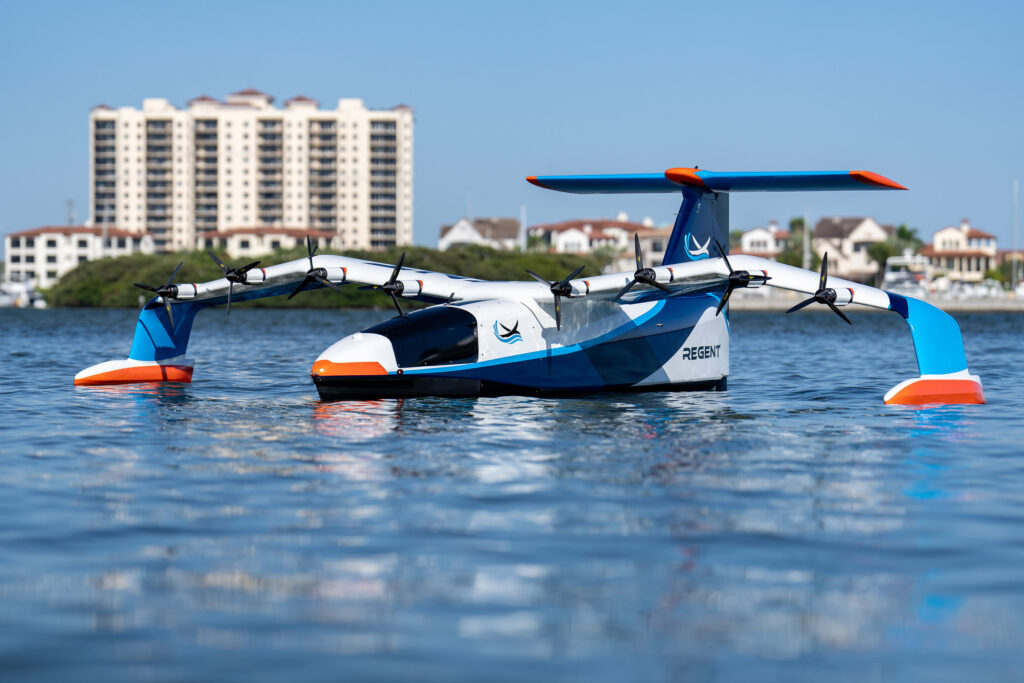
REGENT's technical demonstrator, a 1/4-scale seaglider prototype (Photo: REGENT)
Could you describe how you envision the commercialization and deployment of the seagliders?
We envision our vehicles to act as a bridge between coastal city centers, facilitating multi-modal transportation through coastal airports. We have established a loyal customer base of major airlines and ferry operators such as FRS in Germany, Ocean Flyer in New Zealand, and Southern Airways/Mokulele Airlines—who we plan to deliver our first commercial passenger seagliders to, once they hit the market. Our vehicles will comprise the best features of both maritime and aviation transport, combining the speed and comfort of an airplane with the cost efficiency of a boat. This will enable us to service coastal communities such as New York City, the Hawaiian Islands, and Pacific island nations.
What capabilities will the new facilities/expansion in Rhode Island provide?
Our new facility expansion will support initial low-rate production and at-rate production to fulfill our $8B commercial backlog.
Those motors look they're in nice sealed pods. And you know perfectly well that electrical systems have been operated successfully on ships for over a century. There are plenty of reasons why this electric ekranoplan is little more than a toy. The fact that it's electric and operates in a salt-water environment is not one of them.
But if you watch the quarter scale tests, the motors appear to be standard RC "outrunner" electric motors without the farings shown in the mockup.
https://www.youtube.com/watch?v=Ka1GpNGdjXM
And if the concept reaches the full scale stage, the motors will need to be air cooled because of weight considerations. Azipod electric motors and other such applications have the luxury of accommodating the extra weight and bulk associated with a closed-loop liquid cooling system using heat exchangers to transfer heat into the sea water.
The same tech is used for ocean-going diesel and gas engine cooling.
An aircraft or any "ekranoplan" can't afford the added bulk and weight of a closed loop liquid cooling system with a liquid to air heat exchanger.
Throw in “electric” in front of anything nowadays and tech companies dump money in to it.
A toy for the 1% it looks like to me. $200,000 for a boat that can fly. What happens when the battery goes dead and you are out to sea?
Sorry, $3M per unit.
Calm waters are all that thing is good for.
Money down a drain.
A toy is all it is.
LOL!! 180 mile range???
What has that got to do with this electric powered one? Ground effect flight is well known.
I’d rather ride in this than one of the ‘electric planes’ that folks are trying to develop.
How many commercial examples are in service?
Doesn't matter. You're comparing propulsion types, not design of aircraft.
Apples/oranges.
It’s all of the above, but whatever.
Yep
A good one
Disclaimer: Opinions posted on Free Republic are those of the individual posters and do not necessarily represent the opinion of Free Republic or its management. All materials posted herein are protected by copyright law and the exemption for fair use of copyrighted works.