Posted on 12/27/2022 9:21:12 AM PST by Red Badger
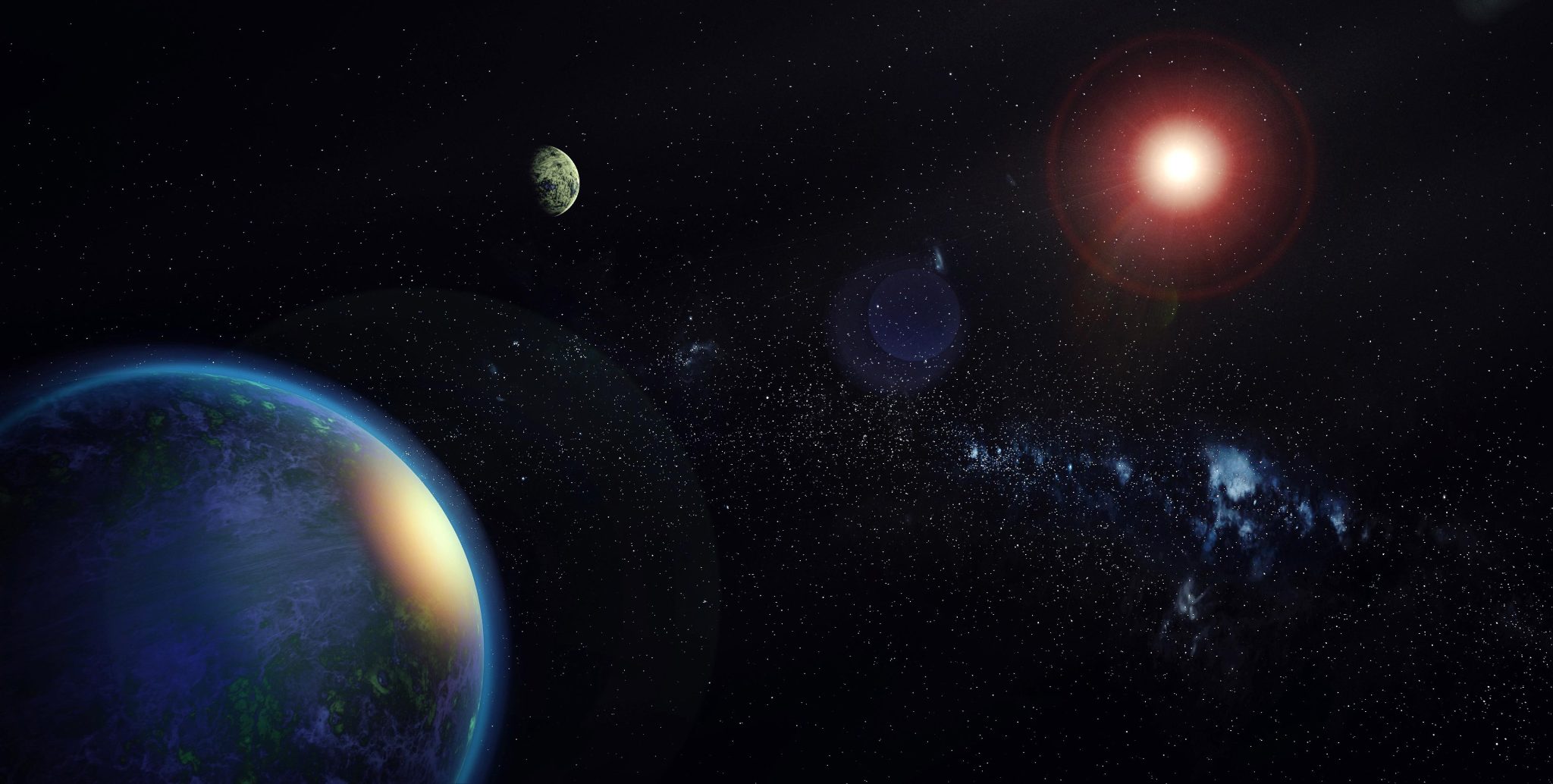
Two Earth Mass Planets Orbiting Star GJ 100 Artist’s impression of two Earth-mass planets orbiting the star GJ 1002. Credit: Alejandro Suárez Mascareño and Inés Bonet (IAC)
**************************************************************************
An international scientific team led by researchers at the Instituto de Astrofísica de Canarias (IAC) has discovered the presence of two planets with Earth-like masses in orbit around the star GJ 1002, a red dwarf not far from the Solar System. Both planets are in the habitability zone of the star
“Nature seems bent on showing us that Earth-like planets are very common. With these two we now know 7 in planetary systems quite near to the Sun” explains Alejandro Suárez Mascareño, an IAC researcher, who is the first author of the study published in the journal Astronomy & Astrophysics.
The newly discovered exoplanets orbit the star GJ 1002, which is at a distance of less than 16 light years from the Solar System. Both of them have masses similar to that of the Earth, and they are in the habitability zone of their star. GJ 1002b, the inner of the two, takes little more than 10 days to complete an orbit around the star, while GJ 1002c needs a little over 21 days. “GJ 1002 is a red dwarf star, with barely one-eighth the mass of the Sun. It is quite a cool, faint star. This means that its habitability zone is very close to the star” explains Vera María Passegger, a co-author of the article and an IAC researcher.
The proximity of the star to our Solar System implies that the two planets, especially GJ 1002c, are excellent candidates for the characterization of their atmospheres based either on their reflected light, or on their thermal emission. “The future ANDES spectrograph for the ELT telescope at ESO in which the IAC is participating, could study the presence of oxygen in the atmosphere of GJ 1002c” notes Jonay I. González Hernández, an IAC researcher who is a co-author of the article. In addition, both planets satisfy the characteristics needed for them to be objectives for the future LIFE mission, which is presently in a study phase.
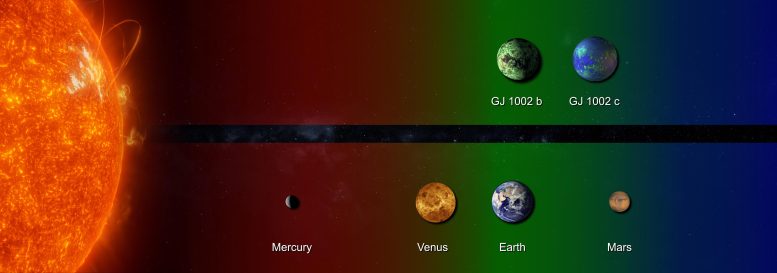
GJ 1002 System Habitability Zone Infographic Infographic comparing the relative distance between the discovered planets and their star with the inner planets of the Solar System. The region marked in green represents the habitable zone of the two planetary systems. Credit: Design: Alejandro Suárez Mascareño (IAC). Planets of the Solar System: NASA
***********************************************************************
The discovery was made during a collaboration between the consortia of the two instruments ESPRESSO and CARMENES. GJ 1002 was observed by CARMENES between 2017 and 2019, and by ESPRESSO between 2019 and 2021. “Because of its low temperature the visible light from GJ 1002 is too faint to measure its variations in velocity with the majority of spectrographs,” says Ignasi Ribas, researcher at the Institute of Space Sciences (ICE-CSIC) and director of the Institut d’Estudis Espacials de Catalunya (IEEC). CARMENES has a sensitivity over a wide range of near-infrared wavelengths which is superior to those of other spectrographs aimed at detecting variations in the velocities of stars, and this allowed it to study GJ 1002, from the 3.5m telescope at Calar Alto observatory.
The combination of ESPRESSO, and the light-gathering power of the VLT 8m telescopes at ESO allowed measurements to be made with an accuracy of only 30 cm/sec, not attainable with any other instrument in the world. “Either of the two groups would have had many difficulties if they had tackled this work independently. Jointly we have been able to get much further than we would have done acting independently” states Suárez Mascareño.
Reference:
“Two temperate Earth-mass planets orbiting the nearby star GJ 1002” by A. Suárez Mascareño, E. González-Alvarez, M. R. Zapatero Osorio, J. Lillo-Box, J. P. Faria, V. M. Passegger, J. I. González Hernández, P. Figueira, S. Sozzetti, R. Rebolo, F. Pepe, N. C. Santos, S. Cristiani, C. Lovis, A. M. Silva, I. Ribas, et al., Accepted on 21 November 2022, Astronomy & Astrophysics.
DOI: 10.1051/0004-6361/202244991
Other members of the IAC who have collaborated in this publication are the researchers Rafael Rebolo López, Víctor Sánchez Béjar and Enric Pallé.
And if it has no magnetic field, all bets are off................
Agreed.
It is more easily understood by realizing the most important factor in the existence of life somewhere else in the universe is not in the ‘conditions’ that occur here or there.
The most important factor is the will to exist and to survive. There are creatures that live on the bottoms of the oceans that endure tremendous pressures, receive no ‘light’ from the Sun, and we didn’t even know they existed even though they have been on this planet longer than us.
What conditions is a ‘cell’ able to endure to survive ? Maybe, like the Universe, that ability is infinite.
That does it! I’ve had it! Turn the ship around, warp drive back to our galaxy.
Honestly, a simple interstellar space flight and you kids can’t behave!

We would have to discover warp drive first. Scientists are looking at that possibility.
You forgot to add a reducing factor that star types like ours represent only about 7-8 percent of the total in the universe.
—
No; I just stated the fact every star has at least one planet - stellar type does not matter.
You are the one stating a reducing factor limiting it to Main Sequence stars, which factor is an obvious fallacy, since we have no clue about the size of the Universe or have even imaged it all.
Moving on.
Disclaimer: Opinions posted on Free Republic are those of the individual posters and do not necessarily represent the opinion of Free Republic or its management. All materials posted herein are protected by copyright law and the exemption for fair use of copyrighted works.