Posted on 09/23/2022 3:28:33 PM PDT by MtnClimber
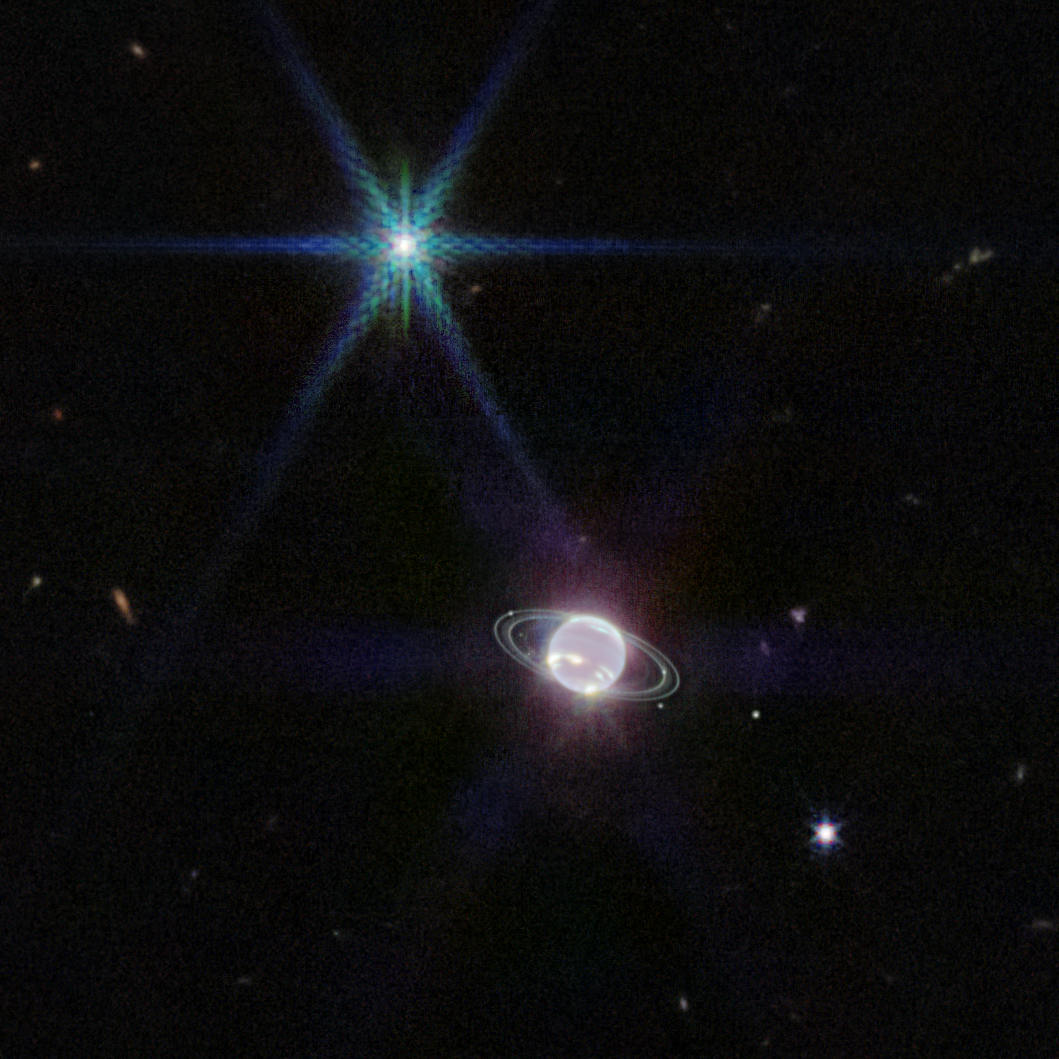
Explanation: Ringed, ice giant Neptune lies near the center of this sharp near-infrared image from the James Webb Space Telescope. The dim and distant world is the farthest planet from the Sun, about 30 times farther away than planet Earth. But in the stunning Webb view the planet's dark and ghostly appearance is due to atmospheric methane that absorbs infrared light. High altitude clouds that reach above most of Neptune's absorbing methane easily stand out in the image though. Coated with frozen nitrogen, Neptune's largest moon Triton is brighter than Neptune in reflected sunlight and is seen at upper left sporting the Webb's characteristic diffraction spikes. Including Triton, seven of Neptune's 14 known moons can be identified in the field of view. Neptune's faint rings are striking in this new space-based planetary portrait. Details of the complex ring system are seen here for the first time since Neptune was visited by the Voyager 2 spacecraft in August 1989.
For more detail go to the link and click on the image for a high definition image. You can then move the magnifying glass cursor then click to zoom in and click again to zoom out. When zoomed in you can scan by moving the side bars on the bottom and right side of the image.
Would that be the sun with that flare?
Neptune. Farther out than Uranus.
Beautiful pic :)
That is Triton, Neptune’s largest moon.
Very eerie, but cool.
they could just add it to the picture and say it was part of 172 individual pictures takin in a sequence. i mean what is actually the difference between your pic and the man made aura off the moon in the top of the pic?
K, thanks!
Amazing.
Neptune gets all the cool press. Meanwhile, its twin, Uranus, is just the unfortunate butt of jokes.
While nobody remembers poor Pluto, relegated to a nothingburger....sniff....
Disclaimer: Opinions posted on Free Republic are those of the individual posters and do not necessarily represent the opinion of Free Republic or its management. All materials posted herein are protected by copyright law and the exemption for fair use of copyrighted works.