Posted on 06/28/2022 9:53:28 AM PDT by Red Badger
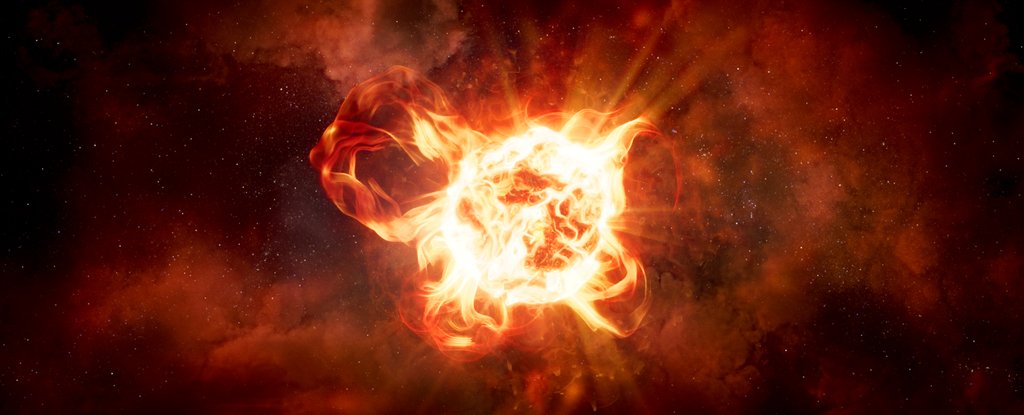
Artist's illustration of VY Canis Majoris. (NASA, ESA, Roberta Humphreys (UMN), Joseph Olmsted (STScI))
Three-dimensional models of astronomical objects can be ridiculously complex. They can range from black holes that light doesn't even escape to the literal size of the Universe and everything in between.
But not every object has received the attention needed to develop a complete model of it, but we can officially add another highly complex model to our lists.
Astronomers at the University of Arizona have developed a model of VY Canis Majoris, a red hypergiant that is quite possibly the largest star in the Milky Way. And they're going to use that model to predict how it will die.
How red hypergiants die has been a matter of some debate recently. Initially, astronomers thought they simply exploded into a supernova, as so many other stars do.
However, more recent data show a significant lack of supernovae compared to the numbers that would be expected if red hypergiants themselves were to explode that way.
The going theory now is that they are more likely to collapse into a black hole, which is much harder to observe directly than the initially suggested supernovae.
It remains unclear what precisely the characteristics of the stars that would evolve into black holes are; and to find out, it would be beneficial to have a model.
Enter the team from UA. They picked VY Canis Majoris as an excellent stand-in for the type of red hypergiants they were interested in learning more about.
The star itself is massive, ranging from 10 AU to 15 AU (astronomical units) in size. And it is only 3,009 light-years away from Earth as it is. This makes VY Canis Majoris, which resides in the southern constellation Canis Major, fascinating to observers.
Its sheer size and proximity to our Solar System make it an excellent observational candidate. With good observational data, astronomers can see the breathtaking complexity of what the star's surface actually looks like.
One of the fundamental processes in a star's death is mass loss. Typically, this happens when gas and dust are blown evenly out of the star's photosphere. However, on VY Canis Majoris, there are massive features that are similar to Earth's coronal arcs but a billion times more massive.
The UA researchers used time on ALMA to collect radio signals of the material that is blasted into space as part of these eruptions.
That material, including sulfur dioxide, silicon dioxide, and sodium chloride, would allow them to detect the speed at which it moves, rather than just the static presence of other ejecta, such as dust.
To do so, they had to align all 48 dishes of ALMA and collect over a terabyte of data to get the correct information.
Processing all that collected data can be pretty challenging, and they are still working on some of it. Still, they had enough so far to present their findings to the American Astronomical Society in mid-June.
When they have even more data, they'll be able to describe an even better model of what one of the largest stars in the galaxy looks like.
And someday, far in the future, that model of what will happen to a red hypergiant might just get a chance to be tested when VY Canis Majoris finally, officially, dies.
This article was originally published by Universe Today. Read the original article.
https://www.universetoday.com/156464/vy-canis-majoris-is-dying-and-astronomers-are-watching/
Aren’t they all slowly dying?
Some faster than others....................
it could have collapsed 3000 years ago, and we just don’t know it yet
If this star was put where Sol current resides, it's diameter would extend beyond Jupiter's orbit.
It's impossible to even imagine. And there are many phenomenon in this universe that dwarf this.
BINGO !!!! So, just what are they watching so intently? Who will be here in 3009 years if the star blinks out today? The ultimate Slow Moving train wreck.

Earth has coronal arcs?
It’s going to be a couple of million years we won’t wait up for it.
So its still smaller than Whoppie?
Only a few more million years to go, eh?
Only 3000 light years away.
I wonder how long of a walk that is...
It's impossible to even imagine."
Well, not really since you just imagined it extending beyond Jupiter's orbit....
:-)
In dog years?...................
We had Noah’s Ark, and Joan of Arc......................
When Chuck Norris stars at the stars, they blink.

Yes, in some sense we can objectively grasp things of such magnitude, but in that sense ‘imagination’ is only scratching the surface of what is actually being described. We can toss all these numbers around, but we puny Earthlings can’t really begin to wrap our brains around such scales. Our senses are tuned to distances in the one-meter range — when that’s increased by ten orders of magnitude, our eyes can’t help but glaze over.
“The star itself is massive, ranging from 10 AU to 15 AU (astronomical units) in size.”
It’s radius is significantly larger than the distance from the sun to Saturn. That’s pretty big.
It’s even OBESE by stellar standards........................
Disclaimer: Opinions posted on Free Republic are those of the individual posters and do not necessarily represent the opinion of Free Republic or its management. All materials posted herein are protected by copyright law and the exemption for fair use of copyrighted works.