Posted on 06/21/2022 7:15:18 AM PDT by Red Badger
Scientists have developed a new technique that can repair and even regenerate heart muscle cells after a heart attack (or myocardial infarction).
While it has only been tested on mice so far, if it works the same in humans it could potentially be a life-saving treatment for people who have suffered a heart attack.
The technique uses a synthetic messenger ribonucleic acid (mRNA). mRNA creates a 'blueprint' of DNA sequences that the body then uses to build the proteins that form and regulate our cells. By tweaking the mRNA, scientists can deliver different instructions for different biological processes.
Here, the edited instructions promote the replication of heart muscle cells (cardiomyocytes) via two so-called mutated transcription factors, Stemin and YAP5SA.
Essentially, the idea is to make heart muscle cells, which have very little ability to regenerate, act more like stem cells, which can be turned into various other types of specialized cells by the body.
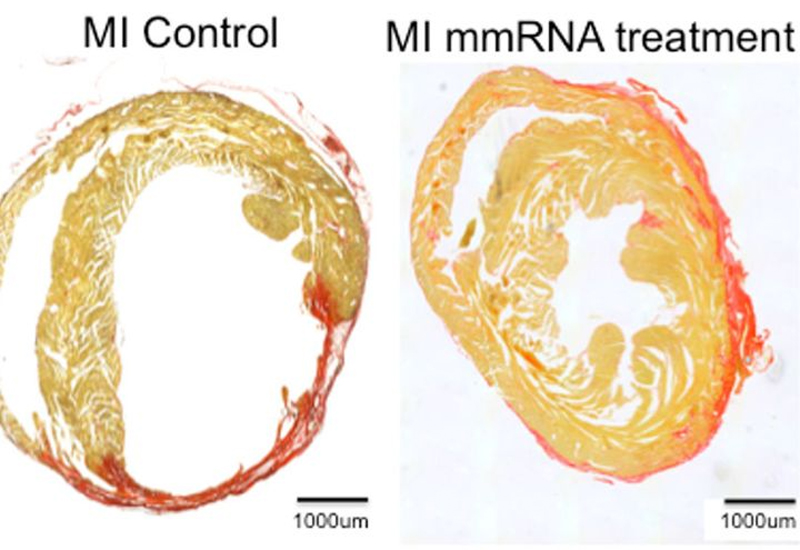
The difference made by the mRNA treatment after four weeks. (The Journal of Cardiovascular Aging)
"No one has been able to do this to this extent and we think it could become a possible treatment for humans," says biologist Robert Schwartz, from the University of Houston in Texas.
Less than 1 percent of adult cardiac muscle cells can regenerate – the cardiomyocytes we have when we die are mostly the same ones we've had since the first month of life – and that means heart attacks and heart disease can leave the heart in a permanently fragile state.
In experiments in both tissue culture dishes and in living mice, Stemin was shown to turn on stem cell-like properties in the cardiomyocytes, while YAP5SA promoted organ growth and replication. The process has been described as a "game-changer" by the team.
The in vivo study involving living mice affected by damaged hearts showed myocyte nuclei replicating by at least 15-fold in the 24 hours after the injections of the mutated transcription factors, Stemin and YAP5SA.
"When both transcription factors were injected into infarcted adult mouse hearts, the results were stunning," says Schwartz.
"The lab found cardiac myocytes multiplied quickly within a day, while hearts over the next month were repaired to near normal cardiac pumping function with little scarring."
The synthetic mRNA added to the cells disappeared in a few days, just as the mRNA produced in our bodies does, the researchers report. This gives the new technique an advantage over gene therapy processes that cannot be easily stopped or removed once they're underway.
It still remains to be seen whether the approach can be translated successfully into humans – and many more years of research will be required to get this into a working treatment – but the team behind the research is confident.
Work continues to understand more about heart disease and heart injury, and how the body responds in its aftermath. Studying cardiovascular health remains a priority for scientists, with heart disease currently the leading cause of death in the US (accounting for around a quarter of all deaths).
"This is a huge study in heart regeneration especially given the smart strategy of using mRNA to deliver Stemin and YAP5SA," says biologist Siyu Xiao, from the University of Houston.
The research has been published in here and here in the Journal of Cardiovascular Aging.

cause we need more mice...
thinking on the same line...
t
Mice should live forever by now.
In lifetime, scientists have cured every form of cancer and countless other diseases in mice. In humans, not so much.
it looks more like a constriction of the muscle and would cause more problems.
Does that mean they can use mRNA to fix the damage done by mRNA?
Red Badger wrote: “MORE GREAT NEWS FOR MICE!...............”
Would you refuse this treatment because it us mRNA to change your DNA?
Having had a mild Heart attack, and quad bypass, I’d have to say no.............................
>Mice should live forever by now.<
Along with the cockroaches.
Red Badger wrote: “Having had a mild Heart attack, and quad bypass, I’d have to say no.............................”
That’s great news. Hope there are no future issues.
But, I’m confused by your response which could be interpreted as you would or you would not take the mRNA therapy.
If I had another Heart attack, I would accept it.
My cardiologist said that I was lucky. Guys my age, 65 at the time, usually don’t get a second chance. They were surprised that there was no damage.............
Red Badger wrote: My cardiologist said that I was lucky. Guys my age, 65 at the time, usually don’t get a second chance. They were surprised that there was no damage.............”
that’s fantastic. I’m a great disappointment to my cardiologist. He keeps scheduling tests but can’t find any issues.
And Keith Richards.
It has been done for humans for a couple of decades using the patient’s own stem cells but only in “experimental” programs. One has to have already survived a heart attack to get on the list.
Cures can’t get FDA approval for use in humans. It cuts into the income streams provided by condition “management” which is what Medicine and Pharma do.
Babies died for this fountain of life?
Disclaimer: Opinions posted on Free Republic are those of the individual posters and do not necessarily represent the opinion of Free Republic or its management. All materials posted herein are protected by copyright law and the exemption for fair use of copyrighted works.