Posted on 04/27/2022 9:41:39 AM PDT by Red Badger
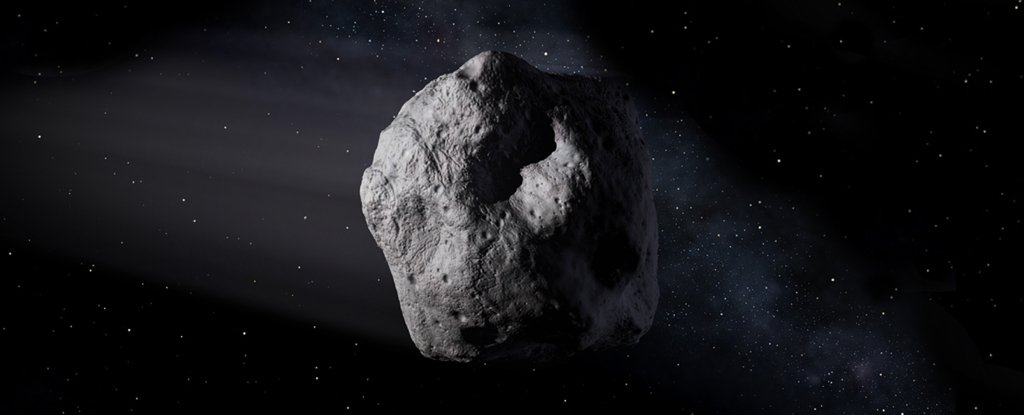
Illustration of an asteroid. (NASA/JPL/Caltech)
A gigantic "potentially hazardous" asteroid that may be twice the size of the Empire State Building is set to zoom past Earth Thursday (April 28), according to NASA.
The asteroid, named 418135 (2008 AG33), has an estimated diameter between 1,150 and 2,560 feet (350 to 780 meters) and will break into Earth's orbit at a blistering 23,300 mph (37,400 km/h). Thankfully, the asteroid is expected to skim past our planet without any risk of impact.
At its closest point, the asteroid – traveling at more than 30 times the speed of sound – will come within about 2 million miles (3.2 million kilometers) of Earth, which is roughly eight times the average distance between Earth and the Moon.
This may sound like a big gap, but by cosmic standards, it's actually a stone's throw away.
Related: We may finally know why spinning-top asteroid Ryugu has such a weird shape
NASA flags any space object that comes within 120 million miles (193 million km) of Earth as a "near-Earth object" and any fast-moving object within 4.65 million miles (7.5 million km) as "potentially hazardous".
Once the objects are flagged, astronomers closely monitor them, looking for any deviation from their predicted trajectory that could put them on a collision course with Earth.
The incoming space rock was first discovered on 12 January 2008, by asteroid surveyors at the Mt. Lemmon SkyCenter observatory in Arizona and last zipped past Earth on 1 March 2015, according to NASA's Center for Near Earth Object Studies (CNEOS).
The asteroid swings by our planet roughly every seven years, with the next close flyby predicted to come on 25 May 2029.
Thursday's asteroid might not even be the biggest space rock to hurtle past us in the coming weeks.
That title will likely go to 467460 (2006 JF42), which has an estimated diameter between 1,247 and 2,822 feet (380 to 860 m) and will be traveling at roughly 25,300 mph (40,700 km/h) when it passes us on 9 May 2022.
If astronomers ever do spy an asteroid flying straight at Earth, space agencies around the world are already working on ways to possibly deflect the object.
On 24 November 2021, NASA launched a spacecraft as a part of its Double Asteroid Redirection Test mission, which plans to redirect a nonhazardous asteroid by ramming it off course, Live Science previously reported.
China is also in the early planning stages of an asteroid-redirect mission. By slamming 23 Long March 5 rockets into the asteroid Bennu, the country says it would be able to divert the space rock from a potentially catastrophic impact with Earth, Live Science previously reported.
Last year there was a small asteroid (~250 feet in diameter) that passed the earth at a distance of about 1/2 the distance to the moon. NASA didn’t see it until AFTER it had past by us.
The sun was in their eyes.
I found the following comments regarding the impact a smaller asteroid would make for some perspective:
“The asteroid is about 150 feet in diameter and has a mass estimated at about 143,000 tons,” NASA astronomer Don Yeomans wrote....”Should an object of that size hit Earth, it would cause a blast with the energy equivalent of about 2.4 million tons — or 2.4 megatons — of TNT explosives, more than 180 times the power of the atomic blast that leveled Hiroshima.”
Beautifully posed.
Human extinction
ELE=Human et al extinction
The stupid... it hurts.
Disclaimer: Opinions posted on Free Republic are those of the individual posters and do not necessarily represent the opinion of Free Republic or its management. All materials posted herein are protected by copyright law and the exemption for fair use of copyrighted works.