Posted on 04/19/2022 6:54:48 AM PDT by Red Badger
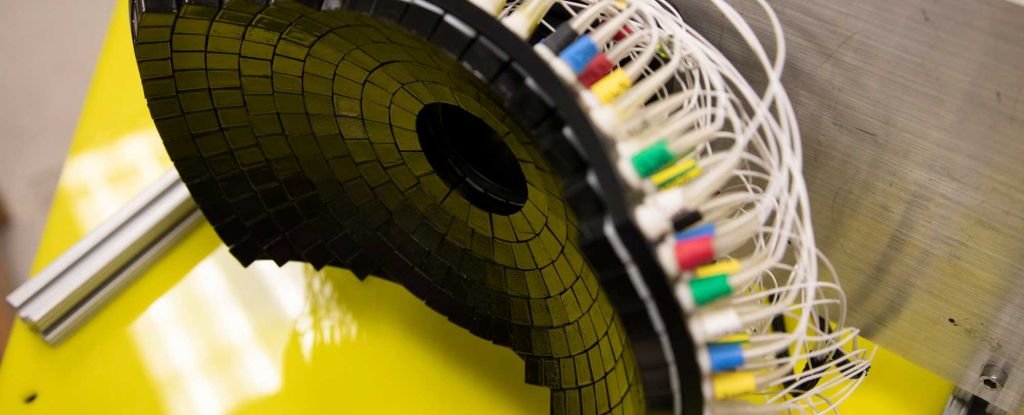
The 700kHz, 260-element histotripsy ultrasound array transducer. (Marcin Szczepanski, Michigan Engineering)
===================================================================
Rats afflicted with liver cancer have demonstrated the efficacy of a fascinating, non-invasive treatment.
Using focused ultrasound, scientists have managed to destroy up to 75 percent of the volume of a liver tumor. The treatment also seems to trigger the rats' immune systems into taking over and clearing the rest.
In 80 percent of the animals, the cancer seemed to be destroyed, with no sign of metastases or recurrence in the three months they were monitored for, the researchers said.
The treatment, called histotripsy, is currently being trialed in humans with liver cancer.
"Histotripsy is a promising option that can overcome the limitations of currently available ablation modalities and provide safe and effective non-invasive liver tumor ablation," said biomedical engineer Tejaswi Worlikar of the University of Michigan.
"We hope that our learnings from this study will motivate future preclinical and clinical histotripsy investigations toward the ultimate goal of clinical adoption of histotripsy treatment for liver cancer patients."
Developed and pioneered at the University of Michigan, histotripsy seems to offer new hope for patients with one of the deadliest forms of cancer: the five-year survival rate for liver cancer is currently lower than 18 percent in the US.
The technique employs an ultrasound transducer, not for bouncing off internal structures for imaging purposes, but to physically disrupt cancerous tumors.
The way it works is by ultrasound cavitation – similar to the method used to non-invasively break down fat cells for weight-loss treatments. Waves of ultrasound are directed at the area to be treated; the vibrations generate tiny bubbles in the targeted tissue. When the bubbles collapse, or burst, the tissue is disrupted, destroying that part of the tumor.
It's not often possible to target the entire tumor. The way the masses are positioned, their size and their stage can all influence whether it's safe to use histotripsy on the entire tumor.
But even partial treatment resulted in complete regression in 81 percent of the rats treated, the researchers found. By contrast, 100 percent of the control rats showed tumor progression.
"Our transducer, designed and built at [University of Michigan], delivers high amplitude microsecond-length ultrasound pulses – acoustic cavitation – to focus on the tumor specifically to break it up," said biomedical engineer Zhen Xu of the University of Michigan.
"Even if we don't target the entire tumor, we can still cause the tumor to regress and also reduce the risk of future metastasis."
For the purpose of this study, 22 lab rats were implanted with liver cancer. Half were left as a control group, while the remaining 11 were treated using histotripsy, targeting between 50 and 75 percent of the tumor volume.
An additional three rats were treated to a lesser extent, with the histotripsy targeting just 25 percent of the tumor volume.
Following treatment, the rats were euthanized and dissected to determine how successful the treatment had been. The researchers looked for signs of progression, metastasis, and immune markers.
The prognosis for the control rats was dire. All 11 showed signs of progression and metastasis. Within three weeks, the tumours reached the maximum size allowed by ethical protocols and the animals were euthanized.
But the treated rats fared much, much better. Not only did the treatment proceed without complication or side effects, the majority of the rats – nine of the 11 – showed tumor regression, and experienced tumor-free survival for the remainder of the study, around 10 weeks.
Previous histotripsy studies had demonstrated that the treatment is effective at reducing tumor volume. The new work shows that it seems to significantly increase survival rates post-treatment, too.
"This study demonstrated the potential of histotripsy for successful non-invasive tumor ablation, and prevention of local tumor progression and metastasis. Even with partial ablation, complete local tumor regression was observed in 9 of 11 treatment rats, with no recurrence or metastasis up to the 12-week study endpoint, as evidenced by MRI and histology," the researchers wrote in their paper.
"These results suggest that histotripsy may not increase the risk of developing metastases post-ablation, as compared to controls. Future studies will continue to investigate the safety, efficacy, and biological effects of histotripsy, for potential translation to clinic."
The research has been published in Cancers.
Very kool.
Thanks for posting this.
GOOD NEWS.................FOR RATS................
What about for Republicans?
Thanks. I’ve been putting off radioembolisation cause I’m scared of the side effects. This sounds promising. Although I’m not a Rat. I’m a constitutional conservative.
Rife generators have been doing this for a long while ....but the AMA decreed it Illegal. Money to be made.
Dr. Fauci is sad. Is there a way to reverse this to cause cancer for “gain of function”? Research purposes only, ya’ understan.
Invasive sound waves?
Could they be Barry Manilow’s songs?
This sounds wonderful. A (literally) targeted treatment without the side-effects of drugs.
Heinlein, among others, predicted this.................
That would be inordinate sound waves...................
It would be great if this could lead to a treatment for tumors as successful as lithotripsy has been for stones?
Very interesting. I found this video has a little more info on the procedure... https://www.youtube.com/watch?v=pHvHg5ZvrdU
Any alien species observing us would have to believe, by the evidence, that our medical research is primarily aimed at improving the health of lab rats.
There was a cartoon long ago that showed two anthropomorphic rats wearing lab coats, looking at a picture of a supposedly extinct human being, far into the future, where one says:
Humans must have really, really loved our ancestors, they cured us of every known disease....................
You can’t patent soundwaves. Big Pharma will strangle this infant in the crib.
Look into the history of Royal Rife. He was treating cancer with soundwave frequencies as far back as 1940. He was destroyed as were his machines and research papers.
Wino’s relieved buy more Night Train.
Ha! - I was going to post about Rife machines too but glad I read down the thread first so that I didn’t duplicate.
Seems hard to believe only because that’s an incredible result and it seems like an even bigger breakthrough than they make it sound.
Have they given up on finding some chemical poison to sell us?
Disclaimer: Opinions posted on Free Republic are those of the individual posters and do not necessarily represent the opinion of Free Republic or its management. All materials posted herein are protected by copyright law and the exemption for fair use of copyrighted works.