Skip to comments.
New compound provides innovative PAIN RELIEF
https://medicalxpress.com ^
| NOVEMBER 10, 2021
| by University of Arizona
Posted on 11/11/2021 5:55:12 AM PST by Red Badger
Researchers at the University of Arizona Health Sciences are closer to developing a safe and effective non-opioid pain reliever after a study showed that a new compound they created reduces the sensation of pain by regulating a biological channel linked to pain.
Most people experience pain at some point in their lives, and the National Institutes of Health estimates 100 million people in the U.S. suffer from chronic pain. Approximately 21-29% of patients prescribed opioids for chronic pain misuse them and 8-12% of people using an opioid for chronic pain develop an opioid use disorder, according to the National Institute on Drug Abuse. In 2019, nearly 50,000 people in the U.S. died from opioid-involved overdoses.
"Drug discovery for chronic pain is at the forefront of this research, and it's being amplified by the intersection of the COVID-19 pandemic and the opioid epidemic," said Rajesh Khanna, Ph.D., associate director of the UArizona Health Sciences Comprehensive Pain and Addiction Center and professor of pharmacology in the UArizona College of Medicine—Tucson. "Drug discovery is a very arduous process. Our lab looked at a fundamental mechanism of pain, came up with a way to differentiate it from those before us and found a compound that has the potential as a new non-opioid treatment for pain."
The paper, "Selective targeting of NaV1.7 via inhibition of the CRMP2-Ubc9 interaction reduces pain in rodents," was published today in Science Translational Medicine.
The biological mechanism at the heart of the research is NaV1.7, a sodium ion channel that previously was linked to the sensation of pain through genetic studies of people with rare pain disorders.
Nerve cells, or neurons, use electrical currents to send signals to the brain and throughout the body, and sodium ion channels are vital to a cell's ability to generate those electrical currents. When a neuron is stimulated, the NaV1.7 channel opens and allows positively charged sodium ions to cross the cell membrane and enter the previously negatively charged cell. The change in charge across the cell membrane generates an electrical current, which increases the excitability of the neuron and sets in motion a cascade of events that leads to pain.
Because NaV1.7 is a human-validated target for pain, multiple attempts have tried to stop pain by using sodium ion channel inhibitors to block NaV1.7. None have been successful. Dr. Khanna and his team took a different approach—rather than block NaV1.7, they wanted to indirectly regulate it.
Using a compound they designed and dubbed 194, the team successfully regulated NaV1.7 activation in the laboratory using nerve cells from four different species, including humans. In animal models, 194 was effective in reversing pain in six different pain models in both sexes.
Researchers also found that 194 also may promote pain relief by activating the body's endogenous, or naturally occurring, opioid system. Once produced, endogenous opioids activate receptors that produce physiological changes such as pain relief. And 194 did so without causing motor performance issues, depressive behaviors or addiction.
Finally, Dr. Khanna and the team observed a synergistic effect when 194 was combined with morphine and gabapentin. This is a promising sign that 194 could also be used in a dose-reduction strategy for painkillers that have negative side effects, including opioids, while maintaining high levels of pain relief.
The science behind 194
Dr. Khanna's prior research identified a protein, collapsin response mediator protein 2 (CRMP2), and an enzyme, Ubc9, that both play a role in NaV1.7 activation. CRMP2 is a protein that binds to NaV1.7 and transports it to the cell membrane, where sodium ions are then transferred into the cell. Ubc9 is an enzyme that tags CRMP2 with another protein—a small ubiquitin-like modifier protein—to specifically direct control of NaV1.7.
Building on this knowledge, Dr. Khanna and the team set out to determine if they could directly regulate the activity of NaV1.7 by blocking Ubc9 from interacting with CRMP2. Team members including May Khanna, Ph.D., associate professor of pharmacology and BIO5 Institute member, Vijay Gokhale, Ph.D., associate research professor in the BIO5 Institute, and Samantha Perez-Miller, Ph.D., researcher and scientist in the Department of Pharmacology, examined 50,000 existing small molecules to identify the ones with a structure similar to Ubc9.
They selected less than 50 of the closest matches, which were then tested in Dr. Khanna's laboratory to see if their presence would suppress the influx of sodium through NaV1.7. The findings were promising, so the team set their sights on developing a unique, more effective compound.
The result was 194, which UArizona patented and licensed to startup Regulonix LLC through Tech Launch Arizona, the UArizona office that commercializes inventions stemming from university research. Drs. Khanna and Gokhale founded Regulonix LLC in 2016 to address the growing opioid epidemic by developing new, non-addictive ways to treat pain and commercializing those innovations.
While 194 shows great promise for pain relief, Dr. Khanna and the team have been working with the National Institutes of Health's National Center for Advancing Translational Sciences to optimize the compound. In this case, an NCATS team is primarily focusing on improving 194's half-life—the time it takes for a drug to reduce by half in your body—and its drug-like properties.
It is an important step in optimizing the compound's potential as a pain-relieving drug and advancing to the next stage, where researchers will file for Food and Drug Administration approval to begin clinical trials.
Explore further
UA startup Regulonix licenses non-opioid pain drug candidates that are more effective than morphine
More information:
Selective targeting of NaV1.7 via inhibition of the CRMP2-Ubc9 interaction reduces pain in rodents, Science Translational Medicine (2021).
www.science.org/doi/10.1126/scitranslmed.abh1314
Journal information: Science Translational Medicine
Provided by University of Arizona
TOPICS: Business/Economy; Health/Medicine; History; Society
KEYWORDS: pain; painresearch
Navigation: use the links below to view more comments.
first 1-20, 21-25 next last
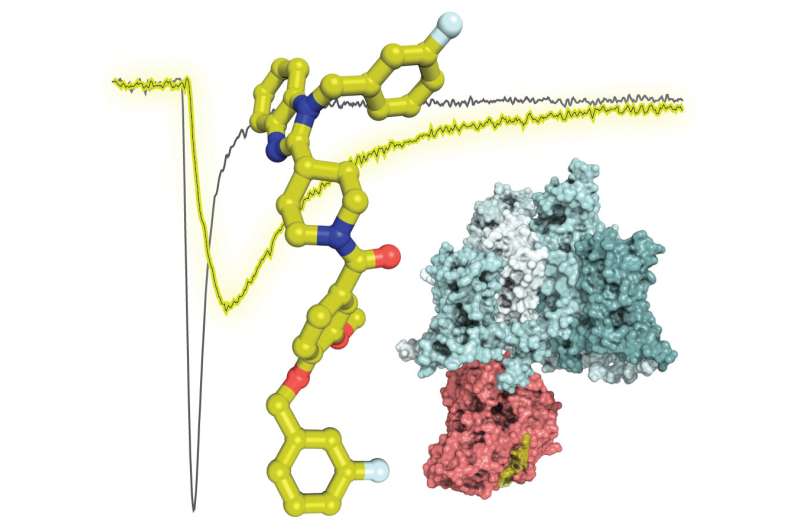
The structure of compound 194 (yellow sticks) overlaid on an electrophysiology trace showing reduced sodium currents (yellow vs. black lines) from cells that are treated with compound 194. The structure illustrates the predicted interaction of CRMP2 (pink, PDB 2GSE) with the Nav1.7 channel (cyan, PDB 6J8G).
Credit: University of Arizona Health Sciences
To: Red Badger
How soon will we see celebrities advertising it on TV?
2
posted on
11/11/2021 6:02:27 AM PST
by
bert
( (KE. NP. N.C. +12) Free Republic has gone to hell is a Covid handbasket)
To: bert
How soon will we see junkies adulterating it to get high?
To: bert
Doctor Gorka here ...

4
posted on
11/11/2021 6:10:18 AM PST
by
x
To: Red Badger
Will a couple shots of whiskey improve the effects? Asking for a friend.
5
posted on
11/11/2021 6:13:10 AM PST
by
dynachrome
("I will not be reconstructed, and I do not give a damn.")
To: dynachrome
Whiskey is like bacon, more never hurts...................
6
posted on
11/11/2021 6:14:09 AM PST
by
Red Badger
(Homeless veterans camp in the streets while illegal aliens are put up in hotels.....................)
To: Red Badger
Approximately 21-29% of patients prescribed opioids for chronic pain misuse them and 8-12% of people using an opioid for chronic pain develop an opioid use disorder,
SO WHAT, Opiates Work very well for pain and yes it is easy to become addicted to them, I was, and in a Big Way. My addiction was the result of a bad accident and my 3 doctors and I had a long talk about how I was going to be fully addicted to opiates as a result. I said GIVE ME THE DRUGS NOW!! and almost 4 months later when I was healed enough to go through major surgery I was taking 50 Percodan a Day!!! But My Doctors scheduled me for 3 weeks in the Hospital, the first week was to go through MANAGED WITHDRAWLS in a Hospital Bed, which was Mandatory because they can't have you flopping around during a 12 hour surgery because of your Physical Addiction to Opiates. They don't do this anymore and that is the real crime, now they get you hooked and leave you to deal with it yourself.
7
posted on
11/11/2021 6:23:22 AM PST
by
eyeamok
(founded in cynicism, wrapped in sarcasm)
To: Red Badger
Promises, promises ... How many diabetes, pain, age-reversal ... cure 'breakthrough' drugs and supplements have we seen and read about? How many times have we read about research facilities finding a 'revolutionary' breakthrough only to learn that it's not viable in the real world. There are many medicines and procedures that work on rats, which fail on humans for any of a number of reasons.
Could it be that research universities need to publish Hannity-like news from time to time to keep their jobs and keep the $$ coming in? I'm from Missouri. Call me skeptical.
To: Red Badger
Since outlawing opioids unless you’re on your deathbed, this could be helpful.
9
posted on
11/11/2021 6:24:42 AM PST
by
albie
To: eyeamok
Blame the FDA and the DEA.........................
10
posted on
11/11/2021 6:25:25 AM PST
by
Red Badger
(Homeless veterans camp in the streets while illegal aliens are put up in hotels.....................)
To: Red Badger
Thank you for adding this graphic! Now it makes perfect sense!! (/s)
11
posted on
11/11/2021 6:35:47 AM PST
by
NEMDF
To: Red Badger
...Whiskey is like bacon, more never hurts..... Not until the next morning...
To: GaltAdonis
That’s when you need more of BOTH!....................
13
posted on
11/11/2021 6:40:56 AM PST
by
Red Badger
(Homeless veterans camp in the streets while illegal aliens are put up in hotels.....................)
To: NEMDF
Thank you for adding this graphic! Now it makes perfect sense!!Ya got me laughing!!! Thanks!!!
To: x
Yep.....
I was amazed last evening to see Dr Gorka (PhD) hawking the pain reliever. He is in high company having that task.
I wondered what it is and looked it up. I can’t tell you because I don’t remember except one ingredient was some kind of Japanese flower. It was second on a list of three.
Number three was declared worthless.
Number 1 was declared to e best and had other ingredients as well. None are “drugs” all are natural compounds I guess
15
posted on
11/11/2021 6:50:48 AM PST
by
bert
( (KE. NP. N.C. +12) Free Republic has gone to hell is a Covid handbasket)
To: Red Badger
Great.
My wife might like this.
What is the current market availability?
16
posted on
11/11/2021 7:00:07 AM PST
by
Cletus.D.Yokel
(This is NOT a pandemic of the unvaxx'd. It is a complete loss of common sense.)
To: Red Badger
I’m very fortunate at my age to live a pain-free life. I’m a Vietnam era veteran, so I’m getting up in years. Never broken a bone or ever had surgery, which is a miracle, considering all the things I’ve done during my life.
17
posted on
11/11/2021 7:09:11 AM PST
by
AlaskaErik
(In time of peace, prepare for war.)
To: Cletus.D.Yokel
Research stage................
18
posted on
11/11/2021 7:20:26 AM PST
by
Red Badger
(Homeless veterans camp in the streets while illegal aliens are put up in hotels.....................)
To: Cletus.D.Yokel
Research stage................
maybe volunteer as a test subject?...................
19
posted on
11/11/2021 7:20:49 AM PST
by
Red Badger
(Homeless veterans camp in the streets while illegal aliens are put up in hotels.....................)
To: Red Badger
Approximately 21-29% of patients prescribed opioids for chronic pain misuse them This claim strikes me a ludicrously exaggerated.
How do they know? Do they decrease the pain meds until the patients are incapacitated or whimpering constantly?
After having my left shoulder taken apart and repacked twice I was taking about a gram of Vicodin every day for months. I needed it to do the PT. When I stopped the PT I stopped taking the Vicodin and felt sick for a few days.
Stop torturing those with chronic pain because the authorities refuse to deal with the real addicts on the streets.
20
posted on
11/11/2021 7:52:11 AM PST
by
pierrem15
("Massacrez-les, car le seigneur connait les siens" )
Navigation: use the links below to view more comments.
first 1-20, 21-25 next last
Disclaimer:
Opinions posted on Free Republic are those of the individual
posters and do not necessarily represent the opinion of Free Republic or its
management. All materials posted herein are protected by copyright law and the
exemption for fair use of copyrighted works.
FreeRepublic.com is powered by software copyright 2000-2008 John Robinson