Posted on 10/21/2021 8:46:35 AM PDT by Red Badger
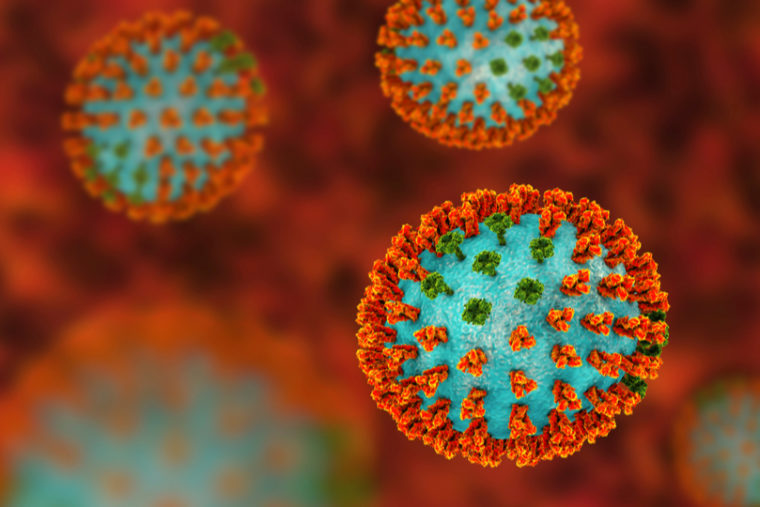
The strain of influenza virus H3M2 strain. This 3D illustration shows surface glycoprotein spikes hemagglutinin (orange) and neuraminidase (green). (Image: Shutterstock) Scientists have known for decades that a flu virus in a human body can be a lot different than viruses grown in a lab. As opposed to the uniform, spherical, textbook-style viruses in a petri dish, in humans they vary in shape and composition — particularly the abundance of certain proteins — even if they are genetically very similar.
It has been difficult however, to study the exact number and location of these proteins on any individual virus. The go-to method in cell biology involves attaching a fluorescent protein to the area of interest; the light makes the area easier to image and study.
But trying to attach fluorescent proteins to the molecules that make up a flu virus is like trying to get a third person on a tandem bike: There just isn’t room. The fluorescent proteins are about the same size as the flu proteins; introducing such a relatively large element throws the virus out of whack.
A paper by Michael Vahey, assistant professor in the School of Engineering & Applied Science at Washington University in St. Louis, and Daniel A. Fletcher, the Purnendu Chatterjee Chair in Engineering Biological Systems and chair of bioengineering at the University of California, Berkeley, demonstrates that flu proteins can be tagged using a different method.
The process has already yielded information that hints to one advantage at minimum for having so many flu phenotypes, that is, various shapes and configurations found in genetically identical flu particles.
The paper was published Nov. 29 in the journal Cell.
“Under what circumstances is it adaptive, and how so?” Vahey asked. “This is a first step toward understanding that. But it’s not a complete picture.”
In order to move past the labeling difficulties, Vahey adapted a method that is typically used to label a specific area on a protein called, appropriately, “site-specific labeling.” Instead of using a fluorescent protein, he inserted sequences five- to 10-amino-acids-long into the proteins that make up influenza A virus. This is the most common flu virus, and also the most dangerous to humans.
After inserting these short sequences, he introduced enzymes and small amounts of fluorescent dyes. These enzymes take different dye molecules and connect them to the engineered viral proteins, giving researchers the ability to see individual proteins without disrupting how they — or the virus they make up — functions.
Of particular interest to researchers are the proteins hemagglutinin (HA) and neuraminidase (NA). HA is responsible for allowing a flu virus to attach to a cell and NA is responsible for decoupling the virus from the cell so that it can go on to infect others. (This is where designations such as H1N1 or H3N2 come from; the surface of the virus has different types of HA and NA that are referred to by specific numbers, or subtypes).
“Once we have the ability to label individual viruses, we can image them and quantify how much of each protein they have per particle, and what the size of that particle is,” Vahey said.
Utilizing site-specific labeling overcomes a longstanding challenge in the study of flu viruses. Now that they could take a more detailed look, Vahey and Fletcher decided to do just that, setting up an experiment that might help them understand whether or not the variation seen in individual flu viruses might be adaptive, helping the virus to spread infection.
The researchers studied individual flu viruses released from cells, some of which were treated with a substance that blocks NA from doing its job, releasing the virus from a cell. (This is how the antiviral drug Tamiflu works. If the virus cannot release itself from the cell, it cannot spread and reproduce).
Then they compared the virus particles that were able to detach from the untreated cells to those that were able to detach from the cells treated with the NA inhibitor.
“What we found is that viruses that are smaller, or have more NA, are more resistant to the NA inhibitor,” Vahey said. “They were more likely to be able to detach from a cell that has been challenged with Tamiflu.” They could then go on to infect more cells.
The results suggest that these two variations — being smaller than average, or having more NA — could be beneficial for a virus that found itself in a person who had been treated with Tamiflu. It’s one example of how having lots of diversity among individual viruses might be advantageous.
On the other hand, viruses with more HA, or that are larger, can bind more strongly to cells. “Under any particular circumstance, it might be beneficial to be anywhere within that range,” Vahey said. “In the case of Tamiflu treatment, you’re inhibiting NA such that the viruses that happen to have more NA and also happen to be smaller now have a little bit of a leg up.”
More broadly, Vahey said, “If you have an environment that is changing rapidly over time, if you were reliant on genetic adaptations, you might be in some trouble, because it takes a certain amount of time for mutations to accumulate.” But phenotypic diversity generates changes relatively quickly. Each time a virus replicates, the next generation displays a host of variation, some of which might be suited to the environment where it finds itself.
Down the line, the importance of phenotype may have implications for the development of new flu vaccines. “Typically in the development of a flu vaccine, you’re concerned about how genetic changes in the virus may reduce the effectiveness of the vaccine,” Vahey said. “This could be an additional consideration, how variation in viral phenotype may contribute.”
“Typically the receptor that the virus binds to in not identical in, say a bird and a human,” said Michael Vahey, assistant professor in the School of Engineering & Applied Science, noting that flu virus binds to receptors almost like Velcro. “There are many different hooks, the more you have, the harder it is to peel it off.” In the case of influenza, the “hooks” are hemagglutinin (HA).
It’s possible that a variant animal flu virus with a high number of HA can successfully attach to a human cell, creating new ways to make humans miserable with the flu.
Notice that the ‘regular’ influenza virus is also a ‘corona virus’.
I would bet that a ordinary seasonal flu shot would protect you from the WHU-Flu perhaps better than the mRNA ‘jabs’................
Yeah, but the Big Pharma would be left out of the Big Money. kick 10% up to the big guy.
Ping.
“ Notice that the ‘regular’ influenza virus is also a ‘corona virus’.”
****************************************************************
Mein Gott! The flu virus has SPIKE PROTEINS! The horror… the horror.
Years ago, talking about the H5N1 Influenza, the chief epidemiologist of Vietnam made a brilliant assertion.
He had found a herd of domestic swine that had that flu. And each and every pig in the herd had on average, FIVE different variations of that flu. Each of the five strains were competing with each other to become the dominant flu in each pig.
He said it is acting like a competitive semifinals. Then, the “winning strain” in each pig would compete with the winning strain in every other pig, in the “finals”, with the eventual result of a dominant “grand champion” strain in the entire herd.
As extraordinary as that sounds, he then pointed out there are tens or hundreds of thousands of bird flocks and animal herds out there doing the SAME THING.
And looked at as a whole, it is like a gigantic computer, making a vast number of calculations, to produce an *ideal* flu variant.
This is why a single successful flu strain might produce thousands of ‘clades’, or variants, in a short period of time.
Sooo...Covid IS the Flu!
One of the best kept secrets around is BHT and its ability to kill LIPID covered viruses amongst them the corona virus.
And for the ones hesitant to use it there is always QUERCETIN+ZINC+D3+VITAMIN C + B complex. The later doesn’t prevent you from catching the virus, neither does the vaccine, but it helps to shake it off quickly.
BHT short for butylatedhydroxytoluene, has been around for the better part of thirty years or more, has been approved as a food additive by the FDA as safe for human consumption in small quantities and using common sense. Without going into all the details which would fill many pages some of the benefits are difficult to ignore even so pharmaceutical as well as the medical profession does their best to do so. As a prophylactic it would serve its purpose very well until the right vaccine comes along, without any undesirable side effects, besides being inexpensive and is safer than alcohol consumption, use of tobacco or many other unhealthy eating habits, including many prescription dugs with, many of them having undesirable side effects. No doubt whenever you had a prescription filled it came along with a sheet filled with warnings.
Some of the reasons are that that there is no money to be made by pharmaceutical companies as patents related to BHT ran out long time ago and in order to have it approved for medical application it would require an immeasurable amounts of human tests with expenditures in the millions of Dollars which most likely will never be recovered.
On the other hand many doctors may know about it but will refrain from suggesting it as recommending anything which is not approved by the FDA would leave them wide open to lawsuits, as it is pretty well known that one of the American dreams is, to fall on your neighbors property and then sue them for what ever they can get.
Over the years enough information about BHT has surfaced that if used in small quantities to achieve a particular result, such as from 100 mg to about 1g (one gram or 1000mg) and in most cases 250mg to 450mg may do a nice job for some of the things suggested, it may be less harmful than an equivalent amount of Aspirins. Again do your own research and use common sense which appears to be in short supply these days. Should you decide to try don’t go overboard with it, as more is not always better.
Even so if you still apprehensive or hesitant, use it only when one of those nasty viruses appears on the scene and use it as a prophylactic in a small quantity perhaps up to 450 mg and once the danger subside stop taking it. The catch is that in order to do its job BHT works better before you get sick, as BHT will NOT REPAIR ANY DAMAGE which may already have been done by an infectious disease such as the corona virus. Even so, if taken afterwards BHT will still continue to disable lipid covered viruses, but to repair any damage already caused may require different medications.
One suggested way of taking BHT is to dissolve the quantity you intend to take first in oil as BHT is only soluble in either oil or alcohol, I is also much better absorbed by the human body, but alcohol is not recommended to consume along with BHT. One way of doing it is to dissolve 18 grams or 277 grains, if you happen to have a powder scale used for reloading, of BHT in 200 milliliters of olive oil in a small glass bottle. Then heat it up slightly in a microwave for maybe 40 seconds and then shake it a few times. A teaspoon of this substance, depending on its size will give you approx. 450 mg of BHT which in most cases should do the trick.
So why take BHT on the firs place? It has been long known that BHT will damage the lipid layer or cover from LIPID COVERED viruses and the coronavirus happens to be just such one of such viruses and by doing so will prevent such a virus from attaching itself and do its dirty work.
The Principal Benefits of BHT
In order of importance, supplementing with BHT can help with:
Reduce and prevent viral infections such as herpes, thus terminating their outbreaks. But BHT is also effective against many different human and animal viruses including CMV (cytomegalovirus),9 pseudorabies,10 genital herpes,11HIV,12 and many strains of influenza. These are just a few but not all of the viruses that have a lipid envelope and may be killed by BHT include herpes simplex I, herpes simplex II, herpes zoster, CMV, West Nile virus, HIV virus, influenza virus, hepatitis B and C viruses, avian flu influenza virus and the SARS virus. However, BHT has not been clinically tested to treat and address these infections individually, and there probably never will be as no money can be made. Here, it may be of interest to note that a patent had been filed with the number US4350707 for BHT because of its LIPID COVERED virus killing ability approximately 30 years ago, however in the meantime this patent has expired.
Now keep in mind that very few things in life are perfect and this holds true for vaccines as well as BHT. So when everything comes down to being cut and dried, do you prefer risking being infected with a nasty virus with all kinds of unpredictable side effects or take a chance with some substance which overall has a very good safety record.
Besides most viruses will mutate over time, and by the time someone may come up with the proper vaccine it may no longer match the virus which is currently making its round. But this doesn’t make any difference with BHT if such a virus mutates or not. As long as such a virus has a lipid coating it will damage and disable it..
One of my hunches is, of course it is only speculation, and is based on how vaccination generally works. After BHT has finished the deactivation process of a given virus, such a virus may no longer have the potential to harm the human body, however any remnants of it may encourage our immune system to spring into action and produce anti bodies against this particular virus. Basically this is how basic immunization works by injecting a deactivated virus in anticipation that our immune system responds to it and begins to fight the real thing, when it come along by means of antibodies it has developed in the mean time.
More recently what you may call a ‘Quickie’ COVID “vaccines” are being worked on and developed which inject a live, SYNTHETIC virus, programmed to invade each and every the cell in our body, more or less using the human body as a bio-reactor in hopes to encourage the he human body on its own to develop anti bodies to fight a specific virus. It is a known technique but never tried before on a large scale due to safety concerns. But with the latest COVID virus coming along and being declared as an emergency the FDA dropped most of heir safety requirements giving pharmaceutical companies more or less a free hand to see how I will work on a huge number of people.
So called “Quick” developed vaccines may work just fine initially for a specific virus which they have been designed for, but later on should you get in infected with a mutated strain of such a virus, and viruses can and will mutate which is a guarantee, the outcome may not always be in your best interest and may have severe consequences. I for one would not want to be the first in line for such a vaccine and provide a test case.
Myself and many others who have been using BHT off and on for the past thirty years whenever one of these lipid covered viruses made their rounds have been pretty successful in keeping those nasty viruses at bay with no side effects.
Disclaimer: Opinions posted on Free Republic are those of the individual posters and do not necessarily represent the opinion of Free Republic or its management. All materials posted herein are protected by copyright law and the exemption for fair use of copyrighted works.