Posted on 10/20/2021 8:44:38 AM PDT by Red Badger
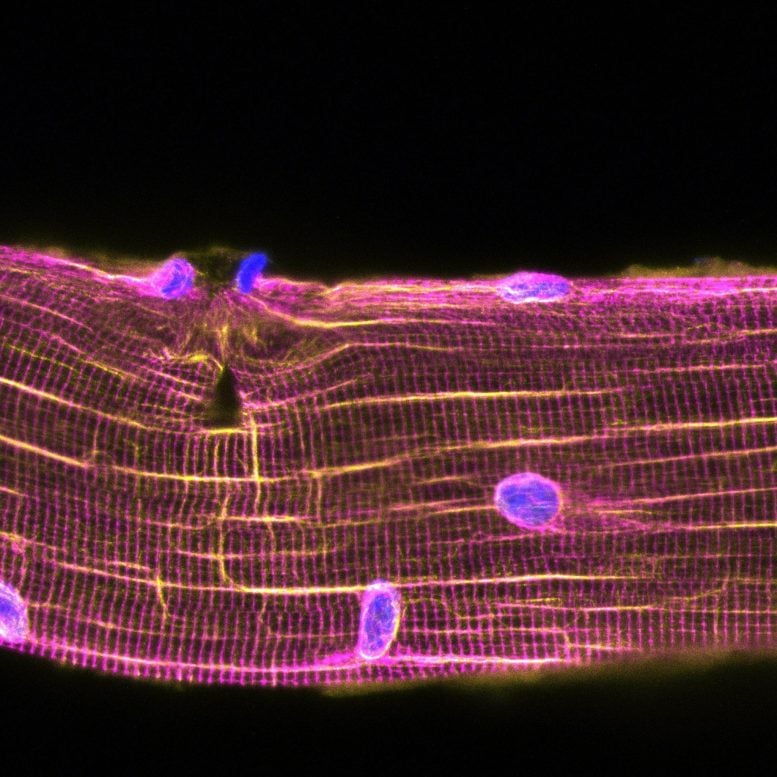
The microtubule network (green) re-organizes at the muscle lesion and attracts myonuclei. Credit: William Roman, iMM
=====================================================================================
Muscle is known to regenerate through a complex process that involves several steps and depends on stem cells. Now, a new study led by researchers at the Instituto de Medicina Molecular João Lobo Antunes (iMM; Portugal) and the University Pompeu Fabra (UPF Barcelona; Spain) and published on October 15, 2021, in the scientific journal Science describes a new mechanism for muscle regeneration after physiological damage relying on the rearrangement of nuclei. This protective mechanism opens the road to a broader understanding of muscle repair in physiology and disease.
Skeletal muscle tissue, the organ responsible for locomotion, is formed by cells that have more than one nucleus, an almost unique feature in our body. Despite the plasticity of muscle cells, their contraction can be accompanied by muscle damage. William Roman, main author of the study and researcher at iMM and UPF Barcelona, explains: “Even in physiological conditions, regeneration is vital for muscle to endure the mechanical stress of contraction, which often leads to cellular damage.” Although muscle regeneration has been deeply investigated in the past decades, most studies were centered on mechanisms involving other cells, including muscle stem cells, which are required upon extensive muscle damage.
“In this study, we found an alternative mechanism of regeneration that is muscle cell autonomous,” says Pura Muñoz-Cánoves, group leader at the University Pompeu Fabra, and study leader. Researchers used different in vitro models of injury and models of exercise in mice and humans to observe that upon injury, nuclei are attracted to the damage site, accelerating the repair of the contractile units. Next, the team dissected the molecular mechanism of this observation: “Our experiments with muscle cells in the laboratory showed that the movement of nuclei to injury sites resulted in local delivery of mRNA molecules. These mRNA molecules are translated into proteins at the site of injury to act as building blocks for muscle repair,” explains William Roman. On the importance of these discoveries, Pura Muñoz-Cánoves says: “This finding constitutes an important advance in the understanding of muscle biology, in physiology and muscle dysfunction.”
In addition to its implications for muscle research, this study also introduces more general concepts for cell biology, such as the nuclear movement to injury sites. “One of the most fascinating things in these cells is the movement during development of their nuclei, the biggest organelles inside the cell, but the reasons why nuclei move are largely unknown. Now, we showed a functional relevance for this phenomenon in adulthood during cellular repair and regeneration,” says Edgar R. Gomes, group leader at the Instituto de Medicina Molecular and Professor at Faculdade de Medicina da Universidade de Lisboa, who co-led the study.
Reference: “Muscle repair after physiological damage relies on nuclear migration for cellular reconstruction” by William Roman, Helena Pinheiro, Mafalda R. Pimentel, Jessica Segalés, Luis M. Oliveira, Esther García-Domínguez, Mari Carmen Gómez-Cabrera, Antonio L. Serrano, Edgar R. Gomes and Pura Muñoz-Cánoves, 15 October 2021, Science. DOI: 10.1126/science.abe5620
The work was developed at iMM and UPF Barcelona in collaboration with the University of Valencia. This study was funded by the Association Française contre les Myopathies, the European Molecular Biology Organization, the Human Frontiers Science Program, MINECO-Spain and the European Research Council.
“mRNA - Making Our Lives Better”

Star Trek tech comes to life...again!
Which came first, the TECH or the TREK? Did the ST writers come up with the idea for the technology and the techies create it, or was the technology being worked on and the word got out to the writers, who included it in the shows?
Muscle fibers don’t have delineated plasma membranes like other cells. The spaced apart nuclei indicate that there are different cells.
This makes sense and is fascinating .
Actual science.

Izzat the Kamala Harris Exercise Video?.....................
Interesting question. My uncle had PhD’s from MIT in just about every field of science, and he was qualified astronaut (back when they were sending chimps into space).
In 1965 he passed away under mysterious circumstances at the age of 42 - but his life kind of answers your question.
He worked on classified stuff for several of the the national security agencies - he was called a “futurist”. He wrote a couple books in the 1950s - one called “Beyond Tomorrow”. It was a study of what the future might look like.. including hollowed-out asteroids by which humans could migrate to distant galaxies…terraforming of planets… “saucer men” who were just a biological head in a floating vehicle.
Lots of these ideas were later used in sci-fi… my grandfather said that authors such as Arthur C Clarke used to “pester” my uncle and other real scientists for ideas.
By the way, I’m NOT saying my uncle was the first person to dream these things up - doesn’t work that way.. ideas are passed down from generation to generation and maybe put in a new context - but nothing is original.
Joni Mitchell, James Taylor and many other songwriters have admitted the same thing - that their music was derived from something they heard.. they tweaked it, but they didn’t really create it from nothing.
All I’m saying is that there have always been real scientists and that the science fiction writers got their ideas from the real scientists rather than the other way around.
I don’t know this for a fact, but I bet Jules Verne went to industrial trade shows and looked at engineer drawings of real inventors - and then he wrote his stories… I don’t think the real inventors needed to read Jules Verne books in order to think of things to invent.
Muscle is known to regenerate through a complex process micro men find hope women not amused.
How long before it’s a staple in the weight rooms of sports teams?
I could use it for soreness and shoulder pain after some workouts.
How long before it’s ‘banned’ as a PES?....................
Reminds me of something I heard about the discovery of semiconductors. Some scientist with a nose for the garlicy scent of the element Germanium suspected it was involved in the aromas his strangely behaving Silicon crystals were producing. If he weren't taking notice of the smell, the discovery wouldn't have happened that day.
nothing is original
My tagline at one time read "Creativity is having the wit to capitalize on your mistakes"
However, it's a little scary to think that the most creative people are at the edge of sanity - their brains, either naturally or through chemical inducement, are injecting irrelevant thoughts in the midst of ongoing logical interpretation. If they keep control, and if they capitalize on it, they come up with new songs, new stories, new discoveries, or new ways of thinking, if they can successsfully relate their new thought. Lots of challenges there, and in the process they might just "lose it".
Disclaimer: Opinions posted on Free Republic are those of the individual posters and do not necessarily represent the opinion of Free Republic or its management. All materials posted herein are protected by copyright law and the exemption for fair use of copyrighted works.