Posted on 07/01/2021 8:29:26 AM PDT by Red Badger
A water disinfectant created on the spot using just hydrogen and the air around us is millions of times more effective at killing viruses and bacteria than traditional commercial methods, according to scientists from Cardiff University.
Reporting their findings today in the journal Nature Catalysis, the team say the results could revolutionize water disinfection technologies and present an unprecedented opportunity to provide clean water to communities that need it most.
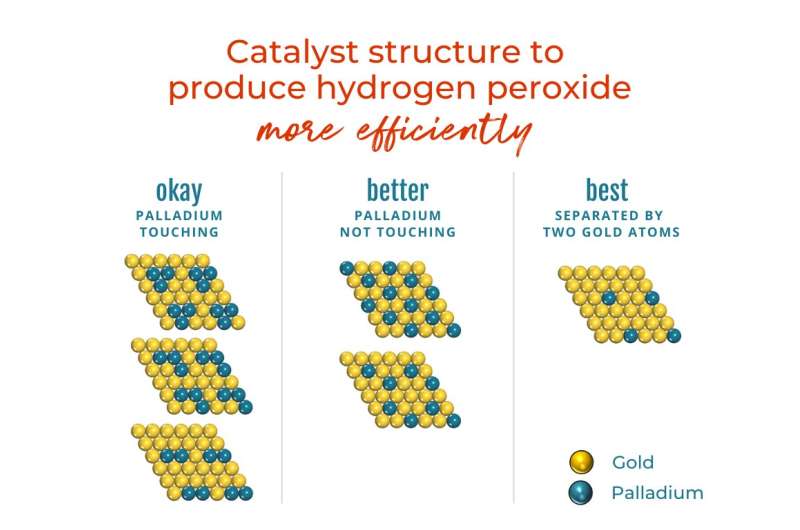
Their new method works by using a catalyst made from gold and palladium that takes in hydrogen and oxygen to form hydrogen peroxide—a commonly used disinfectant that is currently produced on an industrial scale.
Over four million tons of hydrogen peroxide are made in factories each year, where it is then transported to the places it is used and stored. This means that stabilizing chemicals are often added to the solutions during the production process to stop it degrading but these reduce its effectiveness as a disinfectant.
Another common approach to disinfecting water is the addition of chlorine; however, it has been shown that chlorine can react with naturally occurring compounds in water to form compounds which, in high doses, can be toxic to humans.
The ability to be able to produce hydrogen peroxide at the point of use would overcome both efficacy and safety issues currently associated with commercial methods.
In their study, the team tested the disinfection efficacy of commercially available hydrogen peroxide and chlorine compared to their new catalytic method.
Each was tested for its ability to kill Escherichia coli in identical conditions, followed by subsequent analysis to determine the processes by which the bacteria were killed using each method.
The team showed that as the catalyst brought the hydrogen and oxygen together to form hydrogen peroxide, it simultaneously produced a number of highly reactive compounds, known as reactive oxygen species (ROS), which the team demonstrated were responsible for the antibacterial and antiviral effect, and not the hydrogen peroxide itself.
The catalyst-based method was shown to be 10,000,000 times more potent at killing the bacteria than an equivalent amount of the industrial hydrogen peroxide, and over 100,000,000 times more effective than chlorination, under equivalent conditions.
In addition to this, the catalyst-based method was shown to be more effective at killing the bacteria and viruses in a shorter space of time compared to the other two compounds.
It is estimated that around 785 million people lack access to water and 2.7 billion experience water scarcity at least one month a year.
In addition to this, inadequate sanitation—a problem for around 2.4 billion people around the world—can lead to deadly diarrheal diseases, including cholera and typhoid fever, and other water-borne illnesses.
Co-author of the study Professor Graham Hutchings, Regius Professor of Chemistry at the Cardiff Catalysis Institute, said: "The significantly enhanced bactericidal and virucidal activities achieved when reacting hydrogen and oxygen using our catalyst, rather than using commercial hydrogen peroxide or chlorination shows the potential for revolutionizing water disinfection technologies around the world.
"We now have proven one-step process where, besides the catalyst, inputs of contaminated water and electricity are the only requirements to attain disinfection.
"Crucially, this process presents the opportunity to rapidly disinfect water over timescales in which conventional methods are ineffective, whilst also preventing the formation of hazardous compounds and biofilms, which can help bacteria and viruses to thrive."
Explore further
Scientists demonstrate a better, more eco-friendly method to produce hydrogen peroxide
More information:
A residue-free approach to water disinfection using catalytic in situ generation of reactive oxygen species, Nature Catalysis (2021). DOI: 10.1038/s41929-021-00642-w , www.nature.com/articles/s41929-021-00642-w
Journal information: Nature Catalysis
Provided by Cardiff University
Boiling water does not separate it into its elemental constituents.
Bookmark
There are ozone generators for laundry water that are approved for dairy farms in lieu of bleach. I installed one for our home laundry but a voltage spike killed the device.
These are the kinds of inventions that truly matter but are not given the recognition they deserve. Who remembers any celebration over highway rumble strips that have saved hundreds of thousands of sleepy American drivers? I am pretty sure that invention saved my life once.
Thieves all over the world are right now looking forward to the deployment of this tech.
The thieves are too busy stealing catalytic converters from cars to be interested.
I use a CPAP machine every night with a water reservoir.
Supposedly, we are supposed to use the purified/distilled water which comes in big containers. Hard to use and how sterile are they after a few uses. Besides they take up a lot of counter space.
I got a new CPAP machine after possibly getting the crud, 2 years ago in November.
I had no ideal what I had. and could I give it to my wife.
A freeper suggested using regular sterilized drinking water in the 16 ounce bottles to rinse and fill the CPAP water container. Then, add a few drops of Peroxide to the filled water container before using it every night before going to bed. The next morning I rinse and air/sun dry the water reservoir to be ready for that upcoming night’s use.
Since then, I have not had a single cold or flu crud. Nor has my wife.
The water and peroxide in the water reservoir captured the allergens/germs/viruses and neutralized them during the night.
However, the outside/indoor allergens are still waiting for me to remove the mask to breathe the air where they are.
The technology to take nasty water and make it clean and usable has been around for decades.
What we need is a more efficient way to desalinate water and then distribute it to the entire southwestern united states.
I also use a CPAP machine every night. I have learned that distilled water is recommended for the humidifier because it has no mineral content that could be deposited in the water chamber.
FYI for the mis-informed, ordinary water is H2O (2 atoms of hydrogen and one of oxygen) while hydrogen peroxide is H2O2 (2 atoms of hydrogen and two of oxygen). The extra atom of oxygen will naturally become a molecule of oxygen O2 from multiple molecules of hydrogen peroxide or from exposure alone.
Also, for those thinking that the catalyst of gold & palladium sounds tempting to thieves for the metal value, it would be like grubbing for the gold coating on electronics. Doable in theory but impractical on anything other than an industrial scale.
I cannot remember where and I doubt if that source was unique but the point was made that it is Capitalism that makes small improvements like these rumble strips worthwhile. Socialism & Communism favor Monolithic enterprises as they are easier to govern. Such enterprises tend to be strong on production rather than improvement.
Competition makes for improving an already present product an advantage, at least in an ideal world! I remember when they came out with the food storage bags with a 'lip' that made it easier to use!
bookmark
Cardiff?
Hmmm...
There’s always strange things happening when you straddle a rift...
Cheap is relative - if the infrastructure of current water treatment systems can be reduced in scale and/or complexity, it’s still a win.

“How are the people who can’t afford clean water going to afford gold and palladium???”
Parker, Tony Beets and Mr. Gold will donate the gold.
Beat me to it.
+1
Disclaimer: Opinions posted on Free Republic are those of the individual posters and do not necessarily represent the opinion of Free Republic or its management. All materials posted herein are protected by copyright law and the exemption for fair use of copyrighted works.