Posted on 05/20/2021 7:41:42 AM PDT by Red Badger
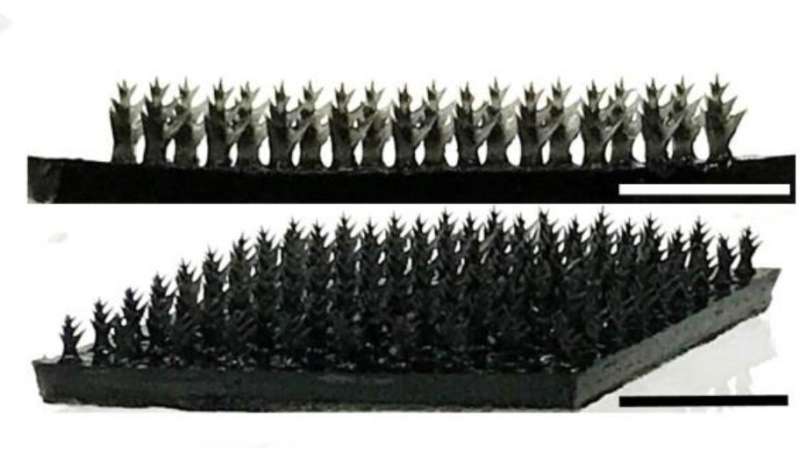
Images of representative fabricated PVA/PPy gel micro-tree array. Scale bar: 1 cm. Credit: California Institute of Technology
_____________________________________________________________________
Tiny structures inspired by the shape of cactus spines allow a newly created material to gather drinkable water from the air both day and night, combining two water-harvesting technologies into one.
The material, a micro-architected hydrogel membrane (more on that later), can produce water through both solar steam-water generation and fog collection—two independent processes that typically require two separate devices. A paper about the material was published in Nature Communications on May 14.
Fog collection is exactly what it sounds like. At night, low-lying clouds along sea coasts are heavy with water droplets. Devices that can coalesce and collect those droplets can turn fog into drinking water.
Solar-steam generation is another water-collection technique. It works especially well in coastal areas because it is also capable of water purification, though it works during the day instead of at night. In the method, heat from the sun causes water to evaporate into steam, which causes water to evaporate into steam, which can be condensed into drinking water.
Because the two technologies operate under such different conditions, they typically require different materials and devices to make them work. Now, a material developed at Caltech could combine them into a single device, working to generate clean water 24 hours a day.
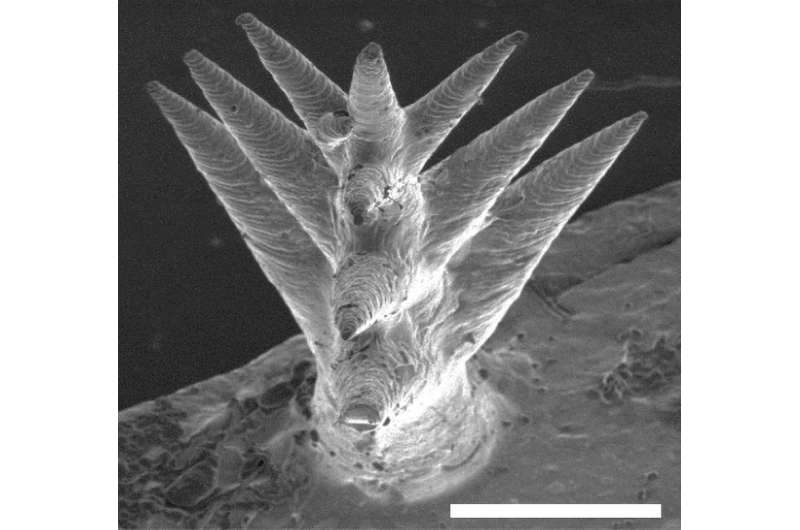
Images of an individual representative tree micro-topology. Scale bar: 1 mm. Credit: California Institute of Technology
____________________________________________________________________________
"Water scarcity is a huge issue that humanity will need to overcome as the world's population continues to grow," says Julia R. Greer, the Ruben F. and Donna Mettler Professor of Materials Science, Mechanics and Medical Engineering and Fletcher Jones Foundation Director of the Kavli Nanoscience Institute. "Water covers three-quarters of the globe, but only about one half of one percent is available freshwater."
Greer has spent her career developing micro- and nano-architected materials; that is, materials whose very shapes (controlled at each length scale, nanoscopic and microscopic) give them unusual and potentially useful properties. In this case, Greer collaborated with Ye Shi, formerly a postdoctoral scholar at Caltech and now a postdoctoral scholar at UCLA, to create a membrane of arrayed tiny spines that resemble Christmas trees but are in fact inspired by the shape of cactus spines.
"Cacti are uniquely adapted to survive dry climates," Shi says. "In our case, these spines, which we call 'micro-trees," attract microscopic droplets of water that are suspended in the air, allowing them to slide down the base of the spine and coalesce with other droplets into relatively heavy drops that eventually converge into a reservoir of water that can be utilized."
The spines are built out of a hydrogel; that is, a network of hydrophilic (water-loving) polymers that naturally attract water. Due to their tiny size, they can be printed onto a wafer-thin membrane. During the day, the hydrogel membrane absorbs sunlight to heat up water trapped beneath it, which becomes steam. The steam then recondenses onto a transparent cover, where it can be collected. During the night, the transparent cover folds up and the hydrogel membrane is exposed to humid air to capture fog. As such, the material can harvest water from both steam and fog.
In an operation test conducted during the night, samples of the materials ranging from 55–125 square centimeters in area were able to collect about 35 milliliters of water from fog. In tests during the day, the material was capable of collecting about 125 milliliters from solar steam.
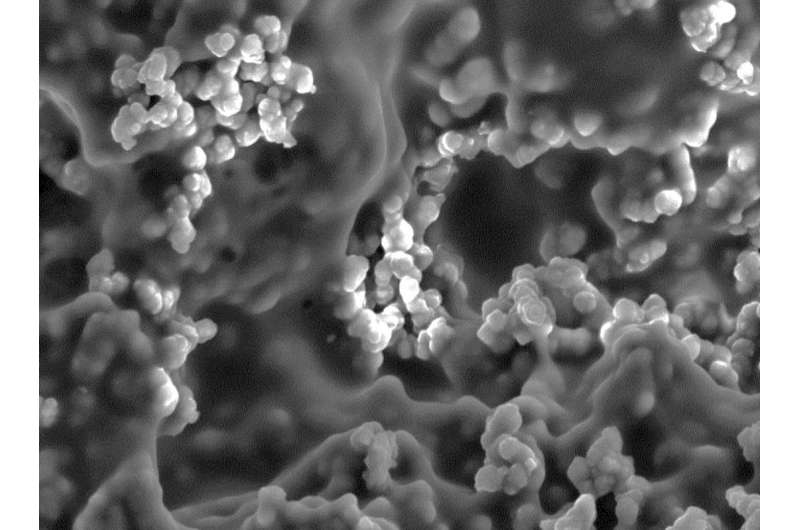
Porous structure of gel matrix. Credit: California Institute of Technology
________________________________________________________________________
The exact design of the membrane was created using the design program SolidWorks.
The hydrogel itself is a polyvinyl alcohol/polypyrrole (PVA/PPy) composite gel, a non-toxic and flexible material used in numerous applications including in capacitors, wearable strain and temperature sensors, and batteries.
To fine-tune the design of the micro-trees, Greer and Shi worked with Caltech's Harry Atwater, Howard Hughes Professor of Applied Physics and Materials Science; and Ognjen Ilic, formerly a postdoctoral scholar at Caltech and now Benjamin Mayhugh Assistant Professor of Mechanical Engineering at the University of Minnesota.
Using computer modeling, Ilic computed the heat distribution within the micro-trees to help define the size and shape that would be most effective at drawing water from the air. With this successful proof-of-concept, the team now hopes to find a private partner capable of commercializing the technology for water-scarce regions.
"It is really inspiring that a relatively simple hydrophilic polymer membrane can be shaped in a morphology that resembles cacti spines and be capable of tremendous enhancement in water collection. I guess evolution really works," Greer says.
The Nature Communications paper is titled "All-day Fresh Water Harvesting by Microstructured Hydrogel Membranes."
Explore further
Video:
Tiny shape-shifting polymers developed for potential medical applications
More information: Ye Shi et al, All-day fresh water harvesting by microstructured hydrogel membranes, Nature Communications (2021). DOI: 10.1038/s41467-021-23174-0
Journal information: Nature Communications
Provided by California Institute of Technology
Maybe not as far from economic reality as I thought!
The path to the deserts of the moon and mars leads through the deserts of earth.
https://www.youtube.com/watch?v=FRYPRsXbYbg
Moon has water. Tons of it......................
Created material to gather drinkable water from the air both day and nigh.
Earl the water taste funny to you?.

I did not recall that, but it is nonsense. It requires the body to generate the power necessary to cool the body.
But, by the law of entropy, that is impossible.
The body would automatically generate more waste heat than it was capable of removing, because it would be using muscle power to run the pumps.
You have to dump the waste heat somehow.
Maybe that escaped my memory as well. Was there some sort of magic material to dump the heat to the atmosphere? Did the book mention the temperature?
I am sure others will check my logic here.

:D
All a stillsuit was supposed to do was preserve as much moisture from escaping as it could. It was not anywhere near 100% efficient even under the best conditions. It required the wearer to breathe in thru the nose and out thru the mouth. Urine and fecal matter was collected in side leg pockets and moisture recycled. Even with a good Fremen-made stillsuit, a person could only last about two weeks in the open desert of Dune with no replenishment of water supply........................
Unfortunately...Warning:This product contains a chemical known to the State of California to cause cancer,...
“I was into power converters when I was a teen. Then I grew up and discovered girls.”
And the difference is............?
Absolutely... And shut down all the golf courses and artificial lakes. Priorities need to be set.
“ If done large scale would this effect subsequent rainfall downwind like the Midwest?”
In the Midwest most moisture comes up from the Gulf.
so does mars.
the key to life on the moon and mars is to learn to desalinate water there in such a way as to harvest the minerals and metals in the salt water. you learn to do that by doing desalinating efficiently (meaning removing AND separating out the minerals and metals in seawater—and selling them at profit) on earth. the by product of this is that seawater desalination becomes much cheaper—cheap enough for desert farming.
HAHA! Good one!
“The path to the deserts of the moon and mars leads through the deserts of earth.”
I have no problem with that argument.
I only suggest that invention and practicality do not always go hand in hand, and the water idea, to meet the economic burdens related to necessity, will see much more practical adoption of that technology in “off world” situations than on earth.
Probably ideal conditions, but, that is what is implied by the paper.
Indeed. I'd like to see what kind of volumes they would get after having this sit outside for a couple of months. Would imagine that accumulated dust would reduce yield. Can the thing be cleaned?
Cost per gallon of water?
People pay 8 dollars a gallon for bottled water but bitch about gasoline at 3 dollars a gallon...................
Disclaimer: Opinions posted on Free Republic are those of the individual posters and do not necessarily represent the opinion of Free Republic or its management. All materials posted herein are protected by copyright law and the exemption for fair use of copyrighted works.