Posted on 02/24/2021 10:37:09 AM PST by Red Badger
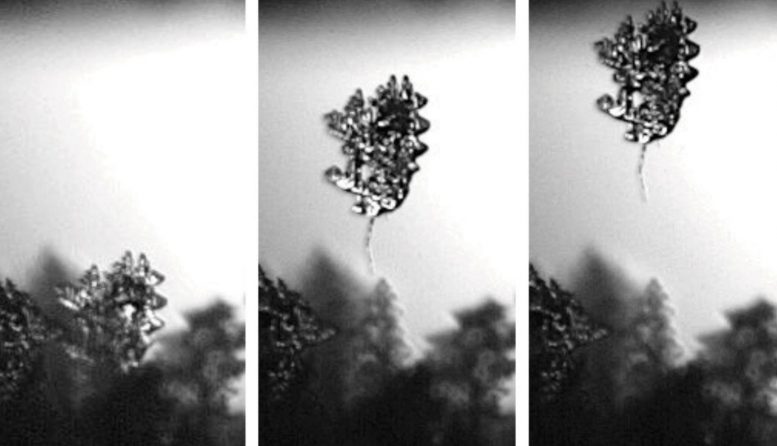
Frost breaks off and “jumps” upward due to an electrostatic charge. Credit: Virginia Tech
===========================================================
If you have ever gotten up on a winter morning and thrown yourself into the arduous task of scraping frost from a windshield, a Virginia Tech lab is engaging science that could make your life much easier. In research funded by the National Science Foundation, Associate Professor Jonathan Borekyo has led a team in developing a potential solution for frost removal by way of electrostatics.
As water freezes, positively charged protons and negatively charged electrons separate. Frozen ice crystals become electrified as the top of the frost becomes warmer than the bottom of the frost. This causes charged ions to move from top to bottom (warm to cold), but it turns out that the positive ions can migrate faster. The top of the frost ends up being negatively charged while the bottom is more positively charged, a concept known as charge separation.
Charge separation in frost has been studied in the past, but the effect has never been exploited to remove the frost from its surface. Boreyko’s Nature-Inspired Fluids and Interfaces Lab set out to fill that gap. The team started by artificially creating frost on a surface. They then suspended a film of water above the frost using filter paper. Opposites attract, so the negatively-charged top of the frost sheet attracted the positive ions in the water. This generated an electric field that exerted an attractive force on the frost sheet.
Using a high-speed camera, the team observed frost particles breaking off their substrate and jumping toward the opposing film of water. Frost was grown on both metal and glass surfaces, indicating that the jumping frost effect is possible regardless of the thermal and electrical properties of the object holding the water.
With this data in hand, the team is moving to larger scales in their testing. The ice particles in this experiment were very small in size, each only a few millimeters or less. Boreyko’s team is working toward removing large sheets of ice by increasing the amount of charge that comes near the frost. By replacing warm water with actively charged electrodes, the small frost jumps could become large-scale ice evacuations.
“If we can amplify this electrostatic de-icing effect, such that entire sheets of ice or frost are instantly ripped away from their surface, it could be a game-changer for the aircraft and HVAC industries,” said Borekyo.
These findings were published in ACS Nano. The article’s lead author was Ranit Mukherjee, a graduate student in Boreyko’s lab.
bookmark
That’s why when it’s icy, I rub my hair on my windshield to create a static charge.
If true, like everything there is no free lunch. Using “electrostatics” to drive off ice particle will require not just and electrostatic voltage, but also a current induced by the particles moving which means you have to supply electric power. The question will be, if it works at all, then how much power and is that practical.
I don’t follow how this could help aircraft - don’t you need another sheet of water the ice can be attracted to to - jump?
If you have ever gotten up on a winter morning and thrown yourself into the arduous task of scraping frost from a windshield …No, because I warm up my car first.

Remote starter, one of mans greatest inventions, in cold or heat.
Sounds like a potential alternative to carbon fiber for de-icers on wind-turbine blades.
Ping.
So all you have to do is wrap the wings of an aircraft with special filter paper. Anyone see anything wrong with that?
Either this article is not well written or else this concept is just plain silly.
The “science” appears sound. It is now a question of devising the “technology” to make use of the knowledge in a practical way.
so instead of a $0.50 ice scraper that take that take less than 5 minutes to scrape the entire glass of a car, you can now do it in less than two hours and $50,000.00 de-icer and a very long extension cord.
Computers were much the same way when they were first introduces. You could replace 10 clerical workers with a very large and expensive computer system that took 10 computer scientists and engineers to operate. and it was less effective, in the short run anyway
Works for me. 👍🏻
That’s why I have a shed.
Or move to South Florida.
Thanks to many years of driving, “one eyed drunk” I just scrape a quarter inch of my windshield. /S (1/2 inch!)
Charge the surface in contact with the frost more positive to generate repulsion of the frost particles. As frost is generally low in ion content and of crystalline form, it should be of low electrical conductance.
Sounds as though they may have created a Coulombic explosion in the frost.
Disclaimer: Opinions posted on Free Republic are those of the individual posters and do not necessarily represent the opinion of Free Republic or its management. All materials posted herein are protected by copyright law and the exemption for fair use of copyrighted works.