Posted on 02/24/2021 10:24:41 AM PST by Red Badger
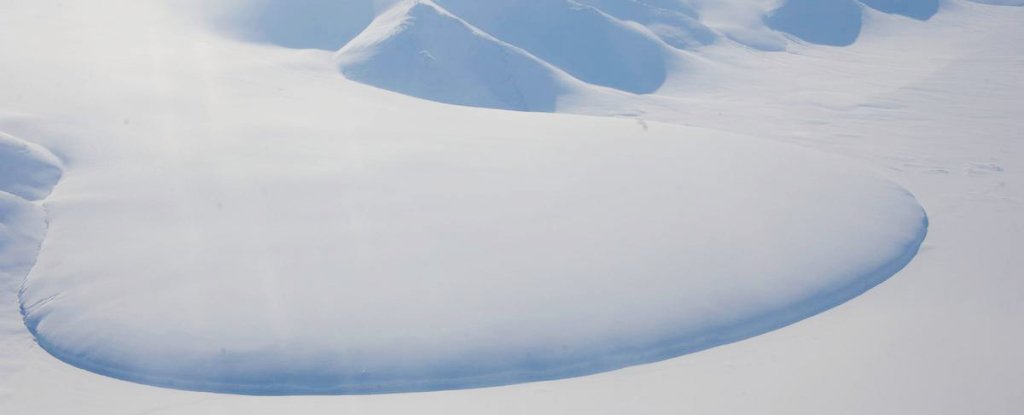
Piedmont Glacier in north-east Greenland (Coen Hofstede/Alfred Wegener Institute)
=============================================================
It should be simple. When temperatures on Earth get hotter, huge amounts of water ice trapped in giant glaciers begin to thaw, releasing water into the oceans, and causing sea levels to rise. It's the story of our lives.
By contrast, when global temperatures plummet, which happens during ice ages, sea levels proceed to drop, as water content retreats from the ocean, freezing once more in huge inland ice sheets.
This epic, ongoing cycle of ice ebb and flow – the transitions from glacials to interglacials – has been occurring since time immemorial. But there's a problem.
For years now, scientists tracking these cycles have suggested there's a "missing ice" problem: a mysterious discrepancy between very low sea levels roughly 20,000 years ago, and the volume of ice stored in glaciers at the same time.
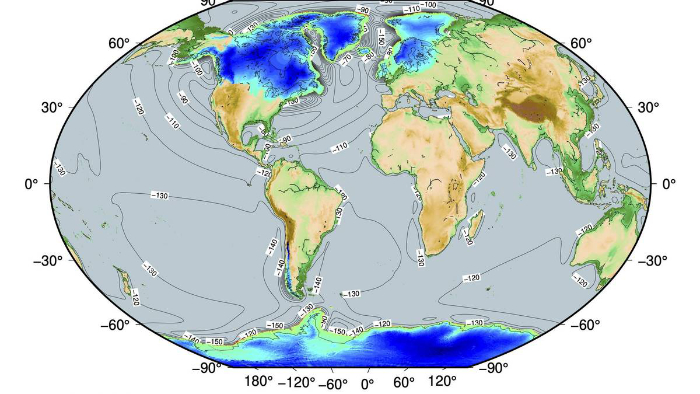
Ice surface elevation, 20,000 years ago. (Evan Gowan/Alfred Wegener Institute)
=============================================================
At its heart, the problem is this. During the peak of Earth's last ice age – the Last Glacial Maximum (LGM), which ended approximately 20,000 years ago – sea level is thought to have been about 130 metres (427 ft) lower than it is today, based on ancient coral sediment evidence.
But modelling suggests ice volume in glaciers at this point in time wasn't great enough to explain such a low sea level. So how can we explain this 'missing' ice?
In a new study led by geophysicist Evan Gowan from the Alfred Wegener Institute in Germany, researchers appear to have found a solution.
With a new reconstruction called PaleoMIST 1.0, the researchers were able to model the evolution of global ice sheets way into the past, much farther back than even the LGM.
"It looks like we've found a new way to reconstruct the past as far back as 80,000 years," Gowan says.
The results of the model suggest the anomaly in our data isn't a case of missing ice, but rather mistaken inferences about how low the sea level actually fell during the LGM.
According to PaleoMIST 1.0's ice physics model, the sea level dropped no more than 116 metres below where the waves lap today, with ice volume (being fully accounted for) clocking in somewhere around 42.2 × 10⁶ km3.
"We, therefore, find no basis for the missing ice problem, as our LGM reconstruction is compatible with existing sea-level constraints," the researchers explain in their study.
According to the team, the misdirection of the missing ice argument stems from a couple of factors – firstly, over-reliance on far-field indicators (coral sediment evidence from locations elsewhere in the world), which may not accurately represent global average sea levels as we once thought they did.
Another issue is a long-established but seemingly flawed method used to estimate glacier masses, oxygen isotope ratio cycles – which appears to produce discrepancies when reconciling sea-level height and glacier masses as far back as the LGM, at least.
"The isotope model has been used widely for years to determine the volume of ice in glaciers up to many millions of years before our time," says one of the team, geophysicist Paolo Stocchi from the Royal Netherlands Institute for Sea Research.
"Our work now raises doubts about the reliability of this method."
While the missing ice mystery appears to be solved, the researchers don't expect theirs will be the last word on this topic.
After all, their own solution's incompatibility with oxygen isotope ratio cycle-based reconstructions has, in a way, "created a new missing ice problem", the team admits.
Whether and how that new uncertainty can be resolved is a challenge for another day, in future research that may yield even clearer glimpses of ice sheet evolution in the distant past.
The findings are reported in Nature Communications.
That’s what struck me as well - 47 feet. Based on data that infers what was going on 20,000 to 80,000 years ago. I guess if one gets paid to study this kind of stuff, they need to keep coming up with reasons to get paid.
I’d give them a number, +/- 50 feet and be done with it.
I’m no scientist and therefore probably wrong in this but...
This sounds a whole lot like they had evidence that pointed to an issue and to solve the issue they discarded the evidence.
A friend has sold property in Miami and moved to land in Orlando which is 20 or 30 feet above sea level.
A friend has sold property in Miami and moved to land in Orlando which is 20 or 30 feet above sea level.
Have these researchers considered sinking and rising land mass? For example areas of North America and Eurasia are still rising from loss of heavy glacier weight. This also affects the coastal areas as well and will continue to do so. So how does rhis change their ice volume calculations?
Isostatic rebound from the loss of ice that melted has often been used as a fudge factor in this context. This latest study just changes the fudge factor.
Put ice in a funnel and the funnel in your glass. When the ice melts, the water level will rise. Heat the water enough, and the level will drop again. Cool the water vapor so that it falls back into the funnel as ice, and you'll build up ice out of the water. When the ice gets warm, it melts, and the melt water flows into the glass. Rinse, repeat for millions of years. Or seven days, if you're God.
This is what is called a hypotheses. It is supposed to be tested. If it passes all the tests, it will become a theory. If it fails, dump that model and start over, unless the data you collected suggests changes that more closely follow the data. Test some more. Rinse, repeat, until you can't falsify it. Then call it a Law of Nature until we learn enough to falsify it again. Then start over. Rinse, repeat.
Anyone who says "The Science is settled." doesn't know what he's talking about. (Yes, Al, I'm talking about YOU!) Science will be settled after the heat death of the universe, or the 2nd Coming. Which ever arrives first.
BTW, evidence is pretty good that ice melts. Ice in glaciers is on land. Once the ice melts it's called water. The resultant water runs into the sea, where it's still called water. If the glacier itself makes it to the ocean and a chunk breaks off, it's called an ice berg. It floats because it's slightly less dense than water. When it gets warm enough, it melts just like in your glass. Since it's less dense, when it melts it doesn't raise the level of the water. If it was more dense, it would sink to the bottom, and raise the water level slightly.
“Because it’s slightly less dense than water.”
Don’t you pay any attention to that, icebergs!
You are not dense!
You may not be as smart as say a garbage scow, but you are fine the way you are!
Dense
There are ice cubes all over the world crying now because some people think they are dense.
Horrible.....just horrible
Yes, I’ve read it, and I understand what he’s saying - that there was a worldwide flood and that geology is all screwed up.
he’s saying - that there was a worldwide flood and that geology is all screwed up.
—
He’s saying more than that with the claims for Atlantis and 2,500km asteroid. Everyone that keeps up knows there was a flood when the ice dams on the ice cap let go. The most plausible theory to date is the Taurid shower in 10800 BC. includes much geological, physical, and cultural evidence to explain the events between the end of the Ice Age, the beginning of the Younger Dryas and its ending.
Geology isn’t so much screwed up as the scientists with skin in the game protecting each other with consensus thinking; if the evidence does not fit conventional thinking, or some pet theory, then it is an anomaly and dismissed or hidden. That is the battle across almost all scientific disciplines.
His proofs are not needed to explain what happened. Atlantis is just a stretch too far. Besides, there is more than ample evidence that Atlantis was a misdirection created by the Westerners to hide their trade routes and it got passed on to the Upper Egyptians who conquered the Westerners in the North. From them to Solon to Plato and thence to us.
It is is far more likely that an advanced civilization may have existed in the now sunken Sundaland off Indonesia.
Disclaimer: Opinions posted on Free Republic are those of the individual posters and do not necessarily represent the opinion of Free Republic or its management. All materials posted herein are protected by copyright law and the exemption for fair use of copyrighted works.