Posted on 02/19/2021 8:29:03 AM PST by Red Badger
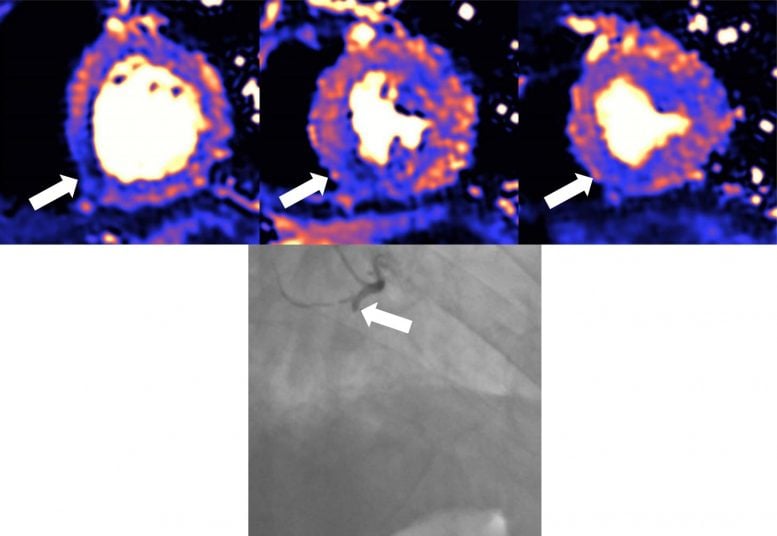
MRI scan of damaged heart. Blue means reduced blood flow, orange is good blood flow. In this figure the inferior part of the heart shows dark blue, so the myocardial blood flow is very reduced and the black and white angiography, which looks directly at the blood vessels, shows that the vessel which supplies the blood to this part of the heart is occluded. The 3 colored images are 3 different slices of the heart: the basal the mid and the apical slice. Credit: European Heart Journal
================================================================
Around 50% of patients who have been hospitalized with severe COVID-19 and who show raised levels of a protein called troponin have damage to their hearts. The injury was detected by magnetic resonance imaging (MRI) scans at least a month after discharge, according to new findings published today (February 18, 2021) in the European Heart Journal.[1]
Damage includes inflammation of the heart muscle (myocarditis), scarring or death of heart tissue (infarction), restricted blood supply to the heart (ischaemia) and combinations of all three.
The study of 148 patients from six acute hospitals in London is the largest study to date to investigate convalescing COVID-19 patients who had raised troponin levels indicating a possible problem with the heart.
Troponin is released into the blood when the heart muscle is injured. Raised levels can occur when an artery becomes blocked or there is inflammation of the heart. Many patients who are hospitalized with COVID-19 have raised troponin levels during the critical illness phase, when the body mounts an exaggerated immune response to the infection. Troponin levels were elevated in all the patients in this study who were then followed up with MRI scans of the heart after discharge in order to understand the causes and extent of the damage.
Professor Marianna Fontana, professor of cardiology at University College London (UK), who led the research together with Dr. Graham Cole, a consultant cardiologist at Imperial College London, said: “Raised troponin levels are associated with worse outcomes in COVID-19 patients. Patients with severe COVID-19 disease often have pre-existing heart-related health problems including diabetes, raised blood pressure and obesity. During severe COVID-19 infection, however, the heart may also be directly affected. Unpicking how the heart can become damaged is difficult, but MRI scans of the heart can identify different patterns of injury, which may enable us to make more accurate diagnoses and to target treatments more effectively.”
The researchers investigated COVID-19 patients discharged up until June 2020 from six hospitals across three NHS London trusts: Royal Free London NHS Foundation Trust, Imperial College Healthcare NHS Trust and University College London Hospital NHS Foundation Trust. Patients who had abnormal troponin levels were offered an MRI scan of the heart after discharge and were compared with those from a control group of patients who had not had COVID-19, as well as from 40 healthy volunteers.
“The recovering COVID-19 patients had been very ill; all required hospitalization and all had troponin elevation, with around one in three having been on a ventilator in the intensive care unit,” said Prof. Fontana.
“We found evidence of high rates of heart muscle injury that could be seen on the scans a month or two after discharge. Whilst some of this may have been pre-existing, MRI scanning shows that some were new, and likely caused by COVID-19. Importantly, the pattern of damage to the heart was variable, suggesting that the heart is at risk of different types of injury. While we detected only a small amount of ongoing injury, we saw injury to the heart that was present even when the heart’s pumping function was not impaired and might not have been picked up by other techniques. In the most severe cases, there are concerns that this injury may increase the risks of heart failure in the future, but more work is needed to investigate this further.”
The function of the heart’s left ventricle, the chamber that is responsible for pumping oxygenated blood to all parts of the body, was normal in 89% of the 148 patients but scarring or injury to the heart muscle was present in 80 patients (54%). The pattern of tissue scarring or injury originated from inflammation in 39 patients (26%), ischaemic heart disease, which includes infarction or ischaemia, in 32 patients (22%), or both in nine patients (6%). Twelve patients (8%) appeared to have ongoing heart inflammation.
Prof. Fontana said: “Injury relating to inflammation and scarring of the heart is common in COVID-19 patients with troponin elevation discharged from hospital, but is of limited extent and has little consequence for the heart’s function.
“These findings give us two opportunities: firstly, to find ways of preventing the injury in the first place, and from some of the patterns we have seen, blood clotting may be playing a role, for which we have potential treatments. Secondly, detecting the consequences of injury during convalescence may identify subjects who would benefit from specific supporting drug treatments to protect heart function over time.”
The findings of the study are limited by the nature of patient selection and included only those who survived a coronavirus infection that required hospital admission.
“The convalescent patients in this study had severe COVID-19 disease and our results say nothing about what happens to people who are not hospitalized with COVID, or those who are hospitalized but without elevated troponin. The findings indicate potential ways to identify patients at higher or lower risk and suggest potential strategies that may improve outcomes. More work is needed, and MRI scans of the heart have shown how useful it is in investigating patients with troponin elevation,” concluded Prof. Fontana.
The study is also the subject of a discussion between Prof. Fontana and Prof. Eike Nagel, at the Society for Cardiovascular Magnetic Resonance annual meeting on Friday 19 February, where it will be presented for the first time.[2] Prof. Nagel, director of the Centre for Cardiovascular Imaging at Deutsches Zentrum Für Herz-Kreislauf-Forschung (DZHK), Frankfurt, Germany, is the senior author on an earlier paper[3] that found ongoing heart problems in up to 78% of COVID-19 patients who were less sick and most of whom did not require admission to hospital.
References:
“Patterns of myocardial injury in recovered troponin-positive COVID-19 patients assessed by cardiovascular magnetic resonance” by Tushar Kotecha et al., 18 February 2021, European Heart Journal. DOI: 10.1093/eurheartj/ehab075 Society for Cardiovascular Magnetic Resonance virtual scientific sessions 2021, 09.00-09.45 hrs Central Standard Time in USA (6 hours behind GMT): https://bit.ly/3oMn84t “Outcomes of Cardiovascular Magnetic Resonance Imaging in Patients Recently Recovered From Coronavirus Disease 2019 (COVID-19)” by Valentina O. Puntmann, MD, PhD; M. Ludovica Carerj, MD; Imke Wieters, MD; Masia Fahim; Christophe Arendt, MD; Jedrzej Hoffmann, MD; Anastasia Shchendrygina, MD, PhD; Felicitas Escher, MD; Mariuca Vasa-Nicotera, MD; Andreas M. Zeiher, MD; Maria Vehreschild, MD and Eike Nagel, MD, 27 July 2021, JAMA Cardiology. DOI: 10.1001/jamacardio.2020.3557
Probably useful if they had the same tests run before they acquired covid, otherwise how would they be sure it’s covid caused?
Not an option. Must...not...alleviate...the...crisis...!
You dumb asses. The troponin release in the hospital shows NEW DAMAGE. That’s how we diagnose a heart attack. And the MRI confirms it. Keep pretending it’s”just the flu bro”.
Just the flu, bro. /s
They looked the same so the authors did not think it was necessary to print identical images. Wastes paper, you know. Part of being green.
I’ve been doing the regular flu shots plus taking zinc and vit. K2 and D3.
the buried lead:
“The findings of the study are limited by the nature of patient selection and included only those who survived a coronavirus infection that required hospital admission.”
thus this study is pure junk. /not sarcasm
not saying it won’t be published. 99% of what is published these days is junk or worse political junk.
Troponin can be elevated for other reasons too though-renal disease, congestive heart failure and myocarditis for example. I would be curious to see the age distribution of these test subjects. It would be interesting to see if there were any 20-40 year olds in there.
Most of the people I see admitted with/for Covid are not at all obese. I think they may have stayed thin by smoking though. I have seen countless heart attack victims come through my ER too and they’re rarely obese believe it or not. They’re frequently smokers though. I have seen athletic 40 year olds have heart attacks in fact. The last one I remember died right on the basketball court. he received immediate high quality CPR from a physician he was playing with but he never came back. Without getting too specific, it would be an understatement to say that he was in good shape. He wasn’t even 50 years old yet.
I HATE all the hype and disinformation... wait... I should say NON-information. We need COVID DETAILS!
Headline:
“Heart Damage Found in More Than Half of COVID-19 Patients Discharged From Hospital”
Now, if you read the article, (WHO DOES THAT?), it does say
“hospitalized with “SEVERE” COVID-19 “. (I read “ventilator” (just me)).
Just like “of COVID vs with COVID we NEED TO KNOW ...
1. Actually HAVE COVID or just TESTED POSITIVE for COVID?
2. Symptoms, DID THEY GET SICK?
3. If sick, HOW SICK? (sniffles (a cold) or VENTILATOR)
4. If sick, for HOW LONG?
A friend of my wife’s, family had a Superbowl party. “Supposedly” they all came down with COVID.
Hearing this you naturally think the worst. THEY ARE ALL GONNA DIE!
I don’t know the “truth”, but I have questions that need to be answered before I could be concerned.
1. Did they really get COVID or just “test positive”?
2. Was it EVERYONE?, most, some, one?
3. Did they actually get SICK? HOW SICK? How many of each?
4. Recovery, how fast?
This story could be anything from a tragedy to a NOTHINGBURGER!
DETAILS! INSIST ON DETAILS or you are being manipulated.
You dumb asses. The troponin release in the hospital shows NEW DAMAGE. That’s how we diagnose a heart attack. And the MRI confirms it. Keep pretending it’s”just the flu bro”.
Didn’t realize it was this high a percentage, but heart damage has been a fairly common occurrence for the serious cases of COVID.
I think you can surmise from the headline that if people were admitted inpatient at the hospital they had a more severe case of COVID.
It’s all about narrative.
one thing about this COVID thing - it has revealed many on the right now go for narrative over fact. Increasing numbers of people on the right live in an alternate reality as well.
So, 50% if the most severe COVID cases who did not die have this issue.
Prof. Fontana said: “Injury relating to inflammation and scarring of the heart is common in COVID-19 patients with troponin elevation discharged from hospital, but is of limited extent and has little consequence for the heart's function.
However, it has “little consequence.”
This also happens with the worst flu patients who don't die:
I sat BS
Why would I believe anything any medical institution ever tells me again?
Just throwing it out there —
CV19 (sars-cov2 with later GOF), initially and specifically attacks ACE-2 receptors. After ACE-2, as mutation and variants developed, it was likely to go after half dozen other receptors.
The two most concentrated locations of ACE-2 receptors are found in the lungs and in the heart. And of course ACE-2 are also in the liver and kidneys.
Several publications were already showing, and then predicting loss of lung and heart function due to scaring as a result, back to late Winter/Spring 2020.
That being said, there is no question, within the senior demographics (globally), there are naturally already significantly higher rates of lung and heart loss of function.
As Dr. Zelenko said early on...once you end up in a hospital in COVID, your odds of survival are drastically worse. The goal is to treat people before that happens, which he did with HCQ and Zinc, as my 76-year old neighbor did successfully.
Does it show images of what it looked like before?
My first thought as well.
What are they using as a baseline? Nothing, to be sure. It wouldn’t fit the narrative.
Disclaimer: Opinions posted on Free Republic are those of the individual posters and do not necessarily represent the opinion of Free Republic or its management. All materials posted herein are protected by copyright law and the exemption for fair use of copyrighted works.