Posted on 01/22/2020 1:14:26 PM PST by Red Badger
=================================================================
Bespoke car maker Rolls-Royce is advancing research on nuclear small modular reactors.
Rolls-Royce's staid reputation as haute luxury belies its legacy of innovation in aerospace and other engineering.
Modular reactors are easier to manufacture, making costs both lower and more predictable.
===================================================================
Rolls-Royce has taken a sharp right turn, from making million-dollar luxury sedans to researching cutting-edge nuclear small modular reactors (SMRs). Modular reactors are au courant in energy technology, and Rolls-Royce joins startups and governments around the world in trying to shrink the footprint and increase the safety of nuclear energy.
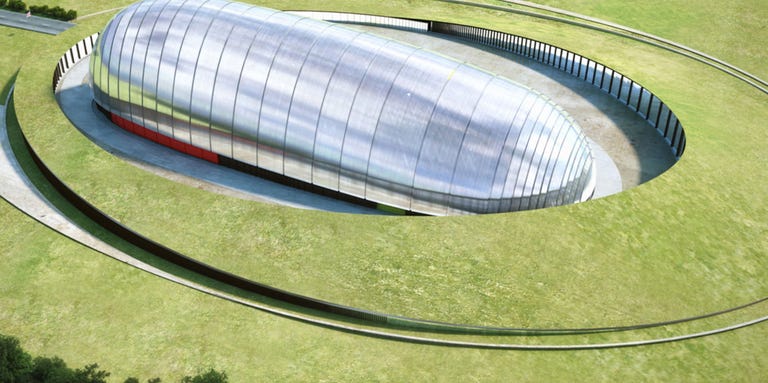
With its SMR design, which is "just one-tenth the size of a typical large-scale reactor site," a pressurized water reactor is enclosed with robust safety layers that are still far smaller in volume than the reactor space in a traditional nuclear plant. The reactor is oriented vertically, so gravity helps to move the hot and cold water around. Despite its much smaller size, the reactor will produce an expected 450 MWe, compared with 600 MWe at each of the two reactors at the existing Dungeness B plant in Kent.
Since the late 1800s, the Rolls-Royce company has engineered electronics and machinery, including engines for airplanes, automobiles, and ships. The car business—where Rolls-Royce handmakes extreme high-end luxury vehicles only—is the tip of an experimental iceberg that goes back over a century, although the company has sold off some of its more interesting arms of business in recent years.
Today, it’s pushing for SMR technology in a series of new power plants around the U.K. Rolls-Royce is known for handcrafted vehicles, but it’s worked to revolutionize tooling and manufacturing in its nitty gritty engineering arm. The company says its approach to SMRs is motivated by how modular manufacturing can save a great deal of resources and money, making cutting-edge nuclear an option even during the twilight of England’s existing nuclear plants. The last of these traditional plants will be offline by 2030.
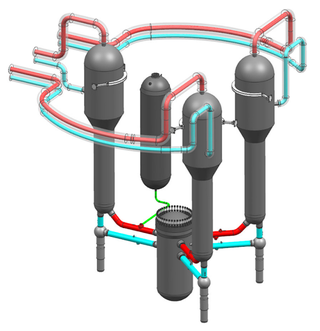
Rolls-Royce’s illustration of its Reactor Coolant System Rolls-Royce
=================================================================
By relying on predictable, relatively portable nuclear reactors, manufacturers can standardize how much these nuclear plants will cost and therefore how much the energy they make will cost, Rolls-Royce says. In the U.S., nuclear power plants are often a complex nest of tax subsidies. This is a big change from the heyday of nuclear, when plants had to incentivize to the places where they sought to build.
The predicted first two sites of Rolls-Royce SMR plants are in northern England and Wales. One site is home of an interminably delayed nuclear project, and the other a decommissioned nuclear plant. In a way, this technology is a case of the “faster spaceship” problem: Traditional nuclear projects launched sometimes decades ago are so complex and hard to finalize and pay for that a lightweight startup project can lap them many times over.
What are the advantages of an SMR plant over a traditional nuclear plant? Well, proponents say almost everything about modular reactors is an improvement. Rolls-Royce in particular says that manufacturing many small reactors at once saves money and overhead compared with “a stand-alone bespoke major project.” That, in turn, enables “a predictable programme from first concrete to commissioning in just four years, including 500 days on site for the modular build.”
Among the U.K.’s existing nuclear plants, the shortest build time was eight years and the longest was nearly 20. Rolls-Royce’s modular construction time is in line with the U.K.’s earliest (and now long-retired) original Magnox plants, which took four years each to get on the grid.
These SMR plants sit somewhere on a continuum between a traditional handmade Rolls-Royce car and an Ikea bookshelf, hopefully bringing together the best aspects of both—and with no Allen wrenches.
Decades ago the Army experimented in small reactors which could serve remote posts. They had a plant which could run with a three-man crew. One day, out in the isolated National Reactor Testing Station in central Idaho, the admin site received a warning from the Army site a few miles away. Personnel were dispatched. Everything looked normal but there was no one around and the responders’ dosimeters pegged out before getting near the reactor building. Through a window, they saw a couple of bodies lying in the building and immediately withdrew. Eventually they found the third crew member impaled by a control rod stuck in the ceiling of the reactor room. The investigation determined that one crew member was having an affair with the wife of another crew member. It was murder-suicide with collateral damage. The human factor is very relevant.
The Army was put out of the nuclear plant business, the site and bodies were buried under concrete and many of those helping the recovery exceeded their lifetime radiation doses and had to retire.
it wouldn’t be worth the effort
and this would not just be in the dirt, it would be behind 5 foot thick steel reinforced concrete.
Not sure efficiency of operation matters with a nuclear plant. If you keep the cost of the material down, the fuel for this type of plant is not extremely expensive. But obviously people would balk at having hundreds of buried nuclear plants in their neighborhood. :)
Hmmm... The plan for one in Wales seems dangerous... How close to the "rift" will they be building it? Has Captain Jack been consulted about this?
That's not the reason submarine reactors are so small for their power output. The actual reason they're so powerful for their size is due to their insane enrichment. Commercial reactors are enriched to roughly 5% U235. US Navy reactors are enriched beyond bomb grade, to a minimum of 93% U235.
The primary function of an atomic pile is to produce heat energy, which is then used to drive some kind of reciprocating or rotating motion, to spool up dynamos which then power the more efficient electric motors to be used to turn the propellers on the final drive.
Most nuclear submarines use steam turbines with direct drive for propulsion. I've never heard of reciprocating steam engines on a submarine. I think that went away by World War 1 when battleships converted to turbines.
Of course there are turbine generator sets on all nuclear submarines, but they aren't for propulsion with the exception of a few one-off subs like the USS Tullibee and the USS Lipscomb. Those are the only two turbo-electric USN subs, but I believe the new Columbia class might be turbo-electric as well.
Steam is often the medium used to carry the energy to the mechanism, be it a turbine, or a swashplate, or even an older design of a reciprocating piston-driven multi-cylinder engine. It is a matter of harnessing the heat energy for the most efficient means of recovering the maximum that can be extracted before releasing the excess heat to the environment.
Thorium-fueled Molten Salt reactors are an even more adaptable design that is highly scalable, and which produce virtually no long-lived isotopes as a result of operation, and are inherently impossible to fail due to a runaway reaction and overheating, causing the “China Syndrome”, which was always a possibility with the older uranium-fueled Light Water reactors.
I don't know much about thorium reactors, but most PWR's won't runaway either due to their negative temperature coefficient of reactivity. The hotter the coolant and moderator get, the fewer reactions occur.
Meltdowns occur when coolant is removed, but that's not a runaway reaction. The fuel is just hotter than the melting point of the cladding.
Do your comments for nuclear submarines apply to nuclear aircraft carriers?
Just curious.
For some reason the power discussion also reminds me of the way modern diesel-electric locomotives operate.
Propelled by electric motors that are powered by generators that are fueled by diesel fuel.
Man, that's an arrogant statement for them to make. What about the P&W R2800? That powered the P-47 Thunderbolt, F4U Corsair and F6F Hellcat.
Or the P&W R1830s that powered B-24 Liberators, C-47 Dakotas (the DC-3), PBY Catalinas, and F4F Wildcats?
But it interesting that RR and P&W are still in competition today in the commercial airline engine market.
Yes, they are very similar to submarine reactors, just larger. Nimitz class carriers have two reactors with roughly three times the thermal output of the single reactor in a Los Angeles class sub.
For some reason the power discussion also reminds me of the way modern diesel-electric locomotives operate. Propelled by electric motors that are powered by generators that are fueled by diesel fuel.
Not just modern locomotives. The first mass produced American diesel locomotives built in the late 1930's were diesel electric. There were no mass-produced direct drive diesel locomotives built in America.
Most of our diesel submarines were diesel-electric too, at least from WW2 to their obsolescence due to nuclear power.
Dash-cam videos depicting the lack of competence for many drivers, provides convincing evidence which weighs against allowing them manual control of a flying vehicle. Would need an underground bunker for a home.
The Merlin in the P51 with drop tanks allowed the fighter escort to go all the way to Berlin with the bombers and back.
When someone speaks of a Thorium 232 reactor, they often fail to mention that it is the breeding of Uranium 233 from the Thorium, which provides a fissionable fuel.
As said by many, our stockpile of used fuel rods retain about 95% of their initial energy content. Processed to fuel a salt coolant based reactor, this fuel reserve could power the grid for the better part of a century.
It takes a sizable crew 24-hour-a-day watch to keep them safe.
I feel a since of awe over that engine. I always will.
“Not sure efficiency of operation matters with a nuclear plant.”
Someone told me that the major ongoing cost of a nuclear plant was making the loan payments.
The Allisons in the P-38 could do that too. In fact, the P-38s were the first allied fighters to escort bombers all the way to Berlin and back, not the P-51.
NuScale plans delivery of their first on in six years
The U233 rings a bell. I kind of remember reading that a while back now that you mention it. Not a nuclide I know much about either though.
I'm skeptical that salt coolants will ever be practical due to their absurdly high freezing point. We had one salt cooled reactor in a submarine, the S2G... it was eventually replaced with an S2W PWR because of coolant solidification. Maintenance was next to impossible.
The prototype for the S2G was upstate NY. (It was called S1G) Unlike the naval PWRs, it had a massive containment sphere built around it. We called it the "Death Star" or "Dig Ball" back over twenty years ago. Death Star name is obvious, but the Dig Ball name came from having the S1G replaced with a D1G PWR years later.
I'm not sure if this is true or not, but the size of the Dig Ball was supposedly the volume of that would contain the coolant at atmospheric pressure should the coolant piping rupture. But the S1G had molten salt coolant that would supposedly explode on contact with air, unlike the PWRs that would instantly flash to steam. Still, the Dig Ball is big, so perhaps it did use size instead of strength to contain whatever it was containing.
I eant my neighborhood pebble bed reactor
I want one in the back yard for .... emergencies...
It has been argued that the German failure in the Battle of Britain was actually the turning point in the war. American fighters, bombers, and engines weren’t a factor in that conflict.
Disclaimer: Opinions posted on Free Republic are those of the individual posters and do not necessarily represent the opinion of Free Republic or its management. All materials posted herein are protected by copyright law and the exemption for fair use of copyrighted works.