Posted on 01/22/2020 1:14:26 PM PST by Red Badger
=================================================================
Bespoke car maker Rolls-Royce is advancing research on nuclear small modular reactors.
Rolls-Royce's staid reputation as haute luxury belies its legacy of innovation in aerospace and other engineering.
Modular reactors are easier to manufacture, making costs both lower and more predictable.
===================================================================
Rolls-Royce has taken a sharp right turn, from making million-dollar luxury sedans to researching cutting-edge nuclear small modular reactors (SMRs). Modular reactors are au courant in energy technology, and Rolls-Royce joins startups and governments around the world in trying to shrink the footprint and increase the safety of nuclear energy.
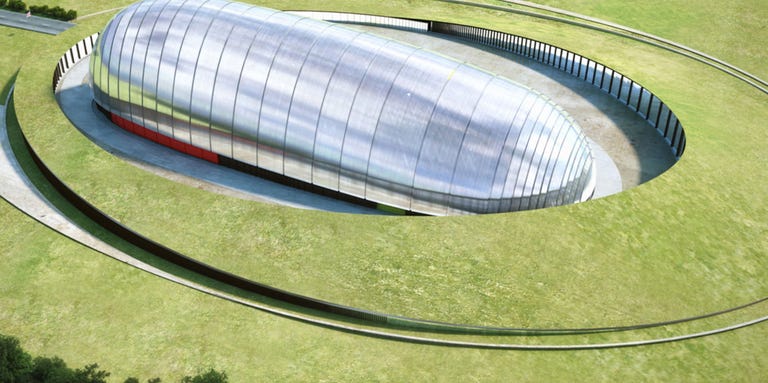
With its SMR design, which is "just one-tenth the size of a typical large-scale reactor site," a pressurized water reactor is enclosed with robust safety layers that are still far smaller in volume than the reactor space in a traditional nuclear plant. The reactor is oriented vertically, so gravity helps to move the hot and cold water around. Despite its much smaller size, the reactor will produce an expected 450 MWe, compared with 600 MWe at each of the two reactors at the existing Dungeness B plant in Kent.
Since the late 1800s, the Rolls-Royce company has engineered electronics and machinery, including engines for airplanes, automobiles, and ships. The car business—where Rolls-Royce handmakes extreme high-end luxury vehicles only—is the tip of an experimental iceberg that goes back over a century, although the company has sold off some of its more interesting arms of business in recent years.
Today, it’s pushing for SMR technology in a series of new power plants around the U.K. Rolls-Royce is known for handcrafted vehicles, but it’s worked to revolutionize tooling and manufacturing in its nitty gritty engineering arm. The company says its approach to SMRs is motivated by how modular manufacturing can save a great deal of resources and money, making cutting-edge nuclear an option even during the twilight of England’s existing nuclear plants. The last of these traditional plants will be offline by 2030.
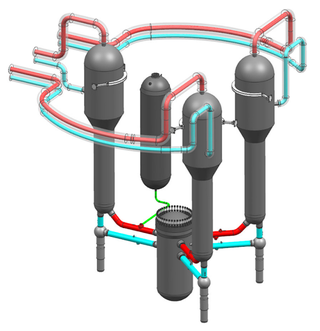
Rolls-Royce’s illustration of its Reactor Coolant System Rolls-Royce
=================================================================
By relying on predictable, relatively portable nuclear reactors, manufacturers can standardize how much these nuclear plants will cost and therefore how much the energy they make will cost, Rolls-Royce says. In the U.S., nuclear power plants are often a complex nest of tax subsidies. This is a big change from the heyday of nuclear, when plants had to incentivize to the places where they sought to build.
The predicted first two sites of Rolls-Royce SMR plants are in northern England and Wales. One site is home of an interminably delayed nuclear project, and the other a decommissioned nuclear plant. In a way, this technology is a case of the “faster spaceship” problem: Traditional nuclear projects launched sometimes decades ago are so complex and hard to finalize and pay for that a lightweight startup project can lap them many times over.
What are the advantages of an SMR plant over a traditional nuclear plant? Well, proponents say almost everything about modular reactors is an improvement. Rolls-Royce in particular says that manufacturing many small reactors at once saves money and overhead compared with “a stand-alone bespoke major project.” That, in turn, enables “a predictable programme from first concrete to commissioning in just four years, including 500 days on site for the modular build.”
Among the U.K.’s existing nuclear plants, the shortest build time was eight years and the longest was nearly 20. Rolls-Royce’s modular construction time is in line with the U.K.’s earliest (and now long-retired) original Magnox plants, which took four years each to get on the grid.
These SMR plants sit somewhere on a continuum between a traditional handmade Rolls-Royce car and an Ikea bookshelf, hopefully bringing together the best aspects of both—and with no Allen wrenches.
Submarines have the entire ocean to use for the coolant cycle, which allows for the much smaller footprint. The primary function of an atomic pile is to produce heat energy, which is then used to drive some kind of reciprocating or rotating motion, to spool up dynamos which then power the more efficient electric motors to be used to turn the propellers on the final drive. Steam is often the medium used to carry the energy to the mechanism, be it a turbine, or a swashplate, or even an older design of a reciprocating piston-driven multi-cylinder engine. It is a matter of harnessing the heat energy for the most efficient means of recovering the maximum that can be extracted before releasing the excess heat to the environment.
Thorium-fueled Molten Salt reactors are an even more adaptable design that is highly scalable, and which produce virtually no long-lived isotopes as a result of operation, and are inherently impossible to fail due to a runaway reaction and overheating, causing the “China Syndrome”, which was always a possibility with the older uranium-fueled Light Water reactors.
Nice. (grins)
What’s the fuel? Thorium?
5.56mm
Nope. What really killed the nuke industry was the giant bear paw rammed up the ass of the f'n anti-nuclear movement. The Soviets crippled the nuclear industry in the USA as a strategic measure and did it by pouring money into the protest organizations and their disinformation campaigns and tortious interference.
Thorium, plutonium, uranium, banana peels................
Pipes of Color is so millennial.
Because early adopter venture capitalists soured on the idea after losing beaucoup bucks invested in boatcar/carboat. The Amphicar!.

Chernobyl was an open air reactor. It did not have a pressurized containment vessel. It failed in part to poor design but largely due to incompetence and stupidity.
/thread hijack
Well actually it a was combination of both. I’ll leave the distribution of blame up to you.
“banana peels”
The Delorean?
5.56mm
Graphene nanotubes are the key, don’tcha know?
I’m stealing that
“the machinery always seems to wind up under the control of idiots.”
Really? There are over 400 operating nuclear power plants in the world. How many serious accidents have there been in the last 50 years? It’s safest method of power generation in the world.
You can’t overcome the human factor here.
Back at the time of the Three Mile Island accident, a TVA spokesman sought to reassure citizens about the safety of their plant, stating that each and everyone of their techs was a high school graduate.
IIRC I did a spit take upon hearing that....huh, just wondered ifvthe writers of The Simpsons based Homer's job on that news item.
Jay Leno has one of those beasts in a road car.
It sounds like RR is heading in the right direction. As an architect, I have been waiting for someone to come up with a reactor the size of a 50 gallon hot water heater with fissionable material the equivalent of a ping pong ball running a closed loop steam turbine to produce enough electricity to light and heat a standard 2500 SF home. These units would last 99 years and be encased in lead and concrete in the back yard. No more electric bills.
we put them in submarines dont we ??
—
So true
“It just needs some engineering work.”
I think larger power plants supplying a large area will always be a more efficient scheme than a bunch of smaller ones.
Disclaimer: Opinions posted on Free Republic are those of the individual posters and do not necessarily represent the opinion of Free Republic or its management. All materials posted herein are protected by copyright law and the exemption for fair use of copyrighted works.