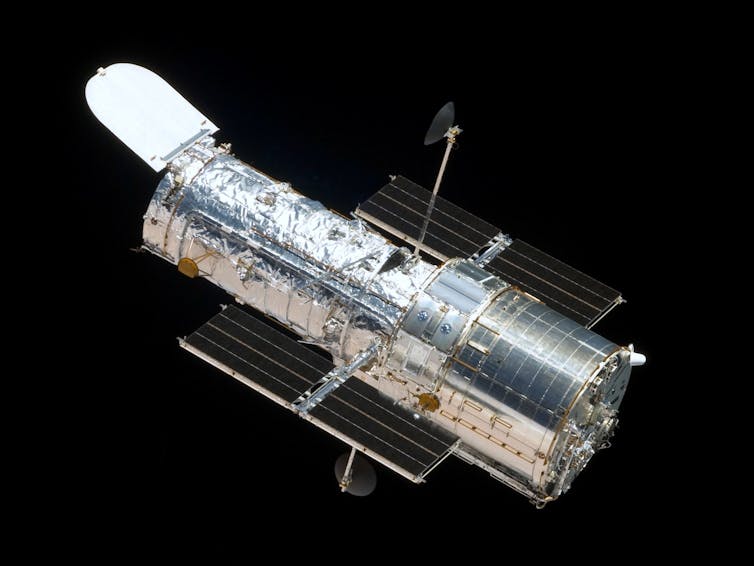
The Hubble Space Telescope as seen from the departing Space Shuttle Atlantis, flying STS-125, HST Servicing Mission 4 - Wikipedia
Posted on 08/08/2018 11:39:48 AM PDT by ETL
Next time you eat a blueberry (or chocolate chip) muffin consider what happened to the blueberries in the batter as it was baked. The blueberries started off all squished together, but as the muffin expanded they started to move away from each other. If you could sit on one blueberry you would see all the others moving away from you, but the same would be true for any blueberry you chose. In this sense galaxies are a lot like blueberries.
Since the Big Bang, the universe has been expanding. The strange fact is that there is no single place from which the universe is expanding, but rather all galaxies are (on average) moving away from all the others. From our perspective in the Milky Way galaxy, it seems as though most galaxies are moving away from us – as if we are the centre of our muffin-like universe. But it would look exactly the same from any other galaxy – everything is moving away from everything else.
To make matters even more confusing, new observations suggest that the rate of this expansion in the universe may be different depending on how far away you look back in time. This new data, published in the Astrophysical Journal, indicates that it may time to revise our understanding of the cosmos.
Cosmologists characterise the universe’s expansion in a simple law known as Hubble’s Law (named after Edwin Hubble – although in fact many other people preempted Hubble’s discovery). Hubble’s Law is the observation that more distant galaxies are moving away at a faster rate. This means that galaxies that are close by are moving away relatively slowly by comparison.
The relationship between the speed and the distance of a galaxy is set by “Hubble’s Constant”, which is about 44 miles (70km) per second per Mega Parsec (a unit of length in astronomy). What this means is that a galaxy gains about 50,000 miles per hour for every million light years it is away from us. In the time it takes you to read this sentence a galaxy at one million light years’ distance moves away by about an extra 100 miles.
The Hubble Space Telescope as seen from the departing Space Shuttle Atlantis, flying STS-125, HST Servicing Mission 4 - Wikipedia
This expansion of the universe, with nearby galaxies moving away more slowly than distant galaxies, is what one expects for a uniformly expanding cosmos with dark energy (an invisible force that causes the universe’s expansion to accelerate ) and dark matter (an unknown and invisible form of matter that is five times more common than normal matter). This is what one would also observe of blueberries in an expanding muffin.
The history of the measurement of Hubble’s Constant has been fraught with difficulty and unexpected revelations. In 1929, Hubble himself thought the value must be about 342,000 miles per hour per million light years – about ten times larger than what we measure now. Precision measurements of Hubble’s Constant over the years is actually what led to the inadvertent discovery of dark energy. The quest to find out more about this mysterious type of energy, which makes up 70% of the energy of the universe, has inspired the launch of the world’s (currently) best space telescope, named after Hubble.
Now it seems that this difficulty may be continuing as a result of two highly precise measurements that don’t agree with each other. Just as cosmological measurements have became so precise that the value of the Hubble constant was expected to be known once and for all, it has been found instead that things don’t make sense. Instead of one we now have two showstopping results.
On the one side we have the new very precise measurements of the Cosmic Microwave Background – the afterglow of the Big Bang – from the Planck mission, that has measured the Hubble Constant to be about 46,200 miles per hour per million light years (or using cosmologists’ units 67.4 km/s/Mpc).
On the other side we have new measurements of pulsating stars in local galaxies, also extremely precise, that has measured the Hubble Constant to be 50,400 miles per hour per million light years (or using cosmologists units 73.4 km/s/Mpc). These are closer to us in time.
Both these measurements claim their result is correct and very precise. The measurements’ uncertainties are only about 300 miles per hour per million light years, so it really seems like there is a significant difference in movement. Cosmologists refer to this disagreement as “tension” between the two measurements – they are both statistically pulling results in different directions, and something has to snap.
So what’s going to snap? At the moment the jury is out. It could be that our cosmological model is wrong. What is being seen is that the universe is expanding faster nearby than we would expect based on more distant measurements. The Cosmic Microwave Background measurements don’t measure the local expansion directly, but rather infer this via a model – our cosmological model. This has been tremendously successful at predicting and describing many observational data in the universe.
So while this model could be wrong, nobody has come up with a simple convincing model that can explain this and, at the same time, explain everything else we observe. For example we could try and explain this with a new theory of gravity, but then other observations don’t fit. Or we could try and explain it with a new theory of dark matter or dark energy, but then further observations don’t fit – and so on. So if the tension is due to new physics, it must be complex and unknown.
A less exciting explanation could be that there are “unknown unknowns” in the data caused by systematic effects, and that a more careful analysis may one day reveal a subtle effect that has been overlooked. Or it could just be statistical fluke, that will go away when more data is gathered.
It is presently unclear what combination of new physics, systematic effects or new data will resolve this tension, but something has to give. The expanding muffin picture of the universe may not work anymore, and cosmologists are in a race to win a “great cosmic bake-off” to explain this result. If new physics is required to explain these new measurements, then the result will be a showstopping change of our picture of the cosmos.
“The other reason is that since the laws of science break down as you approach the creation of the universe, there’s no reason to believe the first law of thermodynamics would apply.”
This also means there is no reason to believe any of their models of what might happen would apply either. You simply cannot extrapolate if you can’t assume that the conditions you are extrapolating based on will remain consistent with what you can observe or infer from experiment. Once you assume those conditions change, if you continue to extrapolate you are just fudging the model to insert whatever conditions produce the results you desire.
“Some critics say that the formation of stars and galaxies violates the law of entropy, which suggests systems of change become less organized over time. But if you view the early universe as completely homogeneous and isotropic, then the current universe shows signs of obeying the law of entropy.”
The law of entropy doesn’t really say that systems become less organized, that is just a consequence. The law actually says that the system will tend to become more homogeneous, with every point in the system tending towards the same, lowest possible energy level. If the system was already completely homogeneous to begin with, then it would require an input of energy from outside the system to change that. However, the Big Bang theory treats the universe as a closed system, with no possible outside input. So there is definitely a contradiction there. Either it can’t start out homogeneous, or it can’t be a closed system. You can’t have it both ways.
“Another related response is that space itself can expand faster than the speed of light, as space falls outside the domain of the theory of gravity.”
Well, if we are talking relativity, space is integral to the theory of gravity, since it is distortion of space itself that produces the phenomenon of gravity. However, according to relativity, space must be able to transmit gravity instantaneously, so space being able to expand faster than the speed of light should not be a contradiction.
“According to most ‘experts’, nothing.”
Maybe the universe is not expanding at all. Maybe everything is just shrinking :)
Black holes would have to not just be shrinking faster, but shrinking faster than the speed of light. That would account for why light could not escape, and why we could never observe them directly.
I want an equal number of galaxies in every universe, no excuses!!!
“But isn’t time relative depending on the observer and what is being observed?”
That’s a tricky question. Relativity assumes that there is no universal frame of reference, so there isn’t some outside place that we can measure distances (including time) based on and apply it to all the different frames that observers are seeing.
That being said, if you really start critically examining relativity, there is a strong implication in some of the results that there IS a universal frame of reference. So it may well be that there is a universal standard we could measure time based on, independent of any observers, and Einstein just made the wrong assumption.
Chuck Norris is the singularity!
There can be only one chuck Norris!
Well the singularity is already there, formed by the supernova or whatever force caused it.
Space CAN move faster than the speed of light (otherwise we could see things beyond our horizons). The event horizon is just where space starts REALLY shrinking.
Quick, Someone hire Sheldon Cooper to do the math. I can see a Nobel in my future!
It is all so confusing to me, hence I said I won't lose sleep thinking about it. After we began space flights, scientists tested the validity of Einstein's theories about time being relative depending on frames of reference. Two identical timepieces, one stayed on Earth while another was carried by astronauts on a space journey. After the astronauts landed, the two timepieces were compared and differed in elapsed time, the reality just as calculated by theory. Elapsed time was less for the fast-moving astronauts. So confusing!
“What’s the universe expanding into????”
According to this thread, the universe is expanding into a hot fresh blueberry muffin.
(post 25)
Well, it looks like i have a lot of reading to do...
Disclaimer: Opinions posted on Free Republic are those of the individual posters and do not necessarily represent the opinion of Free Republic or its management. All materials posted herein are protected by copyright law and the exemption for fair use of copyrighted works.