Posted on 09/23/2026 5:38:02 AM PDT by Red Badger
At noon on September 22, a small ceremony will take place at the foot of a bronze statue in Manhattan’s City Hall Park. A color guard will stand at attention, a wreath will be laid and most New Yorkers walking by probably will not notice.
They should.
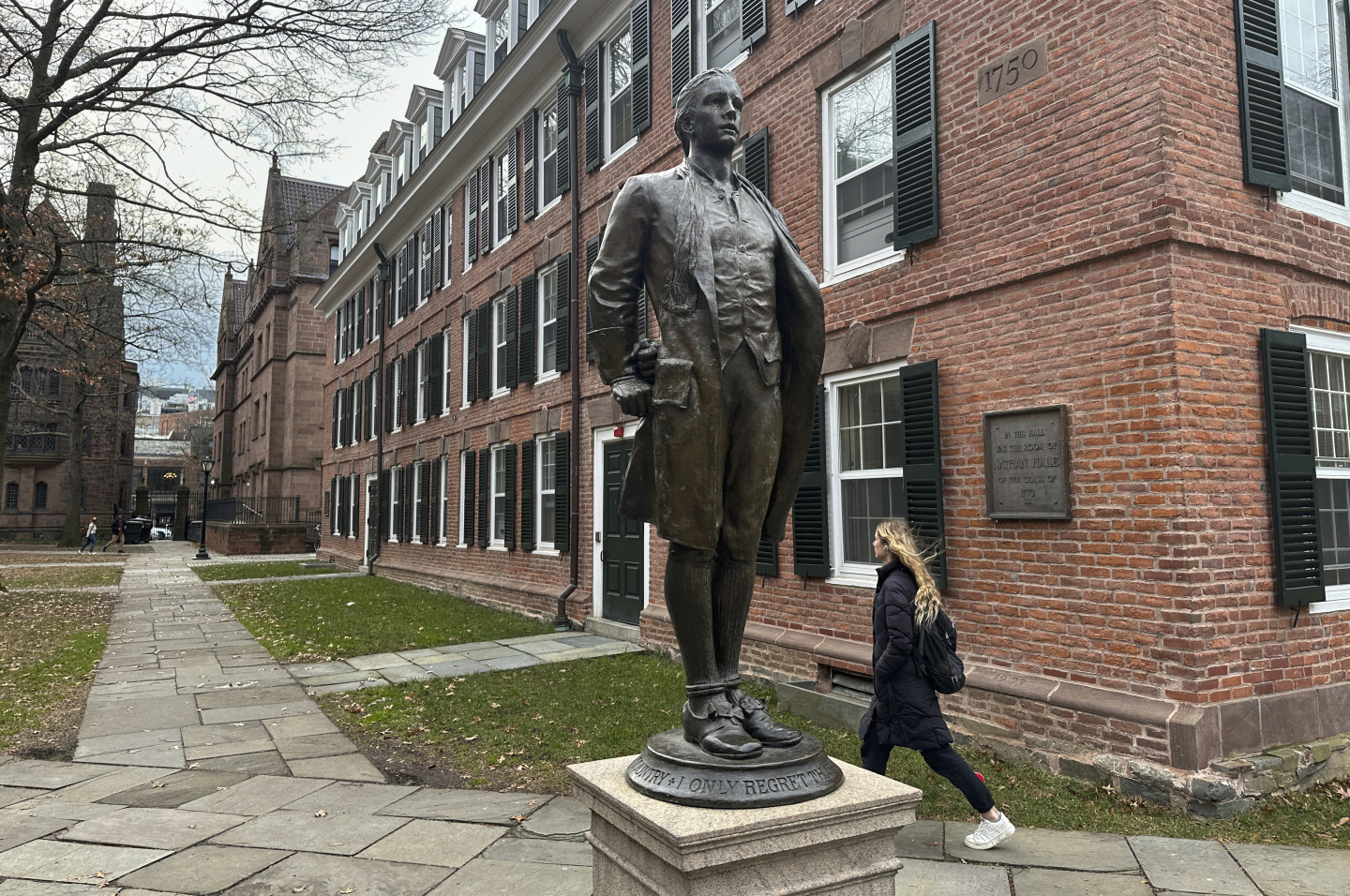
The statue is of Nathan Hale, one of America’s first spies. Two hundred and fifty years ago, the British hanged him. He was 21 years old.
Hale hardly seemed destined for spy work. He was a Yale graduate, class of 1773, and a schoolteacher from Coventry, Connecticut – tall, fair and, by contemporary accounts, somewhat guileless.
After the battles of Lexington and Concord in April 1775, Hale joined a Connecticut regiment. In the summer of 1776, he served with Knowlton’s Rangers, an elite reconnaissance unit organized under George Washington after the American defeat on Long Island.
Washington desperately needed intelligence about British troop strength and positions in New York. He asked for a volunteer to go behind enemy lines.
Hale was the only one to step forward. Friends tried to dissuade him, but he insisted on going. In mid-September 1776, disguised as a schoolmaster, he crossed Long Island Sound and entered British-held territory. He gathered information about troop deployments and fortifications, but within days his mission unraveled.
According to one account, British Maj. Robert Rogers, commander of the Queen’s Rangers, became suspicious of Hale, pretended to share his Patriot sympathies and induced him to reveal himself. Hale was arrested and brought before British Gen. William Howe.
There was no trial; A spy caught behind enemy lines and out of uniform faced execution.
The following morning, September 22, Hale was taken to the British artillery park, believed to have been near what is now Third Avenue and East 66th Street. He asked for a Bible and a clergyman. Both requests were denied.
British officer Frederick Mackenzie later recorded that Hale “behaved with great composure and resolution,” saying that he believed it was the duty of every good officer to obey the orders of his commander-in-chief and urging those around him to be prepared to meet death whenever it came.
The British orderly book was more clinical: “A spy from the enemy (by his own full confession) apprehended last night, was this day executed at 11 o’clock in front of the Artillery Park.” Far better known are the words generations of Americans have associated with Hale: “I only regret that I have but one life to lose for my country.”
Whether that was his final utterance is uncertain. The sentiment closely resembles a passage from Joseph Addison’s “Cato,” a play Hale and many of his generation knew well, and the famous formulation was recorded later rather than at the scene.
Whatever his precise words, Hale went to the gallows with remarkable calm and courage. Accounts say his body was left hanging as a warning before being buried in an unmarked grave whose location remains unknown.
When he went to the gallows, American independence was barely two months old. Washington’s army had been driven from Long Island, New York had fallen to the British and there was no guarantee that the new nation would survive. Hale gave his life not for a victorious country, but for the possibility of one.
Hale did not command an army or draft a founding document. His intelligence mission failed. But the Revolution depended on more than the famous men whose portraits now hang in museums and government buildings.
It depended on thousands of Americans – soldiers, farmers, sailors, tradesmen and, in Hale’s case, a young schoolteacher – who were willing to risk everything to secure the independence their leaders had declared.
As America marks 250 years of independence, it is worth remembering that the words of the Declaration meant little unless Americans were willing to fight and die for them.
More than a century after Hale’s death, the Sons of the Revolution gave New York the statue that now stands in City Hall Park. Its location is fitting. The young Connecticut schoolteacher faces City Hall in a town that was once under British military occupation, a reminder that the freedom New Yorkers take for granted came at a heavy price.
Nathan Hale had only one life. At 21, with his country’s future hanging in the balance, he was willing to give it. Two hundred and fifty years later, America should honor and remember that.
Michael Freund is a Visiting Fellow at The Heritage Foundation and a columnist for The Daily Signal.
A very good thread - thanks for posting.
I did not know that about his “words.” It sounds like someone might have embellished a little.
Perhaps when they sent him on his mission, someone might have trained him a bit on Op-Sec. His mouth got him in trouble. And that is too bad.
The kid had guts though.
Howe’s hard-heartedness with Hale sealed Major John Andre’s fate when he got caught conspiring with Benedict Arnold.
That type of spying was in its infancy at that time. Most armies disdained the official use of spies because it was largely considered dishonorable, even by the very people who surreptitiously used them.
They didn’t even want it known that they used spies. So, he wouldn’t have gotten any training in OpSec...his fault that, even then, he was not the right person for the job.
But he had guts, and was willing. God Bless him.
Indeed he did. Moral Courage, in spades. At 21, a Yale graduate, schoolteacher, and a man willing to die for what is right. Were there more like him today...
Washington was quite the spymaster. He understood the leveling effect that superior information regarding the enemy gave him. The proof is his Culper Spy Ring. Masterfully conducted!

And that guy (Simco) creeped me out.
I know the series deviated from the book for entertainment purposes (and thus from reality as portrayed by the author) but I still enjoyed it.
Thank you for posting this.
My home town!
Captain Nathan Hale School
Nathan Hale Soda Shop(aka”Clarence’s”)
Nathan Hale Gas
..and a couple others I probably forgot
Nathan Hale Fife and Drum Corps(I played snare drum)
And of course - Nathan Hale Monument and Nathan Hale Homestead
“Hale gave his life not for a victorious country, but for the possibility of one.”
An immensely important observation.
https://en.wikipedia.org/wiki/USS_Nathan_Hale
We need a new one.
There should ALWAYS be a major naval vessel bearing the name of Nathan Hale....ALWAYS............
How soon before the statue of Nathan Hale is torn down, deemed that of a Racist White Colonizer.
US history is not taught in US public schools - except the Howard Zinn and 1619 project version - that the U.S. was founded on White Supremacy, genocide of the Native Population ,slavery of “black bodies,” and suppression of LGBTQ and women.
I used to drive through/by Coventry frequently on Route 66. It seemed lovely and still lightly populated. I didn’t know that Connecticut’s great Nathan Hale was from that area. I wish I had stopped and visited it a time or two.
“”An immensely important observation.””
Sooo true...We look around at young people today and pray we never have to rely on them for the security of our country.
I recently finished reading Bill O’Reilly’s “Killing England”...and I learned more from it than I even remember being taught in school oh! so many, many years ago. Of course, our interests were different then than in our OLD AGE!
Before he was a celebrity and commentator, O’Reilly was a history teacher. Just wondered if you knew that.
Nathan Hale is one of my very favorites.
Demoncraps ruined it. Completely.
Disclaimer: Opinions posted on Free Republic are those of the individual posters and do not necessarily represent the opinion of Free Republic or its management. All materials posted herein are protected by copyright law and the exemption for fair use of copyrighted works.
