Posted on 07/07/2026 10:17:06 AM PDT by Red Badger
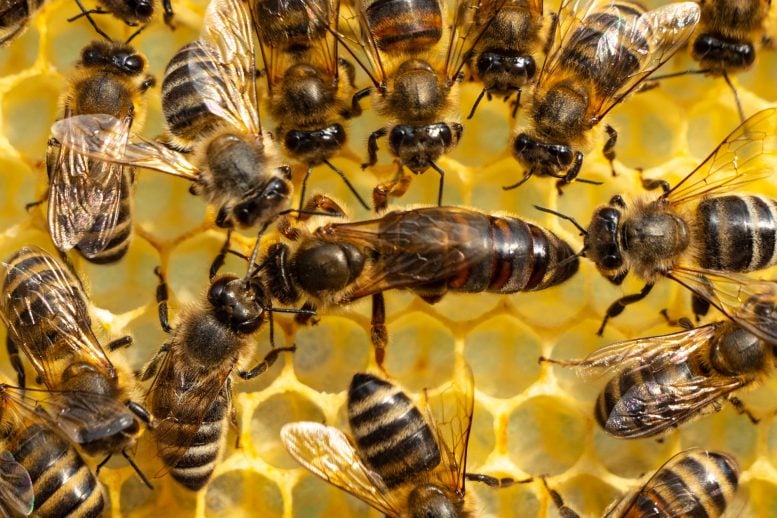
Royal jelly is only part of what makes a queen honeybee. Scientists found that worker bees build specialized “royal cribs” and work together to create the ideal environment for raising the colony’s future queen. Credit: Shutterstock
Honeybee queens are made not just by royal jelly, but by an entire colony engineering the perfect royal nursery.
For years, scientists believed the recipe for creating a honeybee queen was surprisingly simple. Feed an ordinary larva enough royal jelly, and it develops into the colony’s ruler. A new study, however, reveals that becoming a queen depends on far more than diet.
Researchers found that young worker bees build specialized nursery chambers using unique wax, maintain warmer conditions, and provide constant care, creating an environment that plays a vital role in shaping the next queen.
Specialized “Royal Cribs” Shape Future Queen Bees
Published in the journal Nature, the research shows that queen cells, sometimes called “royal cribs,” are much more than protective structures. These wax chambers are carefully engineered nurseries designed to help healthy queens develop. The team also identified a previously unknown group of young worker bees, called “queen cell builders,” that appear specially adapted for constructing and maintaining these royal chambers.
“The old idea was relatively simple: take an egg, move it into a queen cell, feed it royal jelly, and you get a queen,” said Boris Baer, entomologist and director of the Center for Integrative Bee Research (CIBER) at the University of California, Riverside, whose laboratory contributed to the work. “What we found is that there’s an entire machinery behind this process. It’s much more sophisticated than we imagined.”
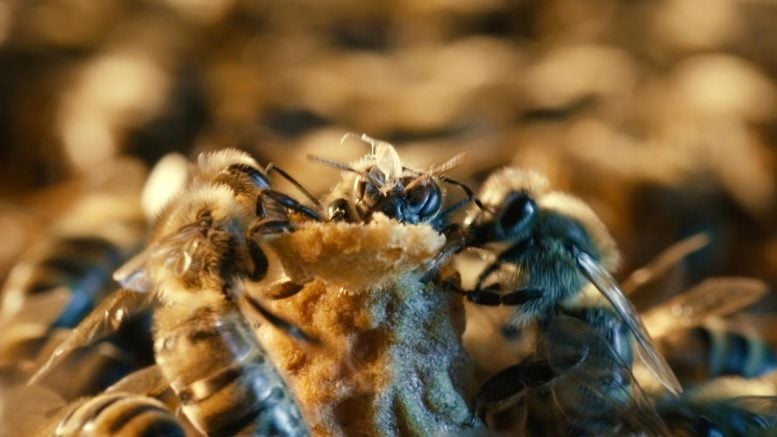
Royal Crib - Hatching queen surrounded by royal guards. Credit: More than Honey/Markus Imhoof
Honeybee queens and worker bees both begin life as nearly identical eggs. Despite those similar beginnings, queens grow much larger, develop more quickly, live far longer, and become the colony’s only egg-laying females responsible for producing future generations.
Scientists have long viewed royal jelly, the nutrient-rich substance fed to young larvae by worker bees, as the main factor driving those dramatic differences.
This study suggests that food alone cannot explain how a queen is made.
Custom Wax and Warm Nurseries Help Queens Develop
To better understand the process, the researchers combined thermal imaging, behavioral tracking, materials science, and chemical analysis. Their work revealed major differences between queen cells and the familiar hexagonal brood cells where worker bees develop.
Unlike ordinary cells, the peanut-shaped queen chambers are built from wax with distinct physical and chemical characteristics. The material is less dense, more flexible, and better at retaining heat and moisture, creating conditions that support developing queens. It also contains different fatty acids and chemical signals that contribute to what researchers describe as a specialized developmental environment.
To determine whether the nursery itself influenced development, the team raised queen larvae inside chambers made from either queen wax or ordinary worker wax. Even when both groups received the same diet, larvae raised in worker wax were more likely to die and developed into smaller queens. The results suggest that the surrounding environment is just as important as nutrition.
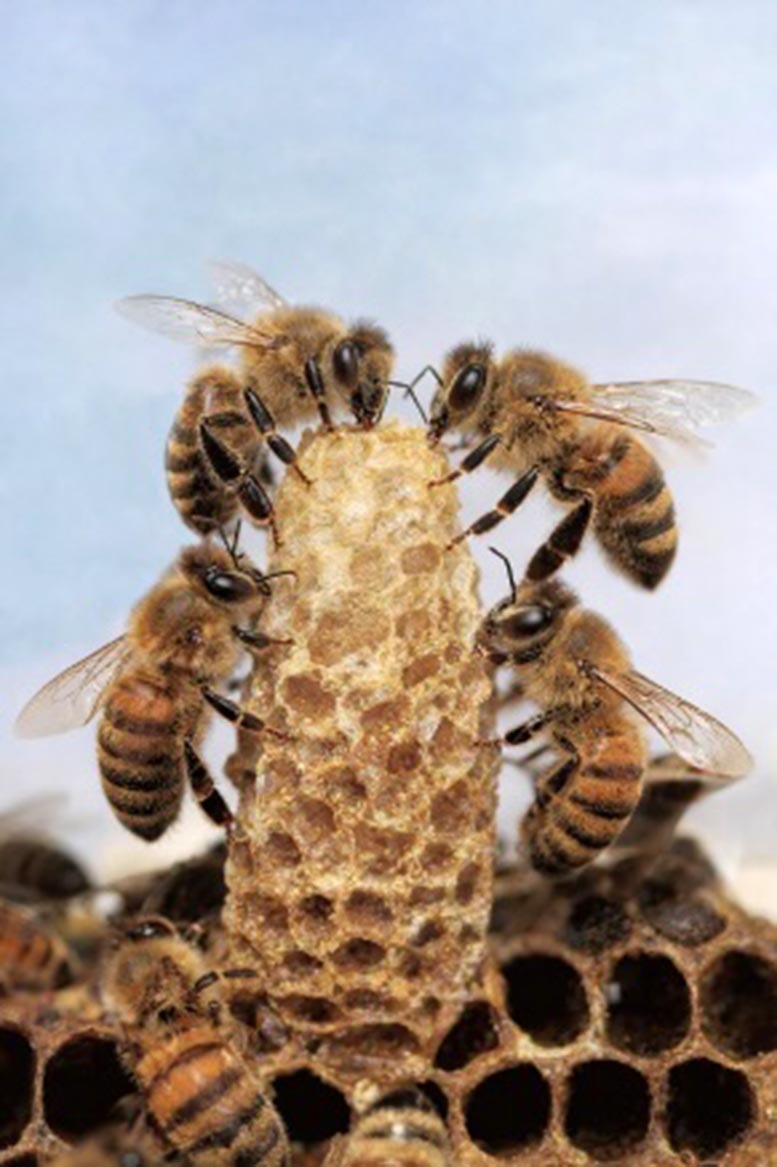
Queen Cell - A queen cell with the royal guard attendants. Credit: Fang Yu/UCR
Meet the “Queen Cell Builders”
The study also uncovered the workers responsible for creating these royal nurseries. Known as queen cell builders, these bees are generally younger than other workers and maintain unusually high body temperatures while caring for future queens. Their physiology also changes as they perform this specialized task.
The additional warmth appears to help queens develop faster. A queen bee reaches adulthood in about 16 days, compared with roughly 21 days for a worker bee, allowing a colony to replace its ruler more quickly when necessary.
Rather than simply recycling wax already present in the hive, the bees actively collect, modify, and enrich materials specifically for queen chambers. They also activate different biological pathways involved in wax production, effectively changing how their own bodies function while constructing these specialized nurseries.
The researchers even tracked how wax moved throughout the hive. By adding small amounts of graphite to ordinary honeycomb, they observed the darkened wax later appearing in queen cells. The experiment showed that worker bees deliberately gather, transport, and transform wax to build these royal chambers.
A Colony Works Together To Raise Its Queen
Baer said the process resembles a royal court far more than a simple insect nursery. Producing a queen requires an organized effort involving many members of the colony.
“You can think of it as something like Buckingham Palace,” he said. “There is a dedicated group of bees focused entirely on raising the queen, and if they don’t get it right, the colony cannot reproduce.”
The researchers observed the same behavior in both Asian and European honeybee species, suggesting this queen-making strategy evolved long ago and is deeply rooted across honeybees.
The project combined expertise in behavior, physiology, materials science, chemistry, and genomics. It was led by former UCR postdoctoral researchers Yu Fang and Yahya Al Naggar.
“In its collaborative nature, this project reflects the broader CIBER philosophy of bringing different disciplines together to tackle complex biological questions,” Baer said.
What the Discovery Could Mean Beyond Honeybees
The findings may extend beyond bees themselves. Researchers say the work could influence how scientists think about development in general by highlighting the powerful role that surroundings, social interactions, and built environments can play in shaping biology.
For decades, the story of the queen bee seemed straightforward: special food creates a special insect. This research paints a much richer picture, showing that a queen emerges through the coordinated work of an entire colony that carefully engineers the conditions needed for her development.
“This work highlights how much sophistication exists inside insect societies,” Baer said. “Honeybee colonies are not simply collections of individuals. They function as integrated biological systems capable of engineering their own environments.”
Reference:
“Queen cell architecture shapes honey bee queen development” by Yu Fang, Beibei Ma, Xiaolu Jin, Anja Buttstedt, Yahya Al Naggar, Kathy Darragh, Huafeng Tian, Yin Zhu, Guan Yang, Yiying Yang, Yuan Huang, Wanli Li, Rumeng Xu, Jianke Li, Fuliang Hu, Liming Wu, Wenjun Peng, Xiaofeng Xue, Boris Baer and Kai Wang, 3 June 2026, Nature.
DOI: 10.1038/s41586-026-10534-3

|
Click here: to donate by Credit Card Or here: to donate by PayPal Or by mail to: Free Republic, LLC - PO Box 9771 - Fresno, CA 93794 Thank you very much and God bless you. |
Regular walking every day from 15-30 minutes should help with balance issues as well. I have never fallen yet, knock on wood. My latest fad is attending Zumba class twice every week at local YMCA. I get silver sneakers card from Humana Medicare advantage and can attend exercise classes without cost.
Yes, this complex and coordinated multi-step process, dependent on highly specialized behaviors and adaptive physiology is a result of bee evolution. Riiiiight.
No — workers are sterile females; queens are fertile females; drones are males.
Check out the short story “Royal Jelly” by Roald Dahl.
When I was a kid, there was an ‘Outer Limits’ episode entitled ‘ZZZZZ’ that has haunted me ever since:
https://en.wikipedia.org/wiki/ZZZZZ
The full episode used to be on YouTube, but I can’t find it now.
Outer Limits was great! Never saw that one, though, unfortunately.
LOL. I remember them.
A lot of the episodes are on Archive.org, but the episode numbers seem to be messed up and I can’t find it there. It’s on Prime, if you have that (Season 1, Episode 18):
https://www.imdb.com/title/tt0667853/
Thanks. We do have Prime, though my wife is the one who watches TV from that.
Tell her the Outer Limits is really cool.
Aren’t God’s creations grand?
agreed on the allergies issue- might be a good way to acclimate oneself to the allergens- my bro inlaw raised honey- we’d chew the comb from time to time- was awesome tasting-
ok, thats it=- NOT taking royal jelly- ha!
His research focuses on Africanized bees?
I had never heard anything about either, so I had to look to see if the internet had any hits on the topic. The issue with allergies regarding pollen was all I could find, but they were in The Washington Compost, & The New York Slimes, neither of which I can view because they have paywalls. Besides, I try to avoid giving them any hits to begin with. 😁🤙
I just remember them taking some bee product, but I think it was for general health, not to treat any specific problem.
"Royal Jelly" is a short horror story by Roald Dahl, first published in 1959 and included in his 1960 collection Kiss Kiss. The narrative follows Albert Taylor, a beekeeper, and his wife Mabel Taylor, who are distressed that their newborn daughter refuses to feed and is losing weight. Albert devises a disturbing solution by adding royal jelly, a substance used to make queen bees grow rapidly, to the baby’s milk. The baby begins to drink ravenously and gain excessive weight, prompting Mabel to object. Albert dismisses her concerns by citing magazine articles on the substance’s nutritional value and later admits he consumed it to increase his fertility. The story concludes with a macabre twist: Mabel realizes her husband resembles a giant bee and their daughter a large grub, as Albert refers to the child as "our little queen."
The story was adapted as an episode of the television series Tales of the Unexpected in 1980, starring **Timothy West and Susan George as the couple.
I found the TV version on youtube:
Tales of the Unexpected - Roald Dahl - Royal Jelly - Susan George & Timothy West 1980
Not sure where I can find a copy of the book, though I will keep looking. Until then I willwatch the TV version. 😁🤙
If you haven't seen the TV version I highly recommend you watch it, as it is only 25 minutes.
Here's that link to the New York Slimes article:
Link provded only because I clicked on thelink, just for you 😁🤙
nytimes.com › 1988 › 08 › 27 › us › reagan-s-allergy-unchanged.html Reagan's Allergy Unchanged - The New York Times August 27, 1988 - President Reagan's allergist has determined that there has been no essential change in his sensitivity to pollen, Marlin Fitzwater...
Disclaimer: Opinions posted on Free Republic are those of the individual posters and do not necessarily represent the opinion of Free Republic or its management. All materials posted herein are protected by copyright law and the exemption for fair use of copyrighted works.