Posted on 05/07/2026 5:51:42 PM PDT by DoodleBob
…Most other nations dutifully adopted SI, changing road signs and packaging and teaching the metric system in schools. Even the United Kingdom, which had lagged for years, mostly embraced the system in an effort to keep pace with other European Union nations. (Since the U.K. left the EU, metric opponents there have argued the nation should stop using metric units, a controversial proposition that has yet to be adopted.)
Despite international adoption and increasing federal policy encouraging the use of metric units, the U.S. continued to drag its feet. Resistance was fueled in part by industrialists who argued the system was too complicated and expensive to implement, legislators suspicious of “foreign” influence, and controversies over whether wide-scale federal adoption might infringe on states’ rights.
The end result was confusion. Though the U.S. officially declared SI the nation’s preferred system through the 1975 Metric Conversion Act, even federal agencies were slow to adopt metric in industry, education, commerce, and daily life. One example is road signs: Though federal officials attempted to turn a new interstate in Arizona into an SI poster child in the wake of the Metric Conversion Act, even giving it kilometer markers instead of mileposts, transportation officials never extended metric-only signage to the remainder of the federal highway system.
…
Nonetheless, Benham still believes voluntary metrification in the U.S. is possible—and encourages individuals to look for the metric measurements that already surround them…
Ultimately, says Benham, a full transition to the metric system won’t be possible until individuals take the plunge and decide to use it in their daily lives. That’s why she focuses on education at her job—and has switched to the metric system in her daily life, setting her smartphone to measure length in kilometers instead of miles and using degrees Celsius instead of Fahrenheit.
(Excerpt) Read more at nationalgeographic.com ...
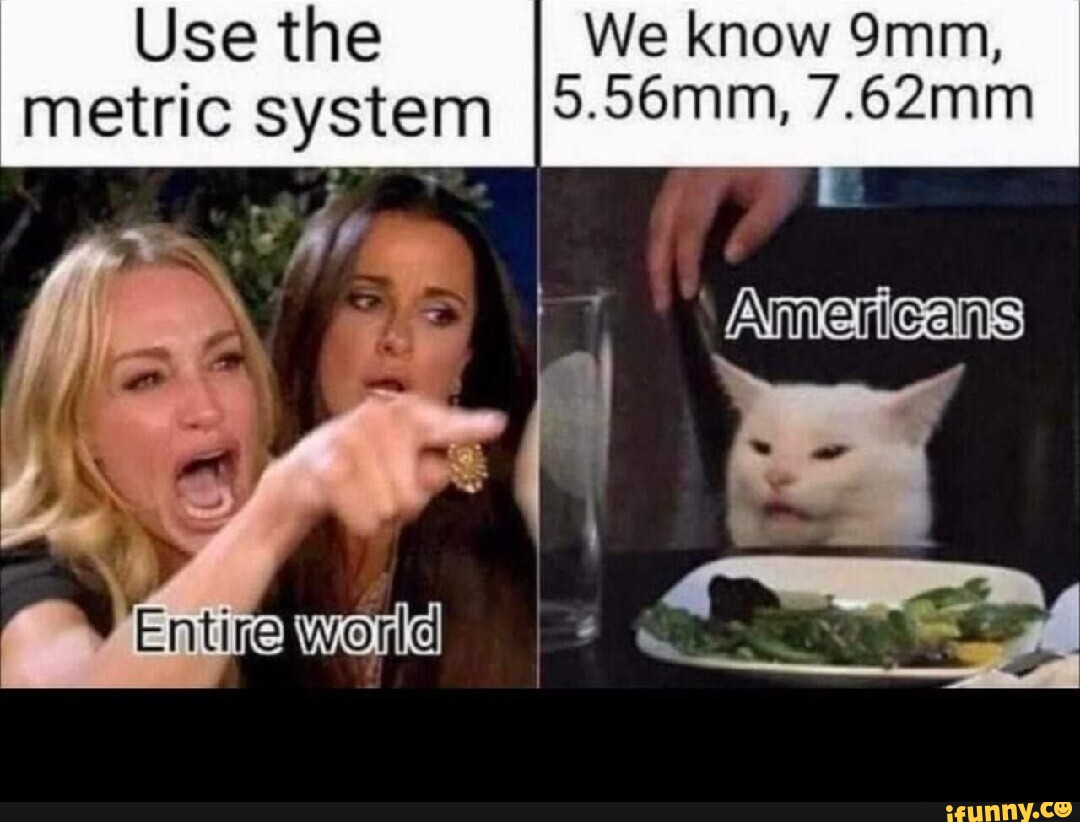
I’m fluent in both systems...9mm, etc.😀
What’s 1/5th of a foot, or 1/5th of a mile? Metric handles fifths better. Customary handles thirds better. Both systems have trouble with sevenths.
A Decimeter kind of relates to the real world... at around four inches. 3 decimeters is about a foot, a quarter decimeter is about an inch.
I don’t think Europeans could be compelled to use decimeters let alone decimeter fractions.
And yet foot and inch are four letter words, very efficient.
Insurance companies must be on this bandwagon, I’m getting weighed in kilograms in more and more drs offices. So you need a calculator to figure out how much you weigh!
What is SI? I see those letters used a few times and no one defines what that means. Do those letters stand for something, initials for words? Apparently SI is another term for the metric system.
But I’ve never heard that terminology before. And have no clue what those letters stand for.
The metric system is intrinsically inferior to standard units because it is based on an arbitrary base-ten number system. Standard units evolved using the more natural base-12 and base-16 systems that are far more divisible and practical for use as units. The metric system was an output of an anti-God French revolution and inflicted on most of Europe by the despot Napoleon and later on their colonies. Now with electronic calculators in use everywhere, the metric system’s only real advantage of easier calculations has been lost.
To me the best unit of measure is the Nautical Mile. 1/24000 of the diameter of the earth at the equator
“We have been using the Metric System in Automotive exclusively since the Mid-Eighties.”
—————
And then look what happened, everybody started losing 10 mm sockets.
What is a tenth of a foot? 1.2 inches
How much does a gallon of water weigh ? 8.34 pounds
What does 7 gallons of water weigh? 58.38 pounds
A tenth of a meter is 10 centimeters
A liter of water weighs 1 kilogram
What does 7 liters of water weigh? 7 kilograms
etc etc etc
And 1/5 portions are so amazingly common. But, oh, oops, 528 ft. Is 1/10th of a mile, so 1056ft. Is 1/5th. Really not hard - quick - what’s 1/3 of a kilometer?
You’re going to say, “sure, but who has a good feel for what 1056 ft. Is” - but you don’t have any better feel for 200m just because it has more zeroes.
I once detested it, until I had to use it.
It’s so simple and easy. l just move the decibel on many calculations.
It the worst of American jingoism to call it leftist or communist. It was a step forward in pursuit of reason.
How many jiggers are in a hogshead? That’s what it replaced.
The International System of Units, internationally known by the abbreviation SI (from its official French name, Système international d’unités), is the modern form of the metric system
At standard temperature and pressure and only for pure water- but pretty close otherwise.
How often do you weigh water? And how often pure water at STP? Just curious...
One of the arguments to use metric is that it is based on base 10 and easier to perform calculations. Ya, 299 792 458 is easy to perform calculations with. So is 9.8m/ssec2. And what is the universal gravitational constant in metric? And all measurements taken in real life are easy even 10’s. Do I need to continue?
Thanks for posting that - I have it in my photos, but no website to readily grab it from.
Oh, and that’s still true 56 years after the fact.
And we should go back to the full “Age of Reason” with 10 day weeks and 10 month years and... that all was so much more rational amd worked out so well.
Please see my tagline.
Thanks for the info.
Disclaimer: Opinions posted on Free Republic are those of the individual posters and do not necessarily represent the opinion of Free Republic or its management. All materials posted herein are protected by copyright law and the exemption for fair use of copyrighted works.