
Posted on 12/20/2025 6:02:42 AM PST by MtnClimber
It was less than three years ago — early 2023 — that I was writing about the then-universal government and industry line that electric vehicles (EVs) would soon be taking over the American car market. In April 2022 the Biden Administration had adopted aggressive vehicle mileage standards intended to be achievable only through rapid transition to EVs. Our “climate leader” states, California and New York, had then adopted regulations in August and September 2022, respectively, mandating a phase-out of sales of combustion vehicles, to culminate in 2035, after which only EVs would be allowed. In a post in January 2023, I linked to the websites of Ford and GM, where they both touted their grand plans for rapid conversion of their companies to the manufacture of mostly or entirely EVs. At that time, Ford was claiming that it would “lead America’s shift to EVs,” and would achieve 50% of its sales in that category by 2030. GM bragged about its “path to an all-electric future” by 2035.
In a post on February 23, 2023, I expressed skepticism.
It seems like all the smart people have made up their minds that the future of automobiles belongs to electric vehicles. . . . So, are electric vehicles about to sweep the country and become the dominant form of transportation? I bet against it.
Here was my reasoning:
This is just a specific instance of the general principle that it is always wise to bet against central planning of the economy. EVs may be a successful niche product for a small number of wealthy consumers, but the idea that they will fully replace gasoline powered cars in short order is the dream of central planners, who think they can implement their dream by coercion. Central planning never works, and won’t work this time either.
The past few weeks have brought a lot of news on the EV front. The short version is that even I would not have predicted how quickly and completely the EV fantasy has collapsed.
The background, of course, is that the second Trump administration took prompt steps on re-entering office to end the huge federal support that had been propping up EV sales. The large tax credit for EV purchases was ended by the One Big Beautiful Bill Act, signed on July 4 and effective after September 30, 2025. On December 3, the administration announced the roll-back of the vehicle mileage standards known as “CAFE,” to levels at which combustion vehicles can comply.
The collapse of EV sales began immediately with the end of the tax credit. On October 31, trade publication Inside EVs reported on the first month’s results after the end of the credit:
Both J.D. Power and S&P Global Mobility estimate that October's EV market share plummeted to around 5% in the U.S., from a record high of over 12% in September. The battery-powered share of sales also dropped significantly on a year-over-year basis, from over 8% in October 2024. The last time EVs made up 5% of U.S. vehicle sales was in early 2022. According to S&P Global Mobility, some 64,000 new electric vehicles were sold in October. That's an epic drop from September, when Americans bought or leased nearly 150,000 EVs as they scrambled to cash in on the expiring $7,500 incentive.
The big automakers were quick to realize that they had to do a pivot. On December 15 the Wall Street Journal reported that Ford would take a massive charge of $19.5 billion to write down its EV investments:
Ford Motor said Monday it expected to take about $19.5 billion in charges, mainly tied to its electric-vehicle business, a massive hit as the automaker retrenches in the face of sinking EV demand. The sum is among the largest impairments taken by a company and marks the U.S. auto industry’s biggest reckoning to date that it can’t realize its electric-vehicle ambitions anytime soon.
The $19.5 billion is in addition to some $13 billion of operating losses that Ford has incurred over the past 3 years trying to compete in the EV business, even with the huge government subsidies:
Ford . . . has lost $13 billion on its EV business since 2023. . . .
Over at GM, the write-down is smaller, but the change of direction is no less stark. From NBC News, October 16:
On Tuesday, General Motors reported it was taking losses totaling $1.6 billion related to planned changes to its EV rollout. The company attributed some of the change to President Donald Trump’s elimination of the $7,500 in EV purchasing incentives enacted by President Joe Biden.
Nor is the collapse of EV sales limited to Ford and GM. From the NBC piece, as to Tesla:
Plunging sales at Tesla — still the U.S. leader in EV sales — are also contributing to the weakening outlook. Its second-quarter sales dropped almost 13%, and CEO Elon Musk has warned of some “rough quarters” ahead for the company.
And a comparable phenomenon is occurring in other countries, although under differing regulatory and policy regimes. From the Wall Street Journal, October 14:
The Rest of the World Is Following America’s Retreat on EVs. Canada, U.K. and European Union back off electric-vehicle targets as economic reality sets in and even China shows cracks. . . . Carmakers argue the EV business model is an unprofitable proposition given still-high battery costs, spotty car-charging networks and dwindling government subsidies. Incentive programs have ended or have been pared back across Europe and in the U.S. and Canada.
Let’s face it, this was always ill-conceived central planning, and it was never going to work. I went back to the links that I had included to the Ford and GM websites in my January 2022 post. Both links remain active, but the excited talk about leading the way to an all-EV future has been scrubbed from both. Instead, if you go there, you will find, in the case of GM, further links to follow if you want to buy yourself an EV; and in the case of Ford, general news about the company. Reality has returned.
Another communist dream bites the dust.
The charging stations and the electric power infrastructure are totally missing.
Many EV owners also own a hybrid car, or a normal internal combustion engine car, as well.
Is your daughter hedging her EV bet in this way?
I’ve been driving cars for 65 years. I love them.
I now drive a Tesla Model 3. It is by far the most fun to drive, among all American brands, Porsches, Audis and Japanese cars I’ve owned. FSD is the future.
The politicians were stupid to try to accelerate EV adoption. But I believe it is inevitable over time.

Just like the AMC Pacer, fat liberal women love this for the same reason. They identify with it.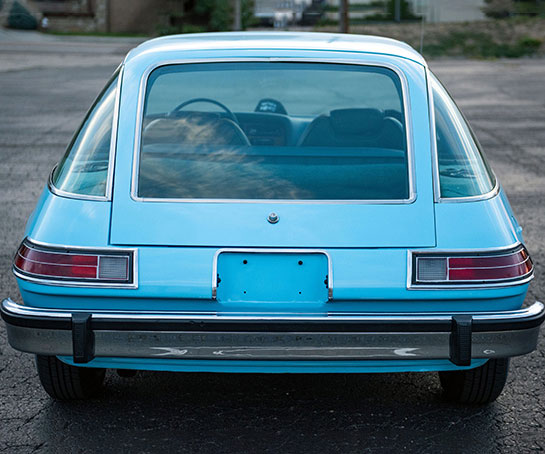
Also, you get into an accident with one of those things, anything more than a relatively minor fender bender, and you have to replace the battery. If the airbags deploy, definitely, I would think. Last I heard, the technology does not exist at any level yet that would allow a battery to be serviced by testing all the cells and replacing any out-of-spec cells while the vehicle is being repaired.
I may be behind the the times on that, but it was last I looked at it. Which means you have to spend anywhere from $10-20K. That's steep. And all the environmental stuff.
But the biggest impediment is infrastructure. I think they had the mindset that if they build the cars, the infrastructure would come. People think of that solely in terms of charging stations, but it is far more than that. None of the behind-the-scenes things like upgrading the energy grid, with more transmission capability and more energy generation have even remotely been done, not to mention things like upgrading homes, motels, hotels, and every other thing under the sun to allow cars to charge. If you stay at a motel, you rightly expect to be able to charge overnight.
And there is the fire hazard. The first time there is a EV fire on a ferry or under a high rise that results in a loss of life with lawsuits, ferries will ban EV's, and insurance (and rents payments for apartment buildings will go up)
I am not against EV technology. From a practical, hands-on driving experience perspective, high torque, quietness, I think it is great. This is an EV you can buy for $200K+, and it is beautiful, has an insane 0-60, but only goes 200 miles on a charge:
Not in the least practical, but if I could own one to drive on Sundays...I would.
But like most things, when it is mandated by government, IT IS GOING TO FAIL, AND FAIL BADLY.
Especially when it is being mandated by government to address a hoax like Climate Change.
The Wrong Thing for The Wrong Reasons.
“ Technology doesn’t make them feasible yet.”
This has been said about EV’s since about 1900.
I took my 2008 Silverado in for an oil change yesterday. The guy asked me the basic questions. I told him that “Sylvia” has been very good to me for over 18 years and I asked him to take good care of her. He snickered and smiled and said you have a name for her? Yes, I do. She is the lady that I rely on everyday.
Technology doesn’t make them feasible yet
______________________
Probably never will.
Kind of simple physics.
Gas engines has been optimized to the degree that they are pretty close in efficiency to the power generators.
Electricity distribution (wires) are expensive and will always have loses.
Charging times will always be longer than buying gas (physics!)
And batteries are probably not going to be really light ever.
In physical terms, EV uses a lot more energy than Gas.
It take energy to generate electricity, energy loss in transmission, battery loss in charging, discharging,
EV engine loss, and all the energy needed to carry those heavy batteries around!
It is just that we do not see the energy in EV.
We see gas, but electricity somehow appears in the jack, not seen, not emitting.
And gas is heavy taxes, while electricity is subsidized.
So people may see savings where there are none, just by gov actions.
Government! Please, do not try to fight Physics!
Laws of Physics (God laws) trump any Government laws!
I don’t have a problem with EV’s. I have a problem with the government mandates. If the electrical grid capacity grows to support it and if the vehicles can be sold without subsidies then the adoption will happen through market forces.
As would many others, myself included. I’ve been looking at new vehicles lately. Holy smokes! The tech and convenience features are flat-out overwhelming. It’s a pipe dream, but one can wonder: Is there a market for a much lower cost version of some vehicles? As little tech as possible to keep them running reliably (achieved decades ago), just bare bones with all the advantages of modern suspensions, brakes, and safety features. Something that doesn’t email me when one of my tires is low, for example (this recently happened to me with a 2024 vehicle...).
As someone once pointed out, owner’s manuals used to include procedures for normal maintenance, like adjusting carburetors and valves. Today, the manuals begin with a warning to not drink coolant...
You have cars that can only go max 300 or so miles, most much less, before having to charge for up to 4-5 hours, again most much longer for a full charge. Then you decide to close as many fossil fuel power plants as possible and replace them with unreliable wind and solar to produce the energy to charge said cars. What could possibly go wrong. Only a moron with no understanding of how the real world works or government bureaucrats pushing an agenda would buy that scenario as doable.
Absolutely! Batteries store energy for use at a later time. Gasoline produces energy when burned. The first problem to be solved is abundant and reliable generation and distribution of electricity. More than than, there are great expanses of road where charging stations are out of the question. Then there are those places without roads or power lines.
The EV might one day be good for use within cities; however, they will never be useful "out there".
...and don't eat the tools.
They’ll still have a market where charging is easy and routine and trips are short, such as urban single family homes where charging takes place in garages. In these situations, they’ll sell themselves without the help of compulsion or subsidization. I think even Trump recognizes this.
I started telling people during the gas crisis of the 70’s that they way to go was a small ICE powerplant used as a generator not a motivator. And that it’s only purpose should be to run when necessary to charge the batteries. With that setup you could drive on electricity forever as long as you kept some gas in the tank to produce said electricity. Nobody listened. They are listening now. A couple of auto makers Scout and Ford are looking to offer that setup in the trucks and SUVs.
The states sure can, if they want to keep all people from other states out of their state. It would be suicide.
“Refuel in 5 minutes or less, drive 4 hundred miles or more without fear of not being able to refuel. Try that with an EV.“
Getting 400 miles worth of range in 5 minutes is the kill shot for EV’s. No EV at any price can even approach it. Not everyone needs that many if not most do.
For most people EVs aren’t practical due to cost and range issues. Ford pushing an EV pickup was particularly a bad decision. While many pick up owners use their trucks mostly as a regular car, they also tow boats, trailers and campers or haul large or heavy items. Pickups are also the mainstay for small businesses, farmers and ranchers. EV versions of pickup trucks are totally unsuited for these purposes. The EV Mustang was also a non starter for customers. It was only government mandates and subsidies that moved a small EV market, not meeting the wants and needs of the market.
Disclaimer: Opinions posted on Free Republic are those of the individual posters and do not necessarily represent the opinion of Free Republic or its management. All materials posted herein are protected by copyright law and the exemption for fair use of copyrighted works.