Skip to comments.
Iranian Regime tv Channel One hacked while it was airing Khamenie speech
various
| 10-8-22
Posted on 10/08/2022 1:05:38 PM PDT by nuconvert
Iranian Regime national tv Channel One hacked about an hour ago. During a broadcast of Khamenie speech, a red crosshair appeared over his face and chanting of Women. Life. Freedom. There was writing to the side saying "Rise up. Join us". Also 4 photos at the bottom of the screen of young people killed and additional writing: "The blood of our youth is dropping from your paws".
Also, there was a huge banner in the middle of Tehran highway today that read: We are no longer afraid of you. We will fight.
Also, attempted attack on IRI ambassador in Denmark. Her bodyguard was stabbed. Diplomatic Security intervened before the attacker could stab the ambassador.
TOPICS:
KEYWORDS: basij; deathtothemullahs; denmark; ebrahimrigi; erdogan; iran; iranprotests; iraq; irgc; iri; israel; khameini; khamenei; kurdistan; lebanon; mahsaamini; mullahloversonfr; mullahsmustbekilled; najisharifizindashti; protests; qudsforce; raisi; receptayyiperdogan; shahrammaroufmola; syria; turkey; yemen; zahedi
Navigation: use the links below to view more comments.
first previous 1-20 ... 1,961-1,980, 1,981-2,000, 2,001-2,020 ... 2,461-2,478 next last
26APR2026 Pakistan has notified six routes for the transportation of goods to Iran against an encashable bank guarantee amid reports that thousands of containers destined for Iran are awaiting clearance at Pakistani ports.
For this to come into force, the Ministry of Commerce has issued a statutory regulatory order, Transit of Goods through Territory of Pakistan Order 2026.
According to the order, following routes have been designated for the transit of goods:
Gwadar-Gabd
Karachi/ Port Qasim-Lyari-Ormara-Pasni-Gabd
Karachi/ Port Qasim- Khuzdar-Dalbandin-Taftan
Gawadar-Turbat-Hoshab-Panjgur-Nagg-Besima-Khuzdar-Quetta/ Lakpass-Dalbandin-Nokundi-Taftan
Gwadar-Liari-Khuzdar-Quetta/ Lakpass-Dalbandin-Nokundi-Taftan
Karachi/ Port Qasim -Gwadar- Gabd
https://www.dawn.com/news/1995253
1,981
posted on
05/02/2026 3:10:24 AM PDT
by
AdmSmith
(GCTGATATGTCTATGATTACTCAT)
To: AdmSmith; blitz128; BeauBo; nuconvert
1,982
posted on
05/02/2026 3:19:20 AM PDT
by
gleeaikin
(Question Authority: report facts and post their links" in your messages.)
Iran Update Special Report, May 2, 2026
Iran does not appear to have altered its negotiating position over the management of the Strait of Hormuz and its nuclear program in its latest proposal. Some elements of the Iranian regime may calculate that Iran can impose sufficient economic and political costs on the United States to coerce the United States to make concessions. Two senior Iranian officials told the New York Times on May 1 that Iran's new proposal, which Iran submitted to the United States via Pakistani mediators on April 30, removed a previous condition that required the United States to lift its naval blockade on Iranian ports before Iran and the United States could begin negotiations.[1] Iran's proposal also reportedly states that Iran is willing to “open” the Strait of Hormuz before the United States announces an end to its blockade.[2] Iran similarly offered to “open” the strait in its previous proposal on April 26, but caveated that it would charge vessels a toll to transit through the strait.[3] Iranian officials have not publicly indicated that the regime will abandon its proposed toll scheme. Supreme Leader Mojtaba Khamenei stated on April 30 that Iran will impose a “new management” in the strait that will reap “economic benefits” for Iran, for example.[4] Iran's latest proposal also pushes discussions over nuclear issues to a later stage, similar to Iran's April 26 proposal.[5] ISW-CTP previously noted that any proposal that pushes nuclear negotiations to a later stage would not force Iran to make concessions regarding its highly enriched uranium (HEU) stockpile or ability to enrich uranium up front, but would rather grant Iran more time to engage in talks about these issues.[6] US President Donald Trump expressed dissatisfaction with Iran's revised proposal on May 1.[7]
Iranian Armed Forces General Staff-run Defa Press argued on May 2 that the war between the United States and Iran has shifted from a direct conflict to a conflict focused on the “imposition of costs.”[8] Defa Press argued that “patience” will be one of the “ultimate determinants of victory,” which suggests that some elements of the regime may be willing to endure the United States’ economic and military pressure while simultaneously imposing economic and political costs on the United States to try to pressure the United States to soften its negotiating demands.
Senior Iranian military and security officials have also expressed pessimism about the prospects for compromise between Iran and the United States. Khatam ol Anbia Central Headquarters Coordination Deputy Brigadier General Mohammad Jafar Asadi and an Iranian security official speaking to Agence-France Presse (AFP) both described renewed military conflict between Iran, the United States, and Israel as “likely” and emphasized that Iranian armed forces remain on full alert.[9] The Khatam ol Anbia Central Headquarters is responsible for joint and wartime operations.
Iran is taking steps to try to withstand the US naval blockade. Iran has begun reducing its oil production as its storage capacity reaches its limits, according to a senior Iranian official speaking to Bloomberg on May 2.[10] Iran is likely reducing oil production rather than halting it because shutting down oil production could cause significant damage to Iranian oil fields.[11] Pentagon officials told Axios on May 1 that 31 tankers carrying roughly 53 million barrels of Iranian oil, worth at least $4.8 billion USD, remain in the Persian Gulf because of the US naval blockade on Iranian ports.[12] The United States has simultaneously expanded economic sanctions to deepen Iran's isolation and restrict its access to energy markets and financial channels.[13]
Hezbollah may be domestically producing first-person view (FPV) drones. Hezbollah posted footage on May 2 showing Hezbollah fighters domestically producing drones, but it is unclear if the drones in the video are FPV drones.[14] Hezbollah's video comes after an Israeli military official told the Associated Press on April 30 that Israel believes that Hezbollah is domestically manufacturing FPV drones.[15] The official noted that FPV drones are relatively easy to produce and require minimal additional parts compared to non-FPV drones.[16] Hezbollah has had the ability to domestically produce drones since at least 2011, and prioritized domestic drone production following the Fall 2024 conflict.[17] Israeli media also reported on May 1 that Israel Defense Forces (IDF) Chief of Staff Lieutenant General Eyal Zamir instructed the IDF to target Hezbollah's FPV drone production and supply chain infrastructure “beyond southern Lebanon.”[18]
https://understandingwar.org/research/middle-east/iran-update-special-report-may-2-2026/
1,983
posted on
05/03/2026 2:31:47 AM PDT
by
AdmSmith
(GCTGATATGTCTATGATTACTCAT)
02MAY2026: Ahmad Vahidi: Commander-in-Chief of the IRGC
Vahidi became Commander-in-Chief of the IRGC following the opening US/Israeli strikes of Operation Epic Fury on February 28, 2026, which killed former Commander-in-Chief of the IRGC Mohammad Papkour. Vahidi is known to be one of the figures who pushed strongly for Mojtaba Khamenei’s appointment as Supreme Leader following his father’s death, and has said to be blocking attempts by President Masoud Pezeshkian to appoint a new intelligence minister following the Israeli strike that killed Esmail Khatib on March 18th, 2026. Vahidi also reportedly pressured Pezeshkian to name Mohammad Bagher Zolghadr as Secretary of the Supreme National Security Council (SNSC).
Vahidi’s greater credibility across the IRGC and broader significance within the security establishment makes him far more significant as a decision maker in the post-Ali Khamenei era of governance than publicly suggested. All scholarship points to Vahidi being a fundamentalist who believes in the path of resistance above all else, and further militarization of the Islamic Republic of Iran. Vahidi was believed to have unsuccessfully pushed for Zolghadr’s inclusion in the delegation headed to Islamabad for recent talks with the United States led by Vice President JD Vance. Vahidi allegedly received pushback from the leaders of the delegation, Araghchi and Ghalibaf, who pointed to Zolghadr’s lack of diplomatic experience. Vahidi is reportedly liaising directly with Mojtaba Khamenei, excluding other senior officials who have not been able to meet with the new Supreme Leader. This positions Vahidi as one of the most powerful actors on the Islamic Republic’s political stage today.
https://www.unitedagainstnucleariran.com/ahmad-vahidi-commander-chief-of-irgc
1,984
posted on
05/03/2026 2:55:11 AM PDT
by
AdmSmith
(GCTGATATGTCTATGATTACTCAT)
To: nuconvert
Iran’s original proposal: “The war ends, US leaves, we control Hormuz, we don’t give up uranium enrichment” Iran’s new proposal: “We don’t give up uranium enrichment, we control Hormuz, US leaves, the war ends.”
https://x.com/DrEliDavid/status/2050708944478191744
Islamist and IRGC thugs that are in charge are begging for Suicide by Trump. Like those movies where the bad guy looks up at the barrel of a gun and says “finish it.” Also, the guy supposed to be in control- Vahidi- has not been heard from in over a week. Is he even alive?
https://x.com/linton158379/status/2050730294328557895
1,985
posted on
05/03/2026 3:04:42 AM PDT
by
AdmSmith
(GCTGATATGTCTATGATTACTCAT)
Danny Citrinowicz - Previously, he served as the head of research and analysis for Iran in the Israel Defense Forces’ intelligence unit.
After 39 Days of War, Iran Thinks It’s Winning
Reading Iran’s latest proposal, one conclusion is hard to avoid: after 39 days of war, Tehran believes it has the upper hand.
This is not a document from a regime under pressure or seeking an exit. It is a proposal from a government that sees the war as an opportunity to reshape the strategic landscape in its favor. Iran is not just asking for an end to hostilities, it is demanding guarantees against future attacks, along with compensation and a structured mechanism to secure it, rooted in its leverage over the Strait of Hormuz. That strait, it is worth recalling, was open before the war began.
Even more troubling is what the proposal does not prioritize. The nuclear issue, ostensibly a central justification for the conflict, is largely deferred. A comparison between Iran’s current terms and its prewar proposal reveals minimal substantive differences, aside from a willingness to extend the duration of a nuclear freeze. Meanwhile, the most effective tool of pressure on Tehran, the maritime blockade, is expected to be lifted before serious nuclear negotiations even begin.
This puts Washington in a bind.
...
Iran’s proposal sends a clear message: it does not intend to concede. The harder question is what Washington intends to do about it.
read more https://x.com/citrinowicz/status/2050958865710432471
and How the War Saved the Iranian Regime
The Unintended Consequences of the U.S.-Israeli Assault
https://www.foreignaffairs.com/iran/how-war-saved-iranian-regime
1,986
posted on
05/03/2026 10:48:40 AM PDT
by
AdmSmith
(GCTGATATGTCTATGATTACTCAT)
Iran Update Special Report, May 3, 2026
Iran's counterproposal to the United States reportedly includes a three-phase plan that seeks to quickly end the war, guarantee no future combined force strikes on Iran, and address the Strait of Hormuz in the first phase, while delaying talks on Iran's nuclear program to a second phase. US President Donald Trump expressed doubt on May 2 that the proposal “would be acceptable.”[1] Al Jazeera, citing unspecified sources, reported on May 3 that Iran's counterproposal to the United States comprises three phases.[2] The first phase includes a “complete end to the war” within 30 days, a mutual “guarantee of non-aggression” between the United States, Israel, Iran, and the Axis of Resistance, anend to the US blockade on Iranian ports in exchange for the “reopening” of the Strait of Hormuz, compensation for Iran “in a new and innovative format,” and the complete withdrawal of US forces from Iran's “maritime perimeter.”[3] It is unclear whether the compensation clause refers to Iran's demand for war reparations or Iran's proposal to establish a toll scheme in the Strait of Hormuz. Iran included a plan to charge vessels that transit through the strait a fee in its previous proposal on April 26.[4] Supreme Leader Mojtaba Khamenei stated on April 30 that Iran will impose a “new management” in the strait that will reap “economic benefits” for Iran, likely referring to the toll scheme.[5] An Iranian media outlet affiliated with former Supreme National Security Council Secretary Ali Shamkhani similarly reported on May 2 that Iran's counterproposal includes “a new mechanism” for the Strait of Hormuz.[6] Islamic Revolutionary Guards Corps (IRGC)-affiliated media separately reported on May 2 that the Iranian Parliament plans to approve a 12-point plan that would place restrictions on which ships are allowed to traverse the Strait of Hormuz.[7] Ships belonging to “hostile countries” would be required to pay war reparations to Iran in order to pass through the strait under this plan.[8]
The second phase of Iran's proposal reportedly includes negotiations between the United States and Iran about Iran's nuclear program.[9] Iran appears to be offering the possibility of discussing nuclear issues at a later date in order to push the United States to end the war and lift its blockade on Iranian ports. Iran does not appear to have made any firm commitments to make concessions regarding its nuclear program in its latest proposal, however. Axios reported on May 2 that Iran would agree to conduct a month of nuclear negotiations if the United States and Iran reached an agreement regarding the Strait of Hormuz and an end to the war in the next month, citing two sources briefed on the proposal.[10] Al Jazeera reported that Iran offered to “discuss the idea” of pausing uranium enrichment for “up to 15 years,” which is longer than previous Iranian proposals to pause enrichment for up to five years.[11] The Iranian proposal also posits that Iran could enrich up to 3.6 percent after the pause ends.[12] The 2015 Joint Comprehensive Plan of Action previously allowed Iran to enrich up to 3.67 percent.[13] President Trump has previously indicated that he would not accept a pause in enrichment and instead seeks for Iran to permanently suspend enrichment.[14] The proposal also states that Iran would be willing to “discuss the fate of” Iran's highly enriched uranium (HEU) stockpile, with possible options including transferring the stockpile abroad or diluting it.[15] The United States has demanded that Iran hand over its HEU stockpile.[16] The proposal also insists that Iran will not dismantle any of its nuclear facilities.[17] The proposal emphasizes the need for sanctions relief for Iran in exchange for Iran's nuclear “concessions.”[18] The Wall Street Journal similarly reported on May 1 that Iran's proposal “calls for discussing the issues around Iran's nuclear file in exchange for US sanctions relief.”[19] Iranian Foreign Affairs Ministry Spokesperson Esmail Baghaei insisted on May 3 that Iran's 14-point counterproposal is exclusively focused on ending the war and does not address nuclear issues.[20]
Baghaei announced on May 3 that the United States has responded to Iran's counterproposal and that the Iranian regime is reviewing the United States’ response.[21] President Trump previously stated on May 1 that he was “not satisfied” with the Iranian counterproposal.[22]
The IRGC Navy likely attacked a vessel in the Strait of Hormuz on May 3, likely to sustain high shipping costs and oil prices to pressure the United States to make concessions.[23] United Kingdom Maritime Trade Operations (UKMTO) reported that multiple small craft attacked a vessel—likely the Liberian-flagged, Greek-owned Minoan Falcon—11 nautical miles west of Sirik, Hormozgan Province, Iran.[24] The vessel sailed northbound through the Strait of Hormuz before it abruptly turned south, likely due to the attack.[25] UKMTO confirmed that the vessel's crew members are safe.[26] The IRGC Navy previously attacked and likely redirected two Greek-owned vessels toward Iran on April 22.[27] CTP-ISW assessed on May 2 that some elements of the regime may be willing to endure the United States’ economic and military pressure while simultaneously imposing economic and political costs on the United States to try to pressure the United States to soften its negotiating demands.[28]
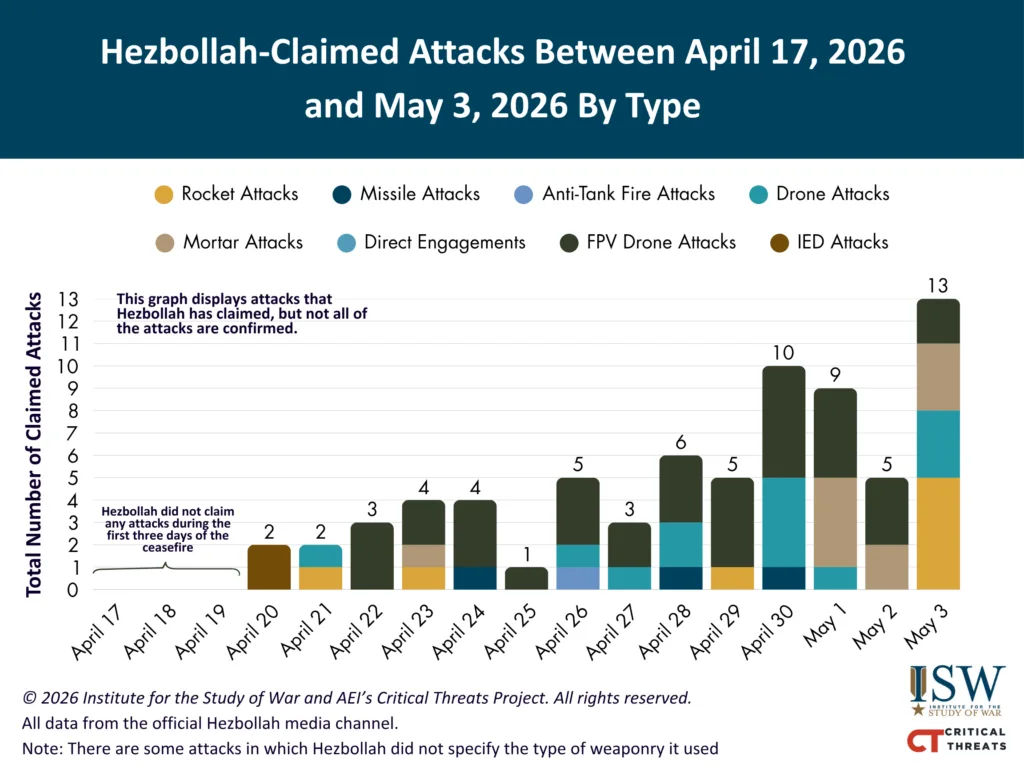
Hezbollah has continued to claim attacks, including first-person view (FPV) drone attacks, against Israeli forces in southern Lebanon.
https://understandingwar.org/research/middle-east/iran-update-special-report-may-3-2026/
1,987
posted on
05/03/2026 10:30:28 PM PDT
by
AdmSmith
(GCTGATATGTCTATGATTACTCAT)
To: nuconvert; gleeaikin
Iran's Revolutionary Guards navy unveiled a new map on Monday showing what it described as the Strait of Hormuz area controlled and managed by Iran's armed forces.
It said the area extends from a line between Kuh-e Mobarak in Iran and south of Fujairah in the UAE, and from another line between the end of Iran's Qeshm Island and Umm Al Quwain in the UAE. It was not immediately clear whether or how much their claimed area of control had changed.

https://x.com/IranIntl_En/status/2051227968119160911
1,988
posted on
05/04/2026 2:59:24 AM PDT
by
AdmSmith
(GCTGATATGTCTATGATTACTCAT)
The Telegraph: From great power to rogue state: how the ayatollahs ruined Iran
Within living memory, Tehran ruled an oil-rich great power brimming with intellectuals inspired by British democracy. So how did it become an impoverished rogue state at war with the West?
Ali Ansari, professor of Iranian history at the University of St Andrews, takes Roland Oliphant through Iran’s tumultuous modern era: from the 1906 Constitutional Revolution and the 1953 coup, to the 1979 ousting of the shah and the 2026 US assassination of Ali Khamenei.
https://www.youtube.com/watch?v=3iL1FcSXIds
1,989
posted on
05/04/2026 5:03:45 AM PDT
by
AdmSmith
(GCTGATATGTCTATGATTACTCAT)
To: AdmSmith; BeauBo; dennisw; blitz128; PIF; nuconvert; Jonty30; BroJoeK; MalPearce; USA-FRANCE; ...
I just viewed the first 15 minutes of this almost 50 minute video, and plan to return to it later for the rest. This is the second installment continuing a previous history of Persia/Iran through the rise of Islam. Several centuries are skipped and this chapter begins by discussing Persia’s struggle to balance relations between England and Russia in the 1800s and 1900s. Persians visited England in the 1800s and were impressed especially with the economic/industrial development and their efforts to create a nation composed of multiple ethnic groups—Scotch, Irish, Welsh, and English.
Around the time of the 1906 Constitution, an agreement was signed to divide areas of Iran into a British area in the south, and a Russian area in the north. Britian got the poor end of the deal, but soon had discovered oil which promising many future events, so I come here to encourage you all to learn more about how Iran arose to be a major Middle East power. [The British home office was so angry about the agreement signed by their people on the ground, it makes me wonder if the Russians had already begun their efforts to create spy’s and agents within the British government. This was a tense period with Russia also engaged in a war with Japan.]
1,990
posted on
05/04/2026 10:12:38 AM PDT
by
gleeaikin
(Question Authority: report facts and post their links" in your messages.)
To: gleeaikin
If you're not already aware of it, you should look into the history of Purim and the ancient bond between the Persians and the Jews.
The current hostilities began on Purim.
-PJ
1,991
posted on
05/04/2026 10:39:35 AM PDT
by
Political Junkie Too
( * LAAP = Left-wing Activist Agitprop Press (formerly known as the MSM))
To: nuconvert; gleeaikin; BeauBo
Iran Update Special Report May 4, 2026
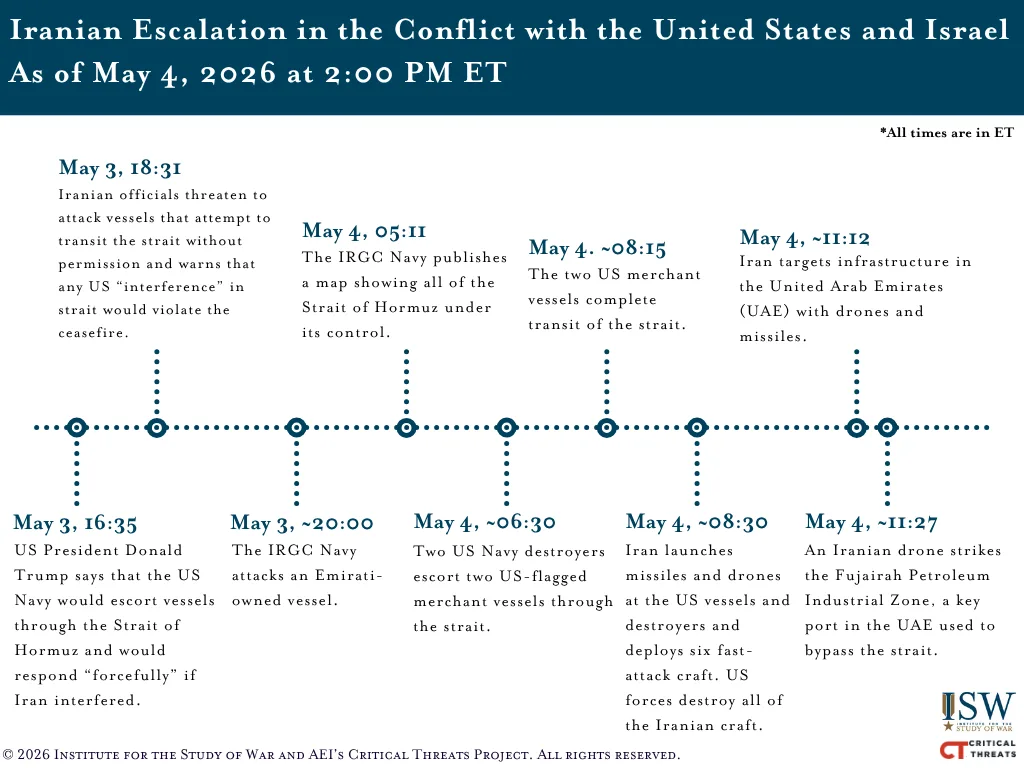
Iran is attempting to demonstrate its “control” over the Strait of Hormuz in response to US attempts to secure freedom of commercial navigation in the strait. Iran is attempting to disrupt these US efforts and demonstrate its control by attacking commercial vessels, oil infrastructure in the United Arab Emirates (UAE), and a civilian building in Oman. Iranian decisionmakers seek to retain “control” over the strait because this “control” is a key piece of leverage over the United States. “Control” of the strait allows Iran to place upward pressure on the global price of oil, which imposes economic and political costs on the United States, the longer the conflict goes on. US President Donald Trump said on May 3 that the US Navy would escort commercial vessels through the strait beginning on May 4. Successful transits under escort would undermine Iran's ability to credibly threaten commercial shipping. Iran's ability to ”control” the strait is dependent on its ability to credibly threaten commercial shipping to compel shipping to pay Iran and use Iranian-dictated travel separation schemes.
Hardline Iranian officials immediately recognized the risk that successful escorts would undermine their ability to threaten shipping and compel shipping to cooperate, and responded rhetorically and militarily. The Iranian Parliament's National Security and Foreign Policy Commission Chairman, Ebrahim Azizi, stated on May 3 that Iran would consider any US interference with Iran's blockade of the Strait of Hormuz to be a ceasefire violation.[1] Iranian forces then attacked an Emirati-affiliated tanker on May 3 with two drones as it tried to pass through the strait.[2] Khatam ol Anbia Central Headquarters Commander Brigadier General Ali Abdollahi Aliabadi threatened on May 4 to attack US warships and commercial vessels that try to transit through the Strait of Hormuz without Iranian permission.[3] The IRGC Navy also published a map of the Strait of Hormuz that claimed that Iran controlled all of the strait.[4] IRGC-affiliated media reported afterwards on May 4 that the IRGC Navy fired ”a warning shot“ at a US warship.[5] US Central Command (CENTCOM) announced on May 4 that two US destroyers guided two US-flagged commercial vessels through the strait without damage.[6] Iran reportedly fired cruise missiles and drones at the vessels and destroyers.[7] Iran also reportedly sent six fast attack craft after the commercial vessels, all of which US forces sank.[8]
Iran then escalated its attacks by targeting naval and land targets in the UAE and Oman on May 4, possibly to try to deter US allies from using the Strait of Hormuz after these initial steps failed to compel the United States to stop its efforts to escort shipping. The Emirati Defense Ministry announced on May 4 that its forces intercepted three of four Iranian cruise missiles fired at the UAE, with one falling in the sea.[9] Iran reportedly launched a drone at an unspecified target at the Fujairah Petroleum Industrial Zone in Fujairah, UAE, which injured three people.[10] The IRGC then reportedly struck a South Korean cargo vessel named HMM Namu, about 36 nautical miles north of Dubai, UAE.[11] The IRGC also reportedly struck an unknown vessel about 14 nautical miles west of Mina Saqr, UAE.[12] The Emirati Defense Ministry announced afterwards that its air defenses engaged Iranian projectiles at least three more times.[13] An Iranian projectile also struck a residential building in the Tabat area of Bukha Province, Musandam Governorate, Oman, but it is unclear if Iran sought to target this building.[14]
US President Trump indicated on May 4 that the most recent Iranian attacks did not constitute a ceasefire violation, however. Trump stated that there was no “heavy firing” when asked whether Iran's actions violated the ceasefire.[15]
It is against the United States’ interests to allow Iran to exert control over the Strait of Hormuz and thus a large part of international maritime commerce. Allowing Iran to exert control over the strait enables Iran to impose economic costs on the United States and the international economy while simultaneously giving it leverage in negotiations over other important issues, such as Iran's nuclear program. Iranian officials have previously stated that Iran will impose a new regime in the Strait of Hormuz that will have “economic benefits” for Iran. Iranian Supreme Leader Mojtaba Khamenei stated on April 30 that Iran will impose a “new management” in the strait that will reap “economic benefits” for Iran, for example.[16] Iran has planned different versions of toll schemes that would allow Iran to charge vessels of its choosing to pass through the strait. Iran offered to “open” the strait in its proposal on April 26, but caveated that it would charge vessels a toll to transit through the strait, for example.[17] Iran could also exploit control over the strait to extract concessions from the United States in talks on issues like Iran's nuclear program. Iranian Armed Forces General Staff-run Defa Press argued on May 2 that the US-Iran conflict is one of attrition, in which each side is trying to impose economic costs on the other in a bid to extract concessions.[18]
The IDF is continuing to implement battlefield adaptations to address the threat of Hezbollah's FPV drones. Israeli media reported on May 3 that the IDF has begun to deploy drone interceptor systems in Lebanon.[28] These drone interceptor systems use radar to identify enemy drones and then launch an interceptor drone equipped with a net to neutralize the incoming drone.[29] IDF drone industry sources told Israeli media that the interceptor system could not effectively detect enemy drones in previous testing about a year ago, however.[30] Ukrainian Unmanned Systems Forces has increasingly and successfully intercepted Russian drones using interceptor drones in their war.[31] An Israeli correspondent reported on May 4 that the IDF has purchased hunting shotguns and is preparing to issue them to IDF units in Lebanon “soon.”[32] Ukrainian and Russian units have also issued shotguns to anti-drone units as a drone countermeasure.[33] The IDF reportedly estimates that its new countermeasures will reduce Hezbollah FPV drone strikes on IDF forces by 80 percent.[34] ISW has observed in the war in Ukraine that the development of successful drone countermeasures requires a rapid innovation cycle, which involves countermeasure prototype testing by frontline units who can communicate with defense industry partners to adapt these prototypes to frontline conditions and then quickly redeploy these adapted countermeasures back to the frontline units.[35]
https://understandingwar.org/research/middle-east/iran-update-special-report-may-4-2026/
1,992
posted on
05/04/2026 8:55:00 PM PDT
by
AdmSmith
(GCTGATATGTCTATGATTACTCAT)
FDD: RADM (Ret.) Mark Montgomery on the Iran conflict and Strait of Hormuz blockade – Mario Nawfal
04MAY2026
https://www.youtube.com/watch?v=wa5cRrcUjdY
Mark Montgomery provides an excellent overview of how ships are protected in the area and what the current situation is like there.
Sal Mercogliano- What’s Going on With Shipping?
04MAY2026
Two U.S. Flagged- Commercial Ships Sail Through the Strait | How Does the Military Convoy Ships?
https://www.youtube.com/watch?v=-7VBPsa2zOA
I highly recommend listening to both.
1,993
posted on
05/04/2026 9:33:29 PM PDT
by
AdmSmith
(GCTGATATGTCTATGATTACTCAT)
To: AdmSmith
US President Trump indicated on May 4 that the most recent Iranian attacks did not constitute a ceasefire violation, however. Trump stated that there was no “heavy firing” when asked whether Iran's actions violated the ceasefire.

1,994
posted on
05/05/2026 10:37:10 AM PDT
by
PIF
(They came for me and mine ... now its your turn)
To: PIF
Iran Update Special Report, May 5, 2026
Iran has conducted a series of attacks against the United Arab Emirates (UAE) over the past 48 hours that are likely intended, in part, to isolate the UAE from other Gulf states.[1] The UAE Defense Ministry reported on May 5 that Emirati air defense systems engaged Iranian missiles and drones.[2] ISW-CTP has not observed any reports of missile or drone impacts in the UAE at the time of this writing. Iran previously launched four waves of attacks against the UAE on May 4, including a drone attack against an unspecified target in the Fujairah Petroleum Industrial Zone.[3] Iran's decision to solely attack the UAE, as opposed to multiple Gulf states, indicates that Iran likely seeks to isolate the UAE and exploit fractures between the Gulf states to sow further divisions between the UAE and other countries in the Gulf. Iranian attacks on multiple Gulf countries would presumably unite these countries against Iran, in contrast.
Iran's attacks against the UAE also likely seek to drive a wedge between the UAE and the United States and Israel in response to the UAE taking steps to strengthen its partnership with the United States and Israel. Iranian state-controlled media has suggested that Iran's attacks against the UAE were driven by the UAE’s increasing alignment with the United States and Israel.[4] An analyst close to the Iranian regime stated on May 4 that Iran targeted the UAE in response to the UAE’s “unprecedented hostile approach” toward Iran, including UAE cooperation with the United States and Israel on security and military matters.[5] An Iranian media outlet affiliated with former Supreme National Security Council Secretary Ali Shamkhani separately cited Israel's reported provision of air defense systems to the UAE as further evidence of the UAE’s alignment with the United States and Israel.[6] IRGC-affiliated media similarly claimed on May 4 that the UAE has become an Israeli “pawn.”[7] Iran also likely seeks to send a message to other Gulf countries that they could become targets if they similarly increase cooperation with the United States and Israel.
Iran's recent attacks against the UAE are also a response to US efforts to restore freedom of navigation through the Strait of Hormuz. US President Donald Trump announced on May 3 the launch of Project Freedom to guide commercial vessels through the Strait of Hormuz and undermine Iranian efforts to “control” shipping through the strait.[8] Iran attacked an Emirati-linked vessel and UAE territory following the announcement, likely to demonstrate Iranian “control” over the strait and deter vessels from attempting to transit through the waterway.[9] The UAE has a direct interest in reopening maritime traffic through the strait. Iran's attacks on the UAE therefore likely seek to impose costs on a key US regional partner that benefits from Project Freedom and demonstrate that Iran can contest US efforts to reopen the strait.
Iran's escalation against the UAE also likely reflects internal Iranian regime dynamics and IRGC Commander Major General Ahmad Vahidi’s efforts to constrain diplomacy. ISW-CTP previously assessed that Vahidi may seek to derail negotiations and may have accepted the risk of potential renewed conflict with the United States and Israel.[10] Vahidi and his inner circle have blocked “pragmatist” officials’ efforts to push Iran toward a more flexible negotiating position.[11] Iran's recent attacks against the UAE and commercial vessels in the Strait of Hormuz highlight how Vahidi has prevailed in the regime's internal power struggle and marginalized “pragmatist” actors, particularly Parliament Speaker Mohammad Bagher Ghalibaf.[12]
Vahidi continues to dictate the regime's approach toward the Strait of Hormuz and Iran's broader conflict with the United States and Israel. Anti-regime media reported on May 5 that Iranian President Masoud Pezeshkian is “angry” with Vahidi’s decision to attack the UAE and called the attack an “irresponsible step” that was taken without Pezeshkian’s knowledge.[13] Pezeshkian is part of a group of pro-negotiations regime officials who view negotiations with the United States as preferable to renewed military conflict and better for the Iranian economy.[14] Pezeshkian reportedly sought an emergency meeting with Iranian Supreme Leader Mojtaba Khamenei to ask him to stop the IRGC’s attacks on the UAE and to prevent their reoccurrence.[15] Israeli media reported on April 19 that Vahidi is the only Iranian official with direct access to Mojtaba and is serving as a conduit for relaying key decisions to other regime officials, however.[16] Anti-regime media also reported on April 1 that Pezeshkian tried repeatedly to contact Mojtaba, but that a “military council” formed by Vahidi prevented Pezeshkian from contacting Mojtaba.[17]
Iranian officials have confirmed that Iran conducted the recent attacks against the UAE. The Khatam ol Anbia Central Headquarters spokesperson denied that Iranian armed forces conducted “any missile or drone operations” against the UAE and claimed that the UAE Defense Ministry's recent announcements about Emirati air defenses intercepting Iranian missiles and drones are false.[18] Senior Iranian officials, including Iranian Foreign Affairs Ministry Spokesperson Esmail Baghaei, have acknowledged that Iran conducted the attacks, however.[19] The Khatam ol Anbia Central Headquarters spokesperson also warned that the UAE must not become a “den” for US and Israeli forces, which echoes threats from other Iranian officials that Iran can target states that host US forces or bases.[20] The spokesperson threatened a “crushing and regret-inducing response” if the UAE targets Iranian islands, ports, or coasts in response to Iran's attacks.[21]
Iran is expanding its efforts to establish bureaucratic frameworks to assert its sovereignty over the Strait of Hormuz. The Iranian regime's English-language media outlet, Press TV, reported on May 5 that Iran has designed and implemented “a new mechanism for exercising sovereignty over the Strait of Hormuz.”[22] The mechanism stipulates that ships that wish to transit through the strait will receive an email outlining “transit regulations” and that vessels must abide by these “regulations” to receive a “transit permit” to transit through the strait.[23] Iranian officials have previously stated that Iran will impose a “new management” in the Strait of Hormuz that will reap “economic benefits” for Iran.[24] Iran has proposed various toll schemes that would enable Iran to charge vessels of its choosing to pass through the strait.[25] This report comes amid other Iranian efforts to formalize Iranian “control” over the strait. Iranian media reported on April 19 that Iran's parliament is drafting a bill that would ban Israeli-linked vessels from transiting the Strait of Hormuz, require vessels from “hostile countries” to obtain approval from Iran's Supreme National Security Council to transit the strait, and bar states that have “caused damage” to Iran from transiting the strait until they pay reparations to Iran.[26]
Iranian officials have continued to emphasize the regime's intention to exert control over the Strait of Hormuz in the long term. ISW-CTP continues to assess that it is against the United States’ interests to allow Iran to exert control over the Strait of Hormuz. Iranian Parliament Speaker Mohammad Bagher Ghalibaf stated on May 5 that “the new equation of the Strait of Hormuz is in the process of being solidified.”[27] IRGC Political Deputy Brigadier General Yadoleh Javani similarly stated that Iran's “new management” of the Strait of Hormuz will be the “foundation of the global and international order.”[28] Allowing Iran to assert “sovereignty” over the strait would enable Iran to impose economic costs on the United States and the international economy while simultaneously giving it leverage in negotiations over other important issues, such as Iran's nuclear program.[29] Iranian Armed Forces General Staff-run Defa Press argued on May 2 that the US-Iran conflict is one of attrition, in which each side is trying to impose economic costs on the other in a bid to extract concessions.[30]
US Secretary of Defense Pete Hegseth and US Chairman of the Joint Chiefs of Staff General Dan Caine stated that Iranian attacks in the Strait of Hormuz and against the UAE on May 4 were not violations of the US-Iran ceasefire in a Pentagon press briefing on May 5.[31] Hegseth stated that “right now the ceasefire with Iran holds.”[32] Hegseth added that Project Freedom is “separate and distinct” from the ceasefire with Iran.[33] Caine stated that nine recent Iranian attacks on vessels and two Iranian vessel seizures in the Strait of Hormuz are “below the threshold of restarting major combat operations at this point.”[34] Caine acknowledged that Iran attacked Oman once and the UAE three times on May 4. US officials have not commented on Iran's May 5 attack on the UAE at the time of this writing.[35]
Iran has reportedly pressured its Iraqi partners to end Iranian-backed Iraqi militias’ kinetic operations, while strengthening Iranian-backed Iraqi political influence, likely to try to avoid US financial pressure against Iraq that negatively impacts Iran.[40] Unspecified informed sources told Iraqi media on May 5 that IRGC Quds Force Commander Brigadier General Esmail Ghaani warned about “real dangers” that could result in a loss of unspecified military privileges and discussed the need for an “alternative plan” regarding militia disarmament during meetings with unspecified militias and Shia Coordination Framework leaders in Baghdad on April 18.[41] The United States has pressured the Iraqi federal government since early 2025 to disarm Iraqi militias and dissolve the Iranian-backed Popular Mobilization Forces (PMF).[42] The PMF is an Iraqi state security institution that includes many Iraqi militias that answer to Iran instead of the Iraqi Prime Minister.[43] US pressure on the Iraqi federal government to reduce Iranian influence in Iraq has increased during the war due to attacks by the militias, including those within the PMF, against US and foreign targets in Iraq and the region.[44] US and Iraqi officials told the Wall Street Journal on April 22 that the US Treasury Department has temporarily halted shipments of Iraq's oil export revenue via the US Federal Reserve due to concerns about militia behavior.[45] The officials said that the United States first blocked a shipment of oil export revenue to the Central Bank of Iraq when the war began in late February 2026 and recently blocked a cargo plane delivery of nearly $500 million USD.[46] The Central Bank of Iraq has managed an account at the New York Federal Reserve on behalf of the Iraqi Finance Ministry since 2003 that holds the Iraqi federal government's revenue from oil exports in US dollars.[47] Oil revenue accounts for about 90 percent of the Iraqi state's budget.[48] Iran uses the Iraqi economy for sanctions evasion and to help fund the Axis of Resistance. The US Treasury Department's actions therefore heavily impact Iran as the regime already faces immense economic pressure from the United States.[49]
Ghaani proposed a so-called “Grand Settlement” plan regarding militia disarmament, according to the informed sources speaking to Iraqi media.[50] Iraqi media reported that unspecified actors first proposed a similar version of this plan in early 2025.[51] The first part of Ghaani’s plan reportedly calls on multiple Iraqi militias, specifically Kataib Hezbollah, Harakat Hezbollah al Nujaba, and Kataib Sayyid al Shuhada, to end their kinetic activity in exchange for maintaining the PMF’s role within the Iraqi state.[52] These militias have, both historically and during the war, been the most kinetically active and are more subordinate to Iran than other militias.[53] Ghaani reportedly outlined a second phase that would seemingly only occur if the first phase failed to reduce tensions with the United States. The second phase would integrate the PMF into the Iraqi Security Forces (ISF).[54] The PMF currently operates separately from the ISF and reports, at least on paper, to the Iraqi Prime Minister instead of the Iraqi Defense Minister.[55] The informed sources implied that Iranian-backed Iraqi militia leaders would be offered senior PMF positions in exchange for their suspension of kinetic operations.[56] Ghaani’s plan reportedly seeks to avoid provoking the United States, while simultaneously consolidating Iranian influence in Iraq via the further infiltration of Iranian-backed Iraqi actors into Iraqi government, diplomatic, and security institutions.[57]
ISW-CTP continues to assess that Iran could decide to build a new, loyal cadre of ideological militias, over which Iran has strong control, that would supplement the political activity of Iranian-backed Iraqi actors. An Iranian-backed Iraqi militia source told UK-based Amwaj Media in November 2025 that Iran would consider funding and politically supporting smaller Iraqi militias that are not affiliated with the PMF, which would place these militias fully outside state structures and control.[58] Iran has previously established splinter groups or front groups to ensure militia loyalty to Iran or to obfuscate the involvement of larger militias in military activity against the United States.[59]
https://understandingwar.org/research/middle-east/iran-update-special-report-may-5-2026/
1,995
posted on
05/06/2026 5:42:28 AM PDT
by
AdmSmith
(GCTGATATGTCTATGATTACTCAT)
To: AdmSmith
I think the ceasefire was the wrong decision..
Now Trump is up against this meeting with Xi next week, and he doesn’t want anything, getting in the way of that.
And the midterms are getting closer every day.
1,996
posted on
05/06/2026 11:47:33 AM PDT
by
nuconvert
( Warning: Accused of being a radical militarist. Approach with caution.)
To: nuconvert
Iran Update Special Report, May 6, 2026
Iran seeks to achieve positive strategic objectives beyond the negative objective of surviving the war. Iran's principal positive strategic objective at this time is to secure recognition of its sovereignty over the Strait of Hormuz, which would fundamentally remake regional and global maritime norms in a manner extremely detrimental to US interests. Iran has denied access to the Strait of Hormuz during the war through mining, drone and missile attacks, and harassment by fast attack craft. Sea denial of the Strait of Hormuz can only be maintained through attacks, however. Long-term control of the Strait would require Iran to secure US recognition of its claims to the Strait of Hormuz through a negotiated agreement so that Iran could order ships to comply with its rules legitimately and then intercept those ships that fail to comply. Iranian negotiators increasingly prioritized securing its control over the Strait in negotiations, likely because it believes Iranian control over the Strait would act as a safeguard against future wars between Iran and Israel and the United States. The Strait under recognized Iranian control would act as a safeguard because Iran could close the Strait and disrupt markets at will, punish states in the Persian Gulf region for “collaborating” with Israel or the United States, and generate revenue through a system of tolls.[1] All of this and more would become legitimate with US recognition of Iranian claims to the Strait if the United States agreed to Iran's demands in negotiations. Recognition would also provide Iran with the legitimacy to intercept ships violating its rules. US, Israeli, or Gulf efforts to disrupt Iranian efforts to manage traffic to Tehran’s benefit would be perceived as acts of aggression if the United States were to recognize Iranian claims to the Strait in negotiations.
Iran has already begun to take steps that demonstrate what these new norms could look like. Iran's “Persian Gulf Strait Authority” also sent an email on May 6 to shipping companies with vessels in the Persian Gulf stipulating that for safe passage through, crews must pay the body in Iranian rials and gain issuances of guarantees from Iranian banks, which would force everyone who wants to use the Strait to violate US sanctions.[2] These demands would be legitimate if Iran achieves its positive strategic aim of securing control over the Strait of Hormuz. The email makes it clear that countries whose ships want to go through the Strait have to lift sanctions.[3]
Iran is also seeking economic relief as a positive objective from the war, which could enable Iran to accelerate its efforts to reconstitute its ballistic missile program. US sanctions on Iranian oil have contributed to severely weakening Iran's ability to raise revenue that the regime has used to fund the development of its ballistic missile program.[4] Iran is also seeking for the United States to unfreeze nearly $100 billion USD in Iranian assets, which could quickly provide the regime with the needed funds for investment into reconstituting its ballistic missile program on the strategic level.[5] These funds would be needed to rebuild missile production plants, development facilities, and plants for raw materials like steel, many of which were destroyed during the current war.[6] Iran has used its ballistic missiles to attack US bases and allies in the recent conflict and in previous conflicts like the 12 Day War.[7] CNN reported on May 6 that Israel is particularly worried about the possible lifting of economic sanctions on Iran and has pushed for restrictions to be imposed on Iran's ballistic missile program.[8] Economic relief would also support ”negative” strategic objectives like preventing regime collapse caused by protests that result from serious economic instability (see below).
The introduction of these positive strategic objectives does not mean that Iran has abandoned its “negative” strategic objectives, which include limiting discussions on its nuclear program and avoiding an economic collapse that could trigger severe domestic unrest, leading to the collapse of the regime. Avoiding the collapse of one's regime is an objective of all regimes. Iranian leaders also almost always insist on the legitimacy of at least some form of a nuclear program. These two objectives are constant and do not represent a comprehensive positive vision for the future of the region. Iran now possesses such a vision. The Iranian objectives, if accomplished in full, would result in an extremely strong Iran that would be able to compel most regional states to follow its lead through control of the Strait of Hormuz.
The Iranian regime is preparing for economic instability that could cause domestic unrest. This effort supports the “negative” strategic objective of preventing regime collapse caused by protests that result from serious economic instability. Iranian Parliament Speaker Mohammad Bagher Ghalibaf published an audio message on May 6, in which he framed the maritime blockade, economic pressure, and media operations as part of an “enemy effort” to undermine national cohesion and force Iran to surrender.[9] These remarks demonstrate that the Iranian regime is attempting to bolster itself against domestic instability that could result from economic pressure rather than preparing to surrender. Ghalibaf called on officials to reduce the effects of economic pressure on the public, urged wartime-style planning, and “jihadi management.”[10] Ghalibaf also called on the Basij to “enter the field seriously” and asked Basij members in mosques, neighborhoods, and social groups to help solve public problems.[11] The regime uses the Basij for civil defense, social control, and protest suppression.[12] Anti-regime media reported on April 27 that Iran's Supreme National Security Council, which is the highest national security body, was reportedly preparing for a potential protest wave as economic deterioration and social pressure intensified.[13] Iranian officials are reportedly concerned about inflation, unemployment, rising prices, shutdowns in the oil, petrochemical, and steel sectors, and broader economic disruption.[14] Iranian officials’ public emphasis on economic management suggests that the regime recognizes that economic pressure could create internal stability risks and is preparing mechanisms to manage those risks. These statements, concerns, and preparations do not on their own indicate that the Iranian regime is prepared to surrender as a result of economic pressure.
ISW-CTP continues to assess that Islamic Revolutionary Guards Corps (IRGC) Commander Major General Ahmad Vahidi is driving decisionmaking over Iran's war and negotiating posture. Iranian officials may still disagree over how to proceed in negotiations, however, and some may present positions that do not necessarily reflect Vahidi’s approval. This may help to explain US officials’ assessment that Iranian decisionmaking remains fragmented, even though Vahidi likely drives decisionmaking due to his proximity to Supreme Leader Mojtaba Khamenei.[15]
It remains unclear what specific demands the US and Iranian delegations are currently negotiating over. A Pakistani source familiar with the negotiations told a New York Post journalist that there are multiple proposals circulating.[16] This makes it difficult to determine the precise terms currently being negotiated or even whether both sides are referring to the same framework. US officials leaked to Axios on May 6 that the White House believes it is close to a one-page memorandum of understanding with Iran that would declare an end to the war and open a 30‑day window for negotiations on a more detailed deal, however.[17] The US sources noted that nothing has been finalized but described this as the closest the sides have come to an agreement since the conflict began.[18] The reported framework would include an Iranian moratorium on nuclear enrichment for 12-15 years, partial sanctions relief and the release of frozen Iranian funds, and a gradual lifting of restrictions in the Strait of Hormuz, with future steps contingent on the success of follow‑on negotiations in venues such as Islamabad or Geneva.[19] It is unclear what is implied by ”restrictions” or if any Iranian official has seen the same memorandum leaked by US officials to Axios.
Iranian officials and media have largely rejected the Axios reporting, insisting that Iran has not agreed to any deal and has not yet formally responded to the latest US proposal, which they say contains unacceptable provisions.[20] Several outlets framed the US media narrative as pressure tactics or market manipulation.[21] The outlets instead emphasized Iran's own previous proposals and stated red lines, including rejection of uranium removal from Iran.[22] US President Donald Trump publicly reinforced a tougher US position at odds with the memorandum leaked by Axios, telling PBS later on May 6, that any deal would require Iran to export its highly enriched uranium, cease operating underground facilities, and accept no future enrichment even at low levels after a moratorium period.[23]
The US naval blockade and sanctions are imposing costs on Iran. US Central Command (CENTCOM) announced on May 6 that US naval forces have directed 52 vessels to turn around or return to ports since the blockade began on April 13.[24] CENTCOM separately stated that a US Navy F/A-18 Super Hornet disabled the rudder of the Iranian-flagged oil tanker M/T Hasna after it tried to violate the blockade in the Gulf of Oman.[25] The US blockade is also straining Iran's oil storage by restricting exports and forcing Iran to store unsold oil. An unspecified Iranian Oil Ministry official told the New York Times on May 6 that Iran has started cutting oil production at some oil wells to mitigate a storage shortage crisis.[26] The official estimated that Iran's onshore and offshore storage could run out in about 40 to 45 days.[27] The US blockade is creating operational and economic pressure for Iran, but the regime appears to be preparing to manage that pressure as a domestic-control problem rather than treating it as a reason to concede (see topline section).
https://understandingwar.org/research/middle-east/iran-update-special-report-may-6-2026/
1,997
posted on
05/06/2026 10:17:18 PM PDT
by
AdmSmith
(GCTGATATGTCTATGATTACTCAT)
To: nuconvert
LARRY KUDLOW: Without Regime Change, Can We Ever Really Trust Iran? Washington and Tehran, it seems, are negotiating in order to begin negotiating. Meanwhile, Project Freedom has been paused which frankly disappoints me because I had hoped our great United States Navy would have been able to ramp up 50 to 100 or more commercial ships through the Strait of Hormuz. And if there's a 30-day period of negotiations, the United States Navy's blockade would gradually be lifted. This too is disappointing. At this point, though, the blockade is very much still in place. So again, we'll wait to see more information. Another piece to this Iran story is President Trump's trip to Communist China. Is this part of the negotiation process?
https://www.foxbusiness.com/politics/without-regime-change-can-we-ever-really-trust-iran
1,998
posted on
05/06/2026 10:24:38 PM PDT
by
AdmSmith
(GCTGATATGTCTATGATTACTCAT)
🛠️ It's now the 69th day of Iran's internet blackout after 1632 hours largely cut off from international networks. The shutdown continues to drive job losses with a disproportionate impact on independent workers, effectively redistributing wealth to regime-aligned groups.

https://x.com/netblocks/status/2052290337209483417
1,999
posted on
05/07/2026 7:03:20 AM PDT
by
AdmSmith
(GCTGATATGTCTATGATTACTCAT)
To: AdmSmith; blitz128; BeauBo; dennisw; adorno; nuconvert
Continued Iranian attacks on Saudi Arabia and other countries like UAE already seem to be successfully “driving a wedge” between the US and Saudi Arabia and others. During today’s news at noon at least two of those countries have decided to deny us the military use of their land space for Iran operations.
2,000
posted on
05/07/2026 9:58:26 AM PDT
by
gleeaikin
(Question Authority: report facts and post their links" in your messages.)
Navigation: use the links below to view more comments.
first previous 1-20 ... 1,961-1,980, 1,981-2,000, 2,001-2,020 ... 2,461-2,478 next last
Disclaimer:
Opinions posted on Free Republic are those of the individual
posters and do not necessarily represent the opinion of Free Republic or its
management. All materials posted herein are protected by copyright law and the
exemption for fair use of copyrighted works.
FreeRepublic.com is powered by software copyright 2000-2008 John Robinson