Iran Update Special Report May 4, 2026
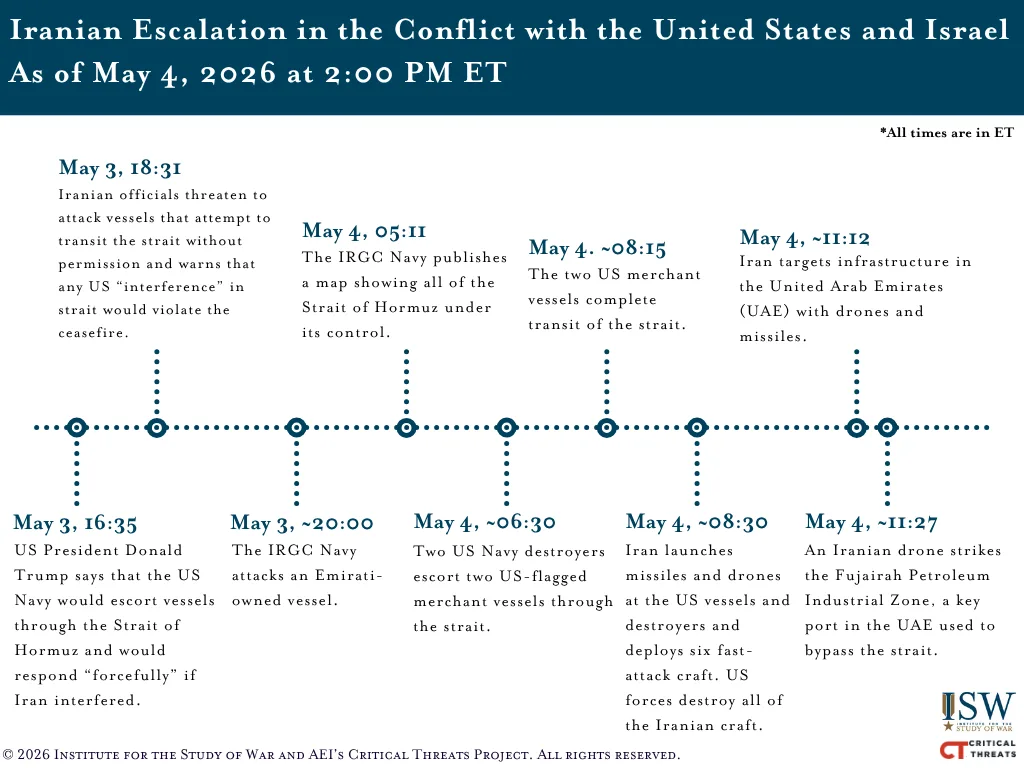
Iran is attempting to demonstrate its “control” over the Strait of Hormuz in response to US attempts to secure freedom of commercial navigation in the strait. Iran is attempting to disrupt these US efforts and demonstrate its control by attacking commercial vessels, oil infrastructure in the United Arab Emirates (UAE), and a civilian building in Oman. Iranian decisionmakers seek to retain “control” over the strait because this “control” is a key piece of leverage over the United States. “Control” of the strait allows Iran to place upward pressure on the global price of oil, which imposes economic and political costs on the United States, the longer the conflict goes on. US President Donald Trump said on May 3 that the US Navy would escort commercial vessels through the strait beginning on May 4. Successful transits under escort would undermine Iran's ability to credibly threaten commercial shipping. Iran's ability to ”control” the strait is dependent on its ability to credibly threaten commercial shipping to compel shipping to pay Iran and use Iranian-dictated travel separation schemes.
Hardline Iranian officials immediately recognized the risk that successful escorts would undermine their ability to threaten shipping and compel shipping to cooperate, and responded rhetorically and militarily. The Iranian Parliament's National Security and Foreign Policy Commission Chairman, Ebrahim Azizi, stated on May 3 that Iran would consider any US interference with Iran's blockade of the Strait of Hormuz to be a ceasefire violation.[1] Iranian forces then attacked an Emirati-affiliated tanker on May 3 with two drones as it tried to pass through the strait.[2] Khatam ol Anbia Central Headquarters Commander Brigadier General Ali Abdollahi Aliabadi threatened on May 4 to attack US warships and commercial vessels that try to transit through the Strait of Hormuz without Iranian permission.[3] The IRGC Navy also published a map of the Strait of Hormuz that claimed that Iran controlled all of the strait.[4] IRGC-affiliated media reported afterwards on May 4 that the IRGC Navy fired ”a warning shot“ at a US warship.[5] US Central Command (CENTCOM) announced on May 4 that two US destroyers guided two US-flagged commercial vessels through the strait without damage.[6] Iran reportedly fired cruise missiles and drones at the vessels and destroyers.[7] Iran also reportedly sent six fast attack craft after the commercial vessels, all of which US forces sank.[8]
Iran then escalated its attacks by targeting naval and land targets in the UAE and Oman on May 4, possibly to try to deter US allies from using the Strait of Hormuz after these initial steps failed to compel the United States to stop its efforts to escort shipping. The Emirati Defense Ministry announced on May 4 that its forces intercepted three of four Iranian cruise missiles fired at the UAE, with one falling in the sea.[9] Iran reportedly launched a drone at an unspecified target at the Fujairah Petroleum Industrial Zone in Fujairah, UAE, which injured three people.[10] The IRGC then reportedly struck a South Korean cargo vessel named HMM Namu, about 36 nautical miles north of Dubai, UAE.[11] The IRGC also reportedly struck an unknown vessel about 14 nautical miles west of Mina Saqr, UAE.[12] The Emirati Defense Ministry announced afterwards that its air defenses engaged Iranian projectiles at least three more times.[13] An Iranian projectile also struck a residential building in the Tabat area of Bukha Province, Musandam Governorate, Oman, but it is unclear if Iran sought to target this building.[14]
US President Trump indicated on May 4 that the most recent Iranian attacks did not constitute a ceasefire violation, however. Trump stated that there was no “heavy firing” when asked whether Iran's actions violated the ceasefire.[15]
It is against the United States’ interests to allow Iran to exert control over the Strait of Hormuz and thus a large part of international maritime commerce. Allowing Iran to exert control over the strait enables Iran to impose economic costs on the United States and the international economy while simultaneously giving it leverage in negotiations over other important issues, such as Iran's nuclear program. Iranian officials have previously stated that Iran will impose a new regime in the Strait of Hormuz that will have “economic benefits” for Iran. Iranian Supreme Leader Mojtaba Khamenei stated on April 30 that Iran will impose a “new management” in the strait that will reap “economic benefits” for Iran, for example.[16] Iran has planned different versions of toll schemes that would allow Iran to charge vessels of its choosing to pass through the strait. Iran offered to “open” the strait in its proposal on April 26, but caveated that it would charge vessels a toll to transit through the strait, for example.[17] Iran could also exploit control over the strait to extract concessions from the United States in talks on issues like Iran's nuclear program. Iranian Armed Forces General Staff-run Defa Press argued on May 2 that the US-Iran conflict is one of attrition, in which each side is trying to impose economic costs on the other in a bid to extract concessions.[18]
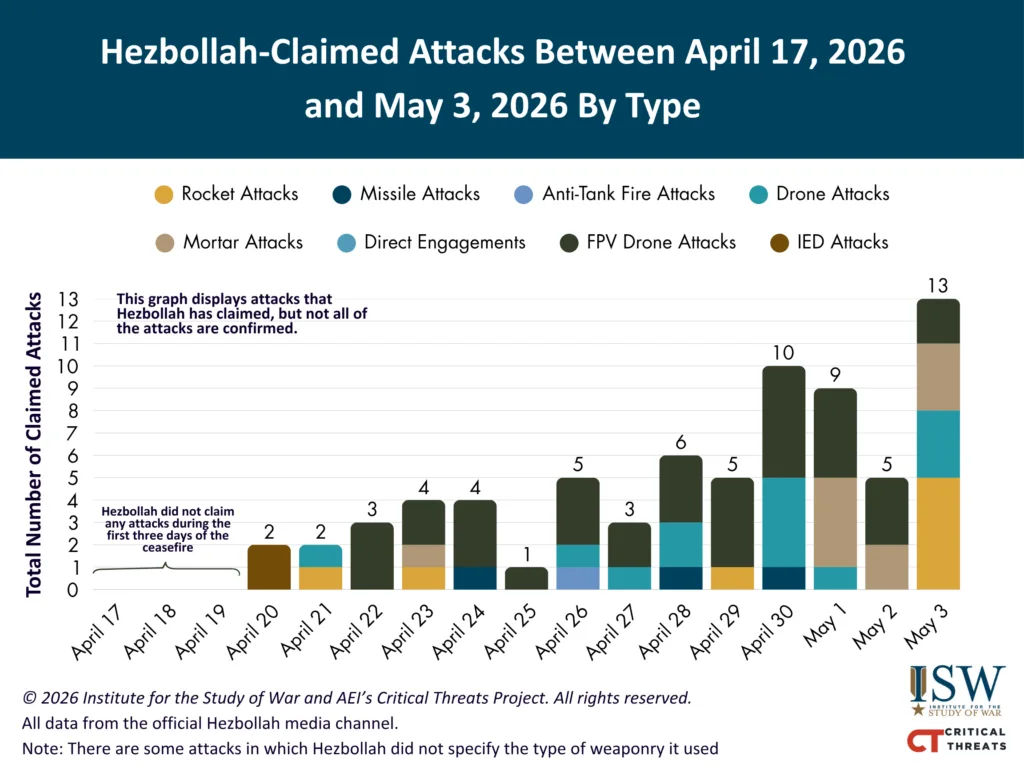
The IDF is continuing to implement battlefield adaptations to address the threat of Hezbollah's FPV drones. Israeli media reported on May 3 that the IDF has begun to deploy drone interceptor systems in Lebanon.[28] These drone interceptor systems use radar to identify enemy drones and then launch an interceptor drone equipped with a net to neutralize the incoming drone.[29] IDF drone industry sources told Israeli media that the interceptor system could not effectively detect enemy drones in previous testing about a year ago, however.[30] Ukrainian Unmanned Systems Forces has increasingly and successfully intercepted Russian drones using interceptor drones in their war.[31] An Israeli correspondent reported on May 4 that the IDF has purchased hunting shotguns and is preparing to issue them to IDF units in Lebanon “soon.”[32] Ukrainian and Russian units have also issued shotguns to anti-drone units as a drone countermeasure.[33] The IDF reportedly estimates that its new countermeasures will reduce Hezbollah FPV drone strikes on IDF forces by 80 percent.[34] ISW has observed in the war in Ukraine that the development of successful drone countermeasures requires a rapid innovation cycle, which involves countermeasure prototype testing by frontline units who can communicate with defense industry partners to adapt these prototypes to frontline conditions and then quickly redeploy these adapted countermeasures back to the frontline units.[35]
https://understandingwar.org/research/middle-east/iran-update-special-report-may-4-2026/
Iran Update Special Report, May 5, 2026
Iran has conducted a series of attacks against the United Arab Emirates (UAE) over the past 48 hours that are likely intended, in part, to isolate the UAE from other Gulf states.[1] The UAE Defense Ministry reported on May 5 that Emirati air defense systems engaged Iranian missiles and drones.[2] ISW-CTP has not observed any reports of missile or drone impacts in the UAE at the time of this writing. Iran previously launched four waves of attacks against the UAE on May 4, including a drone attack against an unspecified target in the Fujairah Petroleum Industrial Zone.[3] Iran's decision to solely attack the UAE, as opposed to multiple Gulf states, indicates that Iran likely seeks to isolate the UAE and exploit fractures between the Gulf states to sow further divisions between the UAE and other countries in the Gulf. Iranian attacks on multiple Gulf countries would presumably unite these countries against Iran, in contrast.
Iran's attacks against the UAE also likely seek to drive a wedge between the UAE and the United States and Israel in response to the UAE taking steps to strengthen its partnership with the United States and Israel. Iranian state-controlled media has suggested that Iran's attacks against the UAE were driven by the UAE’s increasing alignment with the United States and Israel.[4] An analyst close to the Iranian regime stated on May 4 that Iran targeted the UAE in response to the UAE’s “unprecedented hostile approach” toward Iran, including UAE cooperation with the United States and Israel on security and military matters.[5] An Iranian media outlet affiliated with former Supreme National Security Council Secretary Ali Shamkhani separately cited Israel's reported provision of air defense systems to the UAE as further evidence of the UAE’s alignment with the United States and Israel.[6] IRGC-affiliated media similarly claimed on May 4 that the UAE has become an Israeli “pawn.”[7] Iran also likely seeks to send a message to other Gulf countries that they could become targets if they similarly increase cooperation with the United States and Israel.
Iran's recent attacks against the UAE are also a response to US efforts to restore freedom of navigation through the Strait of Hormuz. US President Donald Trump announced on May 3 the launch of Project Freedom to guide commercial vessels through the Strait of Hormuz and undermine Iranian efforts to “control” shipping through the strait.[8] Iran attacked an Emirati-linked vessel and UAE territory following the announcement, likely to demonstrate Iranian “control” over the strait and deter vessels from attempting to transit through the waterway.[9] The UAE has a direct interest in reopening maritime traffic through the strait. Iran's attacks on the UAE therefore likely seek to impose costs on a key US regional partner that benefits from Project Freedom and demonstrate that Iran can contest US efforts to reopen the strait.
Iran's escalation against the UAE also likely reflects internal Iranian regime dynamics and IRGC Commander Major General Ahmad Vahidi’s efforts to constrain diplomacy. ISW-CTP previously assessed that Vahidi may seek to derail negotiations and may have accepted the risk of potential renewed conflict with the United States and Israel.[10] Vahidi and his inner circle have blocked “pragmatist” officials’ efforts to push Iran toward a more flexible negotiating position.[11] Iran's recent attacks against the UAE and commercial vessels in the Strait of Hormuz highlight how Vahidi has prevailed in the regime's internal power struggle and marginalized “pragmatist” actors, particularly Parliament Speaker Mohammad Bagher Ghalibaf.[12]
Vahidi continues to dictate the regime's approach toward the Strait of Hormuz and Iran's broader conflict with the United States and Israel. Anti-regime media reported on May 5 that Iranian President Masoud Pezeshkian is “angry” with Vahidi’s decision to attack the UAE and called the attack an “irresponsible step” that was taken without Pezeshkian’s knowledge.[13] Pezeshkian is part of a group of pro-negotiations regime officials who view negotiations with the United States as preferable to renewed military conflict and better for the Iranian economy.[14] Pezeshkian reportedly sought an emergency meeting with Iranian Supreme Leader Mojtaba Khamenei to ask him to stop the IRGC’s attacks on the UAE and to prevent their reoccurrence.[15] Israeli media reported on April 19 that Vahidi is the only Iranian official with direct access to Mojtaba and is serving as a conduit for relaying key decisions to other regime officials, however.[16] Anti-regime media also reported on April 1 that Pezeshkian tried repeatedly to contact Mojtaba, but that a “military council” formed by Vahidi prevented Pezeshkian from contacting Mojtaba.[17]
Iranian officials have confirmed that Iran conducted the recent attacks against the UAE. The Khatam ol Anbia Central Headquarters spokesperson denied that Iranian armed forces conducted “any missile or drone operations” against the UAE and claimed that the UAE Defense Ministry's recent announcements about Emirati air defenses intercepting Iranian missiles and drones are false.[18] Senior Iranian officials, including Iranian Foreign Affairs Ministry Spokesperson Esmail Baghaei, have acknowledged that Iran conducted the attacks, however.[19] The Khatam ol Anbia Central Headquarters spokesperson also warned that the UAE must not become a “den” for US and Israeli forces, which echoes threats from other Iranian officials that Iran can target states that host US forces or bases.[20] The spokesperson threatened a “crushing and regret-inducing response” if the UAE targets Iranian islands, ports, or coasts in response to Iran's attacks.[21]
Iran is expanding its efforts to establish bureaucratic frameworks to assert its sovereignty over the Strait of Hormuz. The Iranian regime's English-language media outlet, Press TV, reported on May 5 that Iran has designed and implemented “a new mechanism for exercising sovereignty over the Strait of Hormuz.”[22] The mechanism stipulates that ships that wish to transit through the strait will receive an email outlining “transit regulations” and that vessels must abide by these “regulations” to receive a “transit permit” to transit through the strait.[23] Iranian officials have previously stated that Iran will impose a “new management” in the Strait of Hormuz that will reap “economic benefits” for Iran.[24] Iran has proposed various toll schemes that would enable Iran to charge vessels of its choosing to pass through the strait.[25] This report comes amid other Iranian efforts to formalize Iranian “control” over the strait. Iranian media reported on April 19 that Iran's parliament is drafting a bill that would ban Israeli-linked vessels from transiting the Strait of Hormuz, require vessels from “hostile countries” to obtain approval from Iran's Supreme National Security Council to transit the strait, and bar states that have “caused damage” to Iran from transiting the strait until they pay reparations to Iran.[26]
Iranian officials have continued to emphasize the regime's intention to exert control over the Strait of Hormuz in the long term. ISW-CTP continues to assess that it is against the United States’ interests to allow Iran to exert control over the Strait of Hormuz. Iranian Parliament Speaker Mohammad Bagher Ghalibaf stated on May 5 that “the new equation of the Strait of Hormuz is in the process of being solidified.”[27] IRGC Political Deputy Brigadier General Yadoleh Javani similarly stated that Iran's “new management” of the Strait of Hormuz will be the “foundation of the global and international order.”[28] Allowing Iran to assert “sovereignty” over the strait would enable Iran to impose economic costs on the United States and the international economy while simultaneously giving it leverage in negotiations over other important issues, such as Iran's nuclear program.[29] Iranian Armed Forces General Staff-run Defa Press argued on May 2 that the US-Iran conflict is one of attrition, in which each side is trying to impose economic costs on the other in a bid to extract concessions.[30]
US Secretary of Defense Pete Hegseth and US Chairman of the Joint Chiefs of Staff General Dan Caine stated that Iranian attacks in the Strait of Hormuz and against the UAE on May 4 were not violations of the US-Iran ceasefire in a Pentagon press briefing on May 5.[31] Hegseth stated that “right now the ceasefire with Iran holds.”[32] Hegseth added that Project Freedom is “separate and distinct” from the ceasefire with Iran.[33] Caine stated that nine recent Iranian attacks on vessels and two Iranian vessel seizures in the Strait of Hormuz are “below the threshold of restarting major combat operations at this point.”[34] Caine acknowledged that Iran attacked Oman once and the UAE three times on May 4. US officials have not commented on Iran's May 5 attack on the UAE at the time of this writing.[35]
Iran has reportedly pressured its Iraqi partners to end Iranian-backed Iraqi militias’ kinetic operations, while strengthening Iranian-backed Iraqi political influence, likely to try to avoid US financial pressure against Iraq that negatively impacts Iran.[40] Unspecified informed sources told Iraqi media on May 5 that IRGC Quds Force Commander Brigadier General Esmail Ghaani warned about “real dangers” that could result in a loss of unspecified military privileges and discussed the need for an “alternative plan” regarding militia disarmament during meetings with unspecified militias and Shia Coordination Framework leaders in Baghdad on April 18.[41] The United States has pressured the Iraqi federal government since early 2025 to disarm Iraqi militias and dissolve the Iranian-backed Popular Mobilization Forces (PMF).[42] The PMF is an Iraqi state security institution that includes many Iraqi militias that answer to Iran instead of the Iraqi Prime Minister.[43] US pressure on the Iraqi federal government to reduce Iranian influence in Iraq has increased during the war due to attacks by the militias, including those within the PMF, against US and foreign targets in Iraq and the region.[44] US and Iraqi officials told the Wall Street Journal on April 22 that the US Treasury Department has temporarily halted shipments of Iraq's oil export revenue via the US Federal Reserve due to concerns about militia behavior.[45] The officials said that the United States first blocked a shipment of oil export revenue to the Central Bank of Iraq when the war began in late February 2026 and recently blocked a cargo plane delivery of nearly $500 million USD.[46] The Central Bank of Iraq has managed an account at the New York Federal Reserve on behalf of the Iraqi Finance Ministry since 2003 that holds the Iraqi federal government's revenue from oil exports in US dollars.[47] Oil revenue accounts for about 90 percent of the Iraqi state's budget.[48] Iran uses the Iraqi economy for sanctions evasion and to help fund the Axis of Resistance. The US Treasury Department's actions therefore heavily impact Iran as the regime already faces immense economic pressure from the United States.[49]
Ghaani proposed a so-called “Grand Settlement” plan regarding militia disarmament, according to the informed sources speaking to Iraqi media.[50] Iraqi media reported that unspecified actors first proposed a similar version of this plan in early 2025.[51] The first part of Ghaani’s plan reportedly calls on multiple Iraqi militias, specifically Kataib Hezbollah, Harakat Hezbollah al Nujaba, and Kataib Sayyid al Shuhada, to end their kinetic activity in exchange for maintaining the PMF’s role within the Iraqi state.[52] These militias have, both historically and during the war, been the most kinetically active and are more subordinate to Iran than other militias.[53] Ghaani reportedly outlined a second phase that would seemingly only occur if the first phase failed to reduce tensions with the United States. The second phase would integrate the PMF into the Iraqi Security Forces (ISF).[54] The PMF currently operates separately from the ISF and reports, at least on paper, to the Iraqi Prime Minister instead of the Iraqi Defense Minister.[55] The informed sources implied that Iranian-backed Iraqi militia leaders would be offered senior PMF positions in exchange for their suspension of kinetic operations.[56] Ghaani’s plan reportedly seeks to avoid provoking the United States, while simultaneously consolidating Iranian influence in Iraq via the further infiltration of Iranian-backed Iraqi actors into Iraqi government, diplomatic, and security institutions.[57]
ISW-CTP continues to assess that Iran could decide to build a new, loyal cadre of ideological militias, over which Iran has strong control, that would supplement the political activity of Iranian-backed Iraqi actors. An Iranian-backed Iraqi militia source told UK-based Amwaj Media in November 2025 that Iran would consider funding and politically supporting smaller Iraqi militias that are not affiliated with the PMF, which would place these militias fully outside state structures and control.[58] Iran has previously established splinter groups or front groups to ensure militia loyalty to Iran or to obfuscate the involvement of larger militias in military activity against the United States.[59]
https://understandingwar.org/research/middle-east/iran-update-special-report-may-5-2026/
