Skip to comments.
Iranian Regime tv Channel One hacked while it was airing Khamenie speech
various
| 10-8-22
Posted on 10/08/2022 1:05:38 PM PDT by nuconvert
Iranian Regime national tv Channel One hacked about an hour ago. During a broadcast of Khamenie speech, a red crosshair appeared over his face and chanting of Women. Life. Freedom. There was writing to the side saying "Rise up. Join us". Also 4 photos at the bottom of the screen of young people killed and additional writing: "The blood of our youth is dropping from your paws".
Also, there was a huge banner in the middle of Tehran highway today that read: We are no longer afraid of you. We will fight.
Also, attempted attack on IRI ambassador in Denmark. Her bodyguard was stabbed. Diplomatic Security intervened before the attacker could stab the ambassador.
TOPICS:
KEYWORDS: basij; deathtothemullahs; denmark; ebrahimrigi; erdogan; iran; iranprotests; iraq; irgc; iri; israel; khameini; khamenei; kurdistan; lebanon; mahsaamini; mullahloversonfr; mullahsmustbekilled; najisharifizindashti; protests; qudsforce; raisi; receptayyiperdogan; shahrammaroufmola; syria; turkey; yemen; zahedi
Navigation: use the links below to view more comments.
first previous 1-20 ... 1,861-1,880, 1,881-1,900, 1,901-1,920 ... 2,461-2,478 next last
To: adorno
1,881
posted on
04/02/2026 11:08:49 PM PDT
by
AdmSmith
(GCTGATATGTCTATGATTACTCAT)
Iran Update Special Report, April 2, 2026
The combined force has begun striking targets in Iran beyond narrowly defined military targets, such as military vehicles or ammunition depots. The combined force struck the Darou Pakhsh Pharmaceutical Manufacturing Company and the Pasteur Institute of Iran in Tehran Province on April 1 and 2. The Japanese government has listed Darou Pakhsh and the Pasteur Institute of Iran as entities associated with Iranian biological and chemical weapons activities. The combined force has also recently targeted Iranian steel factories, which are critical for both Iran's military production capabilities and the Iranian economy.
US President Donald Trump stated that the United States’ “strategic objectives” for the war are “nearing completion” during a press conference on April 1. Trump said that the United States will continue the war effort until US objectives are “fully achieved.” Trump said that the United States will strike Iran over the “next two to three weeks” while indirect talks between the United States and Iran continue.
US forces struck the B1 (Bileghan) Bridge connecting Tehran and Karaj, Alborz Province, on April 2 to disrupt Iran's ability to transfer missiles to western Iran. A US official told Axios on April 2 that Iran used the bridge to transport missiles and missile components from Tehran to launch sites in western Iran. Iran has increasingly launched missiles from central Iran as the combined force has degraded its ability to launch missiles from western Iran. Iran may seek to transfer missiles to western Iran that do not have a sufficient range to reach Israel if they are launched from central Iran.
Hezbollah may be increasing fire at Israel during Passover to impose psychological impacts on Israeli civilians. Israeli Defense Minister Israel Katz said on April 2 that Hezbollah Secretary General Naim Qassem will pay a “very heavy price” for “the intensified fire toward Israeli civilians as they…celebrate Passover.”
https://understandingwar.org/research/middle-east/iran-update-special-report-april-2-2026/
1,882
posted on
04/02/2026 11:14:38 PM PDT
by
AdmSmith
(GCTGATATGTCTATGATTACTCAT)
To: gleeaikin; nuconvert; adorno
As war now dominates the headlines, it's critical to remember how we got here. In January, Iran's security forces carried out one of the deadliest crackdowns in the country's modern history and at the same time, a parallel war was unfolding online. This special report reveals how Tehran seeded the false narrative that the uprising was a CIA–Mossad plot and how far-left influencers, far-right voices, bot farms and foreign amplification networks helped spread it worldwide.
Drawing on exclusive findings from the Network Contagion Research Institute and interviews with leading analysts, this investigation exposes how the regime exports propaganda to whitewash mass killings and shape global opinion — even as conflict escalates today. An Iran International and The Free Press investigation by @NegarMojtahedi and @FPJaySolomon.
https://x.com/IranIntl_En/status/2038902616680194058
6 min
1,883
posted on
04/02/2026 11:25:43 PM PDT
by
AdmSmith
(GCTGATATGTCTATGATTACTCAT)
To: adorno; BeauBo; SeekAndFind; USA-FRANCE
As my previous comment points out, it is not just that Ukraine has developed great drones, it also knows how to use them. They did sell the drones the Saudi’s are using, but were seriously lacking in how to make the best use of them. The idea that Saudi troops are running away from any combat rather ‘sthan striking back illustrates that they are either insufficiently trained to have confidence or are lacking in motivation and courage to hold their position when threatened.
Weapons are only part of the story. Russia has some of the same technical skills the Ukrainians have. But much more of their equipment, including nukes have suffered from the neglect and carelessness caused by Russia’s highly developed corruption culture. My question is, which countries of the wider world have a culture that will use their drones to threaten the world? I suspect that the countries that best use this new weapon will also be the more desirable countries and governments. Thus no increase in danger to us once they have the new equipment.
1,884
posted on
04/03/2026 5:35:06 PM PDT
by
gleeaikin
(Question Authority: report facts, and post their links" in your message)
To: gleeaikin
which countries of the wider world have a culture that will use their drones to threaten the world?
Today: Russia, Iran, the Houthis, and later North Korea, China and some African countries.
1,885
posted on
04/04/2026 12:26:47 AM PDT
by
AdmSmith
(GCTGATATGTCTATGATTACTCAT)
Iran Update Special Report, April 3, 2026
Iran's ballistic missile program is a military organization that consists of both combat and support elements, and it is impossible to evaluate the overall degradation of Iran's ballistic missile program based on one element of the system. The ballistic missile program consists of combat elements—Iran's missile stockpile and launchers—but it also includes support elements, such as research facilities, development institutions, and industrial facilities. Any evaluation of the degradation that discounts the status of the support elements of the program is therefore incomplete. The US–Israeli campaign has targeted nearly every element of Iran's ballistic program (see below).
The majority of Iranian ballistic missiles are combat ineffective, even if they remain “intact.”[1] About 50 percent of Iranian missile launchers are still “intact,” according to recent US intelligence assessments.[2] This figure, however, appears to include launchers that have been damaged or rendered inaccessible. A unit is considered combat ineffective when it cannot accomplish its assigned mission. A unit does not necessarily need to be destroyed to be considered combat ineffective. A missile launcher that is buried is combat ineffective for the period it is buried. It is also combat ineffective if it cannot move from its underground storage facility.[3]
Assessing Iran's missile threat accurately requires distinguishing between different missile types. Iran possesses short-, medium-, and long-range ballistic missiles in its arsenal. Iran relies on medium-range ballistic missiles to target Israel. Iran fires its short-range missiles to target Gulf states and US assets in these countries. Estimates on the status of Iran's missile program do not distinguish between the two, which limits the ability to use these estimates to completely understand the status of Iran's missile program.
The combined force has rendered many of Iran's missile launchers combat ineffective, but it is entirely unclear whether these “launchers” refer to launchers for medium-range or short-range systems or whether any of the launchers are interchangeable between medium-range and short-range systems. The combined force has struck several tunnel entrances and at least five underground missile facilities to prevent Iranian forces from being able to access missile launchers in these facilities.[4] CNN analyzed 107 Iranian tunnel entrances on March 21 and found that the combined force had struck 77 percent of the tunnel entrances.[5] The status of the launchers in these underground facilities is unclear, but striking these tunnel entrances has at least temporarily rendered these launchers combat ineffective. The combined force has also targeted Iran's efforts to clear rubble from collapsed tunnel entrances.[6] Western media also reported that Iran retains 50 percent of its drone capabilities.[7] Combat ineffectiveness is a temporary state, but other combined force strikes have worked to make it more difficult for Iran to make its ballistic missile forces combat effective again (see below for information on defense industrial strikes).
The rate of Iranian missile fire suggests that Iran's medium-range ballistic missile force has been significantly degraded. The US military assessed that Iranian missile fire has reduced by around 90 percent since the start of the war.[8] ISW-CTP previously observed that Iran has been firing only a few missiles per salvo, and sometimes just one, at Israel in recent weeks.[9] Smaller salvoes are relatively easier for the IDF to intercept, as demonstrated by their performance against small Houthi salvoes between 2023 and 2025.
The short-range ballistic missile force has continued to conduct attacks at a steady rate, but the status of the short-range missile force remains unclear. Iranian missile fire targeting the Gulf states has remained relatively steady since the start of the war, excluding Iran's large missile launches targeting the UAE on the first day of the war. Iran's relatively consistent rate of missile fire at the Gulf states in the weeks since may reflect constraints in specific types of missiles compared to others. The status of Iranian short-range missile capabilities, which target the Gulf states, is difficult to assess using open-source information at this time. Missile fire at the Gulf states has remained relatively steady in recent weeks, but there is limited clarity about how large the remaining stockpiles are and what tactical limitations the Iranian short-range missile units are facing.
The combined force has also targeted Iran's drone program, including drone launchers, but the status of the program is unclear.[10] Western media estimated that Iran retains 50 percent of its drone capabilities.[11] Neither the United States nor Israel has released information about the total number of drone targets struck, but reports suggest drone launches have decreased since the start of the war.[12]
US-Israeli strikes, particularly decapitation strikes, have also created a pervasive fear that may be cause Iranian forces to prioritize their survival and impede their ability to execute their assigned mission. US and Israeli strikes have severely degraded Iran's medium-range missile capabilities. Iranian missile fire targeting Israel has steadily declined since the beginning of the war. Iran has, on average, fired only a few missiles per salvo at Israel since March 20. This impact is less clear within the short-range missile force. US Secretary of Defense Pete Hegseth stated on March 31 that combined force airstrikes have degraded the Iranian military's morale and even led to “widespread desertions, key personnel shortages, and caused frustrations amongst senior leaders.[13] The IDF stated on March 24 that ballistic missile units have refused to go to launch sites due to fear of IDF strikes.[14] Iranian forces also appear to be struggling with recruitment and retention.[15] Some reserve forces have reportedly failed to show up at military centers, for example.[16] These factors can render missile systems combat ineffective because they lack available or willing forces to operate them.
The US-Israeli campaign has solidified the operational success generated by rendering launchers combat ineffective and destroying missile stockpiles by targeting Iran's defense industrial base extensively. Strikes on these sites will make it more challenging for Iran to reconstitute its missile and drone program over the long-term. Iran retains an unclear number of missiles and drones in its stockpiles, but ongoing strikes on Iranian defense industrial sites degrade Iran's ability to rebuild these stockpiles. Iran has also used a sizable portion of its weapons stockpiles in attacks on Israel and the Gulf since the war began. The force has conducted extensive strikes targeting Iran's missile and drone production capabilities. The IDF announced on March 31 that it estimates that it has targeted nearly 70 percent of Iran's defense industry.[17] Combined force strikes have severely damaged Iran's four major missile production sites, including the Khojir, Shahroud, Parchin, and Hakimiyeh facilities, for example.[18] Strikes on defense industrial targets have degraded several components of the missile program, including research, fuel production, components, and testing facilities. The combined force has targeted Iran's steel production capabilities, which are critical for Iran's ballistic missile production capabilities.[19] Iran has ceased operations at its main steel production facility in Esfahan Province, due to damage from repeated airstrikes.[20] The IDF announced on April 3 that it had destroyed 70 percent of Iran's steel production capacity.[21]
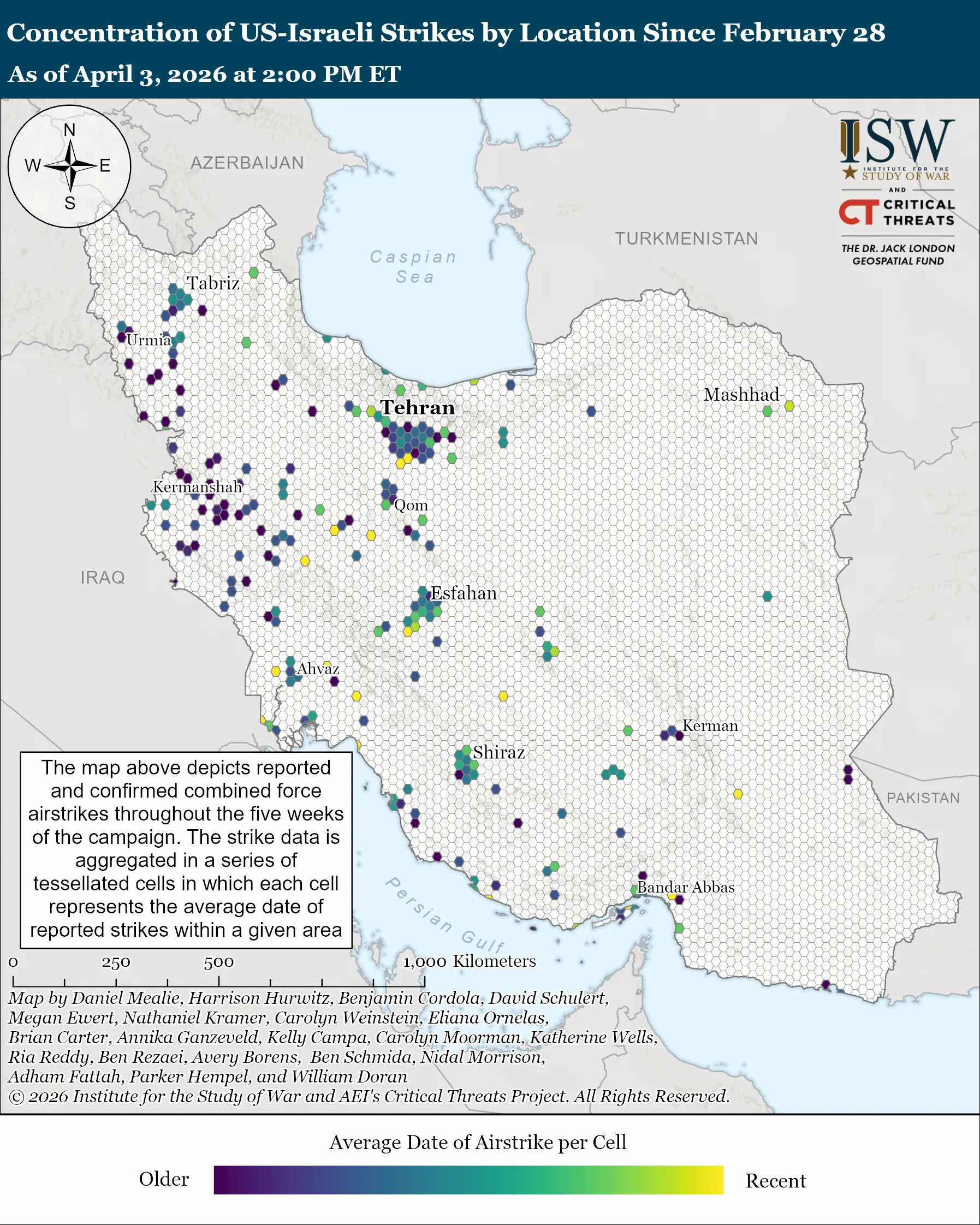
The pattern of recorded US-Israeli strikes shows a gradual shift towards targets in central and eastern Iran in more recent weeks of the campaign, but this effect could be the result of existing data limitations. The map above depicts reported and confirmed combined force airstrikes throughout the five weeks of the campaign. The strike data is aggregated in a series of tessellated cells in which each cell represents the average date of reported strikes within a given area. The combined force concentrated airstrikes targeting West Azerbaijan, East Azerbaijan, Kurdistan, Kermanshah, and Sistan and Baluchistan provinces at the beginning of the campaign, for example. The combined force gradually began to target Gilan, Yazd, Markazi, and Mazandaran provinces in central Iran at a greater scale during the later weeks of the campaign. The combined force has consistently struck Iranian targets in Tehran and Esfahan provinces throughout the campaign, likely given both regions relative importance to the Iranian military and defense industrial apparatus.
This map only depicts a small sample of the combined force's overall strike pattern and reflects the data limitations created by several conditions, including the Iranian regime's internet shutdown. Unverified textual reporting on strikes was excluded from the assessment. Restrictions upon commercially available satellite imagery limit ISW-CTP’s ability to visually confirm strikes. ISW-CTP defines confirmed airstrikes as kinetic activity that Israel or the United States confirmed through official channels or that were geolocated by visual means. ISW-CTP defines reported airstrikes as kinetic activity reported by authoritative sources with or without footage, but has not been confirmed with collaborative evidence.
Unspecified US and Israeli officials confirmed that Iran shot down a US Air Force F-15E over Iran on April 3.[22] This incident is the first known US combat aircraft lost over Iranian territory since the beginning of the war.[23] An unspecified Israeli official and a second source with knowledge of the situation told Axios on April 3 that the two crew members ejected safely after the aircraft was hit.[24] Unspecified US and Israeli sources told the New York Times on April 3 that US forces rescued one crew member and are searching for a second crew member.[25] An unspecified senior Israeli official told Axios on April 3 that Israel canceled planned strikes in Iran to avoid disrupting the rescue effort.[26] Unspecified US officials told CBS News on April 3 that two helicopters participated in the search-and-rescue mission and recovered the F-15E pilot after ejection.[27] The officials added that small arms fire hit the helicopter carrying the recovered pilot, wounding crew members on board, but that the helicopter landed safely.[28] A US A-10 Warthog involved in the search and rescue mission crashed near the Strait of Hormuz.[29] Unspecified US officials said that the aircraft came under Iranian fire and was damaged.[30] The pilot was safely recovered.[31]
Iranian strikes and intercepted fragments damaged several Gulf energy facilities on April 3. Iran continues to target Gulf energy infrastructure, which is part of the Iranian effort to drive up global energy prices and coerce the Gulf states into pressuring the United States and Israel to end their campaign. An Iranian drone struck Kuwait's Mina al Ahmadi Refinery, causing a fire.[70] The Kuwaiti government also acknowledged that an Iranian attack inflicted “material damage” to an unspecified Kuwaiti power and water desalination plant.[71] Iran previously attacked a Kuwaiti desalination plant on March 29.[72] Debris from an unspecified Iranian projectile led to two fires and caused ”significant damage” to Abu Dhabi’s Habshan Gas Complex.[73] At least one person was killed.[74]
Iran continues to launch cruise missiles targeting Gulf states. Iran launched four cruise missiles targeting the UAE and two cruise missiles targeting Kuwait on April 3.[76] Iran has launched at least 45 cruise missiles targeting Kuwait, Qatar, Saudi Arabia, and the UAE since the beginning of the war.[77] Iran has used cruise missiles to target civilian ships in the Persian Gulf and also the Gulf states’ territory.
https://understandingwar.org/research/middle-east/iran-update-special-report-april-3-2026/
1,886
posted on
04/04/2026 12:52:23 AM PDT
by
AdmSmith
(GCTGATATGTCTATGATTACTCAT)
To: nuconvert; BeauBo; gleeaikin
Charlie Rose: Iran War at a Critical Point | Former CIA Insider [Norman T. Roule] Explains the Possibilities
We will talk about many things, including the status of the war, President Trump’s speech to the nation, regime change, the relationship between the United States and Israel, how the war started and how it ends, the Straits of Hormuz, the price of oil, and the global economy.
https://www.youtube.com/watch?v=Aavgdk_7NeU
You should always listen to Norm.
1,887
posted on
04/04/2026 2:07:28 AM PDT
by
AdmSmith
(GCTGATATGTCTATGATTACTCAT)
These should have been taken out before the attack on Iran, but it's not too late. Thousands of Houthi Supporters Rally in Yemen as Sanaa Sends Strong Public Message Backing Iran
https://www.youtube.com/watch?v=Ps8Q_DmtaV4
Workers in Saada, Yemen say they dug tunnels for the #Iran-backed Huthis, who then refused to pay them, telling them: “You worked for the sake of God—go home. The disgruntled workers released videos & are threatening to publish more unless they receive their wages.
https://x.com/nasermoh29/status/2040378263219122292
video Houthis’ Potential Impact on Africa; DRC Commences Anti-FDLR Ops: Africa File, April 2, 2026
The Houthis have not joined Iran's economic warfare campaign since entering the Iran war, but they have threatened to close the Bab el Mandeb—the southern entrance to the Red Sea. Such a campaign could target positions in Africa and benefit from Houthi links in the Horn
Houthi networks in the Horn of Africa could be key in supporting any such campaign due to pressure on primary logistic networks from Iran. Yemeni officials claimed that Islamic Revolutionary Guards Corps officials arrived in Yemen via “the Horn of Africa” in the days before they entered the war in March 2026.
- Somalia: The Houthis and Iran have been increasingly involved in illicit networks linking Yemen and Somalia, which function both as an alternative supply line and a revenue-generating source.
- Djibouti: Djibouti has played a growing role in smuggling weapons to the Houthis since 2023, as the loosening of UN inspections on shipments to Houthi-controlled ports has enabled more weapons to be smuggled in civilian commercial shipments.
- Eritrea or Sudan: SanaaCenter cited a Yemeni official in a 2024 report who said that Eritrea and Sudan have also become nodes to move Iranian weapons and fighters to Yemen.
 Houthi Red Sea attacks and the resulting international response could involve US and allied positions in the Horn of Africa, including US positions in Djibouti and Emirati or possible Israeli assets in Somaliland.

- Energy consultants have warned that the closure of the Bab el Mandeb would “very likely” cause oil prices to surpass more than $150 per barrel, which is more than double the prewar cost, in the following months.
- Saudi Arabia has rerouted a significant portion of its oil exports to the Red Sea port of Yanbu in response to the closure of the Strait of Hormuz, with exports reaching nearly 70 percent of its prewar output and primarily going south through the Bab el Mandeb Strait to Asia. A regional Houthi campaign in the Gulf states or the Red Sea would further cripple the global economy.
Global economy:
The Red Sea and its two entrances—the Suez Canal and Bab el Mandeb—also account for nine to 12 percent of global trade and 25 to 30 percent of global container trade. Major carriers, including Maersk, Hapag-Lloyd, and CMA CGM, have already announced that they have begun rerouting vessels along the alternative route around Africa's southern tip at the Cape of Good Hope, which significantly increases shipping costs and timelines.
https://www.criticalthreats.org/analysis/houthi-yemen-iran-southwest-somalia-ethiopia-drc-rwanda-fdlr-m23-burundi-china-nigeria-iswap-africa-file-april-2-2026
1,888
posted on
04/04/2026 4:44:56 AM PDT
by
AdmSmith
(GCTGATATGTCTATGATTACTCAT)
To: AdmSmith
I listened. Norm’s good. I dont like Rose and it’s time for him to hang it up.
1,889
posted on
04/04/2026 4:45:55 AM PDT
by
nuconvert
( Warning: Accused of being a radical militarist. Approach with caution.)
To: gleeaikin
My question is, which countries of the wider world have a culture that will use their drones to threaten the world?
Only aggressive countries would use drones for threats and possible new wars. And there are countries that are in constant turmoil inside, and to give them purpose, the inept leadership will stir things up elsewhere, in attempts to create nationalistic fervor; iow, create a cause for their existence and a cause which will turn their attentions away from their awful internal conflicts and awful life-styles. Russians have never had a long period of peace and they're always in war mode, thanks to their aggressive leadership and inept economic leadership. Iran and N.Korea and others, are in constant aggressive mode too. That kind of country are the ones to be on the lookout for when it comes to using drones and missiles and whatever else they can get their hands on to wage war or unrest in nearby areas.
Drone don't have the range of missiles, not yet, but they're getting enough range how to be dangerous enough even to countries within a thousand miles of the aggressor. The U.S. is safe, for now. The problem with drones are that, they are still very slow and can be detected almost as soon as they're launched, and shooting them down is getting increasingly easier.
I suspect that the countries that best use this new weapon will also be the more desirable countries and governments.
>br> Any country can get its hands on any weapon, including drones and missiles. There are/will be good countries, and aggressive/hostile countries that get them too. Thus, the world will always be at war, no matter what the weapons and no matter the issues. Good countries is a relative term, since even within the hostile countries, the people will believe that, if they're at war, it's for a good cause.
Thus no increase in danger to us once they have the new equipment.
We are the only country in the world, besides Russia and China, that can bring our weapons in close proximity to where we might have to wage war. Iran could not bring their drones anywhere close to us, and neither could N.Korea. With ICBMS, any hostile country could reach us. But not with drones, unless they had drone-carriers or stashed them close to us in hostile nearby countries, like Cuba or Nicaragua or even Mexico. But, even those drones would be slow fliers and easily detected and perhaps even easier to shoot down.
Drones are the 'in thing' when it comes to weapons, but, eventually they won't be as deadly as they currently are; we're learning how to handle them, and even the Ukrainians are learning that lesson. So, the Ukrainians had better take advantage of the current destructiveness of drones, because they won't be so in a year or two.
1,890
posted on
04/04/2026 6:52:31 AM PDT
by
adorno
( )
To: nuconvert
Did the hackers use a box cuter?
1,891
posted on
04/04/2026 6:59:40 AM PDT
by
central_va
(I won’t be reconstructed and I do not give a damn)
Iran Update Special Report, April 4, 2026
The loss of two US aircraft does not indicate that the combined force has lost or is losing air superiority over Iran. Iranian forces shot down a US F-15E and an A-10 on April 3, marking the first such aircraft losses since the start of the conflict.[1] The combined force has maintained air superiority over Iran since the first phase of the campaign by degrading Iranian air and air defense capabilities.[2] Air superiority is when air power creates the conditions that allow one force to operate at “a given time and place without prohibitive interference from air and missile threats.”[3] Achieving air superiority does not mean that there is no risk to aircraft, and air superiority is not constant at all times, in all places, or at all altitudes.[4] Friendly forces can maintain air superiority even if the enemy is attempting to shoot down friendly aircraft, so long as the enemy air defenses do not seriously impede friendly operations. Iranian attempts to challenge US and Israeli air superiority have not seriously impeded the combined force's ability to conduct operations over Iran, as demonstrated by the persistent strikes nationwide.
China is helping Iran reconstitute the Iranian missile program amid US-Israeli efforts to degrade it. The Telegraph reported that five shipments of likely sodium perchlorate, a key precursor for solid missile propellant, have arrived in Iran from China.[5] All the vessels are owned by the Islamic Republic of Iran Shipping Line Group (IRISL), which the United States sanctioned in 2021.[6] Four of the vessels are docked or floating near the port in Chabahar, Sistan and Baluchistan Province, and one of the vessels is docked or near Bandar Abbas, Hormozgan Province, according to Starboard Maritime Intelligence. China has previously supplied sodium perchlorate to support Iran's ballistic missile program.[7] The combined force has targeted several elements of the Iranian ballistic missile program, including missile fuel and solid propellant motor production sites. China's efforts to help Iran reconstitute could undermine the combined force efforts to degrade or destroy the supporting elements of the ballistic missile program, however.
The combined force targeted the Iran-Iraq border crossing in Shalamcheh, Khuzestan Province, on April 4 for at least the second time since the war began as part of its ongoing efforts to target Iran's repressive capabilities.[8] Iraq has closed the border crossing following the strikes, according to a security source.[9] The strikes come amid reports that at least 1,000 Popular Mobilization Forces (PMF) fighters have deployed to Basij bases in Khuzestan Province via the Shalamcheh crossing.[10] CTP-ISW previously assessed that the regime may be mobilizing PMF fighters, in part, to strengthen control over previous protest hotspots.[11]
The IDF struck Iran's petrochemical facilities in Bandar-e Imam Khomeni, Khuzestan Province, on April 4, which the IDF said the regime used to manufacture materials for ballistic missiles.[21] The IDF stated that the strike targeted a site within the complex that constitutes one of two central facilities used to produce materials for explosives, ballistic missiles, and other weapons, including a key material necessary for ballistic missile production.[22] The IDF struck Fajr Petrochemical Company, Rejal Petrochemical Company, and Amir Kabir Petrochemical Company, according to Iranian media.[23] The United States sanctioned Fajr Petrochemical Company in 2019 for being owned or controlled by Persian Gulf Petrochemical Industries Company (PGPIC).[24] The United States sanctioned the PGPIC and its network of subsidiaries in 2019 for providing financial support to Khatam ol Anbia Construction Headquarters, which is an IRGC-controlled civil engineering and construction firm that dominates broad swaths of the Iranian economy.[25] The United States sanctioned Amir Kabir Petrochemical Company in 2023 for materially assisting Triliance Petrochemical Company, a previously designated firm involved in brokering the sale of Iranian petrochemicals.[26] The US Treasury reported in February 2023 that Amir Kabir facilitated the export of petrochemical products to buyers in East Asia, supporting Iranian efforts to evade sanctions and sustain export revenue.[27]
The combined force targeted an Islamic Republic of Iran Broadcasting (IRIB) radio and television station in Jamaran, northern Tehran Province, on April 3.[28] Iranian media have described Jamaran Station as the most important and “strategic” broadcast transmitter in Iran.[29] The IDF previously targeted the IRIB headquarters in Tehran on March 2, which is similarly responsible for spreading regime propaganda.[30]
The Houthis launched a ballistic missile with a cluster munition warhead and drones targeting central and southern Israel on April 4.[74] The Houthis claimed that they launched a ballistic missile with cluster munitions and several drones at the Ben Gurion Airport in Tel Aviv, as well as “vital military targets” in southern Israel.[75] The IDF said that it detected a ballistic missile launch from Yemen but allowed the missile to land in an open area, according to an Israeli military correspondent.[76] The IDF did not indicate whether the Houthi missile included a cluster munition warhead and did not report any drone interceptions, however.[77] The Houthis claimed that they coordinated the missile attack with Hezbollah and Iran.[78] The Houthis previously launched ballistic missiles with cluster munition warheads at Israel in 2025.[79] This attack marks the sixth time that the Houthis have attacked Israel since entering the conflict on March 28.[80] CTP-ISW continues to assess that the Houthis‘ involvement in the war thus far appears calibrated to try to avoid an immediate escalation with the United States and Israel.[81]
https://understandingwar.org/research/middle-east/iran-update-special-report-april-4-2026/
1,892
posted on
04/04/2026 11:55:58 PM PDT
by
AdmSmith
(GCTGATATGTCTATGATTACTCAT)
Iran Update Special Report, April 5, 2026
US President Donald Trump appears to have extended the deadline for Iran to stop attacking shipping through the Strait of Hormuz to 8:00 PM ET on April 7 amid discussions with Iranian officials.[1] Iranian Supreme Leader Mojtaba Khamenei said on April 5 that Iran would continue attacking shipping through the Strait, however.[2] Trump had previously set the deadline for Monday, April 6, following a prior extension.[3] Trump threatened to attack energy infrastructure and bridges in the event Iran persists in attacking shipping after his deadline.[4] Mojtaba said on April 5 that Iranian forces would continue to threaten shipping in the Strait of Hormuz.[5] Iranian Foreign Affairs Minister Abbas Araghchi held a phone call with Pakistani Foreign Minister Ishaq Dar on April 5 to discuss Pakistan's mediation efforts between Iran and the United States.[6] Media readouts did not disclose if Iran agreed to any negotiations, however.[7]
US Central Command (CENTCOM) confirmed that US forces on April 4 successfully completed the rescue of both F-15E crewmembers after Iran shot down their aircraft on April 2 during a combat mission.[8] CENTCOM had not previously acknowledged the earlier rescue of the F-15E pilot, which occurred on April 3.[9] US special operations forces successfully secured the F-15E weapons system officer (WSO) on April 4.[10] US officials told Western media that the WSO survived after evading capture for 36 hours, but he is seriously wounded and now receiving medical treatment in Kuwait.[11] The rescue operation resulted in an unspecified number of Iranian casualties.[12] US forces destroyed two transport aircraft and multiple MH-6 Little Birds that they could not extract from Iran after the rescue operation.[13] US President Donald Trump stated that the recoveries involved two US “raids” and noted that in the second operation, US forces spent seven hours over Iran.[14] Trump also announced he will hold a press conference in the Oval Office at 1:00 PM ET on April 6.[15]
The Iranian regime media is falsely characterizing the shootdown of the F-15E and subsequent downing of an A-10 attack aircraft during rescue operations as a US defeat.[16] US forces successfully established a makeshift airstrip very close to a major Iranian city, successfully extracted all of its personnel, and the combined force has continued to strike targets in Iran.[17] An Iranian military spokesperson said that Iranian forces ”thwarted” the rescue attempt, even though US forces recovered all personnel in Iran, and all personnel are alive.[18] Iranian regime media argued that US forces would not have struggled to get the MC‑130 aircraft off the ground if Iranian air defense systems had truly been neutralized.[19] The MC-130s were unable to get off the ground because their nose gear got stuck in the sand, not because of any Iranian action.[20]
The Israel Defense Forces (IDF) is continuing to target Iranian tunnel entrances to prevent Iranian forces from using tunnels to conceal missile sites. The head of the Israeli Air Intelligence Group stated on April 5 that Israel must expend “large resources” to prevent Iranian forces from hiding in mountainous areas.[21] The official added that the IDF blocks the tunnel entrances to prevent Iranian forces from entering or exiting the tunnels.[22] Iran buries important missile sites underneath mountains and in tunnels to conceal the sites and to make it difficult for airstrikes to damage them.[23]
Iran has slightly altered its strike packages to include more cruise missiles. Iran has previously not used cruise missiles at the rate it did on April 5, but it is unclear whether this represents experimentation with new tactics, an effort to manage the remaining missile reserves, or something else. Iran launched four cruise missiles at Kuwait, two at Qatar, and one each at the United Arab Emirates (UAE) and Saudi Arabia.[24]
The combined force continued to strike Iranian internal security forces. Islamic Revolutionary Guards Corps (IRGC)-affiliated media reported on April 5 that the combined force struck the Ahvaz International Airport in Ahvaz, Khuzestan Province.[28] It is unclear what the target of the strikes was. The 51st Hazrat-e Hojjat Independent Armored Brigade is based near the airport and operates under the Karbala Operational Base in Ahvaz.[29] OSINT accounts on X reported on April 5 that the combined force struck the IRGC Ground Forces 14th Imam Hossein Division and the Law Enforcement Command (LEC) Provincial headquarters in Esfahan, Esfahan Province.[30] The Imam Hossein Division operates under the Seyyed ol Shohada Operational Base in Esfahan, which the combined force struck on March 8.[31]
The combined force has continued its decapitation campaign against Iranian military officials. The combined force killed IRGC Brigadier General Mostafa Azizi on April 5.[32] IRGC-affiliated media reported on April 5 that Azizi served in the IRGC Navy's 3rd Imam Hossein Naval District in Khuzestan Province.[33] The 3rd Imam Hossein Naval District controls the northwestern Persian Gulf and Khuzestan’s maritime borders and coastal waters, and includes key naval infrastructure such as the Arvand Naval Base and associated surface combat brigades.[34] The IDF separately killed Mohammad Reza Ashrafi Ghahi in Tehran Province.[35] The IDF reported that Ashrafi Ghahi served as the head of commerce in the IRGC Oil Headquarters and managed oil sales that generated billions of dollars annually.[36] Iranian media reported on April 5 that the combined force killed Artesh Air Defense Academy Commander Brigadier General Masoud Zare during recent strikes.[37] US President Donald Trump stated on Truth Social on April 4 that “many of Iran's military leaders” were killed in a large strike in Tehran Province.[38] An OSINT reported that the video Trump shared shows explosions from strikes in northern Tehran conducted on April 3.[39]
Anti-regime media reported on April 5 that Iran's Bank Sepah experienced another major computer network disruption that reportedly prevented the bank from paying IRGC personnel and regime military officials.[40] The combined force previously struck a Bank Sepah building on March 11, in which Bank Sepah said that the strike destroyed the building and disrupted in-person and online services.[41] Bank Sepah is responsible for paying IRGC and Artesh personnel.[42] Repeated disruptions are notable because they could interfere with the regime's ability to pay military personnel, which could exacerbate the challenges the regime is facing with desertions.
The Houthis claimed that they launched a ballistic missile and several drones targeting Ben Gurion Airport, central Israel, and unspecified “vital [IDF] military targets” in southern Israel on April 4.[86] The Houthis noted that they conducted their operation in coordination with Iran and Hezbollah.[87] ISW-CTP has not observed any reports of impacts at Ben Gurion Airport at the time of this writing. This attack marks the seventh time that the Houthis have attacked Israel since entering the conflict on March 28.[88] ISW-CTP continues to assess that the Houthis’ involvement in the war thus far appears calibrated to try to avoid an immediate escalation with the United States and Israel.[89]
Iranian-backed Iraqi militias are attempting to blame Kuwait for attacks on Iraqi oil infrastructure, likely to obfuscate responsibility for these attacks to a domestic Iraqi audience. Unspecified actors also launched six drones targeting a China National Offshore Oil Corporation (CNOOC)-operated oil field in Maysan Province on April 4, igniting a fire.[97] This is the second time an Iraqi militia has targeted a partially or fully Chinese-owned asset since the beginning of the war. No group has claimed responsibility for the attack. Likely Iranian-backed Iraqi actors have repeatedly attacked other foreign-operated energy sites in Iraq since the start of the conflict, however.[98] Kataib Sarkhat al Quds attempted to obfuscate militia responsibility for the attacks on Iraqi energy infrastructure by blaming the Kuwaiti government and the Kurdistan Regional Government in an April 4 statement.[99] This statement will not fool Western governments, the Iraqi government, or others, but the Iraqi groups still need to answer to a popular domestic constituency.
https://understandingwar.org/research/middle-east/iran-update-special-report-april-5-2026/
1,893
posted on
04/05/2026 11:55:14 PM PDT
by
AdmSmith
(GCTGATATGTCTATGATTACTCAT)
Iran Update Special Report, April 6, 2026
Iran rejected a ceasefire agreement with the United States to pause the war and “reopen” the Strait of Hormuz on April 6.[1] Iran's rejection of the latest ceasefire proposal reduces the likelihood that the United States and Iran will reach an agreement by US President Donald Trump's April 7 deadline. The Pakistani-brokered proposal called for an immediate ceasefire followed by several weeks of negotiations to broker a lasting ceasefire and agreement to reopen the Strait of Hormuz.[2] Iran seeks a permanent end to the war rather than a temporary ceasefire, however.[3] Iranian state media reported that Iran's counterproposal included 10 demands, including a lasting ceasefire in the “region,” a “protocol for safe passage” through the Strait of Hormuz, support for Iran's reconstruction, and the lifting of sanctions.[4] Trump rejected Iran's counterproposal as “not good enough” on April 6.[5] A US official similarly described Iran's demands as “maximalist” to an Axios journalist on April 6.[6] Iran's demand for a ceasefire across the “region” presumably refers to a ceasefire that also ends Israel's campaign against Hezbollah in Lebanon. It is unclear what Iran is referring to when it calls for a “protocol for safe passage” through the Strait of Hormuz, but it may refer to a mechanism that would enable Iran to regulate traffic through the strait. This demand suggests that Iran is using the strait as a point of leverage to attempt to extract concessions and secure a favorable post-war agreement with the United States.
Trump stated that the Iranian regime seeks to reach a ceasefire with the United States despite the regime's rejection of the latest ceasefire proposal. Trump characterized Iranian negotiators as “active, willing participant[s]” and said that they “would like to be able to make a deal.”[7] Trump has twice moved his deadline for Iran to reach a deal — including once at the request of Iranian officials—in order to continue talks.[8] Iranian officials have continued to engage with mediators and countries involved in the talks. Iranian Foreign Minister Abbas Araghchi, who is involved in the talks, spoke with his Turkish and Qatari counterparts on April 6.[9] Both Turkey and Qatar are potential mediators for future talks.[10]
President Trump has maintained his threat to strike Iranian energy infrastructure and bridges if Iran does not agree to a deal by April 7.[11] Trump said in an April 6 White House press conference that the United States has a plan to render every bridge in Iran “decimated” and put every Iranian power plant “out of business” by midnight on April 8 if Iran does not agree to a deal.[12] US officials said that US forces are preparing to strike Iranian energy infrastructure on April 7 if President Trump orders them to do so.[13] US Defense Secretary Pete Hegseth said that the United States would conduct its largest volume of strikes on April 6 since the war began and will conduct even more strikes on April 7.[14]
Iran, Hezbollah, and the Houthis appear to have coordinated an attack targeting Israel on April 6, possibly to try to maximize the psychological effects of Iran's limited ability to conduct large-scale attacks against Israel. The three attacks triggered Israeli sirens across northern, central, and southern Israel within a roughly ten-minute period and the munitions used in the attacks appeared to reach Israeli airspace around the same time:[15]
Iran launched two ballistic missiles targeting central Israel.[16] Shrapnel fell in central Israel.[17] Initial military assessments indicated that at least one of the missiles contained a cluster munition warhead.[18]
The Houthis launched “several” drones targeting Eilat, southern Israel, which the Israel Defense Forces (IDF) intercepted.[19] The Houthis also claimed to fire cruise missiles, though these missiles do not appear to have reached Israel.[20]
Hezbollah rocket fire triggered sirens in Margaliot and Manara along the Israel-Lebanon border.[21] The timing of these attacks suggests that the attacks were coordinated to some degree, given the vastly different travel times of the munitions fired at Israel by Hezbollah, Iran, and the Houthis. Ballistic missiles launched from Iran take about 12 minutes to reach Israel, whereas Houthi drones take several hours to reach Israel once launched from Yemen.[22] Israelis living along the Lebanon-Israel border only receive a 15- to 30-second warning of an imminent Hezbollah rocket attack, in contrast.[23] The Houthis also claimed to conduct an attack coordinated with the IRGC and Hezbollah on April 1.[24]
Coordinated attacks between Iran and its Axis partners may aim to impose psychological effects on Israeli civilians by threatening multiple areas across Israel near-simultaneously. The volume and types of munitions used in the attack suggest that this attack was not necessarily intended to overwhelm Israeli air defenses. Iran, Hezbollah, and the Houthis may be unable to conduct a coordinated large-scale attack large enough to achieve this effect. Iran has struggled to conduct large-scale missile and drone attacks targeting Israel since the war began and is instead likely opting for a strategy designed to maximize the effects of its limited fire, including using cluster munitions and firing barrages throughout the day to increase the number of times per day that Israeli civilians must seek shelter. Near-simultaneous attacks from multiple fronts may seek to invoke the feeling among Israeli civilians of being “encircled” by Iran and the Axis of Resistance and thereby terrorize Israeli civilians.
Several social media users have falsely attributed data from the Jewish Institute for National Security of America (JINSA) on Iranian missile impact rates to ISW-CTP. ISW-CTP has not published an independent figure for Iranian missile impact rates in Israel. A recent JP Morgan report cited data from JINSA that missile impact rates in Israel rose from three percent during the first two weeks of the war to 27 percent in later weeks.[25] The 27 percent impact rate likely includes cluster munition impacts, which Iran started using at a greater scale starting in the second week of the war. Cluster munitions disperse over a wide area to maximize damage. Cluster munitions from one warhead can lead to over 30 individual impact sites, as seen on April 6 in central Israel. Many of the Iranian missile attacks that have caused damage and casualties in Israel have involved missiles with cluster munition warheads.
The combined force continued to strike Iranian internal security sites. OSINT accounts on X claimed on April 5 that US forces struck the Islamic Revolutionary Guards Corps (IRGC) Ground Forces 2nd Imam Sajjad Special Forces Brigade in Kazeroun, Fars Province.[42] The Imam Sajjad Brigade operates under the Madinah ol Munawarah Operational Base in Bandar Abbas, Hormozgan Province.[43] Anti-regime media separately reported on April 5 that the combined force struck the “Sarallah Barracks” in Tehran.[44] It is unclear whether this report was referring to the Sarallah Operational Base, which is responsible for coordinating internal security and protest suppression efforts in Tehran.[45] An OSINT account on X reported on April 5 that the combined force struck the Artesh 92nd Armored Division in Ahvaz, Khuzestan Province.[46] The combined force previously struck the 92nd Armored Division on March 12.[47] An OSINT account on X claimed on April 6 that the combined force also struck the Shahid Tondgouyan Basij headquarters in Ahvaz.[48]
The combined force has continued to degrade Iran's internal and external security apparatuses by targeting high-ranking commanders and low-ranking security personnel. The IDF confirmed that it killed IRGC Intelligence Organization Chief Major General Majid Khademi in an airstrike in Tehran.[66] Khademi had held this role since June 2025, when the IDF killed his predecessor, Mohammad Kazemi.[67] The IDF also killed IRGC Quds Force Special Operations Unit 840 Commander Ashar Bagheri.[68] Unit 840 is responsible for conducting clandestine and terrorist activities against Israelis inside and outside of Israel.[69] Bagheri and his deputy, Mohammad Reza Ansari, facilitated attacks against IDF forces operating in the Israeli buffer zone in Syria using Syrian operatives who previously served in the Syrian Arab Army.[70] Bagheri also directed efforts to smuggle weapons from Iran into Israeli territory.[71] Local Iranian officials separately reported on April 5 that a combined force airstrike in Qods County, Tehran Province, killed eight Basij members.[72]
Iran continues to selectively regulate commercial maritime traffic through the Strait of Hormuz. Iran reportedly forced two vessels, the Marshall Islands-flagged Rasheed and Bahamas-flagged Al Dayeen, that were carrying Qatari liquefied natural gas (LNG) bound for the People's Republic of China to turn back before transiting the strait on April 6.[73] This action is part of Iran's effort to impose economic costs on the Gulf states to coerce them to pressure the United States and Israel to end their campaign against Iran. An Indian government official separately stated that Iran has prevented 16 Indian‑flagged vessels, some of which were carrying oil and gas, from passing through the Strait of Hormuz since the start of the war.[74] Iranian Foreign Minister Abbas Araghchi held a phone call with his Indian counterpart, Subrahmanyam Jaishankar on April 6, likely in part to discuss the situation in the Strait of Hormuz.[75]
Iran continued to conduct drone and missile attacks against the Gulf states. Iran fired two cruise missiles at both Kuwait and the United Arab Emirates (UAE) (see below).[80] ISW-CTP previously noted on April 5 that Iran appears to have slightly altered its strike packages against the Gulf states to include more cruise missiles.[81] An Iranian drone also targeted an Emirati telecommunications company building in Fujairah, the UAE.[82]
Senior Houthi official Mohammad Ali al Houthi told Western media on April 6 that the group will refrain from attacking Saudi Arabia so long as the Saudi government “adheres to de-escalation.”[118] This statement is likely an attempt to deter Saudi Arabia from joining the US-Israeli campaign against Iran.
https://understandingwar.org/research/middle-east/iran-update-special-report-april-6-2026/
1,894
posted on
04/06/2026 11:34:02 PM PDT
by
AdmSmith
(GCTGATATGTCTATGATTACTCAT)
Iran Update Special Report, April 7, 2026
The United States and Iran agreed to a two-week ceasefire brokered by Pakistan on April 7 and will begin negotiations in Islamabad, Pakistan, on April 11.[1] The Iranian Supreme National Security Council announced that the regime agreed to the ceasefire on April 7, several hours after US President Donald Trump announced that he had agreed to the ceasefire on the condition that Iran reopen the Strait of Hormuz.[2] Trump made his announcement around three hours after Pakistani Prime Minister Shehbaz Sharif announced on X that diplomatic efforts toward a US-Iran agreement were “progressing steadily, strongly, and powerfully.”[3] Sharif called on Iran to “open” the Strait of Hormuz as a goodwill gesture and urged all warring parties to observe a ceasefire during the two-week period to facilitate a “conclusive” end to the war.[4] Iranian Foreign Affairs Minister Abbas Araghchi confirmed Iran's acceptance of the ceasefire and stated that Iran will allow the “safe passage” of vessels through the Strait of Hormuz during the two-week period “via coordination with Iran's armed forces and with due consideration of technical limitations.”[5]
President Trump described Iran's 10-point counterproposal that it sent to the United States on April 5 as “a workable basis on which to negotiate.”[6] Iran's demands included a permanent end to the war with guarantees that the United States or Israel will not attack Iran again.[7] Iran also demanded the lifting of all primary and secondary sanctions on Iran, the termination of all UN Security Council and International Atomic Energy Agency (IAEA) Board of Governors resolutions against Iran, the payment of reparations to Iran, the withdrawal of US forces from the region, and the cessation of war on all fronts, including Israeli operations against Hezbollah in Lebanon.[8] Iran also reportedly stated that it will charge vessels transiting the Strait of Hormuz a fee of up to $2 million US dollars, the revenue from which it will split with Oman and use for post-war reconstruction.[9] Iran's proposal to charge vessels that transit the Strait of Hormuz highlights Iran's attempt to use the strait as a point of leverage and for its financial gain.
Israel has reportedly agreed to cease operations against Iran and Hezbollah if Iran halts its operations in the Strait of Hormuz.[10] Pakistani Prime Minister Shehbaz Sharif posted on X on April 7 that Iran and the United States’ allies, presumably referring to Iran's Axis of Resistance and Israel, respectively, have agreed to an immediate ceasefire “everywhere, including [in] Lebanon and elsewhere.”[11] Israel and members of Iran's Axis of Resistance have not commented on the ceasefire at the time of this writing.
Combined force strikes on Iranian railways and roads may have cut off several Iranian lines of transportation to move weapons, including missiles and missile launchers or components, across Iran. The IDF struck eight rail bridges and road segments that the Iranian regime uses to move weapons and other military equipment.[12] An Israeli Army Radio correspondent reported that the IDF struck routes that Iran has used to transport missile launchers across Iran in order to evade combined force targeting.[13] These strikes primarily appear to impact transport routes in northwestern and central Iran, which mirrors the combined force's strikes on Iranian missile infrastructure primarily in western and central Iran. The destruction of key railway and road infrastructure may also have multiple secondary effects, such as further disrupting Iran's economy or limiting the regime's ability to move military and security forces across the country.
Several of the strikes appear to have been designed to disrupt the movement of missiles or other weapons to Iran's northwest by severing key Iranian railways connecting Tehran, Zanjan, and Tabriz. It is unclear how heavily Iranian forces rely on railways to transfer this equipment, however. Geolocated images show a cratered railway bridge in Chaharbagh, west of Karaj.[14] This railway connects Tehran to the Caspian Sea through Gilan Province and to other rail lines that lead to Tabriz and Urmia, the capitals of Iran's East Azerbaijan and West Azerbaijan provinces. Iran has two prominent missile bases located near Tabriz—the Southwest Tabriz and Amand missile bases—that the combined force has struck several times in this conflict.[15] Iran has increasingly launched missiles from central Iran as the combined force has degraded its ability to launch missiles from western Iran. Iran may seek to transfer missiles to western Iran that do not have a sufficient range to reach Israel if they are launched from central Iran. OSINT accounts on X reported that the combined force struck a railway bridge in Aminabad, Zanjan Province.[16] Anti-regime media claimed that there is an ammunition and missile depot located near this bridge.[17]
Israeli strikes on roadways and overpasses along routes that connect Tehran to western Iran may have also aimed to disrupt Iranian transfers of missile launchers or other weapons to these areas. An open-source intelligence (OSINT) account posted footage on X of a combined force strike that destroyed an overpass along a highway in eastern Karaj.[18] This strike reportedly took place along a highway that connects Karaj and Tehran to western Iran, and the strike took place around five kilometers south of Karaj’s B1 (Bileghan) Bridge, which is located along the same route. US forces struck the B1 Bridge on April 2 to disrupt Iran's ability to transfer missiles to western Iran.[19] The IDF also struck a bridge along the Hashtroud-Tabriz highway in East Azerbaijan Province.[20] The Hashtroud-Tabriz highway is the main highway that links Tehran to Tabriz through Zanjan. There are presumably alternative routes that Iranian forces could theoretically use, however.
The strikes may also disrupt to some degree Iranian movement of equipment by rail or road between Tehran and central Iran, including in Esfahan. An Israeli journalist posted footage of a reported strike on a railway bridge in Kashan, Esfahan Province, along the main rail line that connects Esfahan City to Qom to the north and ultimately, Tehran.[21] This strike appears to have severed a key rail line between Tehran and not only Esfahan, but also Shiraz and Kerman. Anti-regime media and OSINT accounts on X reported that the combined force struck an unspecified bridge in Qom City, Qom Province.[22] The combined force also struck a rail bridge near Qaleh No, Tehran Province, along the railway that connects Tehran to Mashhad in northeastern Iran.[23]
Russia may be helping Iran conduct attacks on international shipping in the Strait of Hormuz by providing Iran with satellite imagery of the strait.[24] Reuters reported on April 7 that Russian satellites are “actively surveying” the Strait of Hormuz, according to Ukrainian intelligence.[25] Russia has provided Iran with satellite imagery of US, Gulf, and Turkish military assets in the Middle East to help Iran conduct attacks since the war began.[26] Russia previously provided the Houthis with targeting intelligence in 2024 to support their attacks targeting international shipping.[27] United Kingdom Maritime Trade Operations (UKMTO) has received 28 reports of attacks or incidents affecting civilian vessels transiting the strait since the war began.[28] A source familiar with Ukrainian intelligence separately told Israeli media on April 7 that Russia provided Iran with a list of 55 critical energy infrastructure targets in Israel.[29]
Islamic Revolutionary Guards Corps (IRGC) Commander Brigadier General Ahmad Vahidi and Khatam ol Anbia Central Headquarters Commander Ali Abdollahi Aliabadi are reportedly driving decisions related to Iran's kinetic response to the US and Israeli air campaign, according to two sources close to President Masoud Pezeshkian’s office speaking to anti-regime media on April 7.[30] Pezeshkian accused both commanders on April 4 of acting unilaterally and fueling escalation through attacks on regional countries, according to the sources.[31] These internal tensions come amid a separate British media report on April 6 that Supreme Leader Mojtaba Khamenei is incapacitated and receiving medical treatment in Qom, citing a diplomatic memo based on US and Israeli intelligence shared with Gulf allies.[32]
The IDF continued to target IRGC headquarters in Tehran. The IDF struck an IRGC headquarters in Shahrak-e Valfajr, Tehran City, on April 6. There are several military and internal security sites in this area, including the IRGC General Command Headquarters.[56] The IDF previously struck the IRGC General Command Headquarters on March 4 and damaged at least four buildings.[57] The IRGC is the primary body responsible for controlling the Iranian missile and drone arsenals and managing and supporting Iran's Axis of Resistance.[58] The IRGC also oversees the IRGC Ground Forces, which have historically played a role in maintaining internal security.
The IDF said that it also struck an IRGC site that “served the armed forces responsible for suppressing the civilian population in Iran.”[59] CTP-ISW could not confirm the exact site that was struck, but there are several IRGC facilities located near the targeted area, including the IRGC Intelligence Protection Organization and IRGC Ground Forces Headquarters.
US forces “restruck” Iranian military targets on Kharg Island on April 7.[60] The United States reportedly conducted over 90 strikes on military infrastructure on Kharg Island on April 7.[61] A US official told the New York Times that the US strikes were “restrikes” targeting previously targeted military sites on the island.[62] The United States struck bunkers, ammunition storage facilities, a radar station, and other military targets.[63] The United States previously struck military targets on Kharg Island on March 13.[64] The United States did not target oil infrastructure or port facilities in either the March 13 or April 7 strikes.[65] The most recent strikes on Kharg Island come after unspecified sources familiar with US intelligence reports told CNN on March 26 that Iran has reinforced Kharg Island with man-portable air-defense systems (MANPADS) and other military equipment in recent weeks.[66]
Iran continued to conduct drone and missile attacks against the Gulf states. Iran fired 22 drones and 11 ballistic missiles at Saudi Arabia between 2:00 PM ET on April 6 and 2:00 PM ET on April 7.[73] The Saudi Defense Ministry reported that debris from seven intercepted Iranian ballistic missiles fell near Saudi energy facilities in Saudi Arabia's Eastern Province.[74] Multiple media outlets and OSINT accounts published footage of an explosion at the Jubail Industrial City in eastern Saudi Arabia.[75] The IRGC claimed that it launched missiles and drones targeting US energy companies located in Jubail.[76] Saudi Arabia closed the King Fahd Causeway, the only road that links Saudi Arabia to Bahrain, due to the threat of further Iranian attacks targeting the Eastern Province.[77] The United Arab Emirates (UAE) recorded the lowest number of Iranian drone launches at the UAE since March 26 and the lowest number of ballistic missile launches at the UAE since March 25 (see below).[78] An OSINT account reported that an Iranian ballistic missile injured two Pakistani nationals and damaged a Thuraya Telecommunications Company building in Shajarah Governorate, the UAE, on April 7.[79] The Kuwaiti Army reported that it intercepted 17 drones targeting Kuwait in the past 24 hours.[80] This is a notable decrease from the 14 ballistic missiles, two cruise missiles, and 46 drones that the Kuwaiti Army intercepted on April 6.[81]
https://understandingwar.org/research/middle-east/iran-update-special-report-april-7-2026/
1,895
posted on
04/08/2026 2:32:06 AM PDT
by
AdmSmith
(GCTGATATGTCTATGATTACTCAT)
To: nuconvert; BeauBo
 It is cheaper to change the regime in Iran and in North Yemen (Houthis)
1,896
posted on
04/08/2026 5:07:33 AM PDT
by
AdmSmith
(GCTGATATGTCTATGATTACTCAT)
1,897
posted on
04/08/2026 6:32:09 AM PDT
by
AdmSmith
(GCTGATATGTCTATGATTACTCAT)
To: nuconvert
08APR2026 Ward Carroll:
Former CENTCOM Commander's Deep Intel on Ending the Iran War.
Retired U.S. Marine Corps General Frank McKenzie, who was in charge of Central Command from 2019 until 2022, details his experiences in dealing with the Iranian threat and his recommendations for ending Operation Epic Fury. General McKenzie details how he oversaw the raid in Syria that resulted in the death of ISIS leader Abu Bakr al-Baghdadi and the armed drone strike that killed Iranian Republican Guard General Qassim Soleimani and what those actions did - both intended and unintended - throughout the Middle East and eventually led to Operation Epic Fury.
https://www.youtube.com/watch?v=sA82tOwpwJ8
1,898
posted on
04/08/2026 11:45:21 AM PDT
by
AdmSmith
(GCTGATATGTCTATGATTACTCAT)
To: AdmSmith
I’m watching. However, McKenzie admitted that he thought this recent rescue mission was too dangerous, and
would have been against it. Just sayin’.....
1,899
posted on
04/08/2026 12:39:27 PM PDT
by
nuconvert
( Warning: Accused of being a radical militarist. Approach with caution.)
To: nuconvert
Iran Update Special Report, April 8, 2026
US President Donald Trump announced on April 7 that the United States and Iran had agreed to a two-week ceasefire deal mediated by Pakistan.[1] Trump stated that Iran sent a ten-point proposal to form the basis of upcoming negotiations in Islamabad, Pakistan, on April 10.[2] Trump stated that “almost all” of the previous points of contention between the sides have been agreed to.[3] Islamic Revolutionary Guards Corps (IRGC)-affiliated media reported on April 8 that Iran will withdraw from the ceasefire agreement if Israel continues to attack Lebanon, citing an informed source, however.[4] Iran's proposal includes multiple points that contradict the US 15-point proposal on March 24.[5] Iran's proposed ten points are as follows:
A guarantee of no further US attacks against Iran
Iran maintains control of the Strait of Hormuz.
Ending the regional war on all fronts, including against Hezbollah in Lebanon.
Withdrawal of U.S. combat forces from all bases and positions in the region.
Reparations to Iran for war damages.
Acceptance of Iran's right to nuclear enrichment.
Lifting all primary sanctions on Iran.
Lifting all secondary sanctions on Iran.
Termination of all resolutions against Iran by the Board of Governors of the International Atomic Energy Agency.
Termination of all United Nations Security Council resolutions against Iran.[6]
The US proposal stipulated that Iran would not enrich uranium on Iranian soil and dismantle its nuclear program.[7] Trump has demanded multiple times that Iran reopen the Strait of Hormuz.[8]
Iranian Parliament Speaker Mohammad Bagher Ghalibaf stated on April 8 that the United States and/or Israel violated three of Iran's points in the ten-point proposal.[9] Iran's proposal is a framework for negotiation and not a binding agreement on the United States, however. Ghalibaf claimed that Israel violated Iran's demand by continuing to strike Lebanon despite Lebanon not being part of the ceasefire agreement (see below).[10] Ghalibaf also claimed that the United States denied Iran's “right” to enrich uranium.[11] Iran's “right” to enrich uranium was one of the main points of negotiation before the war, and Iran never made a serious compromise on the point of uranium enrichment. Uranium enrichment will remain a major point of negotiation in the upcoming talks on April 10.[12]
Senior US and Israeli officials stated on April 7 and 8 that the Israeli campaign in Lebanon is not a part of the US-Iran ceasefire deal. Hezbollah officials claimed that unspecified actors informed the group that it would be a party to the ceasefire deal.[13] US President Donald Trump told PBS News on April 8 that Lebanon is not included in the US-Iran ceasefire deal.[14] Trump claimed that the Israeli campaign in Lebanon is “a separate skirmish.”[15] Israeli Prime Minister Benjamin Netanyahu's Office released a statement on April 7 saying that the two-week ceasefire does not apply to Lebanon.[16] Israel Defense Forces (IDF) Chief of Staff General Eyal Zamir said that Israel will continue to launch strikes targeting Hezbollah “non-stop” in Lebanon.[17] Hezbollah parliamentarian Ibrahim Moussawi told Reuters on April 8 that Hezbollah halted attacks against Israel after unspecified actors ”informed [Hezbollah] that it [was] part of the ceasefire – so we abided by it.”[18] A Hezbollah official told AP that Hezbollah would give mediators a chance to secure a ceasefire in Lebanon.[19] The official said that Hezbollah had not agreed to the ceasefire yet because Israel had yet to adhere to it.[20] Three Lebanese sources close to Hezbollah told Reuters that Hezbollah stopped attacking Israeli targets on April 8.[21] Hezbollah parliamentarian Hassan Fadlallah told Reuters that Israeli strikes on Lebanon were a ceasefire violation that would have” repercussions for the entire agreement.”[22] All claimed Hezbollah attacks occurred before the US and Iran implemented the ceasefire, with the last claimed attack occurring at 18:00 ET on April 7.[23] ISW-CTP has not observed any Israeli reports of Hezbollah attacks on northern Israel at the time of this writing.
The IDF conducted the largest number of airstrikes against Hezbollah personnel and infrastructure throughout Lebanon, including central Beirut, since the start of the Israeli campaign in Lebanon.[24] The IDF struck over 100 Hezbollah headquarters, command-and-control centers, missile launch sites, and Hezbollah drone unit and Radwan Force sites in Beirut, southern Lebanon, and the Bekaa Valley.[25] Israeli Defense Minister Israel Katz said that the Israeli strikes were the “largest concentrated blow” dealt to Hezbollah since the September 2024 Israeli pager operation, which killed 39 people and wounded more than 3,400.[26] Open source (OSINT) accounts published and geolocated footage showing Israeli strikes in areas of central Beirut, including Ain al Mraiseh and Mazraa.[27] The IDF has repeatedly struck sites in Beirut's southern suburbs since the start of the conflict.[28] The IDF has rarely targeted Hezbollah personnel or sites in central Beirut, however.[29] IDF Arabic spokesperson Lieutenant Colonel Ella Waweya reported on April 8 that Hezbollah has begun to relocate forces from Beirut's southern suburbs to densely populated civilian areas in central Beirut to complicate the IDF’s ability to target the group.[30] The IDF reportedly killed Hezbollah-aligned cleric Sadiq al Nabulsi in an airstrike on the al Zahraa complex in Sidon, Sidon District.[31] Lebanese media reported that Nabulsi was not an official Hezbollah member but preached in favor of Hezbollah.[32] IDF strikes killed 182 people and wounded 890 others, according to the Lebanese Health Ministry.[33] The Health Ministry's numbers did not distinguish between combatants and non-combatants.[34]
Iran has continued to threaten shipping in the Strait of Hormuz despite the ceasefire, which is making vessels reticent to transit the strait. Unspecified Iranian maritime and military authorities have issued radio warnings that vessels transiting without permission could be destroyed.[35] Iran is levying these threats so that it can extract tolls on traffic through an international waterway. The Iranian Oil, Gas, and Petrochemical Product Exporters’ Union spokesperson, close to the Iranian regime, told the Financial Times on April 8 that Iran intends to continue to monitor everything entering and exiting the strait to prevent unspecified weapons transfers to unspecified states.[36] The spokesperson added that Iran requires vessels to transit along Iran's coastline and to submit cargo details by email to Iranian authorities.[37] The spokesperson added that Iran will impose a $1‑per‑barrel tariff on oil shipments—reportedly payable in bitcoin to bypass sanctions—while empty tankers would transit for free.[38] The Wall Street Journal reported in April that fees could alternatively be paid in Chinese yuan and could rise as high as $2 million for large tankers.[39] Iranian shipping officials on April 8 have publicly defended tolls and monitoring as lawful and enforceable under international maritime norms, citing environmental protection and enforcement obligations.[40] Omani Transport Minister Saeed bin Hamoud bin Saeed al Maawali stated on April 8 that Oman will not impose fees as it has signed international maritime agreements; however, and pointed to a legal vacuum created by non‑signatory states such as Iran and the United States.[41] A hardline Iranian Parliament member added on April 8 that political conditions, including mandating the use of the term “Persian Gulf” on shipping documents and pledging to devote 30 percent of Strait‑related revenues to defense and 70 percent to war‑loss compensation.[42] These measures follow parliament's approval of a new management plan that introduces transit fees and Iranian approval for passage on March 30.[43]
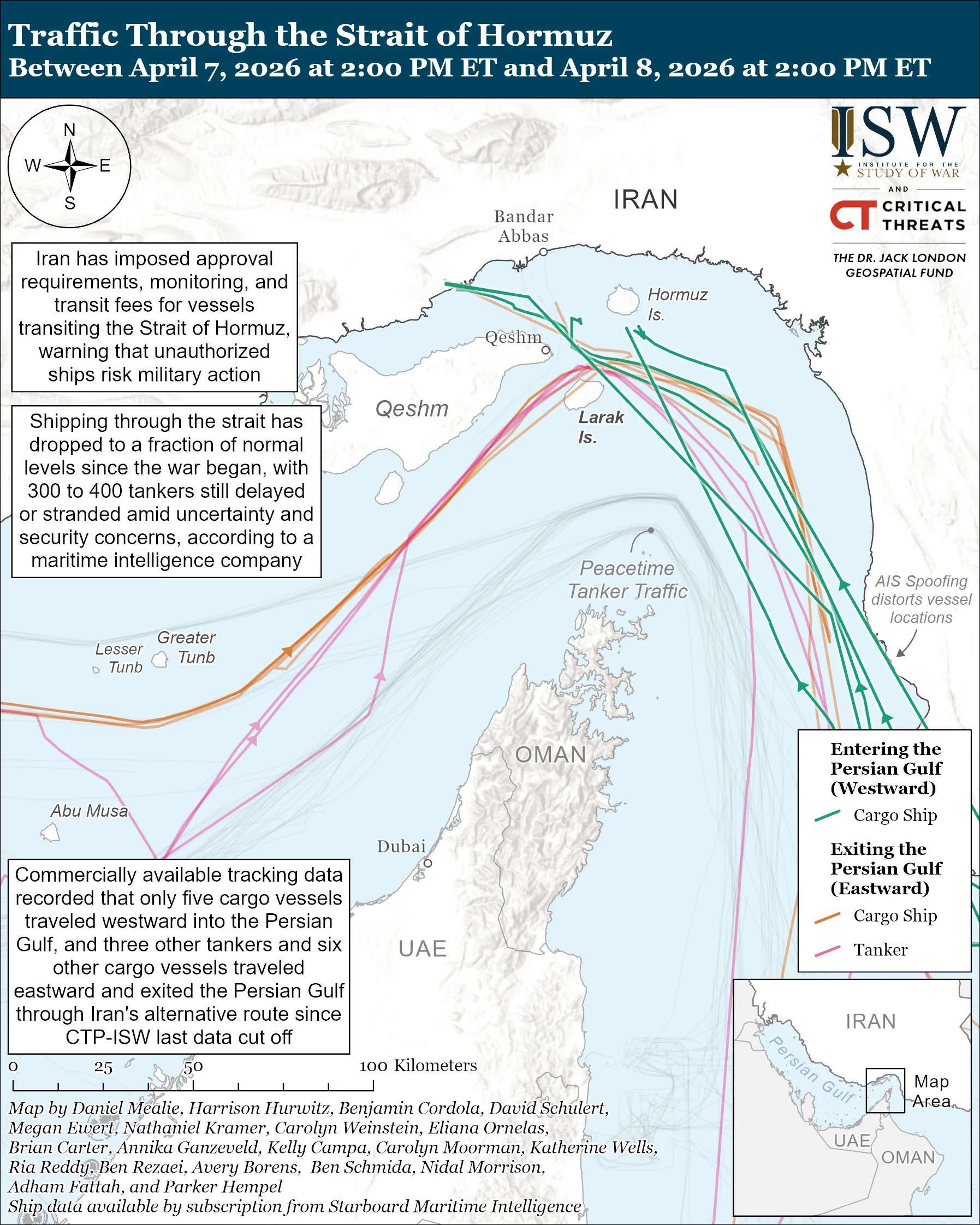
Traffic through the Strait of Hormuz remains significantly low amid Iran's lingering threats and uncertainty over a fragile ceasefire. Commercial maritime tracking data showed only five Iranian‑flagged cargo vessels entered the strait, while just three international oil tankers, six international cargo vessels, and one unknown Iranian-flagged vessel exited via Iran's alternative route between April 7 at 2:00 PM ET and April 8 at 2:00 PM ET.[44] The S&P Global Market Intelligence recorded that Iran permitted only four vessels to transit on April 7, the lowest daily total so far in April.[45] Major shipping companies, including Maersk and Mitsui O.S.K. Lines, continue to suspend or tightly limit transits, citing the absence of clear rules and security guarantees.[46] Shipping and maritime intelligence executives told the Financial Times that daily traffic has fallen to just 10 to 15 vessels, compared with roughly 135 per day before the crisis.[47] Around 800 tankers are now waiting to transit, with an estimated 300 to 400 vessels effectively stranded inside the Persian Gulf.[48]
Iranian Foreign Affairs Minister Abbas Araghchi had to convince Islamic Revolutionary Guards Corps (IRGC) commanders to accept the US proposal for a ceasefire, according to a regional source familiar with the talks speaking to Axios.[49] The ceasefire follows reports that a group of veteran hardline IRGC commanders has consolidated power within the Iranian regime in recent weeks and is playing an increasingly central role in decision-making, such as appointments to key positions.[50] These commanders have been deeply involved in the highest levels of the regime since its foundation in 1979. That Araghchi reportedly had to convince members of the IRGC to accept the ceasefire suggests that the IRGC maintains significant influence over key regime decisions and continues to push for more hardline, anti-Western policies. Sources familiar with talks also described Iranian Supreme Leader Mojtaba Khamenei’s approval for the ceasefire as a “breakthrough” and added that he approved all major decisions related to the ceasefire on April 6 and 7.[51] This suggests that Mojtaba may also retain at least some level of decision-making authority amid reports that Mojtaba is badly injured due to US-Israeli airstrikes and is absent from decision-making.
The combined force struck multiple Iranian petrochemical facilities before the ceasefire went into effect. Anti-regime media reported airstrikes on the Amir Kabir Petrochemical Company, the Bandar Imam Petrochemical Company, and the Mahshahr Fajr Petrochemical Company in Khuzestan Province on April 7.[52] The IDF previously struck the Amir Kabir Petrochemical Company and the Mahshahr Fajr Petrochemical Company on April 4.[53] The IDF has struck several Iranian petrochemical facilities in the days before the ceasefire.[54]
Iran launched multiple strikes targeting Gulf countries after the ceasefire went into effect. The United Arab Emirates (UAE)’s Defense Ministry announced on April 8 that Iran launched 17 ballistic missiles and 35 drones at the UAE after the ceasefire went into effect.[61] Kuwait's Defense Ministry said that Iran launched 28 drones at Kuwait since 1:00 AM ET on April 8, with Kuwait intercepting most of the drones.[62] Kuwait did not characterize these attacks as ceasefire violations, however. Iranian drones struck several sites, including oil facilities and three power and water desalination plants, at the Kuwait Petroleum Corporation and Ministry of Electricity, Water, and Renewable Energy in Kuwait City on April 8, causing significant material damage.[63] Iran did not claim attacks targeting the UAE and Kuwait, but Iranian media noted that the attacks occurred after the reported attacks targeting Iranian oil facilities on Lavan island.[64] The IDF denied its involvement in the attacks targeting the oil facilities.[65]
More text, maps and graphs:
https://understandingwar.org/research/middle-east/iran-update-special-report-april-8-2026/
Oil Price
https://tradingeconomics.com/commodity/crude-oil
1,900
posted on
04/08/2026 11:09:30 PM PDT
by
AdmSmith
(GCTGATATGTCTATGATTACTCAT)
Navigation: use the links below to view more comments.
first previous 1-20 ... 1,861-1,880, 1,881-1,900, 1,901-1,920 ... 2,461-2,478 next last
Disclaimer:
Opinions posted on Free Republic are those of the individual
posters and do not necessarily represent the opinion of Free Republic or its
management. All materials posted herein are protected by copyright law and the
exemption for fair use of copyrighted works.
FreeRepublic.com is powered by software copyright 2000-2008 John Robinson