US President Donald Trump announced on April 7 that the United States and Iran had agreed to a two-week ceasefire deal mediated by Pakistan.[1] Trump stated that Iran sent a ten-point proposal to form the basis of upcoming negotiations in Islamabad, Pakistan, on April 10.[2] Trump stated that “almost all” of the previous points of contention between the sides have been agreed to.[3] Islamic Revolutionary Guards Corps (IRGC)-affiliated media reported on April 8 that Iran will withdraw from the ceasefire agreement if Israel continues to attack Lebanon, citing an informed source, however.[4] Iran's proposal includes multiple points that contradict the US 15-point proposal on March 24.[5] Iran's proposed ten points are as follows:
A guarantee of no further US attacks against Iran
Iran maintains control of the Strait of Hormuz.
Ending the regional war on all fronts, including against Hezbollah in Lebanon.
Withdrawal of U.S. combat forces from all bases and positions in the region.
Reparations to Iran for war damages.
Acceptance of Iran's right to nuclear enrichment.
Lifting all primary sanctions on Iran.
Lifting all secondary sanctions on Iran.
Termination of all resolutions against Iran by the Board of Governors of the International Atomic Energy Agency.
Termination of all United Nations Security Council resolutions against Iran.[6]
The US proposal stipulated that Iran would not enrich uranium on Iranian soil and dismantle its nuclear program.[7] Trump has demanded multiple times that Iran reopen the Strait of Hormuz.[8]
Iranian Parliament Speaker Mohammad Bagher Ghalibaf stated on April 8 that the United States and/or Israel violated three of Iran's points in the ten-point proposal.[9] Iran's proposal is a framework for negotiation and not a binding agreement on the United States, however. Ghalibaf claimed that Israel violated Iran's demand by continuing to strike Lebanon despite Lebanon not being part of the ceasefire agreement (see below).[10] Ghalibaf also claimed that the United States denied Iran's “right” to enrich uranium.[11] Iran's “right” to enrich uranium was one of the main points of negotiation before the war, and Iran never made a serious compromise on the point of uranium enrichment. Uranium enrichment will remain a major point of negotiation in the upcoming talks on April 10.[12]
Senior US and Israeli officials stated on April 7 and 8 that the Israeli campaign in Lebanon is not a part of the US-Iran ceasefire deal. Hezbollah officials claimed that unspecified actors informed the group that it would be a party to the ceasefire deal.[13] US President Donald Trump told PBS News on April 8 that Lebanon is not included in the US-Iran ceasefire deal.[14] Trump claimed that the Israeli campaign in Lebanon is “a separate skirmish.”[15] Israeli Prime Minister Benjamin Netanyahu's Office released a statement on April 7 saying that the two-week ceasefire does not apply to Lebanon.[16] Israel Defense Forces (IDF) Chief of Staff General Eyal Zamir said that Israel will continue to launch strikes targeting Hezbollah “non-stop” in Lebanon.[17] Hezbollah parliamentarian Ibrahim Moussawi told Reuters on April 8 that Hezbollah halted attacks against Israel after unspecified actors ”informed [Hezbollah] that it [was] part of the ceasefire – so we abided by it.”[18] A Hezbollah official told AP that Hezbollah would give mediators a chance to secure a ceasefire in Lebanon.[19] The official said that Hezbollah had not agreed to the ceasefire yet because Israel had yet to adhere to it.[20] Three Lebanese sources close to Hezbollah told Reuters that Hezbollah stopped attacking Israeli targets on April 8.[21] Hezbollah parliamentarian Hassan Fadlallah told Reuters that Israeli strikes on Lebanon were a ceasefire violation that would have” repercussions for the entire agreement.”[22] All claimed Hezbollah attacks occurred before the US and Iran implemented the ceasefire, with the last claimed attack occurring at 18:00 ET on April 7.[23] ISW-CTP has not observed any Israeli reports of Hezbollah attacks on northern Israel at the time of this writing.
The IDF conducted the largest number of airstrikes against Hezbollah personnel and infrastructure throughout Lebanon, including central Beirut, since the start of the Israeli campaign in Lebanon.[24] The IDF struck over 100 Hezbollah headquarters, command-and-control centers, missile launch sites, and Hezbollah drone unit and Radwan Force sites in Beirut, southern Lebanon, and the Bekaa Valley.[25] Israeli Defense Minister Israel Katz said that the Israeli strikes were the “largest concentrated blow” dealt to Hezbollah since the September 2024 Israeli pager operation, which killed 39 people and wounded more than 3,400.[26] Open source (OSINT) accounts published and geolocated footage showing Israeli strikes in areas of central Beirut, including Ain al Mraiseh and Mazraa.[27] The IDF has repeatedly struck sites in Beirut's southern suburbs since the start of the conflict.[28] The IDF has rarely targeted Hezbollah personnel or sites in central Beirut, however.[29] IDF Arabic spokesperson Lieutenant Colonel Ella Waweya reported on April 8 that Hezbollah has begun to relocate forces from Beirut's southern suburbs to densely populated civilian areas in central Beirut to complicate the IDF’s ability to target the group.[30] The IDF reportedly killed Hezbollah-aligned cleric Sadiq al Nabulsi in an airstrike on the al Zahraa complex in Sidon, Sidon District.[31] Lebanese media reported that Nabulsi was not an official Hezbollah member but preached in favor of Hezbollah.[32] IDF strikes killed 182 people and wounded 890 others, according to the Lebanese Health Ministry.[33] The Health Ministry's numbers did not distinguish between combatants and non-combatants.[34]
Iran has continued to threaten shipping in the Strait of Hormuz despite the ceasefire, which is making vessels reticent to transit the strait. Unspecified Iranian maritime and military authorities have issued radio warnings that vessels transiting without permission could be destroyed.[35] Iran is levying these threats so that it can extract tolls on traffic through an international waterway. The Iranian Oil, Gas, and Petrochemical Product Exporters’ Union spokesperson, close to the Iranian regime, told the Financial Times on April 8 that Iran intends to continue to monitor everything entering and exiting the strait to prevent unspecified weapons transfers to unspecified states.[36] The spokesperson added that Iran requires vessels to transit along Iran's coastline and to submit cargo details by email to Iranian authorities.[37] The spokesperson added that Iran will impose a $1‑per‑barrel tariff on oil shipments—reportedly payable in bitcoin to bypass sanctions—while empty tankers would transit for free.[38] The Wall Street Journal reported in April that fees could alternatively be paid in Chinese yuan and could rise as high as $2 million for large tankers.[39] Iranian shipping officials on April 8 have publicly defended tolls and monitoring as lawful and enforceable under international maritime norms, citing environmental protection and enforcement obligations.[40] Omani Transport Minister Saeed bin Hamoud bin Saeed al Maawali stated on April 8 that Oman will not impose fees as it has signed international maritime agreements; however, and pointed to a legal vacuum created by non‑signatory states such as Iran and the United States.[41] A hardline Iranian Parliament member added on April 8 that political conditions, including mandating the use of the term “Persian Gulf” on shipping documents and pledging to devote 30 percent of Strait‑related revenues to defense and 70 percent to war‑loss compensation.[42] These measures follow parliament's approval of a new management plan that introduces transit fees and Iranian approval for passage on March 30.[43]
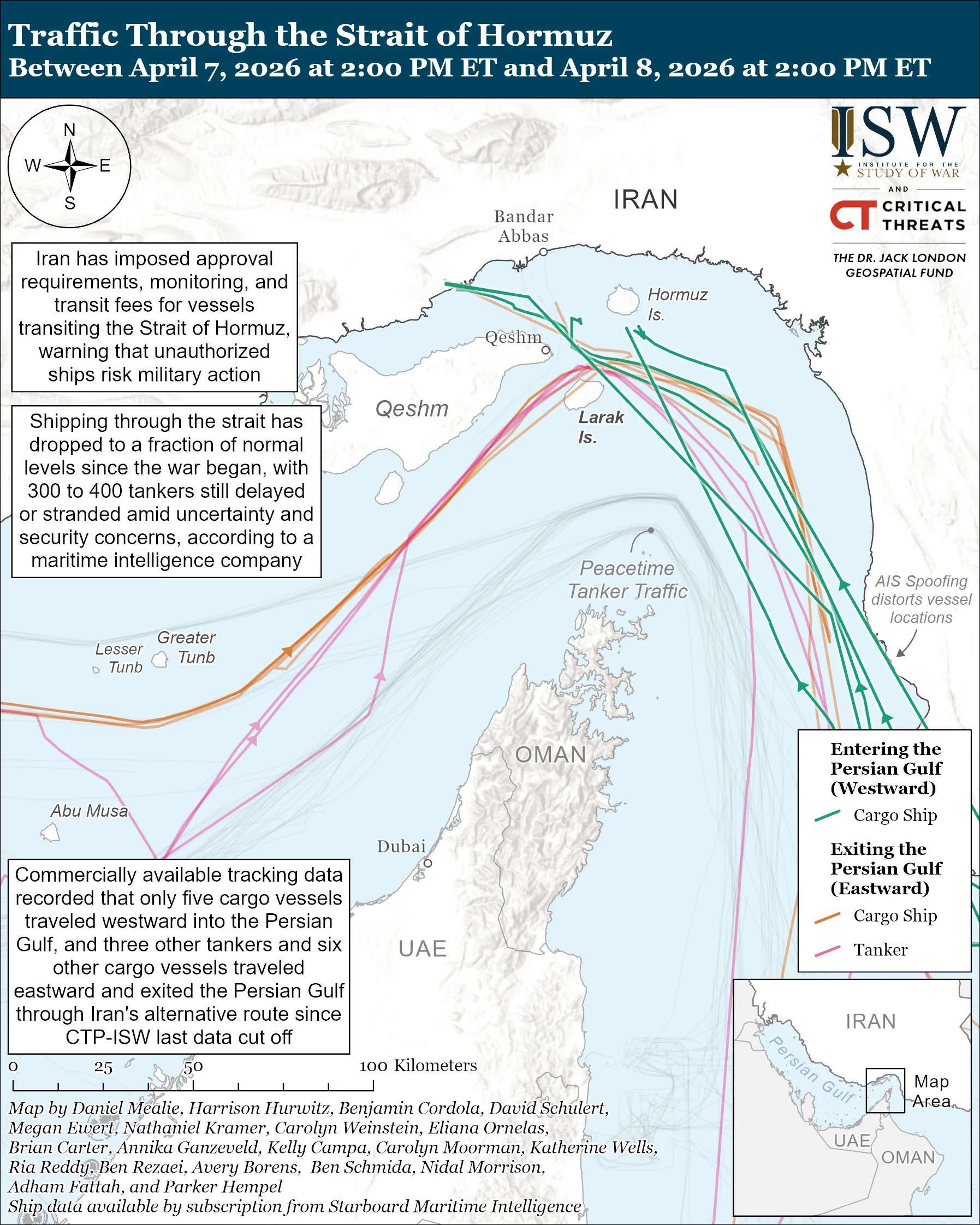
Traffic through the Strait of Hormuz remains significantly low amid Iran's lingering threats and uncertainty over a fragile ceasefire. Commercial maritime tracking data showed only five Iranian‑flagged cargo vessels entered the strait, while just three international oil tankers, six international cargo vessels, and one unknown Iranian-flagged vessel exited via Iran's alternative route between April 7 at 2:00 PM ET and April 8 at 2:00 PM ET.[44] The S&P Global Market Intelligence recorded that Iran permitted only four vessels to transit on April 7, the lowest daily total so far in April.[45] Major shipping companies, including Maersk and Mitsui O.S.K. Lines, continue to suspend or tightly limit transits, citing the absence of clear rules and security guarantees.[46] Shipping and maritime intelligence executives told the Financial Times that daily traffic has fallen to just 10 to 15 vessels, compared with roughly 135 per day before the crisis.[47] Around 800 tankers are now waiting to transit, with an estimated 300 to 400 vessels effectively stranded inside the Persian Gulf.[48]
Iranian Foreign Affairs Minister Abbas Araghchi had to convince Islamic Revolutionary Guards Corps (IRGC) commanders to accept the US proposal for a ceasefire, according to a regional source familiar with the talks speaking to Axios.[49] The ceasefire follows reports that a group of veteran hardline IRGC commanders has consolidated power within the Iranian regime in recent weeks and is playing an increasingly central role in decision-making, such as appointments to key positions.[50] These commanders have been deeply involved in the highest levels of the regime since its foundation in 1979. That Araghchi reportedly had to convince members of the IRGC to accept the ceasefire suggests that the IRGC maintains significant influence over key regime decisions and continues to push for more hardline, anti-Western policies. Sources familiar with talks also described Iranian Supreme Leader Mojtaba Khamenei’s approval for the ceasefire as a “breakthrough” and added that he approved all major decisions related to the ceasefire on April 6 and 7.[51] This suggests that Mojtaba may also retain at least some level of decision-making authority amid reports that Mojtaba is badly injured due to US-Israeli airstrikes and is absent from decision-making.
The combined force struck multiple Iranian petrochemical facilities before the ceasefire went into effect. Anti-regime media reported airstrikes on the Amir Kabir Petrochemical Company, the Bandar Imam Petrochemical Company, and the Mahshahr Fajr Petrochemical Company in Khuzestan Province on April 7.[52] The IDF previously struck the Amir Kabir Petrochemical Company and the Mahshahr Fajr Petrochemical Company on April 4.[53] The IDF has struck several Iranian petrochemical facilities in the days before the ceasefire.[54]
Iran launched multiple strikes targeting Gulf countries after the ceasefire went into effect. The United Arab Emirates (UAE)’s Defense Ministry announced on April 8 that Iran launched 17 ballistic missiles and 35 drones at the UAE after the ceasefire went into effect.[61] Kuwait's Defense Ministry said that Iran launched 28 drones at Kuwait since 1:00 AM ET on April 8, with Kuwait intercepting most of the drones.[62] Kuwait did not characterize these attacks as ceasefire violations, however. Iranian drones struck several sites, including oil facilities and three power and water desalination plants, at the Kuwait Petroleum Corporation and Ministry of Electricity, Water, and Renewable Energy in Kuwait City on April 8, causing significant material damage.[63] Iran did not claim attacks targeting the UAE and Kuwait, but Iranian media noted that the attacks occurred after the reported attacks targeting Iranian oil facilities on Lavan island.[64] The IDF denied its involvement in the attacks targeting the oil facilities.[65]
More text, maps and graphs:
https://understandingwar.org/research/middle-east/iran-update-special-report-april-8-2026/