Posted on 10/08/2022 1:05:38 PM PDT by nuconvert
Iranian Regime national tv Channel One hacked about an hour ago. During a broadcast of Khamenie speech, a red crosshair appeared over his face and chanting of Women. Life. Freedom. There was writing to the side saying "Rise up. Join us". Also 4 photos at the bottom of the screen of young people killed and additional writing: "The blood of our youth is dropping from your paws".
Also, there was a huge banner in the middle of Tehran highway today that read: We are no longer afraid of you. We will fight.
Also, attempted attack on IRI ambassador in Denmark. Her bodyguard was stabbed. Diplomatic Security intervened before the attacker could stab the ambassador.
EU reference number: EU.2909.48
Legal basis: 2022/592 (OJ L114)
Programme: IRN - Iran
Identity information:
• Name/Alias: Sadeq LARIJANI Function: Head of the Expediency Council since 29 December 2018. Former member of the Guardian Council (until September 2021). Former Head of the Judiciary (2009-2019).
Birth information:
• Birth date: 08/1961 Birth place: Iraq, Najaf
• Birth date: 1960 Birth place: Iraq, Najaf
https://pfi.public.lu/dam-assets/pdf/blanchiment/sanctions/ue-liste-consolide-des-sanctions-financires-internationales-jour-au-18042024.pdf
Iran has shown little willingness to concede to US demands on the missile program, regional proxy network, and nuclear capabilities. These three items form the long-standing pillars of Iranian defense strategy, and changing them would require a long strategic rethink in Tehran. The United States and Iran are in talks to attempt to avert US military action against Iran. Iranian Foreign Affairs Minister Abbas Araghchi reiterated in a press conference in Istanbul on January 30 that the Iranian regime is ready to resume talks with the United States if negotiations are “fair and equitable,” but it will not be bullied into negotiations nor give up its missiles and defense capabilities.[1] This comes as the United States recently relayed its demands for a deal to Iran.[2] Three of these demands, which the United States proposed to Iran in the first round of nuclear negotiations in early 2025, require Iran to halt its missile and nuclear programs and its support for regional proxies. Iranian officials do not believe that conceding to these demands would resolve US-Iran tensions, even if they decided to accept the demands, according to a political analyst close to the regime on January 22.[3] The same analyst, along with an Iranian political scientist, confirmed on January 22 and 23 that the United States introduced a fourth demand: Iran's recognition of the State of Israel, a condition that is entirely antithetical to the beliefs of the Islamic Republic under Iranian Supreme Leader Ali Khamenei and the ideology he espouses.[4] Iranian officials have demonstrated an unwillingness to concede on any of these US demands, even amid several diplomatic meetings Araghchi and President Masoud Pezeshkian held with intermediary countries on January 30 to encourage them to convince the United States to not conduct military action against Iran.[5]
Iranian Supreme National Security Council Secretary (SNSC) Ali Larijani met with Russian President Vladimir Putin in Moscow on January 30 to discuss current developments and bilateral economic ties, according to Iranian and Russian media.[6] Larijani’s visit to Russia comes amid a flurry of diplomatic efforts by Iranian officials to avert US military action against Iran.[7] Larijani leads Iran's highest national security decision-making body and played a central role in orchestrating the regime's brutal protest crackdown in December 2025 and January 2026, for which the US Treasury sanctioned Larijani on January 15.[8]
The US Treasury Department sanctioned additional Iranian officials on January 30 for the regime's violent protest crackdown.[78] The United States sanctioned Iranian Interior Minister Eskandar Momeni and Islamic Revolutionary Guards Corps (IRGC) Intelligence Organization head Majid Khademi.[79] Momeni oversees the Law Enforcement Command (LEC), which played a significant role in the regime's violent crackdown on protesters.[80] The United States also sanctioned the IRGC commanders responsible for Tehran, Gilan, and Hamdan provinces and the LEC’s Kermanshah Province commander.[81] The US Treasury Department stated that security forces in Gilan Province killed “hundreds of demonstrators” and fired live ammunition at unarmed activists.[82] Treasury added that the number of demonstrators killed in Tehran Province “overwhelmed local medical services.”[83] The United States also sanctioned prominent “businessman and sanctions evader” Babak Zanjani and two digital asset exchanges associated with him for processing funds linked to the IRGC.[84] The US Treasury Department previously sanctioned the ”architects of the Iranian regime's brutal crackdown on peaceful demonstrators” on January 15, which included Supreme National Security Council (SNSC) head Ali Larijani, who was ”responsible for coordinating the response to the protests on behalf of the Supreme Leader of Iran.”[85]
The Institute for Science and International Security assessed on January 29 that Iran is trying to fortify the Esfahan Nuclear Technology Center (ENTC) in preparation for possible US strikes.[86] The Institute reported on January 29 that increased vehicle activity on the road leading to the tunnel entrances of the ENTC.[87] The Institute assessed that the vehicle activity appears to be related to re-burying the middle and southernmost entrances with soil, which could indicate efforts to protect against future military strikes.[88] The Institute added that these efforts, in combination with efforts at the Mount Kolang Gaz La (Pickaxe Mountain) and Pilot Fuel Enrichment Plant at the Natanz Nuclear Facility, indicate that Iran has prioritized ”recovering and preserving assets related to uranium enrichment rather than uranium conversion.”[89]
https://understandingwar.org/research/middle-east/iran-update-january-30-2026/
https://www.iranintl.com/en/202601319298
or this is a site for the people who have been killed by the regime and the Arab militia.
It’s too bad that the meaning of sanctioned isn’t the same as it was in the Clint Eastwood movie, The Eiger Sanction.
Scoop: Saudi defense minister says Trump not bombing Iran would embolden regime
https://www.axios.com/2026/01/31/saudi-us-strike-iran-kbs-trump
I think several of these Mid East governments that Trump has made nice with have to walk a thin line between showing the public they are independent, and showing us they are cooperating. The Art of the Deal. Hopefully the brave Iran protesters will get some help soon.
Iran Update, January 31, 2026
Iran may be attempting to deter a possible US strike by moving forces and conducting a live-fire naval exercise in the Strait of Hormuz. US Central Command (CENTCOM) said on January 30 that the Islamic Revolutionary Guard Corps (IRGC) Navy will hold a two-day live-fire naval exercise in the Strait of Hormuz starting on February 1.[1] CENTCOM urged the IRGC to conduct the exercise in a “safe and professional” manner and to avoid placing international maritime navigation at “unnecessary risk.”[2] Iranian Foreign Affairs Minister Abbas Araghchi stated on X on January 31 that freedom of navigation and the safe passage of commercial ships through the Strait of Hormuz are vital for Iran and its neighbors and claimed that “outside forces in the region” have historically fueled escalation.[3] Iranian Armed Forces General Staff-affiliated outlet Defa Press claimed on January 29 that the IRGC Navy deployed “hundreds of fast, missile-launching, and support vessels in close proximity” to the USS Abraham Lincoln aircraft carrier.[4] Commercially available satellite imagery from January 27 also showed the IRGC Navy’s “Shahid Bagheri” drone carrier about six kilometers off the coast of Bandar Abbas in the Strait of Hormuz.[5] These naval deployments and the upcoming exercise are notable because Iran did not employ its naval forces during the June 2025 Israel-Iran War. A policy analyst close to the regime stated on January 31 that the “naval-missile” exercise in the Strait of Hormuz and the Persian Gulf aims to deter any possibility of a naval blockade by demonstrating Iran’s military resolve to counter it.[6]
https://understandingwar.org/research/middle-east/iran-update-january-31-2026/
Iranian regime officials have continued to observe and respond to ongoing discussions in Western media about US concerns about a protracted conflict in the Middle East, likely as part of its effort to try to deter the United States from attacking Iran. Iranian Supreme Leader Ali Khamenei warned on February 1 that a US attack on Iran would lead to a regional war.[1] Iranian Foreign Minister Abbas Araghchi also stated on February 1 that if the United States attacks Iran, the conflict will extend to the region and Iran will target all US bases.[2] Iran previously conducted a missile attack in June 2025 targeting al Udeid Airbase in Qatar, which is a key US facility in the region, in retaliation for the US strikes on the Iranian nuclear program during the Israel-Iran War.[3] These statements are likely a response to recent media reports that the United States does not want a wider regional war.[4] Iran is likely threatening to get its regional partners involved and expand a potential conflict in order to try to deter a US attack against Iran.
Iranian officials are continuing to discuss the possibility of US and Iranian strikes with other regional countries, likely as part of a diplomatic effort to avoid a US strike. Qatari Prime Minister Sheikh Mohammad bin Abdulrahman al Thani met with Iranian Supreme National Security Council of Iran (SNSC) Secretary Ali Larijani and Iranian Foreign Affairs Minister Abbas Araghchi in Tehran on January 31.[5] Thani indicated Qatar's support for decreasing regional tensions and emphasized strengthening regional security and stability via peaceful efforts. Egyptian President Abdel Fattah al Sisi also separately spoke with Iranian President Masoud Pezeshkian on January 31. Sisi noted that Cairo is continuing its efforts to restart negotiations between Iran and the United States.[6]
The Gulf states have reportedly warned the United States that Iran's missile program could cause significant damage to US interests in the region, according to two Western officials speaking to Washington Post.[7] The Washington Post reported on February 1 that a Gulf assessment concluded that several key elements of Iran's missile program remain intact, including short-range ballistic missiles and their launchers and some elements of its missile production system. The Gulf assessment also noted the Iranian regime has rebuilt its other, unspecified capabilities that were likely damaged in the June 2025 Israel-Iran War. A former Iranian diplomat told the Washington Post that Iran has doubled its missile production since the war and has made significant progress in repairing launchers damaged during the war.[8] The diplomat noted that the regime has deployed some launchers into Iran's mountainous regions in an attempt to make it more difficult for the United States or Israel to destroy these launchers.
The Iranian regime has continued to downplay the number of civilians it killed during the recent nationwide protests. The Office of Iranian President Masoud Pezeshkian shared a list of 2,986 protesters on February 1 who the regime killed during the recent protests in Iran.[50] Western media outlets have previously reported protester death toll estimates to be between 2,000 and 20,000.[51] The death toll reported by Western media outlets far surpasses the approximately 1,500 protesters who were killed in 2019 and the approximately 550 protesters who were killed during the 2022-2023 Mahsa Amini movement.[52]
An unidentified Iranian official told Reuters on February 1 that the Islamic Revolutionary Guards Corps (IRGC) naval forces have “no plan” to carry out live-fire exercises in the Strait of Hormuz, a day after US Central Command (CENTCOM) reported the IRGC Navy would hold a two-day exercise beginning on February 1.[53]
https://understandingwar.org/research/middle-east/iran-update-february-1-2026/
Iran’s army will hold a military exercise on Tuesday and Wednesday in the western border town of Qasr-e Shirin, local officials said.
The county governor said the drill would take place on Feb. 3 and 4 and warned residents that sounds of explosions would be linked to the exercise.
Qasr-e Shirin lies near Iran’s border with Iraq.
https://www.iranintl.com/en/202602024783
The Iranian regime is conducting a concerted campaign that involves diplomatic, informational, and military lines of effort to try to prevent US military action against Iran. Iranian Foreign Affairs Minister Abbas Araghchi, President Masoud Pezeshkian, and Supreme National Security Council (SNSC) Secretary Ali Larijani have conducted a flurry of diplomatic activity with regional countries in recent days.[1] Araghchi met with Turkish President Recep Tayyip Erdogan and Foreign Minister Hakan Fidan in Istanbul on January 30.[2] Axios subsequently reported on February 2, citing two “sources with knowledge” and an unspecified US official, that Araghchi and US Special Envoy to the Middle East Steve Witkoff are expected to meet in Turkey on February 6 to discuss a possible nuclear deal.[3] Iranian officials have signaled openness to resuming nuclear negotiations with the United States in recent days, likely to try to delay or prevent a US attack on Iran.[4] Iran previously engaged in negotiations with the United States in the spring of 2025 to try to prevent military action against it.[5]
Iran is unlikely to accede to US President Donald Trump's preconditions for negotiations. The United States has demanded that Iran permanently halt uranium enrichment, limit its ballistic missile program, and end “all support” for the Axis of Resistance as preconditions for negotiations.[6] Iranian officials have repeatedly insisted that Iran will not negotiate on its ballistic missile program or support for the Axis of Resistance, which constitute the main pillars of Iran's deterrence and defense strategies.[7] It is possible that the regime could agree to reduce its uranium enrichment, but the regime is unlikely to accept Trump's demand for zero enrichment. Two Iranian officials told Reuters on February 2 that the regime views Trump's demand regarding Iran's ballistic missile program as a “bigger obstacle” than Trump's demand regarding uranium enrichment.[8] This statement suggests that the regime could potentially show some flexibility on the uranium enrichment issue, particularly if it views a potential US attack against Iran as an existential threat. Iranian officials previously stated during negotiations with the United States in the spring of 2025 that Iran would be willing to reduce its uranium enrichment to 3.67 percent, which was the enrichment limit in the 2015 Joint Comprehensive Plan of Action (JCPOA).[9]
Iran may be trying to reduce the United States’ leverage and ability to pressure the regime to accede to US demands. An unspecified Iranian official told Reuters on February 2 that Iran “wants” the United States to remove its military assets from the Middle East before Iran engages in talks with the United States.[10] CNN reported on February 1 that progress toward renewing negotiations between Iran and the United States “appear[ed] to have stumbled,” in part due to the United States’ unwillingness to reduce its military presence in the Middle East.[11] This report suggests that Iran may have formally made the removal of US military assets from the region a precondition for negotiations, which would be consistent with Iran's efforts to delay or prevent a US attack on Iran.
Some Iranian officials have told Western media that Iran would be willing to offer nuclear concessions to the United States. CTP-ISW has not observed any indications that the regime has altered its position on the nuclear issue. An unspecified Iranian official told Reuters on February 2 that Iran is willing to “accept zero enrichment under a consortium agreement” and hand over 400 kilograms of highly enriched uranium (HEU).[12] Iran possessed around 440 kilograms of uranium enriched up to 60 percent before the Israel-Iran War.[13] The Iranian regime previously rejected a US proposal in June 2025 to establish a regional nuclear consortium because the proposal would have ultimately required Iran to halt domestic uranium enrichment.[14] Supreme Leader Ali Khamenei stated at the time that enrichment is an Iranian “red line” and that Iran's nuclear program without enrichment is “practically worthless.”[15] CTP-ISW has not observed any indications that the regime has softened its position on this issue. SNSC Foreign Policy Deputy Ali Bagheri separately emphasized on February 2 that Iran will not transfer its HEU stockpile to another country.[16]
The Iranian regime has continued to warn that a US attack on Iran would trigger a regional conflict. This warning is part of the regime's ongoing informational effort to exploit the United States’ concerns about a protracted regional war to try to deter a US attack. Islamic Revolutionary Guards Corps (IRGC)-affiliated Tasnim News Agency warned on February 2 that a US attack on Iran could trigger a regional war because Iran could retaliate by attacking Israel, international shipping, or US bases in regional countries.[17] Tasnim added that Iran would be “the center of a potential network of conflicts” if the United States attacks Iran.[18] Iranian Armed Forces General Staff-run media similarly warned on February 2 that a US attack on Iran would expand beyond a “limited bilateral conflict” between Iran and the United States into a “multi-level crisis with far-reaching consequences for American interests.”[19] These Iranian media reports echo Khamenei’s warning on February 1 that a US attack on Iran would stoke a regional war.[20]
The Iranian regime has also warned that a US attack on Iran could destabilize Middle Eastern countries that host US bases, likely to try to pressure these countries to urge the United States to refrain from attacking Iran. Tasnim stated on February 2 that Iran could respond to a US attack on Iran by attacking US bases in regional countries and argued that such retaliatory attacks could threaten the “security and stability” of countries that host US bases.[21] Tasnim added that regional countries that host US bases could become involved in “security challenges that have nothing to do with them” if the United States attacks Iran. This report comes amid some regional countries’ opposition to a US attack on Iran. An official from an unspecified Gulf state told the New York Times on January 15 that Qatar, Saudi Arabia, Oman, and Egypt had urged the United States not to attack Iran because they were concerned that Iran could retaliate by striking their territory.[22] The Washington Post separately reported on February 1 that Gulf states warned the United States that Iran retains short-range ballistic missiles and launchers that it could use to strike US interests in the Persian Gulf.[23] Iran has previously struck US interests in regional countries in response to US actions, including in January 2020 when Iran attacked Ain al Asad Airbase in Iraq and in June 2025 when Iran attacked al Udeid Airbase in Qatar.[24]
The Iranian regime has also highlighted its armed forces’ ability and willingness to respond to a US attack as part of its military effort to try to prevent such an attack. The IRGC Navy planned to conduct a live-fire exercise in the Strait of Hormuz on February 1 and 2.[25] CTP-ISW assessed on January 29 that the exercise was likely intended to try to deter US military action against Iran.[26] CTP-ISW also assessed that Iran could respond to a potential US attack by harassing or attacking international shipping.[27] The IRGC Navy cancelled the exercise, however, reportedly following a US warning.[28] Senior Iranian military commanders, including Armed Forces General Staff Chief Major General Abdol Rahim Mousavi and Khatam ol Anbia Central Headquarters Deputy Commander Brigadier General Kiomars Heydari, have also continued to vow that Iranian forces will respond harshly to a US attack.[29] Iranian officials and media have repeatedly threatened in recent days and weeks that Iran could attack Israel, international shipping in the Strait of Hormuz, or US bases in the region, in response to a potential attack.[30]
Iran has several military capabilities that it could use to respond to a US attack, but some of its offensive capabilities are degraded. Iran could use its naval capabilities to harass and attack US vessels or international shipping in the Persian Gulf and Strait of Hormuz. Iran also retains short-range ballistic missiles and launchers that it could use to target US bases.[31] Israel destroyed at least 35-45 percent of Iran's ballistic missile stockpile during the Israel-Iran War, but Iran has reportedly reconstituted its medium-range ballistic missile stockpile to pre-war levels.[32] Iran could use these medium-range missiles to attack Israel. Despite these military capabilities, Iran's Axis of Resistance is significantly weakened and degraded. Iran has long relied on the Axis of Resistance to deter and respond to US and Israeli actions against Iran. The Axis of Resistance failed to meaningfully support Iran during the Israel-Iran War, however, and it is unclear whether the groups that comprise the Axis of Resistance would intervene in a renewed conflict between Iran and the United States.[33]
The Iranian regime seeks to deter a US attack, in part because US military action would presumably disrupt Iran's efforts to reconstitute its nuclear and ballistic missile programs. Iran has taken steps following the Israel-Iran War to rebuild its nuclear program and harden nuclear facilities against future airstrikes. Iran is encasing a newly built facility at Taleghan 2 at the Parchin Military Complex with a concrete “sarcophagus” to harden the facility against potential airstrikes, according to the Institute for Science and International Security.[34] Israel struck Taleghan 2 in October 2024.[35] Iran has also covered the anti-drone cage at the Pilot Fuel Enrichment Plant (PFEP) at the Natanz Nuclear Complex with panels.[36] Israel struck the PFEP, which contained over 1,700 centrifuges, in June 2025.[37] Recent US intelligence has also found that Iran is trying to rebuild its nuclear facilities “deeper underground,” according to a person familiar with recent US intelligence speaking to CNN on January 29.[38] It is unclear which facilities Iran is trying to rebuild deeper underground, although Iran has been conducting construction at the Mount Kolang Gaz La facility near Natanz, which, according to unspecified analysts, told the Washington Post in September 2025, could contain underground halls between 260 and 330 feet deep.[39]
CTP-ISW previously assessed that Iran has been prioritizing the reconstitution of its ballistic missile program after the Israel-Iran War.[40] Iran has sought to reconstruct buildings that previously housed planetary mixers at the Parchin and Shahroud military complexes.[41] Planetary mixers are necessary for producing solid fuel for ballistic missiles. The United States reportedly intercepted a shipment of planetary mixers from the People's Republic of China in the Indian Ocean in November 2025.[42] A US attack on Iran would presumably disrupt Iran's efforts to reconstitute its ballistic missile program because Iran would likely expend its ballistic missile stockpile to retaliate against the United States. Israeli media has also reported that Israel asked the United States to strike Iran's ballistic missile facilities if it decides to attack Iran in order to limit Iran's ability to retaliate.[43]
The Iranian regime is also reportedly concerned that a US strike could trigger renewed internal unrest. Four current Iranian officials told Reuters on February 2 that high-level officials told Supreme Leader Ali Khamenei that public anger over the regime's brutal crackdown on the recent protests has reached a point that “fear is no longer a deterrent.”[44] The officials told Khamenei that a US strike on Iran could “embolden” Iranians to resume protesting and “inflict irreparable damage to the political establishment.” One of the officials stated that a US attack combined with protests could cause the regime to collapse, adding that this is the “main concern” among senior Iranian officials. CTP-ISW previously assessed that the regime has suppressed the protest movement for now, but that the regime's unsustainable securitization measures and refusal to address the underlying grievances that triggered the recent protest movement could cause protests to resume.[45]
The Iranian Artesh Ground Forces will hold a military exercise in Qasr-e Shirin County, Kermanshah Province, on February 2 and 3.[69] Units from the 181st Armored Brigade, which is based in Eslamabad-e Gharb, Kermanshah Province, will participate in the exercise.[70] The Artesh Ground Forces may conduct this exercise in response to the regime's concerns about Kurdish opposition groups that operate in western and northwestern Iran. The regime has historically accused these groups of inciting social unrest among Iran's Kurdish population.[71] The Kurdistan Freedom Party (PAK) claimed an attack on Islamic Revolutionary Guards Corps (IRGC) positions in Kermanshah Province during the recent protests, killing an unspecified number of IRGC personnel.[72] The regime deployed the IRGC Ground Forces 29th Nabi Akram Division to suppress protests in Kermanshah on January 8.[73]
Former Iranian President Hassan Rouhani warned on January 31 that the Iranian regime could face renewed nationwide protests if it does not implement major reforms to address the Iranian public's grievances.[74] Rouhani echoed the regime's rhetoric that “terrorists” took advantage of popular protests but added that the regime should not use such rhetoric to undermine the “legitimate demands” of the people.[75] Rouhani stated that the regime should not silence people and should instead implement reforms so that the population does not seek “foreign intervention.”[76] CTP-ISW previously assessed that the regime has not indicated a willingness to address the underlying causes of the recent protest movement, which increases the probability of renewed protests.[77] Rouhani also stated that the regime should try to mitigate tensions with the United States.[78] Some hardliners, including parliamentarians, criticized Rouhani for his remarks.[79] Parliamentarian Amirhossein Sabeti criticized Rouhani’s call for reform and called on the judiciary to prosecute Rouhani for his mismanagement during his presidency, for example.[80]
https://understandingwar.org/research/middle-east/iran-update-february-2-2026/
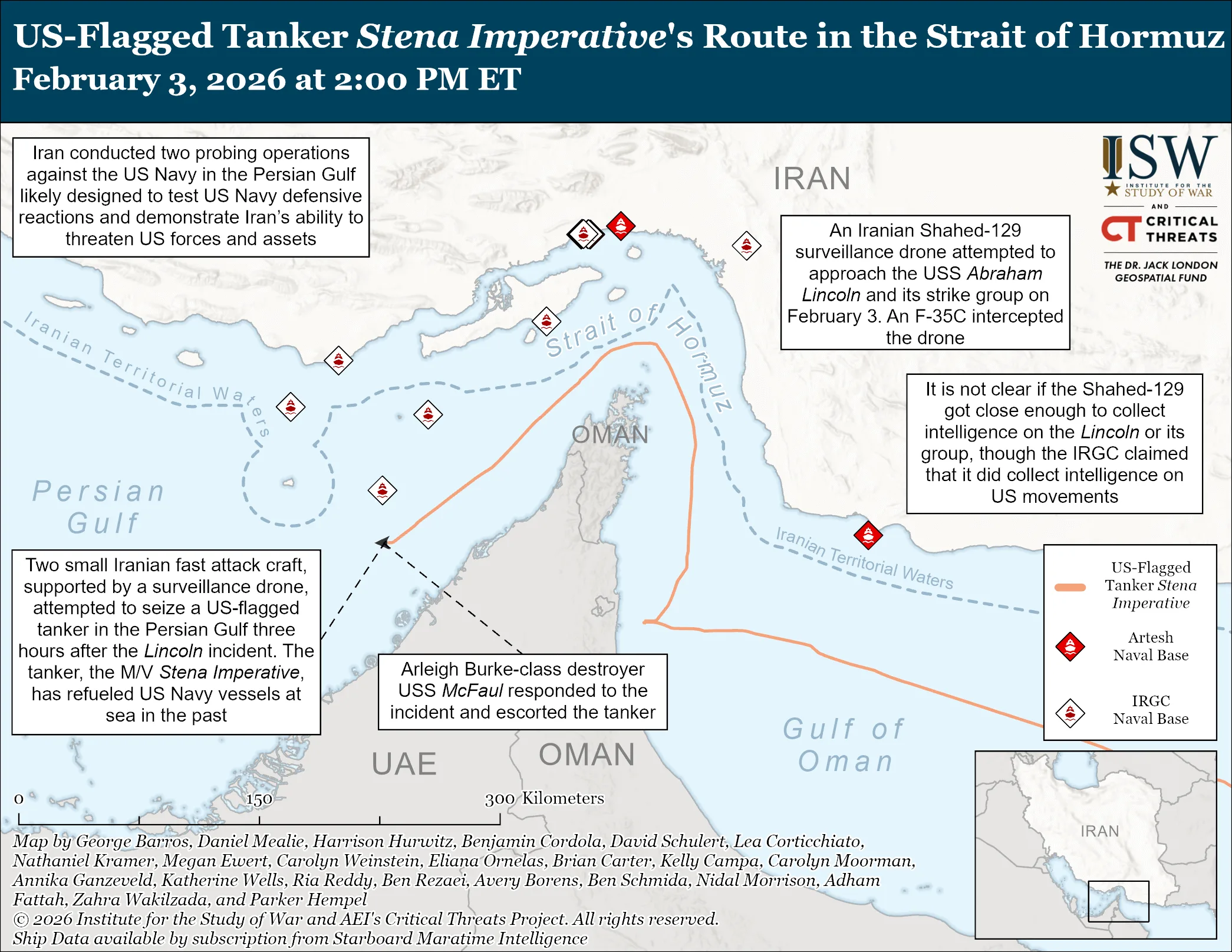
Iran conducted two probing operations against the US Navy in the Persian Gulf, likely designed to test US Navy defensive reactions and demonstrate Iran's ability to threaten US forces and assets. An Iranian Shahed-129 surveillance drone attempted to approach the USS Abraham Lincoln and its strike group on February 3.[1] US Central Command (CENTCOM) reported that the US Navy took de-escalatory measures before a US F-35C Lightning II from theLincoln intercepted and destroyed the drone.[2] It is unclear how close the Shahed-129 came to the Lincoln, though the way that the Lincoln group responded to the drone's approach can give Iran useful intelligence on how the US Navy will engage Iranian drones operating in its vicinity. A probing action seeks to test the strength, disposition, and reactions of an opposing force.
It is not clear if the Shahed-129 got close enough to collect imagery of the Lincoln or its group, though the IRGC claimed that it did collect intelligence on US movements. Islamic Revolutionary Guards Corps (IRGC)-affiliated Tasnim News Agency reported on February 3 that an Iranian Shahed-129 drone was conducting its “routine and legal” mission in international waters to identify, monitor, and film US movements and successfully transmitted imagery to its control center before losing communications.[3] The Shahed-129 is an intelligence, surveillance, and reconnaissance (ISR) and strike drone, unlike the Shahed-136 one-way attack drone that Russia has used in Ukraine.[4] Iran has used Shahed-129 drones extensively across the Middle East, including to attack and collect intelligence on the United States and Israel.[5]
Two small Iranian fast attack craft, supported by a surveillance drone, attempted to seize a US-flagged tanker in the Persian Gulf three hours after the Lincoln incident. The tanker, the M/V Stena Imperative, has refueled US Navy vessels at sea in the past.[6] Arleigh Burke-class destroyer USS McFaul responded to the incident and escorted the tanker.[7] Iran likely targeted this specific vessel to spur a US Navy reaction and determine how and when the US Navy would react to a similar provocation in the future. The IRGC probably also selected the vessel because it has refueled US naval vessels.
These two incidents may be the beginning of an Iranian maritime escalation that seeks to deter a US strike by demonstrating Iran's capability to challenge US naval activity. Iran has previously escalated against the United States in the Persian Gulf in 2019 in response to US sanctions.[8]
The Iranian regime appears to be altering its demands for the location and structure of its upcoming negotiations with US officials, which may be an attempt to further restrict negotiations to solely focus on its nuclear program. Regional sources told Western and regional media on February 3 that the Iranian regime demanded that the location of the United States and Iran's upcoming negotiations on February 6 be changed from Turkey to Oman.[9] The regime also reportedly requested that only US and Iranian officials participate in the negotiations.[10] Iran's demand to make the talks bilateral would remove several regional states that were originally invited to participate in the talks in Turkey.[11] Several of these regional countries have called for a broader agreement that addresses Iran's ballistic missile program and its regional proxies, which suggests that Iran seeks to restrict negotiations to only the nuclear issue. An Axios reporter reported on February 3 that a source with knowledge of negotiations said that Iranian officials demanded a venue and format change to limit the negotiations to only nuclear issues.[12]
Some unspecified Iranian regime officials have floated significant nuclear concessions with the United States, but other named senior regime officials speaking to non-Western outlets have floated more limited concessions, which raises doubts about the sincerity of officials speaking to Western media. Even the limited concessions do not mean US demands of zero enrichment, however. Two unspecified Iranian officials told The New York Times on February 2 that Iran is willing to shut down or suspend its nuclear program but would prefer the United States’ 2025 proposal to create a regional consortium to produce nuclear power.[13] An unspecified Iranian official also told Reuters on February 2 that Iran is willing to “accept zero enrichment under a consortium agreement” and hand over 400 kilograms of highly enriched uranium (HEU).[14] The two officials confirmed to The New York Times that Iranian Supreme Leader Ali Khamenei recently sent a message to Russian President Vladimir Putin via Iranian Supreme National Security Council (SNSC) Secretary Ali Larijani, which stated that Iran may agree to ship its enriched uranium to Russia as it did under the 2015 Joint Comprehensive Plan of Action (JCPOA).[15] The SNSC’s Deputy Foreign Policy Minister Ali Bagheri told Iranian media on February 2 that Iran does not have any intention to transfer its enriched uranium to any country, however.[16] Supreme Leader Representative to the SNSC’s Defense Council Ali Shamkhani separately told a Lebanese Hezbollah-affiliated outlet on February 2 that Iran could reduce its enriched uranium from 60 to 20 percent and that there was “no reason” for Russia to take Iran's enriched uranium as it did under the JCPOA.[17] Shamkhani’s proposal to reduce enrichment levels does not indicate that the regime's decision makers are willing to concede to US demands of zero uranium enrichment.
Shamkhani specifically spoke to Hezbollah-affiliated media to reassure Iran's regional partners that Iran will continue to support them and not give in to the US demand to halt its support. Shamkhani stated on February 2 that Iran is being attacked by the United States and its allies because of its resistance position and noted that Iran will continue to support the members of its Axis of Resistance.[18] Shamkhani added that Iran may negotiate with the United States if the United States de-escalates in the region.[19] Shamkhani is referring to the United States’ increased military presence in the region amid threats to strike the Iranian regime. Shamkhani said that Iran is prepared for a possible war with the United States and that Iran would strike Israel if the United States attacked Iran, however.[20]
Students at a memorial for a student and protester whom the regime killed held a protest in Mashhad, Khorasan Razavi Province, on February 3, against the regime's lethal crackdown.[21] The protest occurred at Azad University's Medical Services Facility. The regime security forces killed Faezeh Hosseinnejad, the slain protester for whom students held the memorial, during the protests in Mashhad on January 9.[22] Protest activity peaked on January 8 and 9, during which the regime massively expanded its use of lethal force and killed thousands of protesters nationwide.[23] The regime has historically tried to block funeral and commemoration ceremonies because they often turn into anti-regime protests.[24]
https://understandingwar.org/research/middle-east/iran-update-february-3-2026/
Iran and the United States are expected to hold talks in Oman on February 6, despite the brief cancellation of the meeting on February 4.[1] Iran continues to show inflexibility toward addressing US demands, which reduces the likelihood that Iran and the United States will be able to reach a diplomatic solution.[2] The United States and Iran had previously agreed to hold talks in Istanbul, Turkey, on February 6, with other regional states participating.[3] Iran's refusal to show flexibility over the location and format of the talks prompted a brief cancellation of the planned US-Iran talks on February 4, according to two unspecified US officials.[4] The Iranian regime also pushed for bilateral US-Iran talks and restrictions that would limit the talks to the Iranian nuclear program, instead of broader negotiations desired by the United States that would address the ballistic missile program and Iran's support for regional proxies.[5] Unspecified officials separately told Axios on February 4 that at least nine regional countries urged the United States not to cancel the talks in ”high-level” messages, which led to a US decision to hold the February 6 talks despite the earlier cancellation.[6] The sources added that the Trump administration remains “very skeptical” that negotiations will proceed.[7]
The administration's skepticism is in response to Iran's efforts to limit the scope of the negotiations. The Trump administration seeks to discuss Iran's nuclear program, ballistic missiles, and support for its proxy network. Iran has signaled that it intends to limit US-Iranian discussions to nuclear issues, almost certainly because it is unwilling to make concessions on either of those two priorities.[8] Iranian officials have repeatedly insisted that Iran will not negotiate on its ballistic missile program or support for its proxy and partner network, which constitute the main pillars of Iran's deterrence and defense strategies.[9] Supreme Leader Representative to the Supreme National Security Council's Defense Council Ali Shamkhani told a Lebanese Hezbollah-affiliated outlet on February 2 that Iran will “definitely continue” to support the Axis of Resistance.[10]
A UK-based Middle East-focused outlet reported on February 3 that some Iranian regime policymakers believe that the only credible deterrent against US military action is the threat of a prolonged, costly war. The outlet reported that Iranian regime members have concluded that limited retaliatory Iranian military action can no longer deter the United States from taking military action against Iran.[11] Previous Iranian strikes that targeted US assets in the region failed to deter US military action, such as Iran‘s strikes targeting Ain al Assad airbase in Iraq in 2020 (in response to the United States’ targeted killing of former IRGC-QF commander Qassem Soleimani) and al Udeid Airbase in Qatar in June 2025 (in retaliation for the US strikes on the Iranian nuclear program).[12] Iran now finds itself under threat of potential US military action once again, despite its strike on al Udeid in June 2025. Iranian officials appear to be reckoning with the concept that threatening similarly limited retaliatory strikes targeting US assets will not deter the US from striking Iran again.
This report about the beliefs of some Iranian policymakers corroborates CTP-ISW’s previous assessment that Iran is attempting to deter US military action against Iran by forecasting that it will escalate into a prolonged regional war.[13] Iranian policymakers have almost certainly seen and internalized the ongoing discussion in Western media about the Trump administration's fears about a broader war. Supreme Leader Ali Khamenei warned on February 1 that a US attack on Iran would lead to a regional war.[14] Foreign Affairs Minister Abbas Araghchi also warned on February 1 that Iran would target US bases and that the ensuing conflict would extend to the region if the United States attacks Iran.[15]
Iranian senior political insiders also confirmed to the same outlet that Araghchi is overseeing Iranian nuclear negotiations with the United States, and Supreme National Security Council (SNSC) Larijani is supervising Iran's coordination with Russia.[16] Araghchi, who has served as foreign affairs minister since August 2024, has been the main point of contact with the United States, specifically US Special Envoy to the Middle East Steve Witkoff, throughout the US-Iran negotiations process since 2025.[17] Araghchi also led the Iranian nuclear negotiating team as deputy foreign minister under the Hassan Rouhani administration between 2017 and 2021.[18] Senior political insiders told the outlet that Araghchi has won “internal battles” within the Iranian regime regarding Iran's nuclear negotiations at ”key junctures” over the past year.[19] Araghchi has also coordinated with Larijani, who oversees Iran's relationship with Russia, according to the insiders.[20] Araghchi attended Larijani’s ”frank and fruitful” meeting with Qatari officials in Doha on January 31, according to a senior Iranian political insider with knowledge of the meeting.[21] Larijani has held several meetings with Russian officials over the past year as the Supreme Leader‘s advisor on international affairs and during his second tenure as SNSC Secretary since August 2025.[22] Larijani also spent nearly 20 years working on Iran's nuclear file, as SNSC Secretary between 2005 and 2007 and particularly as parliament speaker between 2008 and 2020, when he oversaw the passage of the 2015 Joint Comprehensive Plan of Action.[23]
An IRGC-affiliated Telegram channel reported that Iran operated a Russian Mil Mi-28 attack helicopter in Tehran on February 4.[40] Iran received at least one Mi-28 on January 28 as part of a November 2023 Iranian-Russian military agreement.[41] Russian Mil Mi-28 attack helicopters are unlikely to be useful to Iran in conventional aerial warfare against adversaries like the United States and Israel, given that US and Israeli long-range missiles and aircraft can target the helicopters long before the helicopters can attack US or Israeli aircraft. CTP-ISW assessed on January 13 that Iran likely acquired these systems for use against internal disturbances and threats, including protests.[42] Low-flying helicopters can have a deterrent effect against protesters even if the helicopters do not attack the protesters with their weapon systems.
https://understandingwar.org/research/middle-east/iran-update-february-4-2026/
US strikes Iran by Feb 28
graph =>99.9%
https://polymarket.com/event/us-strikes-iran-by-feb-28-odds-30-by-friday
Other dates
https://polymarket.com/event/us-strikes-iran-by
Good grief. Not that long. I’m hoping it’s this weekend.
There are inconsistent reports about whether US-Iran talks in Oman on February 6 will be limited to the nuclear program or also include discussions on Iran's ballistic missile program and regional proxy and partner network. Three unspecified Iranian officials and an Arab official told the New York Times on February 5 that the United States and Iran agreed to focus on Iran's nuclear program, but will also discuss Iran's ballistic missile capabilities and regional proxies during their upcoming talks.[1] Axios, in contrast, cited US officials who reported that the bilateral US-Iran talks in Oman on February 6 will only cover nuclear issues.[2] A political analyst close to the Iranian regime stated that the regime only authorized officials to discuss the nuclear issue among “other minor issues” and noted that Iran will never negotiate over its ballistic missiles. [3] Iranian officials have also continued to publicly insist that Iran will only discuss the nuclear program and will not negotiate on its ballistic missile program or its Axis of Resistance.[4]
Iran may offer limited concessions on its nuclear program, but there appears to be continued disagreement among regime elements over some specific concessions. Egypt, Turkey, and Qatar reportedly proposed a framework on February 5 for the upcoming US-Iran negotiation, which stipulates that Iran has to commit to zero uranium enrichment for three years before limiting its enrichment below 1.5 percent, transferring its highly enriched uranium to a third country, and halting all weapons transfers to its proxies. It is unclear whether Iran would be okay with moving its highly enriched uranium to a third country, however. Supreme National Security Council (SNSC) Secretary Ali Larijani reportedly said that Iran would be willing to transfer its uranium to a third party, such as Russia. Other Iranian officials, such as Supreme Leader Representative to the Supreme National Security Council's Defense Council Ali Shamkhani, have rejected such a transfer.[5]
Iran remains unlikely to make any other concessions related to its missile capabilities and its support for its partner and proxy network in the region, however. Iran's partner and proxy network and its missile capabilities are two long-standing pillars of its defensive strategy.[6] Abandoning these capabilities would require a complete rethink of Iranian defense strategy. A rethink of this magnitude is theoretically possible, but Iranian officials have shown no willingness to rethink their strategy.[7] Iranian officials have repeatedly stated that they believe that their ballistic missiles performed admirably during the 12-Day War and have discussed developing more technologically advanced missiles.[8] Iran has likewise shown no willingness to decrease its support for its proxies and partners in the region.[9] Iran has continued to help fund Hezbollah, for example.[10] Shamkhani also told Hezbollah-affiliated media on February 2 that Iran will continue to support the members of its Axis of Resistance and that Iran would not give in to the US demand to halt its support.[11]
Iran has reportedly continued to take steps to rebuild its nuclear program as part of its nuclear reconstitution efforts to help Iran's nuclear facilities withstand Israeli and US airstrikes. US President Donald Trump told NBC on February 4 that the United States found that Iran is trying to restart the nuclear program at a new, unspecified site in a “different part of Iran.”[12] Trump warned Iran that the United States will do “very bad things” to Iran if Iran restarts its nuclear program.”[13] It is unclear which part of Iran Trump was referring to and whether Iran is relocating any elements of its nuclear program. CNN also reported on February 4 that US intelligence has found that Iran is trying to rebuild its nuclear facilities “deeper underground.”[14]
Iran probably calculates that by dispersing elements of its nuclear program and burying them deeper, it will be able to increase the military requirements to destroy nuclear facilities. These efforts would presumably incorporate lessons learned from the vulnerabilities at the Fordow facility that the United States exploited in the June 2025 strikes.
The Chairman of the SNSC’s Defense Council, President Masoud Pezeshkian, appointed Supreme Leader Ali Khamenei’s representative to the Defense Council, Ali Shamkhani, as the Defense Council's secretary on February 5.[15] Shamkhani’s appointment is almost certainly at the behest of the supreme leader. The Defense Council is Iran's highest national security decision-making body's sub-council on strategic defense, which the SNSC established in August 2025 to streamline decision-making during wartime.[16] Khamenei appointed Shamkhani, alongside former SNSC Secretary Ali Akbar Ahmadian, as his representative on the council three days after its establishment.[17] A Shamkhani-affiliated outlet reported on February 5 that the secretary's role involves coordinating an integrated defense strategy that strengthens preparedness, addresses emerging threats, aligns state institutions with defense priorities, and oversees defense diplomacy and strategic communications.[18] The same outlet proposed in July 2025 the establishment of a notably similar “Strategic Command Center” that would have “cross-sectoral authority” to rapidly respond to evolving threats.[19] This outlet's affiliation with Shamkhani suggests that the July 2025 op-ed reflects his broader ambitions for shaping Iran's strategic defense policy. His appointment as secretary of the newly-formed Defense Council — whose mandate has not yet been publicly defined — indicates that the Defense Council will function as a central body enabling rapid and coordinated decision-making.
https://understandingwar.org/research/middle-east/iran-update-february-5-2026/
February 6, 2026
Location: Iran, countrywide
Event: Increased security measures, road closures, public transportation disruptions, and internet blockages are ongoing. The Government of Iran continues to restrict access to mobile, landline, and national internet networks. Airlines continue to limit or cancel flights to and from Iran.
U.S. citizens should expect continued internet outages, plan alternative means of communication, and, if safe to do so, consider departing Iran by land to Armenia or Türkiye.
Actions to Take:
Leave Iran now. Have a plan for departing Iran that does not rely on U.S. government help.
Flight cancellations and disruptions are possible with little warning. Check directly with your airlines for updates.
If you cannot leave, find a secure location within your residence or another safe building. Have a supply of food, water, medications, and other essential items.
Avoid demonstrations, keep a low profile, and stay aware of your surroundings.
Monitor local media for breaking news. Be prepared to adjust your plans.
Keep your phone charged and maintain communication with family and friends to inform them of your status.
Enroll in the Smart Traveler Enrollment Program (STEP) to receive the latest updates on security in Iran.
https://ir.usembassy.gov/security-alert-land-border-crossings-february-5-2026/
Iran and the United States held talks in Muscat, Oman, on February 6 to establish a framework for future negotiations.[1] The Omani Foreign Affairs Ministry stated that the talks between the Iranian and US delegations, which were headed by Iranian Foreign Affairs Minister Abbas Araghchi and US Special Envoy to the Middle East Steve Witkoff, respectively, “focused on creating the right conditions for the resumption of diplomatic and technical negotiations” and gaining each party's “commitment” to the talks.[2] US Central Command Commander Admiral Brad Cooper also attended the talks, according to a video published by Omani media and a US official speaking to the Wall Street Journal.[3] Araghchi claimed that he discussed “Iran's rights” in a “good atmosphere” with the US delegation and that the talks were a “good start.”[4] A political analyst close to the Iranian regime reported that the talks aimed to establish a framework for negotiations. He added that the talks were focused on “announcing positions, making demands, and presenting proposals” and that Iran and the United States “did not reach an agreement on generalities.”[5] Axios reported on February 6 that the United States and Iran will hold another round of talks in the coming days, citing a source with knowledge of the talks.[6] Israeli media, citing two sources familiar with the matter, reported that the United States told Iran that it expects Iran to make a “tangible and significant concession” regarding its nuclear program in the next round of talks.[7]
Iran remains unlikely to compromise on its red lines, which include uranium enrichment, its ballistic missile program and support for the Axis of Resistance, which reduces the likelihood that Iran and the United States will be able to reach a diplomatic solution during subsequent rounds of negotiations. Araghchi stated on February 6 that he conveyed during the talks that Iran would not agree to stop uranium enrichment or move Iran's uranium stockpile abroad.[8] An Iranian journalist close to the regime similarly stated on February 5 that the regime decided in recent days not to agree to transfer its enriched uranium stockpile to a third country.[9] The Iranian regime's English-language outlet emphasized on February 6 that Iran's ballistic missile program and support for the Axis of Resistance have “no place” in Iran's talks with the United States.[10] A Tehran-based Al Jazeera journalist separately reported on February 6 that the US demands also include curbing Iran's energy exports to the People's Republic of China.[11] Unspecified Iranian officials separately told Iranian state media on February 6 that Iran is prioritizing the lifting of sanctions.[12]
A policy analyst close to the Iranian regime reported on February 5 that the Defense Council will operate independently of the Supreme National Security Council (SNSC).[29] The analyst added that the Defense Council will formally remain a sub-council of the SNSC but will “advance [Iran's] defense policies” independently of the SNSC.[30] The SNSC, which is Iran's highest national security decision-making body, established the Defense Council in August 2025 to streamline wartime decision-making.[31] Iranian media reported in August 2025 that the Defense Council would take “rapid, balanced, and coordinated” steps to confront threats to Iran.[32] The Defense Council's autonomy could create new bureaucratic processes and thereby hamper decision-making during periods of conflict, however. This report comes after Iranian President and Defense Council Chairman Masoud Pezeshkian appointed Ali Shamkhani as the Defense Council's secretary on February 5.[33]
Iranian Defense and Armed Forces Logistics Minister Brigadier General Aziz Nasir Zadeh possibly warned Azerbaijani President Ilham Aliyev during a meeting in Baku, Azerbaijan, on February 6 against allowing Israel to use Azerbaijan's territory to conduct operations against Iran. Nasir Zadeh and Aliyev discussed bilateral cooperation and regional security issues, as well as the threat posed by “the intervention of regional actors,” almost certainly in reference to Israel.[34] Aliyev stated that Azerbaijan “will not allow any threat to Iran.”[35] Iranian media outlets and officials accused Azerbaijan of allowing Israel to launch strikes against Iran from Azerbaijani territory during the June 2025 Israel-Iran War.[36] Iranian officials have also previously expressed concern about Israeli influence in Azerbaijan and deepening relations between Israel and Azerbaijan.[37] Nasir Zadeh separately met with Azerbaijani Defense Minister Zakir Hasanov on February 6 to discuss bilateral security cooperation.[38]
The US State Department sanctioned 14 vessels and 15 entities, including four entities based in Turkey and the United Arab Emirates, on February 6 for transporting and facilitating the sale and purchase of Iranian oil.[39] Vessels in Iran's “shadow fleet,” including those that the US Treasury Department sanctioned on January 6, generate revenue that the Iranian regime uses to fund the Axis of Resistance, its weapons programs, and security services.[40] The United States has sanctioned over 180 vessels involved in transporting Iranian oil since January 2025.[41]
https://understandingwar.org/research/middle-east/iran-update-february-6-2026/
Disclaimer: Opinions posted on Free Republic are those of the individual posters and do not necessarily represent the opinion of Free Republic or its management. All materials posted herein are protected by copyright law and the exemption for fair use of copyrighted works.
