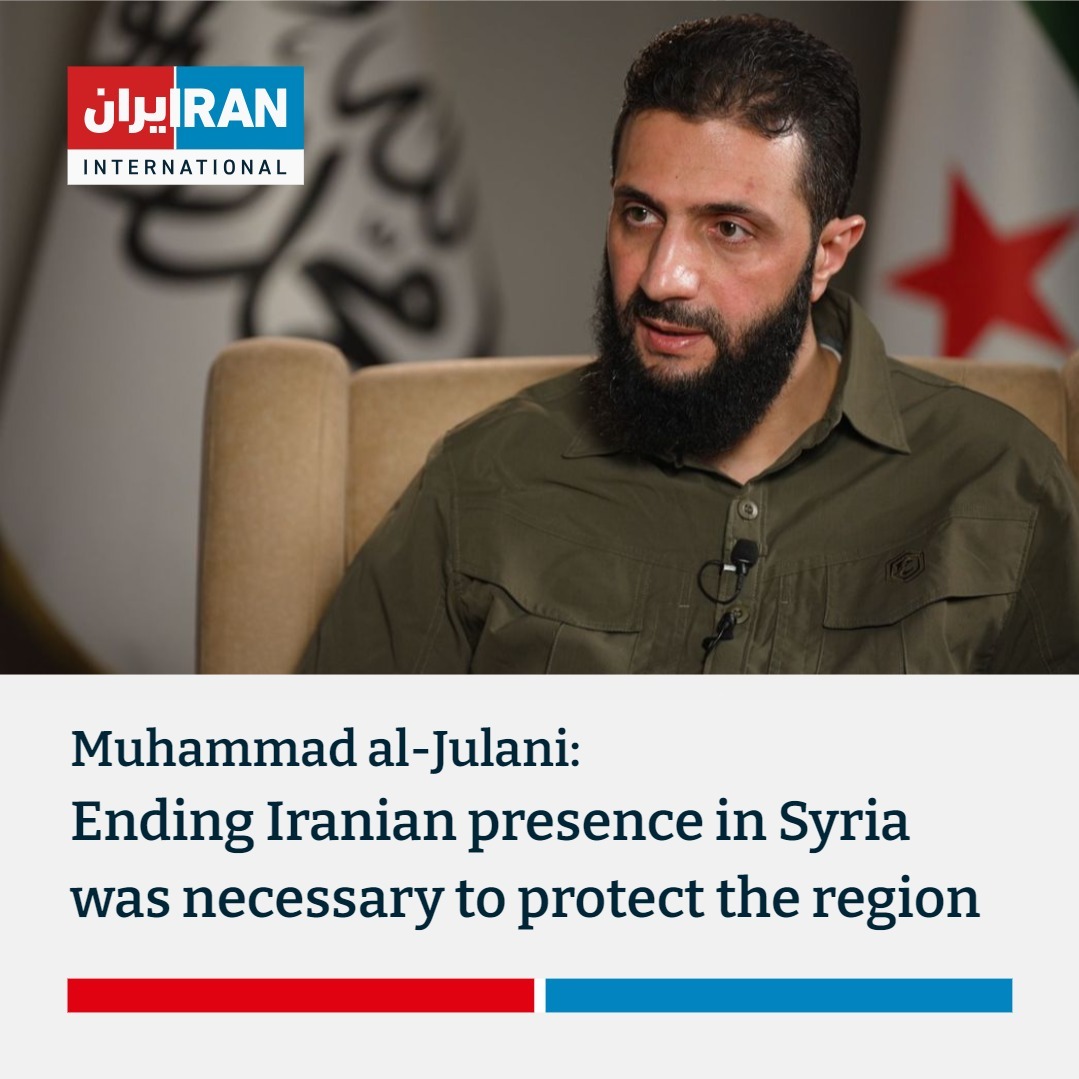
“We succeeded in ending the Iranian presence in Syria, but we harbor no hostility toward the Iranian people. Our issue was solely with the policies that brought harm to our country,” he added.
Posted on 10/08/2022 1:05:38 PM PDT by nuconvert
Iranian Regime national tv Channel One hacked about an hour ago. During a broadcast of Khamenie speech, a red crosshair appeared over his face and chanting of Women. Life. Freedom. There was writing to the side saying "Rise up. Join us". Also 4 photos at the bottom of the screen of young people killed and additional writing: "The blood of our youth is dropping from your paws".
Also, there was a huge banner in the middle of Tehran highway today that read: We are no longer afraid of you. We will fight.
Also, attempted attack on IRI ambassador in Denmark. Her bodyguard was stabbed. Diplomatic Security intervened before the attacker could stab the ambassador.
UNRWA’s Defense: “It was only 19 of our aid workers who committed mass murder.”
Also:
• “It was only 1 of our UNRWA Gaza Headquarters that powered the Hamas terror tunnel computer server.”
• “It was only 1 of our ex-officials who fundraised for UNRWA by writing: ‘America is subjugated by the Jewish Lobby.’”
• “It was only 1 of our Commissioner-Generals who met with Hamas and Islamic Jihad terror chiefs and told them ‘We are united, no one can separate.’”
• “It was only 2 of our UNRWA Teachers Union Chairs who were Hamas terror chiefs in Gaza and Lebanon.”
• “It was only 47 times that we failed to answer UN Watch letters, warnings, and requests to meet about UNRWA staff complicity with terrorism.”
• “It was only 100 of our UNRWA employees on the list of Hamas terrorists sent to us in July, including Mohammad Abu Itiwi who took part in the October 7th massacre, about all of whom we did nothing, because we don’t have the capacity to verify.”
• “It was only 2,000 of our UNRWA teachers in Lebanon who rallied for a Hamas terror chief.”
• “It was only 3,000 of our UNRWA staffers who celebrated the massacre on the Telegram chat group.”
• “It was only 8,000 of our UNRWA teachers in Gaza who rallied for Hamas terror chief and UNRWA official Suhail al-Hindi.”
• “It was only 13,000 of our humanitarian aid workers in Gaza who failed to lift a finger to save the Israeli hostages kidnapped on Oct. 7th and still being tortured in Gaza.”
(Receipts, proof, screenshots, timeline, everything:https://unwatch.org/the-case-against-unrwa/ )
https://x.com/HillelNeuer/status/1864695101643002053
Iran Update, December 5, 2024
Iraqi nationalist Shia cleric Muqtada al Sadr called on Iraqi forces and Iranian-backed Iraqi militias not to intervene in the Syrian conflict on December 5.[70] Sadr emphasized that only the Syrian people can “determine their destiny.”
An Iranian parliamentarian focused on Syria, Abbas Golrou, was intentionally vague about how it will support Syria in a December 4 interview. Golrou stated that Iran will not reveal what it is pursuing in Syria but Iran has previously “responded to the Syrian government’s request and will enter,” Syria if needed in an interview with Iranian media on December 4.[73] Golru is a member of Parliament’s National Security Committee, the head of Parliament’s Foreign Relations Committee, and the deputy head of the Iran-Syria parliamentary friendship group. Golrou claimed that Iran focused its support for Syria on ”counterterrorism,” which is a euphemism for Iranian support for Syria against opposition groups as well as ISIS. Iranian Foreign Affairs Minister Abbas Araghchi also met with his Egyptian counterpart Badr Abdelatty and Iranian Foreign Affairs Ministry Senior Adviser for Policy Ali Asghar Khaji separately spoke with UN special envoy for Syria Geir Pedersen on December 4.[74]
Iranian Deputy Foreign Minister for Legal and International Affairs Kazem Gharibabadi met with Chinese Vice Foreign Minister Ma Zhaoxu in Beijing on December 5 to discuss nuclear negotiations and sanctions.[75] Gharibabadi emphasized his recent discussions with the E3 (the United Kingdom, France, and Germany) in Geneva on “resuming sanctions lifting and nuclear talks.”[76] The officials probably discussed the impact of the incoming Trump Administration’s “maximum pressure” sanctions on Iranian oil exports, although this was not explicitly stated in the meeting summary.[77] Iranian oil exports to China are extremely important to the Iranian economy, and sanctions would increase the cost of China’s imports.[78]
https://www.understandingwar.org/backgrounder/iran-update-december-5-2024
The Axis of Resistance's support to the Assad regime will almost certainly fail to stop the opposition offensive at this time unless ground forces are deployed rapidly and in larger numbers. Iran reportedly plans to send missiles and drones to Syria, and both Iran and Hezbollah will reportedly provide military advisers.[2] Hezbollah sent a “small number” of “advisers” to Syria on December 5 and Hezbollah has already deployed Hezbollah advisers to Homs.[3] The small number of advisers is unlikely to reverse the country-wide collapse of Syrian forces, and missiles and drones cannot hold or take ground on their own. Hezbollah is unlikely to deploy the larger number of fighters required for Assad to regain territory, given Hezbollah's requirements in Lebanon after the group suffered heavy losses during the Israeli ground campaign in Lebanon.
The Iranian, Iraqi, and Syrian foreign ministers held a trilateral summit in Baghdad on December 6 to coordinate responses to Syria's security crisis.[4] The purpose of Araghchi’s visit to Baghdad was likely to solidify a coordinated approach among Iraq, Syria, and Iran. Iranian Foreign Affairs Minister Abbas Araghchi said on December 4 that Iran would “consider” any Syrian request for Iranian ground forces, though no such request has been made at this time.[5] The rapid collapse of Syrian forces across the country will make it difficult for these Iranian ground forces to be able to stop the advance of the Syrian opposition. The opposition is rapidly seizing Assad-held territory, which will make it difficult for Iran to mobilize and then deploy its forces to Syria against the rebels before the rebels destroy much of Assad's remaining forces.
Turkey appears equally unwilling to broker a settlement short of Assad's removal as HTS seeks to overthrow Assad. HTS leader Abu Mohammed al Jolani said that his forces seek to replace the Assad regime in Damascus with a government and a “council chosen by the people.”[6] Turkish President Recep Tayyip Erdogan said that the opposition's goal was “Damascus,” and that he had tried to broker an agreement with the Assad Regime in the past, but that the regime was unwilling to do so.[7] Turkey has previously flirted with the idea of an agreement with the Assad Regime in recent years that would allow Turkey to return its Syrian refugee population to Syria, but these negotiations failed.[8]
The SDF seized key areas in regime-held Deir ez Zor and Raqqa provinces on December 6, making it more difficult for Iran to move forces to Assad or to supply Iranian-backed forces in Syria. Geolocated footage posted on December 6 showed the SDF in both Deir ez Zor City and Albu Kamal City after the withdrawal of Syrian forces.[12] Later reports claimed that the SDF had captured Albu Kamal crossing after Iranian-backed Iraqi militias retreated from the area.[13] The seizure of these sites would prevent Iran from securing a key ground line of communication—the Albu Kamal-al Qaim Border Crossing and the M4 Highway—that Iran uses to transport weapons and personnel to support its Axis of Resistance partners.[14] The fact that neither the regime nor the Iranian-backed forces attempted to hold this key ground demonstrates the degree to which these forces are collapsing.
International Atomic Energy Agency (IAEA) Director General Rafael Grossi announced on December 6 that the rate at which Iran can enrich uranium up to 60% purity is “increasing dramatically.”[57] The IAEA estimates that Iran's capacity to produce uranium enriched to 60% purity may be increased to 7-8 times more than Iran's previous rate of producing approximately 5-7 kilograms of uranium enriched to up to 60% purity per month. The United States Office of the Director of National Intelligence (ODNI) continues to assess that Iran is not building a nuclear weapon[58]. Weapons-grade uranium, suitable for use in nuclear weapons, must be enriched to approximately 90%.
https://www.understandingwar.org/backgrounder/iran-update-december-6-2024
Iran Update, December 7, 2024
The Bashar al Assad regime faces imminent collapse. The Syrian Arab Army (SAA) appears to have already collapsed itself, as its units have fled repeatedly from advancing opposition forces across the country. The SAA is combat ineffective and has yet to present a meaningful defense against the advancing opposition. The opposition forces led by Hayat Tahrir al Sham (HTS) have exploited the collapse of the SAA by advancing further southward and taking control of Homs City, which is the last major obstacle before Damascus. Various opposition groups have similarly taken control of large swaths of central and southern Syria and begun advancing into the southern and eastern outskirts of Damascus. The Assad regime appears to only control parts of Damascus and the western Syrian coast at the time of this writing. Syrian President Bashar al Assad has been entirely absent through the crisis and has refrained from making any public address.[1] Some unverified reports have suggested that Assad has fled, possibly to Iran.[2]
Iran appears unwilling to intervene militarily at any meaningful scale to support the Assad regime at this time. Iranian-backed forces have avoided engaging opposition forces almost entirely. The New York Times reported that an internal Islamic Revolutionary Guards Corps (IRGC) memo acknowledged the growing likelihood that the Assad regime will collapse.[3] It is far from clear, moreover, that Iran could mobilize the forces necessary to save Assad at this point anyway. Iran has launched an emergency evacuation of its diplomatic staff and military officers from Damascus.[4] Iranian Foreign Minister Abbas Araghchi called for political dialogue with the opposition, reflecting heightened Iranian concerns about the longevity of the Assad regime.[5] This Iranian concern and inaction come amid reports that Russia is similarly unwilling to intervene in support of Assad.[6]
Unspecified US officials said that Turkey approved HTS launching its surprise offensive on November 27.[30] Turkish President Recep Tayyip Erdogan has expressed support for the HTS-led drive toward Damascus from the north.[31]
https://www.understandingwar.org/backgrounder/iran-update-december-7-2024
The Iranian embassy in Damascus was seized and destroyed. A poster of Qasem Soleimani and Ayatollah Khomenei was torn apart.
https://bsky.app/profile/noelreports.com/post/3lcrvria7mc2h
video
Iran Update, December 8, 2024
The Iranian Foreign Affairs Ministry issued a generic statement acknowledging the collapse of the Syrian regime. The ministry stated that the Syrian people should determine the future of their country without foreign interference.[46] The ministry expressed readiness to engage “all influential parties” and “help establish security and stability in Syria.” The ministry also expressed interest in friendly relations with a future Syrian government. Iranian President Masoud Pezeshkian reiterated separately that the Syrian people should determine the future of their country.[47] Iranian Foreign Affairs Minister Abbas Araghchi expressed support for UN Security Council Resolution 2254, calling for a political settlement, wherein “all different parties have their role.”[48] An internal Islamic Revolutionary Guards Corps (IRGC) memo stated that Iranian leaders “accepted the fall of Assad and…lost the will to resist,” according to the New York Times.[49]
A hardline Iranian parliamentarian stated that Iran should focus on “atomic bomb testing” following the fall of the Syrian regime. Ahmad Naderi posted on X (Twitter) on December 8 that Iran should focus on testing nuclear bombs and reviving the Axis of Resistance.[50] Naderi has previously stated that Iran should acquire a nuclear weapon to restore deterrence.[51] Naderi’s rhetoric is consistent with growing calls from senior Iranian officials encouraging Iranian Supreme Leader Ali Khamenei to revoke his 2003 fatwa banning the production and use of nuclear weapons.[52] This rhetoric is especially noteworthy given the recent expansion of the Iranian nuclear program, which is making it easier for Iran to build a weapon. The International Atomic Energy Agency (IAEA) reported in November 2024 that Iran continues to develop its nuclear program outside the parameters of the Joint Comprehensive Plan of Action.[53] Iran notified the IAEA on November 29 that it plans to expand its uranium enrichment capacity significantly by installing over 6,000 additional centrifuges and activating some at the Fordow and Natanz nuclear facilities.[54]
https://www.understandingwar.org/backgrounder/iran-update-december-8-2024
Hayat Tahrir al Sham (HTS) is establishing a transitional government and reconciling with members of the former Syrian regime and the Syrian Arab Army (SAA). HTS is attempting to ensure continuity of governance to prevent widespread anarchy in Syria, which is consistent with HTS’ longstanding approach to “liberated areas.”[1] HTS appointed HTS-led Syrian Salvation Government Prime Minister Mohammad al Bashir to lead the transitional government on December 9.[2] HTS established the Salvation Government in northwestern Syria in 2017.[3] Bashir met with HTS leader Abu Mohammed al Jolani and former Assad Regime Prime Minister Mohammed al Jalali on December 9 to discuss the transfer of power from the Assad regime to HTS.[4] Jalali stated on December 8 that he and HTS agreed on “the importance of preserving government institutions and trying to return 400,000 employees to their jobs.”[5] HTS-led Salvation Government Justice Minister Shadi al Waisi separately met with former Assad Regime Justice Minister Ahmed al Sayeh on December 9 to discuss “an efficient handover.”[6] HTS has rapidly rolled out its own governance apparatus in areas of Syria it has liberated from the Assad Regime in the past.[7] HTS likely correctly recognizes that it cannot rely upon its own much smaller and Idlib-focused government apparatus to govern all of Syria it has recently captured and will need to rely upon Syrian government institutions in the interim.
HTS announced on December 9 a general amnesty for all Syrian regime military personnel whom the regime conscripted under compulsory service.[8] HTS emphasized that these individuals’ lives “are safe” and that “no assault on them is permitted.”[9] HTS has similarly sought to integrate Syrian regime military and security personnel into civilian life in Aleppo City since it seized that city on November 30.[10] CTP-ISW previously noted that integrating former combatants into civilian life could ensure stability and security during the post-conflict transition period.[11]
Comment: HTS has learned from the mistakes in Iraq: https://pfiffner.gmu.edu/files/pdfs/Articles/CPA%20Orders,%20Iraq%20PDF.pdf US Blunders in Iraq: De-Baathification and Disbanding the Army"
Iran is attempting to reframe its role in the Syrian Civil War in order to reestablish influence within the new Syrian government. A senior Iranian official told Reuters on December 9 that Iran opened direct communication with unspecified Syrian rebels to “prevent a hostile trajectory” between the two countries.[47] Another official stated that Iran aims to build ties with “those within Syria's new ruling groups whose views are closer to [Iranian views],” though the specific opposition groups are unclear. Iran's “main concern” is that Assad's successor may shift Syria away from Iranian influence, demonstrating that Iranian officials remain concerned about the requirement to reestablish Iranian influence in Syria. Key Iranian officials, including the foreign affairs minister and parliament speaker, have recently tried to reframe the role Iran held in the war. The Iranian foreign affairs minister claimed that Iran has always advocated for “dialogue” with opposition forces, but it is highly unlikely that Iran would have supported talks that would have given Assad or a pliant pro-Iran actor a subordinate role to any opposition organization.[48] Iran's parliament speaker falsely claimed that Iran had only intervened to counter ISIS, not rebel groups.[49] Iran launched a concerted effort to keep Assad in power and maintained its forces in Syria since shortly after the start of the Syrian civil war in 2011.[50] This effort required Iran to fight ISIS, but Iran also fought all threats to Assad's rule, including the opposition.
This Iranian effort is unlikely to succeed, at least in the near term. HTS leader Abu Mohammed al Jolani stated on December 9 that the victory of Syrian opposition forces would end Syria's role as a “playground for Iranian ambitions, spreading sectarianism, and stirring corruption”, reflecting deep resentment toward Iranian influence in Syria.[51]
Members of Iran's armed forces and Iranian policymakers are increasingly disillusioned with Iran's handling of the collapse of the Assad Regime. Iran observers have noted that Islamic Revolutionary Guard Corps (IRGC) and Basij members are critical of Iran's failure to intervene more decisively in Syria to support Assad against the opposition's surprise offensive, citing IRGC communication channels and interviews with IRGC members.[52] An IRGC member stated that Syria was “crucial” for the Axis of Resistance, and “abandoning” Assad was a “betrayal” that would have serious consequences for Iran.[53] Another member stated that the “[IRGC youth] will not forget the cowardice of the decision-makers.”[54] Iranian Parliamentarian Mohammad Manan Raisi stated that “after sacrificing six thousand martyrs and spending billions of tomans, we handed Syria over [in just one week].”[55] These statements reveal dissatisfaction within Iran over its failure to support the Syrian regime, raising concerns about Iran's ability to sustain its influence via the Axis of Resistance. These frustrations—if they become wildly held among the security services and key Iranian leaders—could lead to the removal of top Iranian military commanders, including in the IRGC.
https://www.understandingwar.org/backgrounder/iran-update-december-9-2024
An interesting analysis from the Iranian regime that can also be applied to Iran. But, should they follow their own advice, we'll get rid of them too.
Senior Syrian officials from the deposed Bashar al Assad regime have begun to transfer power to the HTS-led interim government as of December 10. Outgoing Prime Minister Mohammed al Jalili reported that former Assad officials are working with the interim government to preserve state institutions and government workers’ jobs.[1] The chief executive of Sawsan Abu Zainedin—an umbrella group of 200 Syrian civil society groups—emphasized that the interim government would refrain from the “de-Baathification” of the Syrian state.[2] CTP-ISW previously noted that Hayat Tahrir al Sham (HTS) likely recognizes that its own, smaller government apparatus in Idlib Province is ill-equipped to govern all of Syria and that it will need to rely on Syrian institutions at least for a period.[3] US Secretary of State Antony Blinken voiced the United States’ support for a Syrian-led political transition leading to a ”credible, inclusive, and non-sectarian governance” in line with UN Security Council Resolution 2254.[4]
Syrian media reported that the interim Syrian Salvation Government will conduct an assessment of the Syrian Arab Army (SAA) prior to its reorganization.[5] This activity is part of a broader HTS-led effort to reconcile with members of the former Syrian regime and SAA. HTS announced on December 9 a general amnesty for all Syrian regime military personnel, whom the regime conscripted under compulsory service.[6] HTS has similarly sought to integrate Syrian regime military and security personnel into civilian life in Aleppo City since seizing the city in November 2024.[7] CTP-ISW previously noted that integrating former combatants into civilian life could help ensure security and stability during the post-conflict transition period.[8]
Iran is trying to project continued confidence in its regional position despite the fall of the Bashar al Assad regime in Syria. This comes amid reports of infighting within the Iranian security establishment. Senior Iranian officials, including Islamic Revolutionary Guard Corps (IRGC) Commander Major General Hossein Salami, have asserted in recent days that Iran and the Axis of Resistance remain strong.[31] Salami said that Iran has “not been weakened, and Iranian power has not diminished.”[32] The supreme leader representative to the IRGC, Abdollah Hajji Sadeghi, similarly said that the Axis of Resistance “has not changed at all” while acknowledging that the fall of Assad has created ”a major obstacle.”[33] CTP-ISW has contrastingly assessed that the fall of Assad marks the end of the greater Iranian project in the Levant for the foreseeable future.[34] Iranian influence in Syria historically allowed the IRGC to project force westward and move material to proxy and partner forces around the Israeli periphery. The sudden loss of Assad deprives Iran of these military and strategic advantages and will severely undermine future Iranian efforts to rebuild Hamas and Lebanese Hezbollah.
The fall of Assad has reportedly stoked divisions within the IRGC. An unspecified IRGC official told the Telegraph that senior IRGC officers are blaming one another for the fall of Assad.[35] Another unspecified IRGC official said that Iran is at an “impasse” in its efforts to rearm Hezbollah because everyone who Iran sends to move the weapons “are either getting killed or escaping.” The officials noted that some officials are blaming IRGC Quds Force Commander Brigadier General Esmail Ghaani and that “many are now calling” for his removal as he is formally responsible for managing the Axis of Resistance, of which Assad was a part. Ghaani does not solely manage Iranian policy vis-a-vis Syria, however. Other key Iranian officials, including officials close to the supreme leader, are involved as well. These officials include senior advisers to the supreme leader, such as Ali Larijani and Ali Akbar Velayati.[36] CTP-ISW previously assessed that regime infighting could lead to the removal of top Iranian military commanders.[37]
https://www.understandingwar.org/backgrounder/iran-update-december-10-2024
Iran Update, December 11, 2024
Fateh Mubin fighters seized a Captagon factory at Mezzeh Military Airbase on December 11.[13] The opposition fighters claimed that they discovered “millions” of Captagon pills, raw drug materials, and production equipment within an Air Force Intelligence building on the airbase.[14] The Assad regime and its Iranian-backed partners mass-produced Captagon in Syria for years and smuggled it through Jordan to the Gulf Arab states through a smuggling and distribution cartel that has generated billions of dollars in revenue for Iran and its Axis of Resistance.[15] HTS has not explicitly stated that it will halt Captagon supply lines into Jordan.
https://www.understandingwar.org/backgrounder/iran-update-december-11-2024
Iran Update, December 12, 2024
The E3 (France, Germany, and the United Kingdom) sent a letter to the UN Security Council on December 6, announcing its readiness to impose international “snapback” sanctions on Iran.[29] The E3 would invoke the snapback mechanism of the Joint Comprehensive Plan of Action if Iran continues to expand its nuclear program and decline to cooperate fully with the International Atomic Energy Agency (IAEA). The E3 letter comes after Iran dramatically increased its enrichment of uranium to 60 percent.[30] Iran announced on November 27 that it had activated “thousands of advanced centrifuges.”[31] Iran was retaliating for an earlier censure resolution passed by the IAEA Board of Governors, criticizing the lack of Iranian cooperation with the IAEA.
Reuters reported on December 12 that Iran agreed with the IAEA to increase the “frequency and intensity” of international monitoring of activities at the Fordow nuclear site.[32] Iran is likely responding to the threat from the E3 to impose snapback sanctions. It is notable, however, that greater international monitoring has no effect on Iran’s accelerated rate of uranium enrichment.
https://www.understandingwar.org/backgrounder/iran-update-december-12-2024
The Syrian Democratic Forces (SDF) is facing two perceived existential threats in the wake of the fall of the Assad regime, which almost certainly caused the SDF to deprioritize the counter-ISIS mission. The United States helped create the SDF by binding together Kurdish and Arab forces in Deir ez Zor.[20] Arab communities in Deir ez Zor and Raqqa have begun defecting from the SDF and an end to SDF rule in Arab areas, which threatens to unravel the fragile Kurdish-Arab coalition that the United States helped establish.[21] Turkey is simultaneously threatening to destroy the SDF. Turkish Foreign Minister Hakan Fidan threatened on December 13 to “eliminate” the SDF, Kurdistan Workers Party (PKK), and People's Defense Units (YPG).[22] Fidan added that these groups must leave Syria. The SDF, given that it prioritizes these existential threats over the threat it faces from ISIS, has stopped all counter-ISIS operations. This reallocation of SDF resources creates opportunities for ISIS to reemerge and leaves the United States without a viable counter-ISIS partner in Syria, at least temporarily.
SDF commander General Mazloum Abdi announced that the SDF plans to negotiate its role in a future Syrian government, likely to prevent further unrest within Arab populations and militias under the SDF.[23] Abdi stated that the SDF seeks a ”decentralized” Syrian administration in which the SDF is represented in the future government and armed forces.[24] The defection of Arab SDF formations and protests against SDF rule is probably contributing to Abdi’s decision to negotiate with the interim government. Arab citizens in SDF-controlled areas have long-standing grievances against the SDF which include limited reconstruction, repeated SDF abuses of the local populations, and a lack of representative Arab leadership.[25] Abdi probably calculates that by reaching out to the interim government, he can temper the unrest by expressing his willingness to integrate into the Syrian government. Abdi’s outreach to the interim government does not guarantee the SDF’s ability to control popular unrest. Even if he reaches a deal with the interim government. Arab communities are calling for an end to SDF rule, not just the SDF’s integration into the rest of Syria. This implies that these groups do not seek to be a part of an SDF-led autonomous region.
Iranian opposition media reported that Iranian officials instructed the IRGC to sell sanctioned oil stored at the Port of Dalian, China, through intermediary companies.[86] The directive reflects Tehran’s concerns that the incoming Trump administration could prevent Iranian access to the oil reserves.[87] CTP-ISW cannot confirm this report.
Satellite images obtained on December 12 reveal Iran's new drone carrier ship, Shahid Bagheri, undergoing sea trials in the Persian Gulf near Bandar Abbas. The drone carrier was originally a commercial container vessel which was modified with a ski-jump ramp and angled flight deck for drone operations.[88] The Shahid Bagheri drone carrier departed in late November and is currently undergoing its initial sea trial, with Maxar reporting a net-covered drone visible on its deck.[89]
https://www.understandingwar.org/backgrounder/iran-update-december-13-2024
“We succeeded in ending the Iranian presence in Syria, but we harbor no hostility toward the Iranian people. Our issue was solely with the policies that brought harm to our country,” he added.
The Iranian regime does not appear to have assumed a clear strategy for how to approach the HTS-led interim government in Syria, as exemplified by the contradicting reports regarding the safety of Shia holy sites following the fall of the Assad regime. Certain Iranian media outlets have amplified reports of HTS fighters interfering with the Sayyida Zeinab shrine and the Sayyidah Ruqayya shrine, while other Iranian media reports claimed that HTS engaged respectfully during a visit to the shrine in recent days.[19] The fact that the Iranian media is not pursuing a clear messaging campaign about the Shia holy sites in Syria may indicate that the Iranian defense and political establishment has not yet decided how best to interact with the new HTS-led interim government. The rapid pace in which the Assad regime fell, resulting in the loss of billions of dollars for the Iranian regime, has almost certainly forced Iran to re-evaluate its strategy in regard to Syria and the region at large.[20]
https://www.understandingwar.org/backgrounder/iran-update-december-14-2024
Iran Update, December 15, 2024
Turkey will likely continue to back the SNA’s ground operation against the SDF to destroy the SDF. The Turkish foreign minister said on December 13 that Turkey’s strategic objective in Syria is to ”destroy” the SDF, meaning that any ceasefire between the SDF and Turkish-backed groups is presumably temporary.[5] It is unclear when large-scale operations will resume, however. Turkish-backed fighters have also executed injured SDF fighters at hospitals in northern Syria and reportedly looted civilian areas in Manbij.[6] These crimes risk triggering ethnically motivated violence and upsetting Syria’s current relative stability, especially if Turkish-backed fighters enter Kurdish areas and begin killing Kurdish civilians.
The SDF’s fight against Turkey and its proxies will render it unable to support US policy objectives in Syria. The SDF is the key US partner in Syria against ISIS. Only the SDF is capable of conducting competent counter-ISIS operations in the areas it controls, given that HTS and other groups are currently preoccupied with securing newly controlled areas. The SDF also controls al Hol IDP camp and a network of prisons that contain thousands of ISIS supporters and fighters. Turkish violence—including the threat of ethnically motivated killing—would almost certainly cause the SDF to mobilize its forces against Turkish-backed groups. The SDF cannot conduct offensive operations against ISIS while contending with the threat from Turkey and its allies in Syria. It is unclear if the SDF would be able to secure these key facilities if it faces a severe threat from Turkish-backed forces to Kurdish civilian areas.
Israel and Jordan reportedly held secret talks on December 13 to discuss the situation in Syria and the threat of Iranian weapons smuggling to Palestinian militias in the West Bank. Three unspecified Israeli sources told Axios that Israeli and Jordanian officials discussed the growing threat of Iranian-backed groups smuggling weapons into the West Bank via Jordan.[33] Two Israeli officials stated that the talks covered Israel and Jordan’s ”engagement” with the HTS-led transitional government in Syria. One official added that Jordan is acting as a ”mediator” between Israel and the Syrian rebel groups. HTS seized control of the Nassib border crossing into Jordan on December 14.[34] Iranian-backed elements have historically used this crossing and the areas surrounding it to smuggle weapons into Jordan and then into the West Bank to arm Palestinian militias.[35] Iran will almost certainly attempt to find new ways to smuggle weapons into Jordan, however.
https://www.understandingwar.org/backgrounder/iran-update-december-15-2024
Iran Update, December 16, 2024
Israel’s large-scale aerial attack on Iranian missile production sites on October 25 significantly damaged Iran’s missile production capability, including its ability to export Iranian-made missiles to partners like Russia and the Houthis.[46] An unspecified Israeli military source told the Washington Post that Israel’s October 25 strike in Iran caused Iran’s solid-fuel ballistic missile production to drop from two ballistic missiles a day to one missile per week.[47] Iran’s capacity to produce new missiles is unlikely to increase, given that it would take at least a year for Iran to acquire new solid fuel mixers from China to replace the Iranian mixers that Israel destroyed on October 25.[48] The decrease in Iranian ballistic missile production will make it difficult for Iran to conduct another large-scale missile attack targeting Israel and would presumably prevent Iran from supplying the Houthis or Russians with solid-fuel ballistic missiles.[49] The Houthis continue to launch missile and drone attacks targeting sites in Israel, using Iranian-made missiles.[50]
Some Iranian media outlets appear to be engaged in an information campaign to stoke sectarian tensions and promote a hardline approach toward the new HTS-led interim government. Some Iranian media outlets are circulating reports of sectarian harassment, but CTP-ISW has found no evidence that this sectarian harassment is widespread or significant at this time. Some Iranian media outlets, including Tabnak News and Mashregh, separately claimed on December 12 that HTS fighters “stormed” the Sayyida Zeinab shrine and chanted “provocative slogans.”[56] The custodian of the Sayyida Zainab shrine stated that the fighters “visited the shrine with respect.”[57] Tabnak is affiliated with former Islamic Revolutionary Guards Corps Commander Mohsen Rezaei and Mashregh is affiliated with the IRGC Intelligence Organization.[58] Tabnak also claimed on December 13 that HTS ordered the removal of flags, religious texts, and prayer stones from the Sayyida Ruqayya shrine.[59] Some Iranian outlets, including armed forces-run Defa Press, emphasized in their reports on the Sayyida Ruqayya shrine that HTS members entered the shrine ”respectfully.”[60] Tabnak separately reported on December 16 that HTS allegedly handed control of the Sayyida Zeinab shrine to the “Shirazi movement.”[61] Tabnak claimed that this movement is “headquartered in Iraq...and propagates all behaviors that are derogatory to Shiites.” CTP-ISW found no evidence, including in Syrian media, to support the claim that HTS handed control of the shrine to the “Shirazi movement.” The variations within the Iranian information space suggest that different elements of the Iranian regime have adopted different attitudes toward the new HTS-led interim government. The New York Times reported—citing a Tehran-based analyst—on December 13 that a “Syria debate” is occurring in Iran “at all levels of society.”[62] The different tones and varying reports in the Iranian information space likely reflect this internal debate.
Some Iranian media outlets, including Tabnak, Hamshahri, and Rouydad24, claimed that HTS Leader Ahmad al Sharaa (Abu Mohammad al Jolani) appointed Abdulrahman Fattahi as his deputy for Iranian affairs. This appointment could embolden the Iranian faction that has adopted a more hostile stance toward the new Syrian government.[63] Fattahi is known for his leadership of the “Movement of the Muhajerin of Iran’s Sunnis,” which is a group of Iranian Kurdish fighters who fought alongside HTS’s predecessor Jabhat al Nusra in Syria in 2015.[64] Some Iranian media reports characterized Fattahi as the “ISIS leader in Iran” and published footage of Fattahi delivering sermons in Kurdish criticizing Iranian leadership and calling for the liberation of Iranian Sunnis.[65] Syrian media has not confirmed Fattahi’s appointment. The reports about Fattahi’s appointment could increase hostility toward the HTS-led interim government among senior Iranian officials, including Supreme Leader Ali Khamenei, who has recently voiced opposition to the new government.
Bloomberg reported on December 15 that US sanctions on oil tankers have disrupted Iranian crude exports to China.[107] Bloomberg stated that there were unspecified disruptions to October shipments of Iranian oil to China and that Iran did not deliver some of its oil exports in November, according to energy market intelligence firm Vortexa Ltd. Chinese buyers require cargo to be delivered on non-sanctioned vessels. Some independent Chinese refiners, which were recently granted additional import quotas, will likely face challenges because of these disruptions.
The value of the Iranian rial hit a new all-time low on December 16.[108] One US dollar equates to 760,000 rials in Tehran. The Iranian rial has experienced a significant decline from 584,000 rials, with market analysts suggesting potential Central Bank interventions through hard currency reserve injections. The ongoing economic challenges, which have been exacerbated by international sanctions related to Iran’s nuclear program and persistent issues like currency devaluation and inflation, continue to pose substantial risks to the country’s economic stability. This will likely worsen if the incoming Trump administration pursues maximalist policies and harsh sanctions on Iran.
https://www.understandingwar.org/backgrounder/iran-update-december-16-2024
Iran Update, December 17, 2024
Iranian Foreign Affairs Ministry spokesperson Esmail Baghaei said on December 17 that Syria still has debts to Iran despite the fall of the Assad regime.[89] Baghaei said the new Syrian government will assume all of the debt that the Assad regime owed to Iran.[90] Estimates of Syria’s debt to Iran vary widely, with figures ranging from 30 billion dollars to claims of 50 billion dollars spent supporting Assad regime since 2011, though no official account of the debt exists.[91]
International Atomic Energy Agency (IAEA) Director Raphael Grossi said the Joint Comprehensive Plan of Action (JCPOA) is “no longer useful” given the continued expansion of the Iranian nuclear program.[99] Grossi said that Iran has “developed much stronger [nuclear] capabilities” and is “almost at the level of countries that have nuclear weapons.” Grossi noted that the IAEA, United States, China, Russia, and European Union will have to ”define a system that serves the new Iranian reality.” The IAEA reported in November 2024 that Iran continues to develop its nuclear program outside the parameters of the JCPOA.[100] The IAEA report stated that Iran had 182.3 kg of enriched uranium up to 60 percent as of October 26, 2024, which is equivalent to 4.37 significant quantities.[101] The IAEA defines a significant quantity as the “approximate amount of nuclear material for which the possibility of manufacturing a nuclear explosive device cannot be excluded.”[102] These technical developments are especially noteworthy given recent statements from senior Iranian officials encouraging Iranian Supreme Leader Ali Khamenei to revoke his 2003 fatwa banning the production and use of nuclear weapons.[103]
https://www.understandingwar.org/backgrounder/iran-update-december-17-2024
Iran and its partners in Iraq are continuing to try to gain control over the Iraqi National Intelligence Service (INIS). Iraqi Prime Minister Mohammad Shia al Sudani appointed Hamid al Shatri as head of the INIS on December 18.[49] Shatri previously served as an administrative assistant to Popular Mobilization Committee Chairman Faleh al Fayyadh and supported Fayyadh during the Iranian-backed crackdown on the Tishreen protest movement that began in October 2019.[50] Shatri is a member and Fayyadh is a former member of the Dawa Party, which is led by former Prime Minister Nouri al Maliki.[51] Iranian-backed figures, including individuals affiliated with Fayyadh, have increasingly infiltrated the INIS since Sudani came to power in late 2022.[52] Several individuals close to Fayyadh, including his nephew Faisal Ghazi al Lami, have assumed senior positions in the organization since late 2022.[53]
Unspecified sources including Western officials, and Iranian “insiders” told Reuters on December 18 that the Islamic Revolutionary Guard Corps (IRGC) now controls up to 50% of Iranian oil exports. This is a significant increase from three years ago when the IRGC controlled 20% of exports.[67] The Iranian government initiated this shift in 2013, implementing a policy to allocate oil to the IRGC instead of cash. This policy sought to give the IRGC access to greater resources because the Iranian government faced budgetary pressures under sanctions. The IRGC established a network involving a shadow fleet of tankers, Chinese front companies, and ship-to-ship transfers to evade sanctions. One such front company, China-based Haokun, operated by former Chinese military officials, continues to facilitate IRGC oil sales despite being sanctioned by the US Treasury in 2022.[68] The US Energy Information Administration estimated Iran's oil revenues were $53 billion in 2023.[69] These revenues primarily fund Iranian support for the Axis of Resistance, including proxies and regional operations.
https://www.understandingwar.org/backgrounder/iran-update-december-18-2024
Iran Update, December 19, 2024
Russian President Vladimir Putin claimed on December 19 that Russia evacuated 4,000 Iranian fighters from Hmeimim Air Base in Syria during the Syrian opposition offensive.[76] Khatam ol Anbia Central Headquarters Inspection Deputy Brigadier General Mohammad Jafar Asadi refuted Putin’s claim and claimed that Russia only evacuated Iranian civilians from Syria.[77] Asadi stated that Iran “independently” withdrew Iranian military forces and advisers from Syria.
https://www.understandingwar.org/backgrounder/iran-update-december-19-2024
Senior Iranian officials are trying to justify domestically the years-long Iranian support for Bashar al Assad while downplaying the fact that the fall of Assad marks a strategic defeat for Tehran. Iranian Supreme National Security Council Secretary Ali Akbar Ahmadian reiterated regime talking points along these lines in an interview with the official website of Iranian Supreme Leader Ali Khamenei.[30] Ahmadian said that Iran intervened in Syria to fight ISIS and at the request of Assad. This framing ignores that Iran intervened to defend Assad at the early stages of the Syrian civil war in 2011—well before ISIS surged across Iraq and Syria. This framing also ignores how senior Iranian officials have framed previously their role in Syria as part of their efforts to deter and threaten the United States and Israel. Ahmadian admitted that the fall of Assad hurts the Axis of Resistance but then proceeded to argue that Hamas and Lebanese Hezbollah are self-sufficient and do not require Iranian support to remain strong. This downplaying of the fall of Assad and its negative impact on Iranian strategy mirrors Russian efforts to frame the fall of Assad as a victory for Moscow.[31]
https://www.understandingwar.org/backgrounder/iran-update-december-20-2024
Disclaimer: Opinions posted on Free Republic are those of the individual posters and do not necessarily represent the opinion of Free Republic or its management. All materials posted herein are protected by copyright law and the exemption for fair use of copyrighted works.