
Posted on 06/11/2021 11:51:04 AM PDT by Red Badger
At 563 carats, the Star of India is the world’s largest gem-quality blue star sapphire, and is approximately 2 billion years old. (Image credit: D. Finnin/Copyright AMNH)
==================================================================
What does the legendary Star of India — a 563-carat star sapphire the size of a golf ball — have in common with a 35-million-year-old petrified redwood slab; a massive cluster of sword-like crystals that looks like it came from "Game of Thrones;" and a 5-ton (4.5-metric ton) stone pillar that can "sing?"
You can see all of them, along with 5,000 other amazing stones, in the newly renovated Mignone Hall of Gems and Minerals at the American Museum of Natural History (AMNH) in New York City, which is reopening after a four-year closure on Saturday (June 12). There, one-of-a-kind precious gems appear alongside odd-looking rocks — some of which date to billions of years ago — that have been uniquely warped and twisted by extreme temperatures and pressures.
Individually and together, these objects tell a story of the diverse geologic processes that shape minerals on Earth's surface and deep inside our planet, beginning when the world was young and continuing to this day, museum representatives told Live Science.
Related: 13 mysterious and cursed gemstones
The Star of India, which formed about a billion years ago, was discovered in Sri Lanka in the 18th century. It is one of the best-known gems in the world, in part because it was famously and brazenly stolen from AMNH in 1964, along with several more of the museum's prized stones, by a pair of thieves named Jack "Murf the Surf" Murphy and Allan Kuhn, Smithsonian reported in 2014, on the heist's 50th anniversary. (The one-of-a-kind sapphire was recovered and went back on display in 1965).
(Excerpt) Read more at livescience.com ...
Just -00 but half a -000.
Back from my nap. I had to negotiate my departure with the cat, who agreed it was okay as long as arranged the blanket for his continued use.
Ordinarily, I would be thinking about what to fix for supper, but today’s plan is “Leftovers and I mean it.”
Pretty good, ‘cause you’ve gotten all of them since we hijacked the thread! W00t!
Shoot! How’d he do that?
Hey! You got some Levi’s! YAY!
That was nice of Jake to let you leave.
Stick to your guns about the dinner plan!
LOL! The same way he did it this time!
Oh, you mean alertness?
I could do that if I wanted to.
I gave Pat some gas money, since I’ve been using his gas.
Yeah, that alert thing. I could have done what he did but I thought I’d wait and watch just in case someone else came along.
In other news...
The security light behind my parking spot has been out for the last five months, and this morning, it was on! It was out when I went to wash the clothes but on when I came back. All I could say was, “Whoa! How’d that happen?”
I missed one, but not by much.
My bad! I lost count somewhere. Good job, anyway! It’s time you got some, for sure!
Thinks mysteriously turn on and off here, too. Entropic universe and all.
It got very warm outside, but breezy. Shannon was hanging out with me until Kathleen came along. Shannon doesn’t like to be observed being friendly!
104°F in my driveway earlier, I had to change out my headlight assemblies in it.
Then it rained lile Noah was outside fishing.
My goodness!
Everyone is getting rain but the Southwest, which is in such a terrible drought.
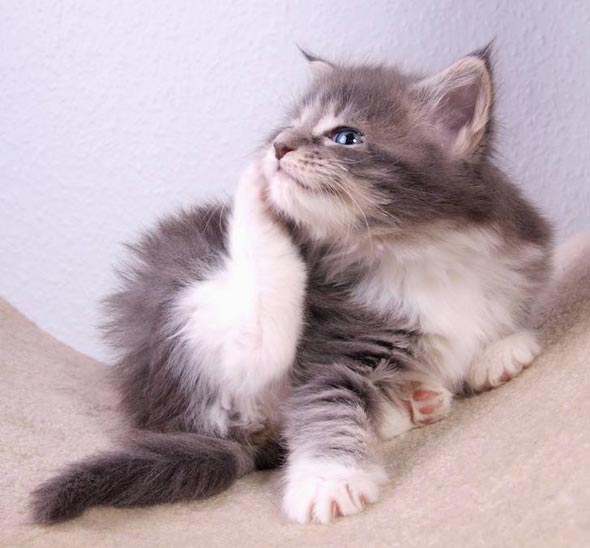
The Thinker, in feline form!
Good morning.
I slept. Until I got cold, and then I woke up.
So how did “Leftovers and I mean it!” go over last night? I’m still chuckling to myself at your audacity! I love it!
On the one hand, I think most of the personnel ate leftovers. On the other hand, we still have some left. Over.
LOL! Not a favorite meal, I guess!
Crikey! I just worked up a sweat! I was going to buy another storage tub, thinking it would be good to hold my clothes, and then I thought I may be able to juggle some stuff in the other ones I’ve had since I moved here, and sure enough. Between the donation pile and the trash, I emptied out a large storage tub.
Then I ordered a dozen different-sized Space Bags from Amazon, and will place my clothes in the Space Bags and put them in the tub I just emptied, since I don’t think I’ll find another large box at Walmart. I need the one I have for the VHS-to-DVD recorder/player to fit in.
I’m so close to being done with the packing the excitement is killing me. I have to exercise control, though, and rest in between a day a packing so I don’t get sick. The last thing I need is a relapse!
Welp, time to close down and head out the door. Since the Lawn Guy was here yesterday, I have to take the cover off the windshield.
That sounds pretty exciting! Good luck at Walmart!
Today’s special animal friend is the clouded leopard, Neofelis nebulosa. The clouded leopard is not closely related to the regular leopard or the snow leopard, both of which are in the genus Panthera. DNA analysis suggests that the clouded leopards (including the Sundan clouded leopard, Neofelis diardi) were the first established genus to diverge from the Ur-cat, the hypothetical ancestor of all Felidae. They are the most ancient of the subfamily Pantherinae, the large wild cats.
The clouded leopard lives in forests in South Asia, from the foothills of the Himalayas south into India and east into Indochina and parts of China. Once found in Singapore and Taiwan, it has been eradicated from those islands. They are small for a large wild cat, with females growing up to 37 inches long (head and body) and males over 40 inches. They can weight up to 50 lbs., and their tails are nearly as long as their bodies.
https://www.youtube.com/watch?v=Z2rhK7bSLg0
Clouded leopards occupy a variety of forested habitats, from mangrove swamps in Borneo to elevations up to 10,000 in the Himalayas. They prefer undisturbed, primary forests, but they have been observed – mainly by cameras or spoor – in second-growth and degraded forests. They feed on a variety of mammals and birds, including wild boar and primates such as the macaque. With the longest canine teeth (relative to skull size) of any feline and a mandible opening over 100 degrees, their jaws are adapted to kill prey larger than themselves; they eat the meat, cartilage, and marrow of bones. They are exceptionally good at climbing and leaping and can descend trees head-down, like squirrels.
Interesting information about feeding them in captivity is found here, also pictures:
https://nationalzoo.si.edu/animals/clouded-leopard
Clouded leopards’ mating habits have rarely (to never) been observed in the wild. Ovulation in the female can occur spontaneously or following copulation. Males can use force and cause injury to the females. Captive breeding is challenging! When successful mating occurs, gestation is around three months, and two or three cubs are usually born. Cubs are independent after around two years, but the mother may have another litter while late-adolescents are still around.
In captivity, all clouded leopard cubs are hand-reared to maximize their survival rate.
https://www.youtube.com/watch?v=prz8Oxb4vQQ
Clouded leopards are listed as Vulnerable by IUCN. They are on CITES Appendix 1 and are protected by national governments throughout most of their range. Enforcement varies. Poaching clearly occurs, since skins and other parts can be found in markets in Thailand and other nations. Habitat loss/fragmentation is a significant threat. The healthiest population seems to be in Borneo, which lacks other large cats and supports large areas of forest.
International Clouded Leopard Day is August 4. Have cake!
If someone wanted to REALLY engineer something helpful, a set of pipelines to carry water from flooded areas to drought-stricken areas would change the country.
So true.
Disclaimer: Opinions posted on Free Republic are those of the individual posters and do not necessarily represent the opinion of Free Republic or its management. All materials posted herein are protected by copyright law and the exemption for fair use of copyrighted works.