Posted on 04/06/2021 9:46:53 AM PDT by Red Badger
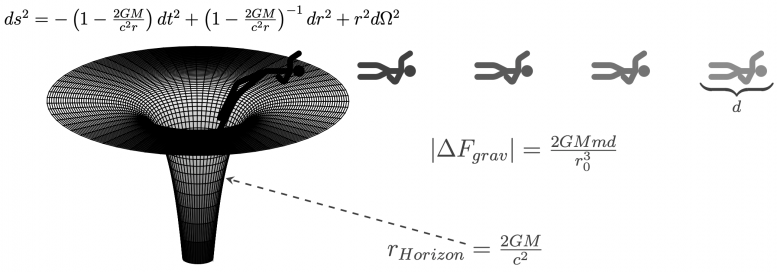
A person falling into a black hole and being stretched while approaching the black hole’s horizon. Credit: Leo Rodriguez and Shanshan Rodriguez, CC BY-ND ===================================================================
To solve the mysteries of black holes, a human should just venture into one. However, there is a rather complicated catch: A human can do this only if the respective black hole is supermassive and isolated, and if the person entering the black hole does not expect to report the findings to anyone in the entire universe.
We are both physicists who study black holes, albeit from a very safe distance. Black holes are among the most abundant astrophysical objects in our universe. These intriguing objects appear to be an essential ingredient in the evolution of the universe, from the Big Bang till present day. They probably had an impact on the formation of human life in our own galaxy.
Two types of black holes The universe is littered with a vast zoo of different types of black holes.
They can vary by size and be electrically charged, the same way electrons or protons are in atoms. Some black holes actually spin. There are two types of black holes that are relevant to our discussion. The first does not rotate, is electrically neutral – that is, not positively or negatively charged – and has the mass of our Sun. The second type is a supermassive black hole, with a mass of millions to even billions times greater than that of our Sun.
Besides the mass difference between these two types of black holes, what also differentiates them is the distance from their center to their “event horizon” – a measure called radial distance. The event horizon of a black hole is the point of no return. Anything that passes this point will be swallowed by the black hole and forever vanish from our known universe.
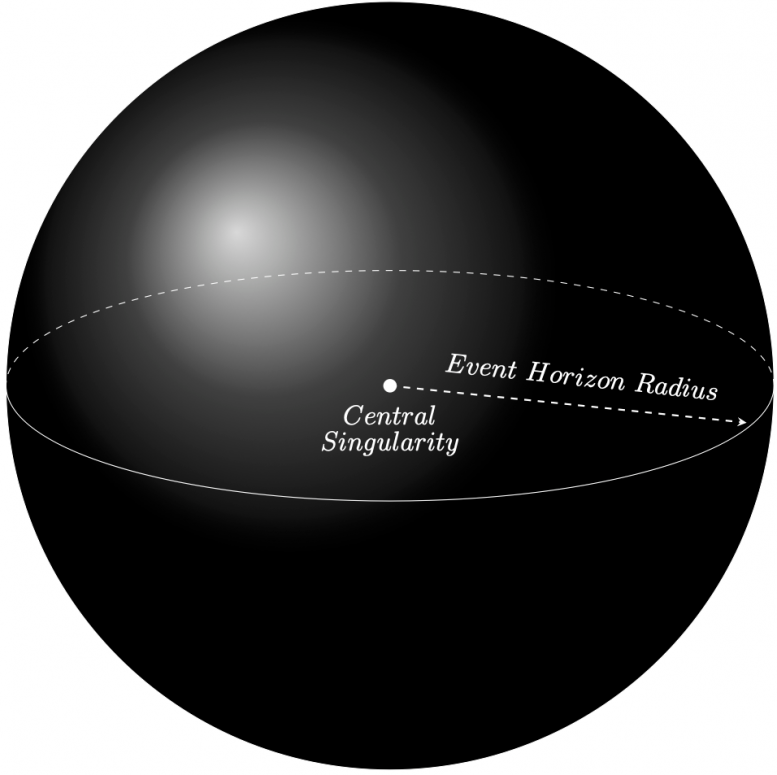
The distance from a black hole’s center of mass to where gravity’s pull is too strong to overcome is called the event horizon. Credit: Leo and Shanshan, CC BY-ND
At the event horizon, the black hole’s gravity is so powerful that no amount of mechanical force can overcome or counteract it. Even light, the fastest-moving thing in our universe, cannot escape – hence the term “black hole.”
The radial size of the event horizon depends on the mass of the respective black hole and is key for a person to survive falling into one. For a black hole with a mass of our Sun (one solar mass), the event horizon will have a radius of just under 2 miles.
The supermassive black hole at the center of our Milky Way galaxy, by contrast, has a mass of roughly 4 million solar masses, and it has an event horizon with a radius of 7.3 million miles or 17 solar radii.
Thus, someone falling into a stellar-size black hole will get much, much closer to the black hole’s center before passing the event horizon, as opposed to falling into a supermassive black hole.
This implies, due to the closeness of the black hole’s center, that the black hole’s pull on a person will differ by a factor of 1,000 billion times between head and toe, depending on which is leading the free fall. In other words, if the person is falling feet first, as they approach the event horizon of a stellar mass black hole, the gravitational pull on their feet will be exponentially larger compared to the black hole’s tug on their head.
The person would experience spaghettification, and most likely not survive being stretched into a long, thin noodlelike shape.
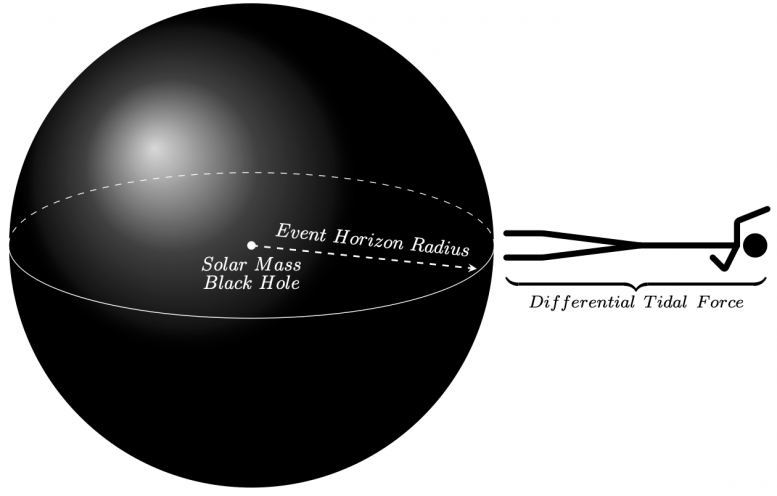
As the person approaches the event horizon of a a Sun-size black hole, the vast difference in gravitational pull between the inidvidual’s head and toes causes the person to stretch into a very long noodle, hence the term ‘spaghettification’. Credit: Leo and Shanshan Rodriguez, CC BY-ND
=========================================================================
Now, a person falling into a supermassive black hole would reach the event horizon much farther from the central source of gravitational pull, which means that the difference in gravitational pull between head and toe is nearly zero. Thus, the person would pass through the event horizon unaffected, not be stretched into a long, thin noodle, survive and float painlessly past the black hole’s horizon.
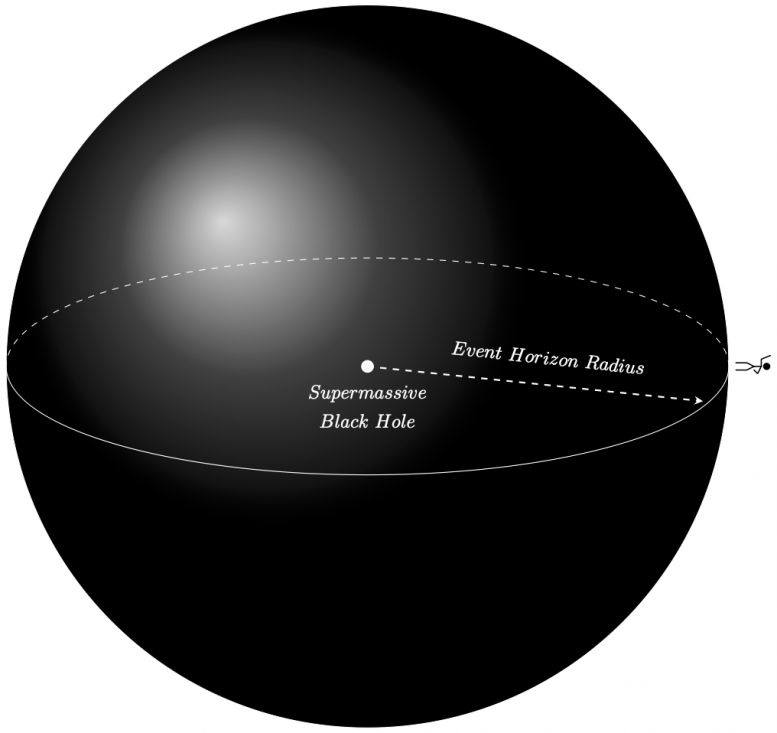
A person falling into a supermassive black hole would likely survive. Credit: Leo and Shanshan Rodriguez, CC BY-ND
==================================================================
Other considerations Most black holes that we observe in the universe are surrounded by very hot disks of material, mostly comprising gas and dust or other objects like stars and planets that got too close to the horizon and fell into the black hole. These disks are called accretion disks and are very hot and turbulent. They are most certainly not hospitable and would make traveling into the black hole extremely dangerous.
To enter one safely, you would need to find a supermassive black hole that is completely isolated and not feeding on surrounding material, gas, and or even stars.
Now, if a person found an isolated supermassive black hole suitable for scientific study and decided to venture in, everything observed or measured of the black hole interior would be confined within the black hole’s event horizon.
Keeping in mind that nothing can escape the gravitational pull beyond the event horizon, the in-falling person would not be able to send any information about their findings back out beyond this horizon. Their journey and findings would be lost to the rest of the entire universe for all time. But they would enjoy the adventure, for as long as they survived … maybe ….
Written by Leo Rodriguez, Assistant Professor of Physics, Grinnell College and Shanshan Rodriguez, Assistant Professor of Physics, Grinnell College.
Originally published on The Conversation.The Conversation
Two good sci-fi movies about black holes and Event Horizon.
First is the old Disney movie “The Black Hole” with a good cast and a couple of robots.
The second one is the movie entitled “Event Horizon”.
“The Australian TV series/movies “Farscape” used “black holes” to travel from universe to universe.
This reminds me of a section of Niven’s “A World out of Time”
https://silo.pub/larry-niven-a-world-out-of-time-o-5405644.html
At worst he had found a brand-new way to die. He asked of the ubiquitous microphones, „Suppose we go too far in? We won’t ever die, will we? We’d be stopped above the Schwarzchild radius.“ „Only to an outside observer. Not to ourselves. Are you about to change my orders?“ Some minutes later he eased himself into the Womb Room chair. He sipped the last of the broth. „Full view.“ Don Juan raced above a sea of churning stars. In a normal galaxy they would have been crowded enough. Here, forced into a plane by the spin of the giant black hole at the center, they were crowded to death. Dying stars burned with a terrible light.
They stood like torches in a field of candles. It must be common enough for star to ram star here, or for tides to rip stars apart. Commoner toward the center, Corbell thought The center of the sea burned very bright ahead of him. He could see no dark dot at the axis. He hadn’t expected to. „How far away are we in normal space?“ „Rest space? Three point six light-years.“ „No problems?“ „I believe I can hold us above the plane of the disk until we have passed that very active swelling ahead of us, between two and three light-years from the singularity.“ Corbell looked down at his drive flame, a dim wisp of white between his feet. There was very little matter above the disk, he guessed. „Suppose you can’t? Suppose we have to go through it?“ „You’ll never feel a thing. That region is where the stars lose their identity. They become streamers of dense plasma with nodules of neutronium in them. Most of the light comes from there. Beyond, there is very great flattening and some radiation due to friction in the matter spiraling inward.“ „What about the black hole itself?“ „I still don’t have a view of it. I estimate a circumference of two billion kilometers and a mass of one hundred million solar masses. The ergosphere will be large. We should have no trouble choosing a path through it.“ „You said circumference?“ „Should I have given you the radius? The radius of a black hole may be infinite.“ There was simply no grasping the size of that disk of crushed stars. It was like flying above another universe. At two billion kilometers, the black hole would almost have contained the orbit of Jupiter; but if Corbell could have seen past that swelling ahead, that Ring of Fire, he would have found the black hole invisibly small. Light caught the corner of his eye, and he turned to see a supernova glaring whiteon-red. He’d just missed seeing a sun torn apart by tides, its ten-million-degree heart spilled across the sky. He asked what he had never asked before. „Peerssa, what are you thinking?“ „I don’t quite know how to answer that.“ „I’m not thinking anything. My decisions are made. They are mathematically rigorous. I face no choices.“ „How are you going to find Earth?“ „I know where Sol will be in three million years.“ „Three — ! Won’t it be more like seventy thousand?“ „We’re diving deep into a tremendous gravity field. Time will be compressed for us. The black hole is large enough that tides will not tear us apart, but we’ll lose almost three million years before I fire the fusion motor. What more can I do? The odds are finite that we will find Sol. Or the State may have spread through a million cubic light-years of space before we arrive.“ „The odds are finite. Peerssa, you’re strange.“ But Corbell felt no urge to laugh. Seventy thousand years B.C., there had been Neanderthal Man and a few Cro-Magnon. Humans. Three million years ago, nothing but a club-swinging, meateating ape. What would inhabit the Earth three million years from now?
So, did they survive?
What was Earth like 3 million years hence?...............
They are no longer theoretical...................
[Could a Human Enter a Black Hole to Study It – And Survive the Event Horizon?]
What happens if you put your head in a particle accelerator?:
https://www.youtube.com/watch?v=mD4J5VUwiAs
Well, that’s the opinion of some.
1. by definition, they cannot be seen as nothing including light escapes them.
2. Hawkings Radiation-apparently does not exist as it pertains to the theory of BH existence, so it is not evidence of BHs.
3.Uncertainty Principle- states it is not possible to locate something exactly
4. The idea of BH is an attempt to explain another theory- the big bang, because mass ought to be evenly distributed throughout the universe but it is not, shooting (black) holes as it were, into that theory of origins ( besides, even my 3rd grade grand child asks where did the big bang come from, who made it go bang? ) and no, it did not occur because “it had to” like some famous dead guy declared. “It”, demands identity, an actor, not nothing doing something; irrational and illogical.
However, as in all science (body of knowledge) and research, seeking is important, but finding is not a function of consensus (ask Galileo, who actually read the Bible), the truth is always self-supporting and self-evident.
He Lives!
Yes, they survive and return to a very changed Earth. There are still people living there, although not many.
You can read the plot summary in eight paragraphs at
https://en.wikipedia.org/wiki/A_World_Out_of_Time
and you can download the entire novel online as a pdf at https://silo.pub/qdownload/larry-niven-a-world-out-of-time-o-5405644.html
If you decide you want to read other stories based in this alternate future timeline , I would recommend his books “The Integral Trees” and “The Smoke Ring”
Forty years ago I was a major Larry Niven fan, but lately I’ve found weaknesses in his writing style.
Disclaimer: Opinions posted on Free Republic are those of the individual posters and do not necessarily represent the opinion of Free Republic or its management. All materials posted herein are protected by copyright law and the exemption for fair use of copyrighted works.