
Posted on 02/22/2026 5:34:58 PM PST by SeekAndFind
The latest social financing figures from China show an economy that is increasingly relying on government debt while private demand for credit remains weak.
The strength of the Chinese technology sector and its exporting companies gives enough room for leverage.
However, behind the weak private sector credit demand lies an evident economic slowdown that the Chinese government acknowledges, challenging consumption patterns, a significant overcapacity problem, and the depth of the housing crisis.
The current economic model, focused on delivering 5% real economic growth, requires larger doses of debt to achieve smaller increments of growth, especially productive sector growth. The government has focused on reducing debt and overcapacity imbalances while reorienting its exports and financial system to lessen dependence on the US dollar; however, the main challenge for the Chinese economy remains boosting consumer demand, despite rate cuts and easing financial conditions.
To understand the intensity of debt of the Chinese model, we must go to the year 2000 and see the acceleration in the flow of debt, not just the current stock. At that time, real GDP growth was around 8–9%, so each percentage point of growth came with roughly 13–16 points of debt‑to‑GDP. Government debt was very low, at around 25% of GDP, and most leverage sat in the state-owned corporate sector with modest household debt. China was able to deliver near‑double‑digit growth with a total non‑financial debt ratio barely above 120% of GDP.
By 2023, non‑financial sector debt had risen to about 285% of GDP, more than doubling its level of 2000. Chinese think‑tanks and official commentators put the “macro leverage ratio” closer to 300% of GDP by 2025, according to the Chinese Academy of Social Sciences. The macro leverage ratio rose by 11.8 percentage points to 302.3 percent in 2025, exceeding the 10.1-point increase reported in 2024.
Over the same period, the trend of real GDP growth has slowed to roughly 4–5%, so each percentage point of growth now requires around 60–75 points of debt‑to‑GDP, more than three times the debt per point of growth required in 2000. Furthermore, it comes mostly from government debt.
In January 2026, aggregate social financing jumped by 7.22 trillion yuan, significantly higher than in the same month of 2025 and above market expectations, consistent with 5% annual GDP growth and a larger composition of the public sector in the mix. Outstanding social financing reached 449.11 trillion yuan at the end of January, rising 8.2% year‑on‑year, while money supply (M2) rose by 9%.
New yuan bank loans were 4.7 trillion yuan, about 420 billion less than a year earlier and significantly below consensus, showing the weak private‑sector credit demand and the prudent approach of Chinese customers and businesses to debt addition. RMB loans outstanding stood at 276.62 trillion yuan, up only 6.1% year‑on‑year, clearly below the pace of overall financing and money growth.
The driver of credit growth in China is no longer households and private firms but the government and state-owned companies.
The real estate problem has impacted Chinese families in numerous ways. Not only did most of them see the value of their homes decline, but many families invested in the attractive yields of real estate developers’ commercial paper, which led to large losses and even the wipe-out of savings for many.
Additionally, despite the excess in supply of houses, prices have not fallen enough to warrant enough appetite for new mortgages, as affordability remains an issue and the traditional prudence of Chinese citizens when it comes to consuming and borrowing adds to the challenge.
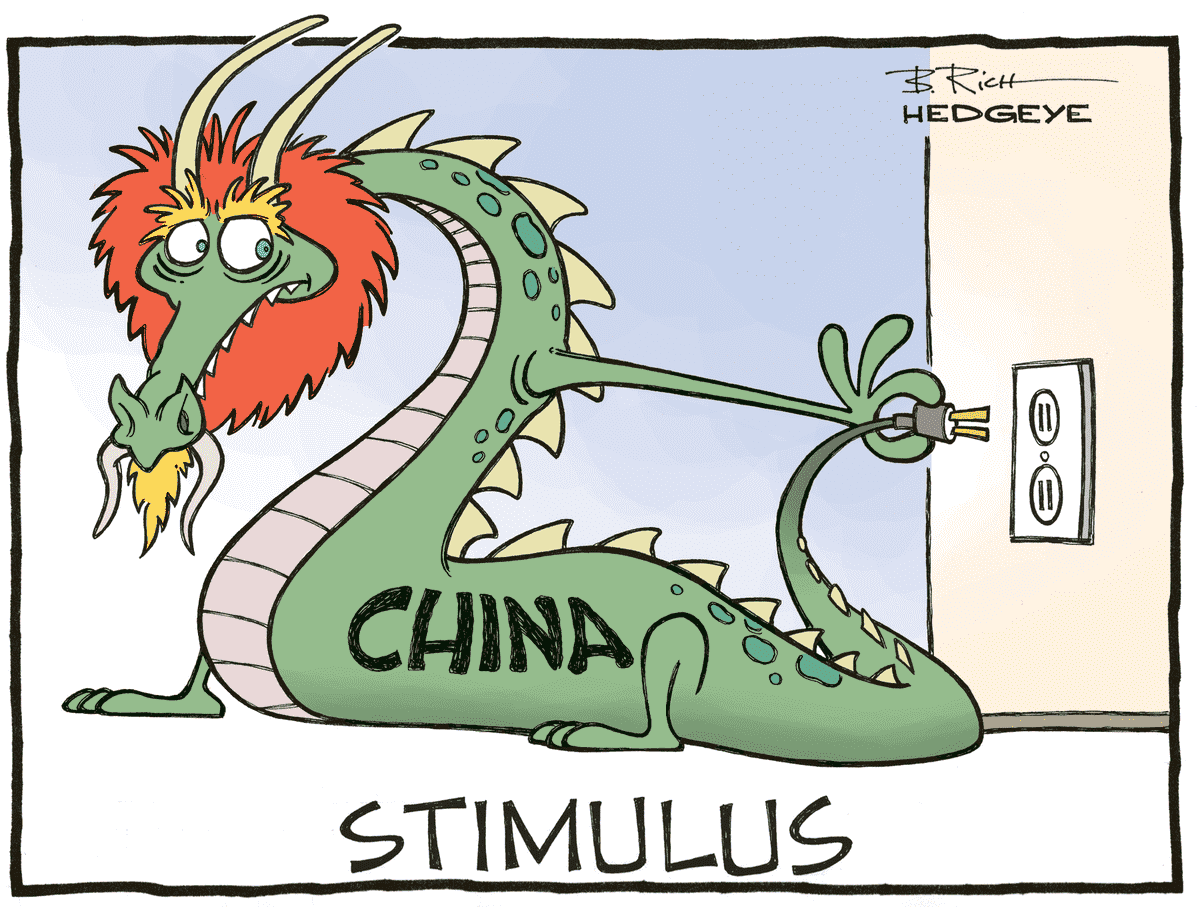
Beijing plans to issue 4.4 trillion yuan in local government special‑purpose bonds in 2025, 500 billion more than in 2024, looking to boost government investment and a “proactive fiscal policy,” knowing that raising taxes would be exceedingly negative for growth and consumption.
Local governments are expected to issue more than 10 trillion yuan in bonds in 2025, including refinancing, general bonds, and new special bonds.
The Chinese government knows that it can manage more debt but also sees the weak investment and household spending and acknowledges that large tax increases would be counterproductive. However, to prevent future debt-driven stagnation, a focus on productivity is necessary.
The official budget sets a deficit of 4% for 2025. However, once all budget items are consolidated, including government funds, special bonds, and off‑budget vehicles, this true fiscal deficit in 2025 is closer to 9%, up from 7.7% in 2024, according to Rhodium Group and JP Morgan. China increasingly relies on hidden or almost fiscal borrowing to support growth.
With outstanding social financing now around 449 trillion yuan and real growth around 4–5%, each incremental point of GDP is increasingly linked with a much larger stock of debt than a decade ago.
This rising credit intensity of growth may prevent a significant slowdown but may create a significant fiscal challenge in the future. The Chinese model demands high growth and low taxes; any change to the fiscal system will be negative.
For years, local governments relied on the sale of land for property development to collect tax receipts. Thus, the drag from real estate is evident in the economy and in fiscal sustainability. Real estate development investment fell 13.9% year‑on‑year in the first three quarters of 2025, with residential investment down 12.9%, the steepest drop since 2021, according to official figures.
Property investment and sales both posted double‑digit declines in 2024, and forecasters expect real estate investment to fall another 11% and sales to drop 7.5% in 2025, according to Reuters, with further declines in 2026 before stabilizing only in 2027… if it happens as fast as consensus estimates.
The property sector, once a key engine for economic growth and tax receipts, absorbs new credit to stabilize its accounts without boosting growth or creating a multiplier effect.
Additionally, China’s industrial capacity utilization remained at 74.9% at the end of 2025, well below the 78.4% peak reached in 2021.
Overcapacity is clear in steel, autos, legacy chips, and parts of sectors like green tech, where expansion has surpassed domestic and external demand. Thus, the purchasing managers’ indices show weak new orders and foreign demand, while bankruptcies and insolvencies have risen, although not to levels that would indicate a financial crisis.
The Chinese economy needs to reopen, improve investor and legal security and allow the housing slump to materialize fully to see the type of productive economic growth it needs to avoid much larger increases in debt. Otherwise, the risk of stagnation will likely be elevated as population growth stalls, overcapacity remains, and the stock of unsold property becomes a larger liability.
China sucks.
China is willing to let the people suffer in order to fix their situation..
Analysts have been forecasting dire things about China’s economy for years. Ghost cities. No energy resources. Debt. Demographic death spiral.
China keeps expanding worldwide. They’re not getting the bad news memo.
My Chinese wife keeps up with real estate in the Greater Bay area around Hong Kong. Housing prices for existing units have crashed by 40 to 60% in some cities and at least 20% everywhere. Property prices have even begun to stagnate or drop in HK though not as much
We know Chinese/HK expats in the UK and US who are looking to go back to China because the cost of living is less and the society is less weird. They also feel freer in China than they do in the US or UK.
I think China is heading for a major recession and financial reset in the property market due to over supply, a falling population. I don’t know how this will affect the rest of the Chinese economy or confidence in the central government.
Why is it a problem for them and not a problem for us?
Here's a graphic on a quite similar model.
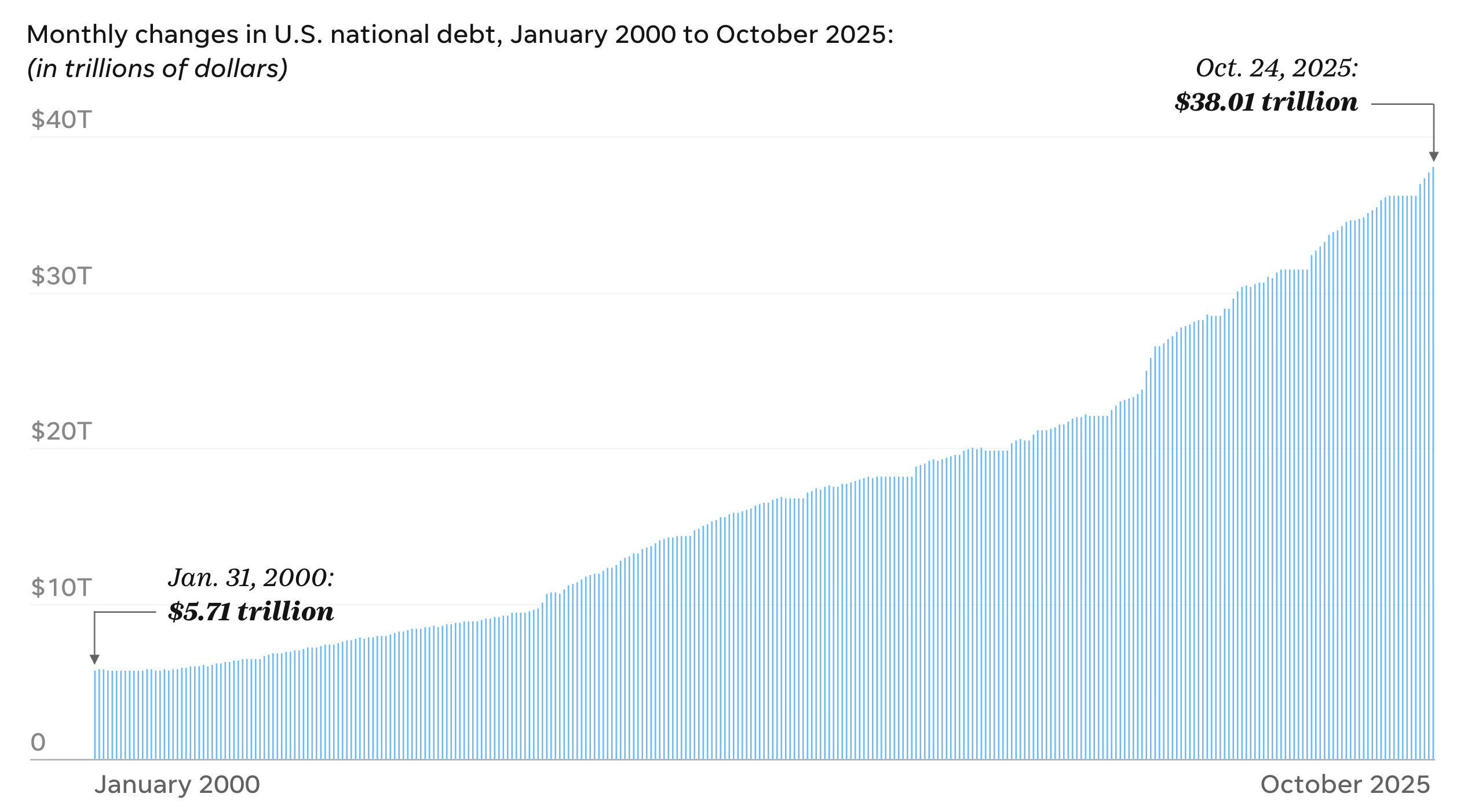
The latest social financing figures from China show an economy that is increasingly relying on government debt
/////////////////////////////////////////////////////
There doesn’t need to be anything more in this article. You can’t take the edge of that.
I love all these capitalists trying to explain what the Chicoms must do.
They’re Chicoms. They killed 60 million of their own people. Capitalist ideas of debt mean nothing to them. They will destroy millions, tens of millions, to balance the books. So what?
And they will still put the first base on the moon.
Nevertheless, China's structural weaknesses place limits on the country. Their military, for example, is riddled with corruption and is unready for a serious fight. China's PLAN (their Navy) is unable to undertake extended deep water operations on a wide scale due to weaknesses in equipment, doctrine, and training.
In China's long history, attention getting imperial accomplishments often came at the cost of durable internal development. It may well be that the pattern is repeating itself.
Disclaimer: Opinions posted on Free Republic are those of the individual posters and do not necessarily represent the opinion of Free Republic or its management. All materials posted herein are protected by copyright law and the exemption for fair use of copyrighted works.