The Camera Saw It
Cardinal Timothy Radcliffe now wants the London event to shrink.
According to the reports, he told AdVaticanum that he gave no blessing, had no prior awareness that blessings would be given, and that the Eucharist at Holy Apostles was private. He also rejected the interpretation that the Mass celebrated a homosexual relationship.
The camera says otherwise.
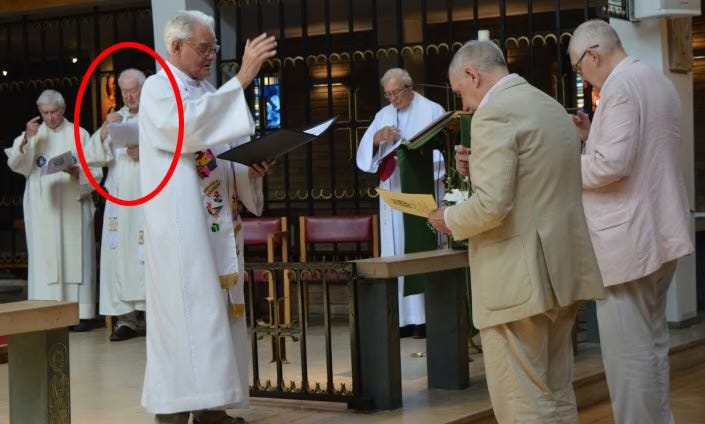
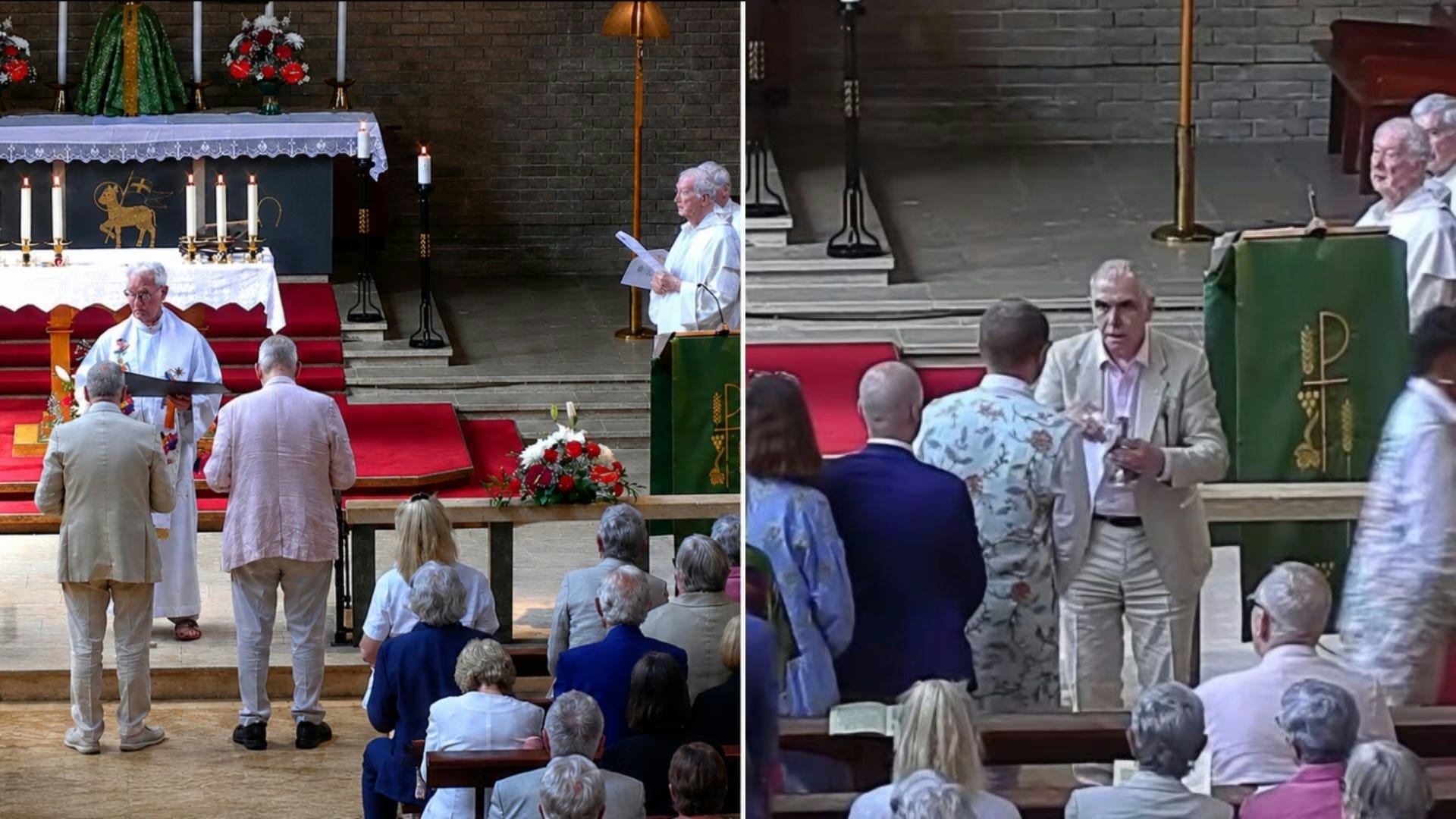
The event marked fifty years of “friendship, partnership, and commitment” between Julian Filochowski and Martin Pendergast. The church was full enough for about 150 people. Relatives and friends came. Photographs were taken. New Ways Ministry covered it. A livestream appeared online, then later disappeared from public view. The two men stood together. Clergy gathered. A blessing was read over them. Radcliffe, according to the image circulated with the report, made the sign of the cross during that blessing.
This is the new Catholic gaslight.
A public ecclesiastical event becomes “private” once scandal breaks. A blessing performed in front of witnesses becomes something the cardinal did not give. A Mass advertised around one couple’s fifty-year partnership becomes a Eucharist that was somehow unrelated to gay relationships “as such.” A homily addressed to Julian and Martin becomes a general reflection on friendship.
The old modernist trick was ambiguity before the act.
The new trick is ambiguity after the video.
Fiducia’s Guardrails Were Always Paper
The official sales pitch for Fiducia Supplicans depended on careful distinctions.
No blessing of the union. No new rite. No confusion with marriage. No liturgical form. No validation of the relationship. Just a spontaneous pastoral blessing for people seeking God’s help.
The London event, as reported, ran straight through those guardrails.
A Mass of thanksgiving. A fiftieth anniversary. A couple standing together. A prayer asking God’s grace to come down upon Julian and Martin as they marked the anniversary of their relationship. A plea that “their love” continue and that all uniting them deepen. A Trinitarian blessing invoked over them.
That is no alleyway blessing after confession.
That is a church event.
Even the 2021 CDF responsum condemns it. Before Fernández, the answer was blunt: the Church cannot bless unions that involve sexual activity outside marriage, including same-sex unions. Positive elements within a relationship could be valued, yet they could never make the relationship itself a legitimate object of ecclesial blessing.
Then came Fiducia Supplicans. It opened a pastoral lane and insisted the lane had rails.
London shows the rails were decorative.
Friendship Excuses Everything
Radcliffe’s homily gives the theology behind the event.
He spoke of friendship as a participation in the life of God. In itself, that phrase can sound orthodox. Christian friendship has a real place in the tradition. Charity unites souls in God. The saints understood holy friendship.
Then Radcliffe reportedly said of the two men: “I believe, Julian and Martin, that your faithful friendship is grounded in a shared passion for peace and for the triumph of justice.”
In that setting, “friendship” becomes the solvent.
The moral question dissolves into a spiritual abstraction. The actual relationship recedes. The cardinal speaks about peace, justice, fidelity, friendship, the life of God. The audience hears sanctification. The couple receives ecclesiastical honor. Anyone objecting appears hostile to friendship itself.
This is the Francis-era art form.
Never say the old doctrine is gone. Create a ceremony where the old doctrine cannot speak.
Never deny sin in a clean sentence. Surround the situation with enough virtue words that sin feels rude to mention.
Never call the relationship a marriage. Let the anniversary, the couple, the blessing, the photographs, the guests, and the altar do the work.
“Then Was Then, and Now Is Now”
The old Roman reaction tells the story.
The report recalls that in 2001, when Filochowski and Pendergast celebrated the twenty-fifth anniversary of their relationship, Cardinal Ratzinger was reportedly angry at the muted response from the English bishops. According to the Tablet account quoted in the report, he told Cardinal Cormac Murphy-O’Connor that the director of CAFOD should be fired.
That earlier Roman instinct still had some Catholic reflex left.
By 2026, the same couple can mark fifty years at Holy Apostles with bishops, clergy, Radcliffe’s homily, and a blessing.
Fr. O’Keefe reportedly summed up the new age: “Then was then, and now is now.”
Exactly.
Then was doctrine with consequences.
Now is pastoral theater with deniability.
Then Rome feared scandal.
Now Rome fears the people who notice.
The Precious Blood and the New Status
The report also says one of the honorees distributed the Precious Blood during Communion.
The controversy goes beyond a sentimental prayer for two old activists. The honoree becomes publicly involved in sacramental distribution during the very celebration marking the relationship. The event moves from “pastoral closeness” to visible ecclesial status.
This is what the revolution always seeks: status.
The old language of welcome was merely the beginning. Welcome became accompaniment. Accompaniment became integration. Integration became blessing. Blessing becomes ministry. Ministry becomes evidence that the Church has already changed.
By the time Rome notices, the new practice has facts on the ground.
Then the denials begin.
Amoris at Ten
The next story fits the same pattern.

Leo XIV’s October gathering for the tenth anniversary of Amoris Laetitia reportedly centers on implementation, with presidents of bishops’ conferences drawn into a synodal process of listening, prayer, and discernment. One theme concerns “failure,” separation, divorce, co-responsibility, concrete experiences, accompaniment, and appreciation.
There is no such thing as divorce in Catholicism.
There is civil divorce. There can be separation. There can be abandoned spouses. There can be annulment if a true marriage never came into being. There can be terrible family wreckage that requires pastoral care.
The Catholic point is that a valid sacramental marriage remains until death.
That is the doctrine the new language keeps surrounding.
Amoris Laetitia changed the practical atmosphere by shifting energy toward discernment of irregular situations. It spoke of integration, mitigation, conscience, limits, complexity, and sacramental help in certain cases. That is why the tenth-anniversary meeting is important. It is the revolution’s family-policy office returning to its founding text.
They are no longer debating whether the crack exists.
They are planning how to build through it.
From Indissolubility to “The Gap”
The phrase “gap between the ideal and reality” is deadly.
Marriage becomes the ideal. Divorce becomes reality. Cohabitation becomes reality. Remarriage becomes reality. Pastoral care then lives in the gap.
That structure sounds compassionate. It also moves the mind away from the juridical and sacramental fact of marriage. The bond becomes a horizon. Human situations become the real material. The Church’s task becomes accompaniment through imperfect lives rather than conversion into obedience.
The old Church did accompany sinners. She also knew the difference between mercy and reclassification.
The Amoris project blurs that line. It lets a person remain in an objective disorder while the system searches for ways to involve, appreciate, and integrate him. Once that logic is enthroned, the same method spreads: divorced and remarried couples, cohabiting couples, same-sex couples, gender identity, women’s ordination protests, every “wound” and “journey” the age wants the Church to bless.
Synodality is the delivery system.
Leo’s German Signal

Leo’s appointment of Christian Würtz to Eichstätt speaks loudly.
Here is a German bishop with heavyweight legal credentials, reportedly aligned with the Synodal Way votes on homosexuality, gender diversity, and blessing ceremonies for couples who “love each other.” He comes from Freiburg, walks toward Maria 2.0 protesters, blesses them, gives them a letter, and symbolically keeps the thread of dialogue alive. When women apply to seminary in protest against the male priesthood, he reportedly treats the act as a sign of seriousness, even while citing universal law as the obstacle.
This is the new Roman personnel pattern.
A bishop can operate inside the rainbow-German reform ecosystem and still rise. He can carry the language of law, theology, dialogue, and process. He can avoid theatrical rupture while signaling openness to the entire reform agenda.
Leo appoints him.
That fact is more important than any single sentence Würtz has spoken. Rome is rewarding a type.
Canonically trained. Synodal. Pastoral. German. Open to blessing ceremonies. Gentle with feminist protest. Acceptable to the new machine.
Eichstätt had been associated with resistance to the German reform path under Gregor Maria Hanke. Leo sends Würtz.
Message received.
Women at the Altar Without Ordination

Archbishop Erio Castellucci’s proposal is even more revealing.
Women would lead the Liturgy of the Word. Priests would preside over the Eucharistic consecration. Call it co-presidency. Present it as a way around the impasse over women’s ordination. Respect the rule that only a priest consecrates, then divide the Mass into functional zones.
This is how revolution advances when dogma still blocks the front door.
The proposal does not need women priests immediately. It creates women quasi-presiders. It teaches the faithful to see the Mass as a set of leadership roles. One role handles Word. Another handles consecration. A team leads the assembly. The priest becomes the consecration specialist.
That mutilates the unity of the Eucharistic sacrifice.
The priest does not merely appear at the moment of consecration as a sacramental technician. He stands at the altar in persona Christi, offering the sacrifice. The Liturgy of the Word and the Liturgy of the Eucharist form one act of worship ordered to sacrifice. To split presidency by sex and function is to catechize the people into a different idea of the Mass.
This is also where the Novus Ordo’s architecture makes the experiment easier. Once the Mass is commonly experienced as segments, ministries, readers, procession roles, presider’s chair, commentaries, and assembly leadership, the next step arrives naturally. Women already read, serve, distribute, preach informally in various settings, lead services, run parishes, and govern offices. Co-presidency is the name for what the system has been rehearsing.
The Same Two Fronts
These stories look separate.
They form one campaign.
Radcliffe and Holy Apostles show the sexual front: the blessing of relationships the old doctrine judged incompatible with chastity.
Amoris at ten shows the marital front: the reworking of pastoral practice around divorce, remarriage, cohabitation, failure, and “reality.”
Würtz shows the personnel front: Rome promotes men formed by the Synodal Way atmosphere.
Castellucci shows the liturgical front: women approach the altar through divided functions and managed language.
Each front uses the same method.
Keep the old formula available for conservatives. Shift practice. Promote new personnel. Create facts. Explain the change as accompaniment, dialogue, synodality, discernment, or pastoral care. When scandal breaks, insist nothing essential changed.
That is the machine.
Why Écône Still Terrifies Them

Now bring Écône back into the frame.
Rome sanctions the SSPX. It issues language of schism. It warns the faithful. It attacks sacraments. It tells families to stay away.
At the same time, Radcliffe can explain away a filmed blessing of a homosexual partnership. Leo can prepare another Amoris implementation event. A German bishop tied to Synodal Way reform can rise. An Italian archbishop can float women’s co-presidency at Mass.
This contrast reveals the real hierarchy of Roman concern.
The SSPX is dangerous because it names the whole postconciliar trajectory. It refuses the fiction that this is a series of disconnected pastoral accidents. It says the Council, the new liturgy, the new ecumenism, the new anthropology, the new collegiality, the new religious liberty, and the new pastoral method all belong to the same crisis.
Rome can tolerate Latin when Latin behaves.
Rome struggles with Tradition when Tradition remembers.
The Pressure Point

This is where the uncomfortable question returns.
A Catholic can resist one bad act. A Catholic can survive one foolish bishop. A Catholic can distinguish office from officeholder. A Catholic can endure humiliation from shepherds who speak badly, govern weakly, or appoint foolishly.
The present pattern feels deeper.
The visible machinery keeps moving in one direction. It promotes the architects and managers of the revolution. It protects ambiguity. It punishes the old Faith. It talks about conscience when dealing with adulterers, tenderness when dealing with homosexual couples, dialogue when dealing with feminists, and law when dealing with traditional Catholics.
The recognize-and-resist Catholic says: the pope remains pope, the bishops remain bishops, and the faithful must resist their abuses.
The sedevacantist says: a Catholic authority cannot govern as the engine of this anti-Catholic transformation.
The rest of us stand in the terrible middle, seeing the force of the evidence and the gravity of the conclusion.
Leo is making that middle harder to inhabit.
The Revolution Has Its Sacraments

The revolution has learned to pray.
It has Eucharists of thanksgiving for partnerships.
It has blessings for relationships.
It has synodal ceremonies for wounds and failures.
It has diocesan processes for gender diversity.
It has seminary conversations with women seeking impossible ordination.
It has theologians who divide the Mass into shared presidencies.
It has cardinals who can invoke friendship and the Trinity while a moral impossibility receives ecclesiastical tenderness.
Then it has the nerve to lecture Écône about communion.
The faithful should study the week carefully.
Radcliffe’s camera.
Amoris at ten.
Würtz in Eichstätt.
Castellucci at the altar.
All of it points in the same direction.
Rome’s revolution is no longer hiding in footnotes. It stands in the sanctuary, smiles for photographs, blesses what earlier doctrine condemned, promotes the men who voted for it, and prepares the next meeting.
Écône is punished because Écône refuses to applaud.

-Catholic-Sat-on-X-Speaking-off-the-cuff-at-lunch-with-200-poo.png)