
Posted on 05/29/2026 5:12:53 AM PDT by Cronos
Anabaptism developed as a radical religious and social movement during the Reformation in 16th century Europe. "Anabaptist" means "re-baptiser" and refers to the movement's central rejection of infant baptism in favour of a conscious act of adult baptism into the Christian faith.
Anabaptist congregations separated themselves from all forms of state control and avoided contact with society outside their own communities. They rejected both the Roman Catholic Church and the new Reformed Protestant Churches. The Mennonites, the Amish, the Hutterites and other similar groups originated in Anabaptist congregations. Militant Anabaptist uprisings occurred in Europe, notably at Münster in Germany in 1534, leaving the movement with a reputation for disrupting the established social order. Anabaptists who fled to England were persecuted during the reigns of Henry VIII and Mary I.
Anabaptism influenced several nonconformist sects in England and the New World, especially the early Baptists, but the word "Anabaptist" was generally a term of abuse during the Civil War and Commonwealth era, used to denote any potentially subversive religious doctrine.

T he English Baptist movement has its origins in a Separatist congregation established at Gainsborough in Lincolnshire, around 1606, which was led by John Smyth (c.1550-1612), a former clergyman who had become disillusioned with the Anglican church. Smyth's followers, along with a small number of sister congregations that had formed in Lincolnshire and Nottinghamshire, were persecuted as dissenters and forced to flee to the Netherlands in 1608. At Amsterdam, the English Separatists came under the influence of the Mennonites, an Anabaptist sect which claimed to practise a pure form of Christianity similar to that of the early Church. A central Mennonite tenet was that infant baptism was meaningless. A deliberate act of adult baptism was essential for entry into the faith. In 1609, Smyth and his followers baptised themselves and confessed Jesus as Saviour to form what is generally regarded as the first Baptist congregation.
After Smyth's death in 1611, Thomas Helwys (c.1550-1616) wrote the first English Baptist confession of faith ( A Declaration of Faith of Certain English People Remaining at Amsterdam ). In 1612, Helwys led his congregation back to London where he established a Baptist church at Spitalfields. Despite their attempts to disassociate themselves from the Mennonites, the early Baptists were persecuted and stigmatised as Anabaptists. Both Helwys and John Murton, who succeeded him as pastor of the Spitalfields congregation, died in gaol, but the Baptist faith grew steadily throughout England and Wales. During the 1630s, the movement split into two groups: the General and Particular Baptists.
"General" Baptists followed the doctrines of Smyth and Helwys. They believed in free will rather than the Calvinist doctrine of predestination taught by the Presbyterians . Baptists laid strong emphasis on individual personal salvation and an acceptance of persecution as an opportunity to testify for Christ. Pastors were elected by the casting of lots. Set prayers and recitations were regarded as a discouragement to true religion and some congregations encouraged prophesying, where members said whatever they believed God had inspired them to say. Travelling General Baptist preachers were regarded as troublemakers by local civil and church authorities throughout the kingdom.
The General Baptists were challenged by the emergence in London of John Spilsbury's Calvinist "Particular" Baptist congregation in 1638. Like General Baptists, the Particular Baptists believed in the separation of church and state. Both groups encouraged lay preachers and came to accept total immersion rather than pouring as the preferred method of baptism. However, Particular Baptists practised stricter regulation of their congregations and accepted Calvin's doctrine of predestination. They believed in salvation for a "particular" few, rather than the "general" salvation preached by the General Baptists.
The Particular Baptist churches held regular meetings of delegates in London and issued the London Confession in 1644, which declared that men must be allowed to follow their own conscience and understanding. By 1658, the Particular Baptists were organised into four large regional associations covering the whole of England. There was no national meeting, but the London pastors greatly influenced the movement as a whole. Many officers and men of the New Model Army were Particular Baptists, including the regicides Ludlow , Axtell and Hewson . John Bunyan (1628-88), author of The Pilgrim's Progress and other spiritual works, served in the New Model Army during the final stages of the English Civil War and became a Baptist in 1653.
During the early 1650s, army Baptists flourished in Ireland under the sympathetic administration of the Lord-Deputy Charles Fleetwood . However, the religious radicals were highly critical of the establishment of the Protectorate. In 1655, Fleetwood was replaced as Lord-Deputy by Henry Cromwell , who succeeded in forcing the leading Baptist officers to resign their commissions or to leave Ireland.
Baptist congregations continued to meet after the Restoration, but they were regarded with suspicion by the church authorities. Many congregations prospered in America.
| Year / Era | Anabaptist Movement | Baptist Movement |
|---|---|---|
| 1520s | Emergence in Zurich (Swiss Brethren) as part of the Radical Reformation. | N/A |
| 1609 | Established movement. | John Smyth establishes the first Baptist congregation in Amsterdam. |
| 1612 | Established movement. | Thomas Helwys returns to England, establishing the first Baptist church on English soil. |
| 17th Century | Persecuted across Europe; expansion to North America (Mennonites, Amish). | Expansion in England (General and Particular Baptists); growth in American Colonies. |
| Feature | Anabaptists | Baptists |
|---|---|---|
| Origin | Radical wing of the Protestant Reformation (1525). | English Separatism (1609). |
| Relationship to State | Historically separatist; pacifist; often rejected oath-taking and civil magistracy. | Historically more integrated; advocated for religious liberty but generally accepted civil duties. |
| Theology of Community | Emphasis on the "gathered church" and strict separation from the "fallen world." | Emphasis on believer's baptism and congregational autonomy, but often remained involved in wider society. |
| Sacramental View | Strict memorialism; often viewed as signs of commitment rather than means of grace. | Ordinance-based; generally viewed as acts of obedience to Christ. |
Baptists are not derived from Anabaptists
The Baptist movement emerged primarily from the 17th-century English Separatist movement rather than a direct descent from the continental Anabaptists. These early Baptists, such as John Smyth and Thomas Helwys, were looking for a way to reform the Church of England, and their adoption of believer's baptism was a reaction to their own specific English context.
And Anabaptists don't date to before the 1520s The formal beginning of the Anabaptist movement is traced to January 21, 1525, in Zurich, Switzerland. On this date, Conrad Grebel and George Blaurock performed the first adult "re-baptisms" after breaking away from the reform movement of Huldreich Zwingli.
But did they dance?.....................
yup, historically some Anabaptists did ban (and do ban) dancing and music.
So the Mennonites are the group most directly descended from the Anabaptists?
Beissel established a cloister, combining a celibate monastic community with a surrounding married community. His teachings were quite heterodox, but what really set his community apart was its homegrown music, the first music composed in what became America. The cloister supported the patriots medically in the Revolutionary War, but didn't survive long after Beissel.
(FD: I had two proposals for my music doctorate in the 70s, and researching Ephrata was one of them; I ended up doing the other--Christopher Herbert, among others, have done the research instead. I did have one other connection to the cloister: it was where I proposed to my wife.)
Bookmark
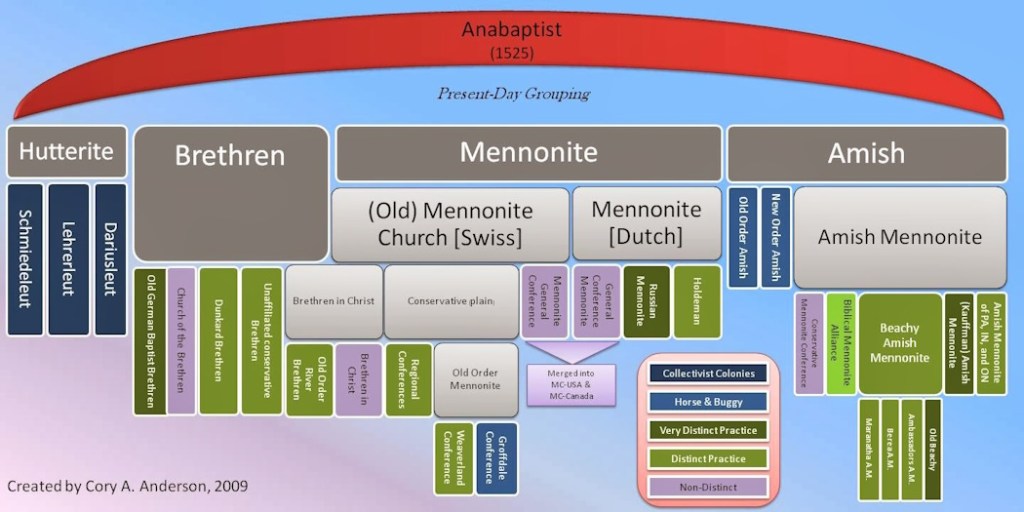
"Baptists" are not descended from ANAbaptists
While the name "Anabaptist" (meaning "re-baptizer") was used as a generic, often derogatory slur by opponents against anyone who rejected infant baptism, the actual historical line of the Baptist denomination comes from an entirely different branch of the Reformation tree: English Puritan Separatism.
John Smyth and Thomas Helwys were English Separatist pastors who fled to Amsterdam to escape religious persecution from King James I.
While in Amsterdam, Smyth's group did encounter continental Anabaptists (specifically the Mennonites). Smyth was so impressed by them that he wanted to merge his congregation with them. However, Thomas Helwys strongly disagreed. * The Split: Helwys and a remnant of the congregation broke away from Smyth precisely because they rejected key Anabaptist doctrines. Helwys led his flock back to England in 1611/1612 to establish the very first distinct English Baptist church in Spitalfields, London.
Yes. Menno Simons, like Martin Luther, was a Roman Catholic priest who had never red the Bible. Once he read it, like Martin Luther, became disillusioned by the Roman Church’s practices that contradicted scripture. While not one of the original Anabaptists, he joined the Anabaptist movement after renouncing the Roman Catholic priesthood and became an Anabaptist leader.
Theologically, Baptists fiercely defended mainstream orthodox and Reformed doctrines that the Anabaptists explicitly rejected
For example:
1. The Human Nature of Christ (The Incarnation): Most continental Anabaptists held to a belief by Melchior Hoffman called “celestial flesh.” They believed that Jesus did not take His physical flesh from the Virgin Mary, but passed through her womb like “water through a pipe.” English Baptists utterly rejected this and held strictly to the orthodox, biblical view that Jesus was fully man, taking His flesh from Mary (Romans 1:3).
2. The Doctrine of Justification: The vast majority of Baptists (particularly the Particular Baptists who formed the largest strand of the movement) were deeply Calvinistic. They believed in the Reformed view of justification by faith alone and the total depravity of man. Continental Anabaptists, by contrast, generally rejected Calvinism, held to a strict free-will theology, and taught a view of justification that required human cooperation and community standard compliance to maintain.
So YOU say.
.
And the TRUTH Shall set You FREE.
Thanks
Simons was ordained a priest in 1524. His training required fluency in Latin and familiarity with the Latin Vulgate Bible and liturgical texts. He was intimately familiar with the Gospels and Epistles because he had to read and preach them to his congregation at every Mass.
Every Catholic priest is required to celebrate the Mass. The Mass is not a human invention that ignores scripture; it is a tapestry of biblical texts. In a single Mass, a priest reads or proclaims the Old Testament, the Psalms, the New Testament Epistles, and the Gospels.
The Church's practice of training priests in scripture aligns precisely with St. Paul's instructions to Timothy: “Follow the pattern of the sound words that you have heard from me... guard the good deposit entrusted to you” (2 Timothy 1:13–14) and “what you have heard from me in the presence of many witnesses entrust to faithful men who will be able to teach others also” (2 Timothy 2:2).
Amen!
In 17th-century England, "Anabaptist" was a highly derogatory political slur, much like calling someone an "anarchist" or a "radical extremist" today. Because the continental Anabaptists had been involved in the violent Münster rebellion of 1534, the English religious establishment (Anglicans and Presbyterians) intentionally labeled the new English Baptists as "Anabaptists" to make them look like dangerous political traitors to the King.
The early English Baptists explicitly complained about this false labeling. In the preamble to the famous London Baptist Confession of 1644, the early Baptists stated they were publishing their beliefs specifically to clear their names from the false accusation of being linked to the Anabaptists: "A CONFESSION OF FAITH of seven congregations or churches of Christ in London, which are commonly, but unjustly, called Anabaptists;."
The actual text is “during his initial entry into the priesthood” not “during his training”
It is physically impossible for a Catholic priest in 1500s to note have read the Bible as it was what he had to read every single day for mass.
Every single day, a Catholic priest was legally required to pray the Divine Office (Liturgy of the Hours), which consists of praying through almost the entire Book of Psalms every single week, along with long daily readings from the Old and New Testaments.
Every single day at Mass, the priest read multiple long selections from the Gospels and Epistles.
So your statement “Menno Simons, like Martin Luther, was a Roman Catholic priest who had never red the Bible” is false
Bookmark
Disclaimer: Opinions posted on Free Republic are those of the individual posters and do not necessarily represent the opinion of Free Republic or its management. All materials posted herein are protected by copyright law and the exemption for fair use of copyrighted works.