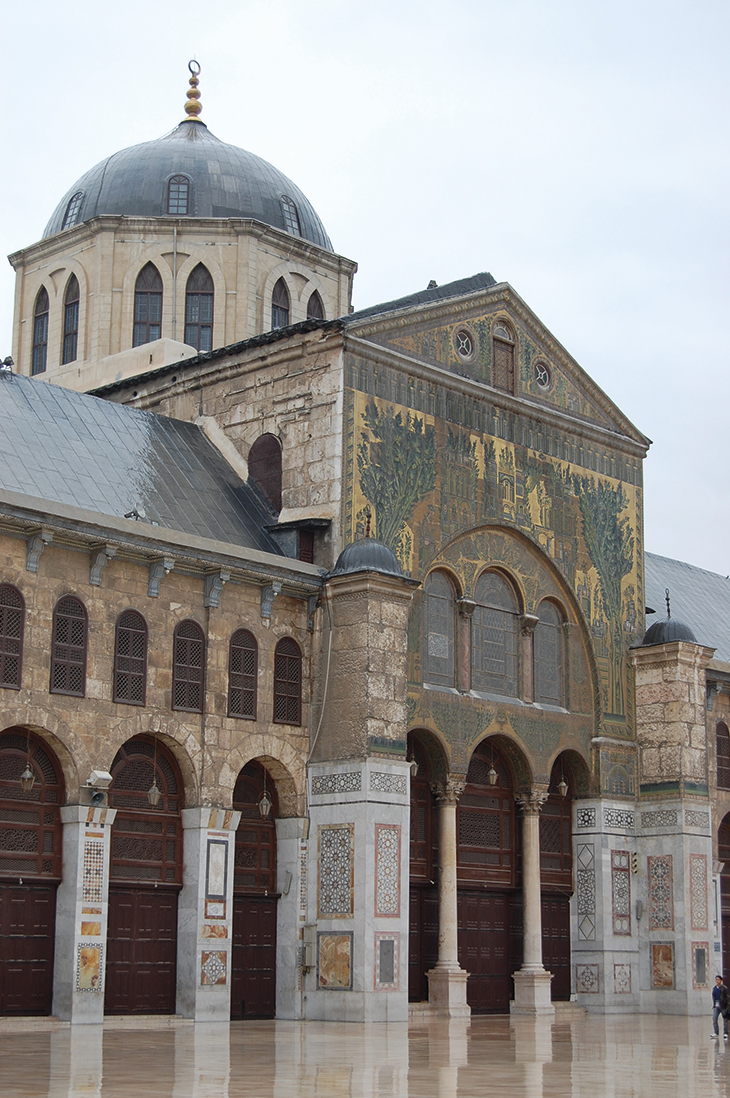
Transept facade of the Umayyad Mosque, Damascus (photo: Alain George, 2010)
Posted on 12/15/2025 5:54:20 AM PST by Cronos
Built to rival the Dome of the Rock in Jerusalem, the great mosque in Damascus has always been claimed by rival faiths
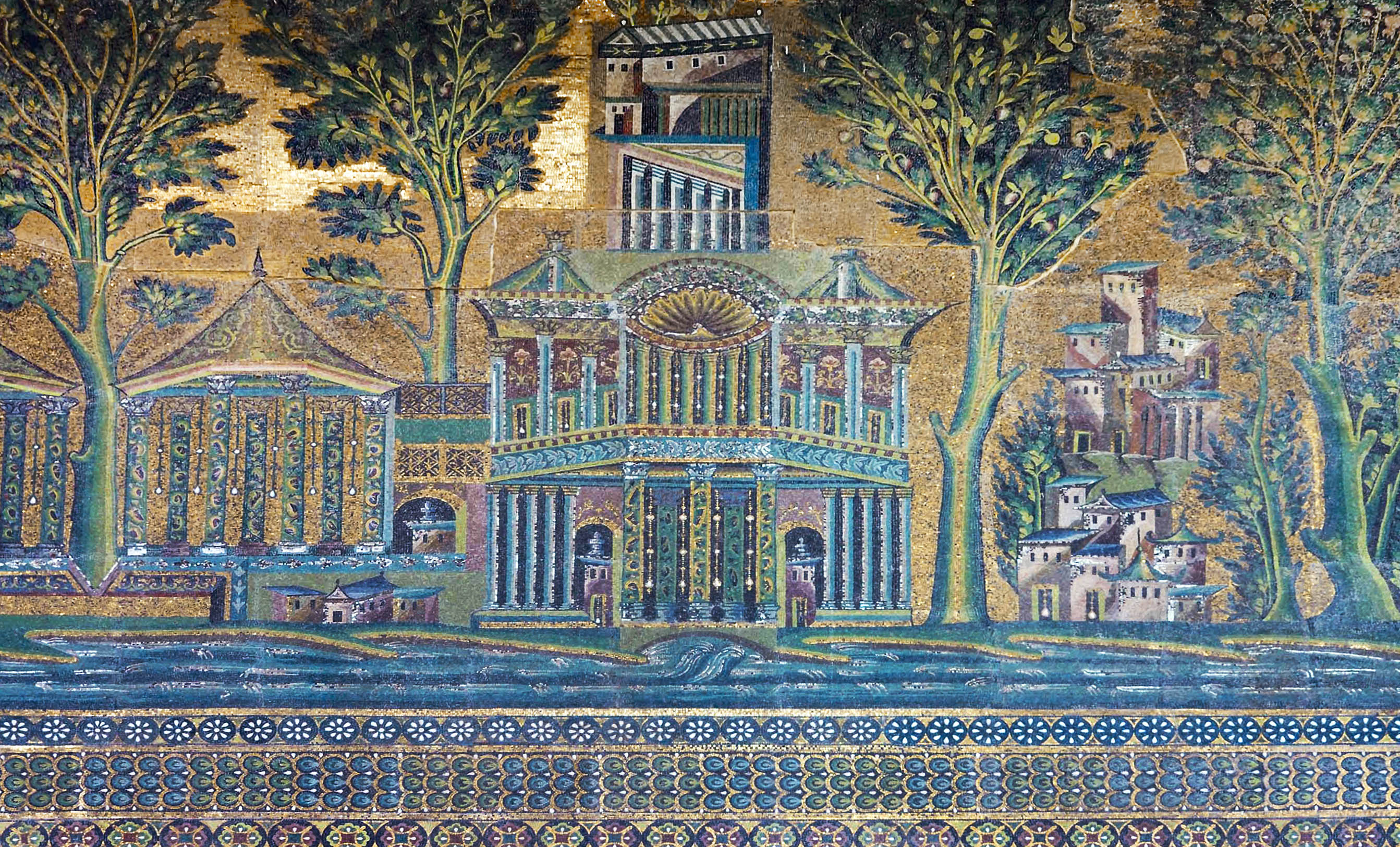
Sometime in the mid 1990s, I was standing in the marble courtyard of the Umayyad Mosque in Damascus when two nuns asked me where they could find the head of John the Baptist. I pointed them towards the grand transept facade, gleaming with green and gold mosaics evoking a fertile paradise. Beyond lay the shrine to John or Yahya ibn Zakariyya, as he is known in Arabic, one of the few shared sites of Muslim-Christian pilgrimage. In 2001, Pope John Paul II would pray there – the first time a pontiff had ever visited a mosque.
Alain George’s illuminating new study shows us that the Umayyad Mosque has always been claimed by rival faiths. George, born in Beirut and now professor of Islamic art and architecture at Oxford, writes that the mosque ‘is one of the oldest continuously used cultic sites in the world’. In the first century, the Romans built a temple to Jupiter, whose columns shoppers in the Old City’s Souq Al-Hamidiyah still amble past today. The place was Christianised in the fourth century; after the Muslim conquest in the 630s, a mosque was built within the walls, and for a few decades it remained in uneasy co-existence with the church.
After taking power in 705, the Umayyad caliph al-Walid, keen to match his father Abdul Malik’s magnificent Dome of the Rock in Jerusalem, ordered the creation of a palatial court-mosque in his capital Damascus. But first he needed to clear out the church. After his offer to buy it was rejected, he ordered his Christian workmen to destroy it. When they refused, the caliph, dressed in a yellow robe, struck the first blow with a pick-axe. The mosque took 10 years to complete and cost the equivalent of a full year’s tax revenue raised from Basra.
Al-Walid’s panegyrists also got to work. When the church and mosque were side by side, ‘people of the book would pray, / the chanting bishops echoed back […] like swallows chattering at dawn.’ But now, ‘prayer of holy truth holds sway / and God’s authentic word is known.’ Still, according to Islamic protocol you weren’t actually allowed to destroy churches. The Byzantine emperor Justinian II reminded al-Walid that Abdul Malik had protected the Church of the Holy Sepulchre. The caliph said he would destroy that church as well unless Justinian sent 200 of Constantinople’s best workmen to Damascus. The weak emperor grudgingly complied.
Who actually built the mosque? The Aphrodito Papyri archive in Egypt contains documents relating to the project, including ‘requests for workers, maintenance stipends and, in one case, 47 litrae (about 15–20kg) of chains’. One Enoch, son of Victor, is listed as a middleman. There are no accounts of work on the Damascus mosque itself but you can get a flavour from reports on the rebuilding of the Prophet Muhammad’s mosque in Medina, which took place around the same time. One fed-up worker scrawled a pig on the apex of an arch. (He was beheaded.) An even more foolhardy soul tried to urinate on the Prophet’s tomb before, as the Muslim chronicler relates, being miraculously struck dead. While at the Damascus mosque there are painted red animals on an arch, they don’t look like pigs and are more likely to be graffiti from Roman times. A Greek biblical inscription does remain legible on the lintel of the triple gate – perhaps a sneaky act of subversion by Christian builders.
Where, in all this, does John the Baptist fit in? Damascus is more usually associated with Saint Paul and there is no mention of the Baptist’s shrine before the Muslim era. Most likely, argues George, the Umayyads simply reassigned a skull-relic to John. ‘By anchoring the mosque deeper in its Christian past,’ he writes, ‘they bestowed on it a sacred aura that the church itself had lacked.’
This is certainly plausible. But I wonder if George hasn’t missed another element. During this era Shias were forging an identity in opposition to the Sunni Umayyads. After Imam Hussein was killed in 680, his head was taken to Damascus for display. There is a shrine in this spot still visited by Shia pilgrims – I was one of them back in the 1990s. As Stephennie Mulder points out in The Shrines of the ‘Alids in Medieval Syria (2014), there are reports that Hussein’s head was kept in the same place as John the Baptist’s. Could the Umayyads have buried the potentially rabble-rousing story of Hussein’s martyrdom by melding it with the tale of another beheaded martyr, but one whose story was safely told in the Qur’an?
I have focused here on the stories around the mosque rather than George’s impressive though sometimes rather technical descriptions of its architectural features. He is very good on the many transformations the mosque has undergone over the years, especially after being afflicted by invasions, wars and multiple fires. (In 1893, the roof and much else were destroyed after a workman sparked up his hookah.) Some of the period pictures of the mosque being repaired are splendidly evocative – particularly one of fez-wearing painters in the 1920s copying the famous mosaics.
But the tangled nature of the mosque’s religious history exerts an irresistible pull. Over the last 10 years, Syria’s civil war has ripped its communities apart with Christians, Sunnis and Shias all targeted for their religion. And while the mosque hardly has a cosy interfaith past, it is also true that each group feels a special connection with the place. During one 15th-century fire, an eyewitness named Ibn al-Himsi reported: ‘The marble burned down and collapsed like melting salt. Glass bits fell alongside a grilled glass window and the lead from the roof melted down […] All grieved profoundly; even the Christians and Jews wept at the sight, as did the people who flocked in from the villages.’
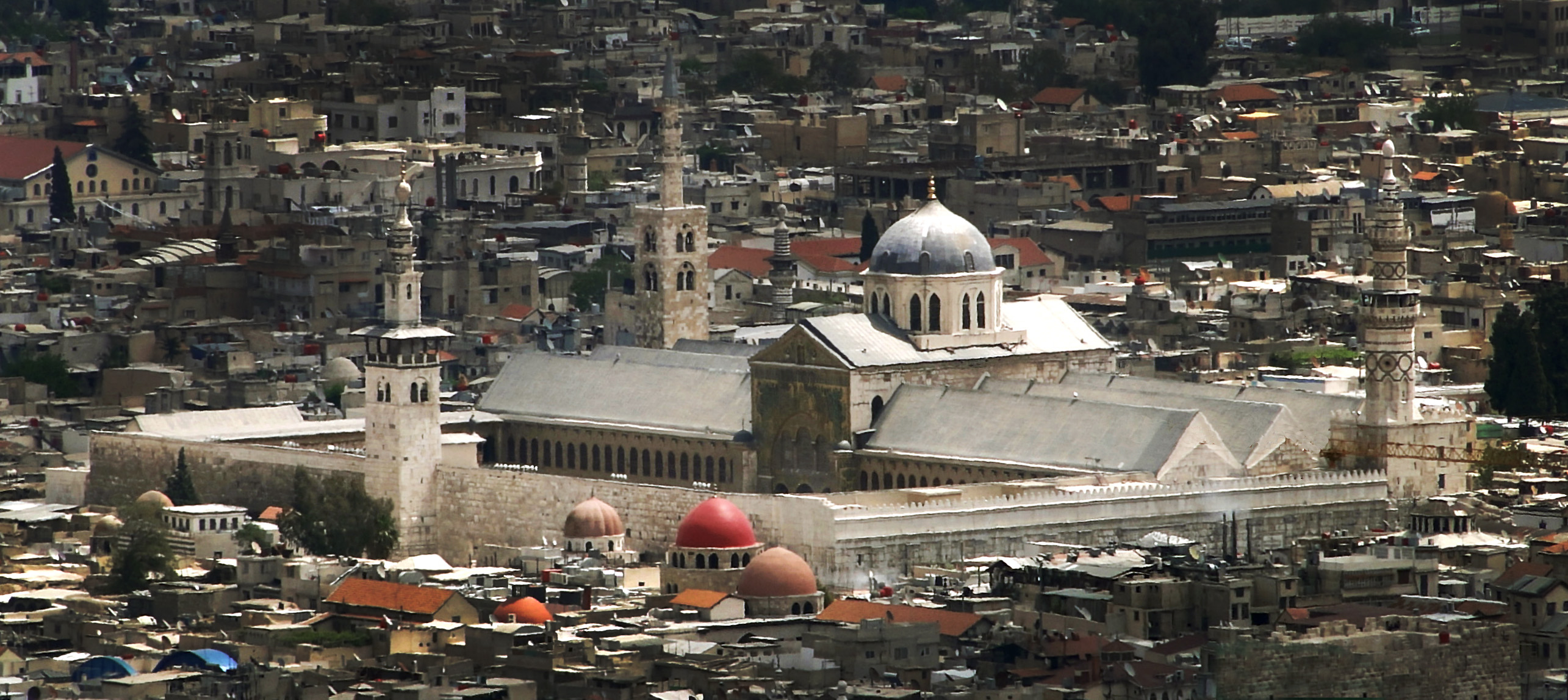
Damascus is one of the oldest continually inhabited cities in the world, with archaeological remains dating from as early as 9000 B.C.E., and sacred spaces have been central to the Old City of Damascus ever since. As early as the 9th century B.C.E., a temple was built to Hadad-Ramman, the Semitic god of storm and rain. Though the exact form and shape of this temple is unknown, a bas-relief with a sphinx, believed to come from this temple, was reused in the northern wall of the city’s Great Mosque.
once Christianity was widely adopted in the eastern part of the Roman Empire, the temple to Jupiter was once again converted, this time into a cathedral dedicated to John the Baptist. This church is attributed to the Emperor Theodosius in 391 C.E. The exact location of the church is unknown, but it is thought to have been located in the western part of the temenos. It was probably one of the largest churches in the Christian world and served as a major center of Christianity until 636 C.E. when the city was once again conquered, this time by Muslim Arabs. Damascus was a key city, as it provided access to the sea and to the desert. When it was clear that the city was going to fall, the defeated Christians and conquering Muslims negotiated the city’s surrender. The Muslims agreed to respect the lives, property and churches of the Christians. Christians retained control of their cathedral, although Muslim worshippers reportedly used the southern wall of the compound when they prayed towards Mecca.
When Damascus became the capital of the Umayyad dynasty, the early 8th century caliph al-Walid envisioned a beautiful mosque at the heart of his new capital city, one that would rival any of the great religious buildings of the Christian world.
From the courtyard, one would enter the prayer hall. The prayer hall takes its form from Christian basilicas (which are in turn derived from ancient Roman law courts). However, there is no apse towards which one would pray. Rather the faithful pray facing the qibla wall. The qibla wall has a niche (mihrab), which focuses the faithful in their prayers. In line with the mihrab of the Great Mosque is a massive dome and a transept to accommodate a large number of worshippers. The façade of the transept facing the courtyard is decorated on the exterior with rich mosaics.
Tear down superiorist blights and reconsecrate!
Ping!......................
.
Sure looks like a Church to me.
[snip] The Byzantine emperor Justinian II reminded al-Walid that Abdul Malik had protected the Church of the Holy Sepulchre. The caliph said he would destroy that church as well unless Justinian sent 200 of Constantinople’s best workmen to Damascus. The weak emperor grudgingly complied... The Aphrodito Papyri archive in Egypt contains documents relating to the project, including 'requests for workers, maintenance stipends and, in one case, 47 litrae (about 15–20kg) of chains'. One Enoch, son of Victor, is listed as a middleman... at the Damascus mosque there are painted red animals on an arch, they don't look like pigs and are more likely to be graffiti from Roman times. A Greek biblical inscription does remain legible on the lintel of the triple gate – perhaps a sneaky act of subversion by Christian builders... During this era Shias were forging an identity in opposition to the Sunni Umayyads. After Imam Hussein was killed in 680, his head was taken to Damascus for display. There is a shrine in this spot still visited by Shia pilgrims – I was one of them back in the 1990s. As Stephennie Mulder points out in The Shrines of the 'Alids in Medieval Syria (2014), there are reports that Hussein’s head was kept in the same place as John the Baptist’s. Could the Umayyads have buried the potentially rabble-rousing story of Hussein's martyrdom by melding it with the tale of another beheaded martyr, but one whose story was safely told in the Qur'an? [/snip]
Disclaimer: Opinions posted on Free Republic are those of the individual posters and do not necessarily represent the opinion of Free Republic or its management. All materials posted herein are protected by copyright law and the exemption for fair use of copyrighted works.
