Skip to comments.
Catholic Caucus: Daily Mass Readings, 07-25-05, Feast of St. James, apostle
USCCB.org/New American Bible ^
| 07-25-05
| New American Bible
Posted on 07/25/2005 6:51:34 AM PDT by Salvation
July 25, 2005
Feast of Saint James, Apostle
Psalm: Monday 33
Reading I2 Cor 4:7-15
Brothers and sisters:
We hold this treasure in earthen vessels,
that the surpassing power may be of God and not from us.
We are afflicted in every way, but not constrained;
perplexed, but not driven to despair;
persecuted, but not abandoned;
struck down, but not destroyed;
always carrying about in the body the dying of Jesus,
so that the life of Jesus may also be manifested in our body.
For we who live are constantly being given up to death
for the sake of Jesus,
so that the life of Jesus may be manifested in our mortal flesh.
So death is at work in us, but life in you.
Since, then, we have the same spirit of faith,
according to what is written, I believed, therefore I spoke,
we too believe and therefore speak,
knowing that the one who raised the Lord Jesus
will raise us also with Jesus
and place us with you in his presence.
Everything indeed is for you,
so that the grace bestowed in abundance on more and more people
may cause the thanksgiving to overflow for the glory of God.
Responsorial PsalmPs 126:1bc-2ab, 2cd-3, 4-5, 6
R. (5)
Those who sow in tears shall reap rejoicing.When the LORD brought back the captives of Zion,
we were like men dreaming.
Then our mouth was filled with laughter,
and our tongue with rejoicing.
R.
Those who sow in tears shall reap rejoicing.Then they said among the nations,
"The LORD has done great things for them."
The LORD has done great things for us;
we are glad indeed.
R.
Those who sow in tears shall reap rejoicing.Restore our fortunes, O LORD,
like the torrents in the southern desert.
Those that sow in tears
shall reap rejoicing.
R.
Those who sow in tears shall reap rejoicing.Although they go forth weeping,
carrying the seed to be sown,
They shall come back rejoicing,
carrying their sheaves.
R.
Those who sow in tears shall reap rejoicing.
GospelMt 20:20-28
The mother of the sons of Zebedee approached Jesus with her sons
and did him homage, wishing to ask him for something.
He said to her,
"What do you wish?"
She answered him,
"Command that these two sons of mine sit,
one at your right and the other at your left, in your Kingdom."
Jesus said in reply,
"You do not know what you are asking.
Can you drink the chalice that I am going to drink?"
They said to him, "We can."
He replied,
"My chalice you will indeed drink,
but to sit at my right and at my left, this is not mine to give
but is for those for whom it has been prepared by my Father."
When the ten heard this,
they became indignant at the two brothers.
But Jesus summoned them and said,
"You know that the rulers of the Gentiles lord it over them,
and the great ones make their authority over them felt.
But it shall not be so among you.
Rather, whoever wishes to be great among you shall be your servant;
whoever wishes to be first among you shall be your slave.
Just so, the Son of Man did not come to be served
but to serve and to give his life as a ransom for many."
TOPICS: Activism; Apologetics; Catholic; Charismatic Christian; Current Events; Eastern Religions; Ecumenism; Evangelical Christian; General Discusssion; History; Islam; Judaism; Mainline Protestant; Ministry/Outreach; Moral Issues; Orthodox Christian; Other Christian; Other non-Christian; Prayer; Religion & Culture; Religion & Politics; Religion & Science; Skeptics/Seekers; Theology; Worship
KEYWORDS: catholiccaucus; catholiclist; dailymassreadings; greater; ordinarytime; stjames
For your reading, reflection, faith-sharing, comments, questions, discussion.
1
posted on
07/25/2005 6:51:35 AM PDT
by
Salvation
To: nickcarraway; sandyeggo; Siobhan; Lady In Blue; NYer; american colleen; Pyro7480; sinkspur; ...
Alleluia Ping!
Please notify me via FReepmail if you would like to be added to or taken off the Alleluia Ping List.
2
posted on
07/25/2005 6:54:23 AM PDT
by
Salvation
(†With God all things are possible.†)
To: Salvation
3
posted on
07/25/2005 6:55:40 AM PDT
by
Salvation
(†With God all things are possible.†)
To: All
From: 2 Corinthians 4:7-15
The Trials He Has Experienced
[7] But we have this treasure in earthen vessels, to show that the
transcendent power belongs to God and not to us. [8] We are afflicted
in every way, but not crushed; perplexed, but not driven to despair;
[9] persecuted, but not forsaken; struck down, but not destroyed;
[10] always carrying in the body the death of Jesus, so that the life
of Jesus may also be manifested in our bodies. [11] For while we live
we are always being given up to death for Jesus' sake, so that the life
of Jesus may be manifested in our mortal flesh. [12] So death is at
work in us, but life in you.
He Is Sustained By Hope in Heaven
[13] Since we have the same spirit of faith as he had who wrote, "I
believed, and so I spoke," we too believe, and so we speak,
[14] knowing that he who raised the Lord Jesus will raise us also with
Jesus and bring us with you into his presence. [15] For it is all for
your sake, so that as grace extends to more and more people it may
increase thanksgiving, to the glory of God.
Commentary:
7-12. In contrast to the greatness of the Gospel--the "treasure"
entrusted to them by God--St. Paul emphasizes the limitations of its
ministers: they are "earthen vessels" (v. 7). To illustrate this he
describes the afflictions and persecution to which he finds himself
subjected and in which God's grace always comes to his aid.
In some way these sufferings of the Apostles and of all Christians
reproduce in their lives the sufferings of Christ in his passion and
death. In his case his suffering opened the way to his glorification
after the Resurrection; similarly his servants, even in this life, are
experiencing an anticipation of the life they will attain in heaven;
this helps them overcome every kind of affliction.
7. St. Paul again stresses that the effectiveness of all his apostolic
activity comes from God (cf., e.g., 1 Cor 1:26-31; 2 Cor 3:5); he it is
who places his treasures in poor earthenware vessels. The image the
Apostle uses--which is reminiscent of the clay which God used to make
Adam (cf. Gen 2:7)--helps Christians realize that through grace they
bear in their souls a wonderful treasure, God himself; like earthen
vessels they are very fragile and they need to be put together again in
the sacrament of Confession. As a gloss on these ideas Monsignor
Escriva taught that Christians by bearing God in their souls are
enabled to live at one and the same time "in heaven and on earth,
divinized: but knowing that we are of the world and made of clay, with
the frailty that is typical of clay--an earthenware pot which our Lord
has deigned to use in his service. And whenever it has got broken, we
have gone and riveted the bits together again, like the prodigal son:
'I have sinned against heaven and against you...'" (quoted in Bernal,
"Monsignor Escriva de Balaguer").
8-9. The Apostle's words assure the Christian that he or she can always
count on God's help: no matter what trials they have to undergo,
victory can be attained with the grace of God as happened in St. Paul's
case. "God is faithful, and he will not let you be tempted beyond your
strength, but with temptation will also provide you the way of escape,
that you may be able to endure it" (1 Cor 10:13). Moreover, St. Paul's
example reminds us that more or less severe suffering and tribulation
will be a normal thing in the lives of Christ's followers; theirs will
never be a comfortable, trouble-free life. "If it is your ambition to
win the esteem of men, if your desire to be well-regarded and seek only
a life of ease, you have gone astray [...]. In the city of the saints,
entrance is given and rest and eternal rule with the King, only to
those who have made their way along the rough, narrow way of
tribulation" (Pseudo-Macarius, "Homilies", XII, 5).
10-11. As happened in St. Paul's case, in their daily lives Christians
must relive the sufferings of Christ through self-denial and penance:
this is part of following Christ and imitating him. "The Christian
vocation is one of sacrifice, penance, expiation. We must make
reparation for our sins--for the many times we turned our face aside so
as to avoid the gaze of God--and all the sins of mankind. We must try
to imitate Christ, 'always carrying in the body the death of Christ',
his abnegation, his suffering on the cross, 'so that the life of Jesus
may be manifested in our bodies' (2 Cor 4:10). Our way is one of
immolation and, in this denial, we find "gaudium cum pace", both joy
and peace" ([St] J. Escriva, "Christ Is Passing By", 9).
Self-denial, mortification, does not have to be something overt; it
should be practiced in the ordinary circumstances of life--for example,
by being punctual for appointments, carefully fulfilling one's duties,
treating everyone with as much charity as possible, accepting little
setbacks in a good-humored way (cf. [St] J. Escriva, "Friends of God", 138).
10. "The death of Jesus": more exactly, the "dying" of Christ: the
Greek word refers to the situation of someone who is dying.
12. In the Apostles, and also in other Christians, the paradox of
Jesus' life is verified: his death is the cause of life for all men.
"Unless a grain of wheat falls into the earth and dies, it remains
alone, but if it dies, it bears much fruit" (Jn 12:24). Afflictions
and tribulations, physical and moral pain, daily self-denial and
penance, cause Christ's disciple to die to himself and, if united to
the sufferings of his Master, they become a source of life for others
through the communion of saints.
13-18. The Apostle explains where he gets the strength to bear all the
tribulations of life--from his hope in the resurrection and his
expectation of being in heaven with those to whom he is writing
(v. 14). There is nothing selfish about this desire for heaven: it
helps us to stay true to the faith and it enables us to see all the
sufferings of this life as something transitory and slight (v. 17), a
necessary step to heaven and a way to obtain incomparably greater
happiness. "If we wish to enjoy the pleasures of eternity," St.
Alphonsus reminds us, "we must deprive ourselves of the pleasures of
time. 'Whoever would save his life will lose it' (Mt 16:25) [...]. If
we wish to be saved, we must all be martyrs, either by the tyrant's
sword or through our own mortification. Let us have this
conviction--that everything we suffer is nothing compared with the
eternal glory that awaits us. 'I consider the sufferings of this
present time are not worth comparing with the glory that is to be
revealed to us' (Rom 8:18). These momentary afflictions will bring us
eternal happiness (cf. 2 Cor 4:17)" ("Treasury of Preaching Material",
II, 9).
13. The Apostle's faith leads him to keep on preaching, despite all
the difficulties this may involve. There is nothing else he can do: he
is convinced that his faith is what can save the world and he cannot
but strive to spread it. If he acted otherwise it would mean his faith
was asleep and he did not truly love others. "When you find that
something has done you good," St. Gregory the Great explains, "try to
bring it to the attention of others. You should, therefore, desire
others to join you on the ways of the Lord. If you are going to the
forum or the baths, and you meet someone who is not doing anything, you
invite him to go along with you. Apply this earthly custom to the
spiritual sphere, and as you make your way to God, do not do so alone"
("In Evangelia Homiliae", 6, 6).
14. What inspires St. Paul's apostolic activity and enables him to bear
all the difficulties it involves, is his firm belief in resurrection in
glory, the basis and cause of which is Christ's resurrection. He also
has the hope of sharing this happiness in heaven, in the presence of
God, with all the faithful for whose salvation he is working on earth.
15. After reminding the Corinthians that all the sufferings he has been
speaking about he has borne for their sake (cf. 4:5), St. Paul tells
them what motivates him most--the greater glory of God, to whom the
faithful should turn in deep gratitude (cf. 1:11; 9:12). This should
be man's primary attitude to God--one of profound adoration and
thanksgiving for all his benefits, as we are daily reminded in the
Preface of the Mass.
"If life's purpose were not to give glory to God, how contemptible, how
hateful it would be" ([St] J. Escriva, "The Way", 783).
Source: "The Navarre Bible: Text and Commentaries". Biblical text
taken from the Revised Standard Version and New Vulgate. Commentaries
made by members of the Faculty of Theology of the University of
Navarre, Spain. Published by Four Courts Press, Kill Lane, Blackrock,
Co. Dublin, Ireland.
4
posted on
07/25/2005 6:59:14 AM PDT
by
Salvation
(†With God all things are possible.†)
To: All
From: Matthew 20:20-28
The Mother of the Sons of Zebedee Makes Her Request
[20] Then the mother of the sons of Zebedee came up to Him, with her
sons, and kneeling before Him she asked Him for something. [21] And He
said to her, "What do you want?" She said to Him, "Command that these
two sons of mine may sit, one at Your right hand and one at Your left,
in Your Kingdom." [22] But Jesus answered, "You do not know what you
are asking. Are you able to drink the cup that I am to drink?" They
said to Him, "We are able." [23] He said to them, "You will drink My
cup, but to sit at My right hand and at My left is not Mine to grant,
but it is for those for whom it has been prepared by My Father."
[24] And when the ten heard it they were indignant at the two brothers.
[25] But Jesus called them to Him and said, "You know that the rulers
of the Gentiles lord it over them, and their great men exercise
authority over them. [26] It shall not be so among you; but whoever
would be great among you must be your servant, [27] and whoever would
be first among you must be your slave; [28] even as the Son of Man came
not to be served but to serve, and to give His life as a ransom for
many."
Commentary:
20. The sons of Zebedee are James the Greater and John. Their mother,
Salome, thinking that the earthly reign of the Messiah is about to be
established, asks that her sons be given the two foremost positions in
it. Christ reproaches them for not grasping the true--spiritual--
nature of the Kingdom of Heaven and not realizing that government of
the Church He is going to found implies service and martyrdom. "If you
are working for Christ and imagine that a position of responsibility is
anything but a burden, what disillusionment awaits you!" ([St] J. Escriva,
"The Way", 950).
22. "Drinking the cup" means suffering persecution and martyrdom for
following Christ. "We are able": the sons of Zebedee boldly reply that
they can drink the cup; their generous expression evokes what St. Paul
will write years later: "I can do all things in Him who strengthens
me." (Philippians 4:13).
23. "You will drink My cup": James the Greater will die a martyr's
death in Jerusalem around the year 44 (cf. Acts 12:2); and John, after
suffering imprisonment and the lash in Jerusalem (cf. Acts 4:3;
5:40-41), will spend a long period of exile on the island of Patmos
(cf. Revelation 1:9).
From what our Lord says here we can take it that positions of
authority in the Church should not be the goal of ambition or the
subject of human intrigue, but the outcome of a divine calling. Intent
on doing the will of His Heavenly Father, Christ was not going to
allocate positions of authority on the basis of human considerations
but, rather, in line with God's plans.
26. Vatican II puts a marked emphasis on this "service" which the
Church offers to the world and which Christians should show as proof of
their Christian identity: "In proclaiming the noble destiny of man and
affirming an element of the divine in him, this sacred Synod offers to
cooperate unreservedly with mankind in fostering a sense of brotherhood
to correspond to this destiny of theirs. The Church is not motivated
by an earthly ambition but is interested in one thing only--to carry on
the work of Christ under the guidance of the Holy Spirit, for He came
into the world to bear witness to the truth, to save and not to judge,
to serve and not to be served" ("Gaudium Et Spes", 3 cf. "Lumen
Gentium", 32: "Ad Gentes", 12; "Unitatis Redintegratio", 7).
27-28. Jesus sets Himself as an example to be imitated by those who
hold authority in the Church. He who is God and Judge of all men (cf.
Philippians 2:5-11; John 5:22-27; Acts 10:42; Matthew 28:18) does not
impose Himself on us: He renders us loving service to the point of
giving His life for us (cf. John 15:13); that is His way of being the
first. St. Peter understood Him right; he later exhorted priests to
tend the flock of God entrusted to them, not domineering over them but
being exemplary in their behavior (cf. 1 Peter 5:1-3); and St. Paul
also was clear on this "service": though He was "free from all men", He
became the servant of all in order to win all (cf. 1 Corinthians 9:19
ff; 2 Corinthians 4:5).
Christ's "service" of mankind aims at salvation. The phrase "to give
His life as a ransom for many" is in line with the terminology of
liturgical sacrificial language. These words were used prophetically
in Chapter 53 of Isaiah.
Verse 28 also underlines the fact that Christ is a priest, who offers
Himself as priest and victim on the altar of the cross. The
expression "as a ransom for many" should not be interpreted as implying
that God does not will the salvation of all men. "Many", here, is used
to contrast with "one" rather than "all": there is only one Savior, and
salvation is offered to all.
Source: "The Navarre Bible: Text and Commentaries". Biblical text
taken from the Revised Standard Version and New Vulgate. Commentaries
made by members of the Faculty of Theology of the University of
Navarre, Spain. Published by Four Courts Press, Kill Lane, Blackrock,
Co. Dublin, Ireland.
5
posted on
07/25/2005 7:00:32 AM PDT
by
Salvation
(†With God all things are possible.†)
To: All
Monday, July 25, 2005
St. James, Apostle (Feast) |
|
|
6
posted on
07/25/2005 7:02:27 AM PDT
by
Salvation
(†With God all things are possible.†)
To: All
Catholic Culture

|
Collect:
Almighty Father, by the martyrdom of St. James you blessed the work of the early Church. May his profession of faith give us courage and his prayers bring us strength. We ask this through our Lord Jesus Christ, your Son, who lives and reigns with you and the Holy Spirit, one God, for ever and ever. |
|
 |
July 25, 2005    Feast of St. James, apostle
St. James, known as the Greater, in order to distinguish him from the other Apostle St. James, our Lord's cousin, was St. John's brother. With Peter and John he was one of the witnesses of the Transfiguration, as later he was also of the agony in the garden. He was beheaded in Jerusalem in 42 or 43 on the orders of Herod Agrippa. Since the ninth century Spain has claimed the honour of possessing his relics, though it must be said that actual proof is far less in evidence than the devotion of the faithful. The pilgrimage to St. James of Compostella in the Middle Ages attracted immense crowds; after the pilgrimage to Rome or the Holy Land, it was the most famous and the most frequented pilgrimage in Christendom. The pilgrim paths to Compostella form a network over Europe; they are dotted with pilgrims' hospices and chapels, some of which still exist. St. James is mentioned in the Roman Canon of the Mass. Before the reform of the General Roman Calendar today was also the feast of St. Christopher who suffered martyrdom in Asia Minor about the year 250. The devotion of our fathers, taking its due from his name (Christopher means bearer of Christ), caused them to place colossal statues of the saint bearing the infant Christ on his shoulders at the entrance to cathedrals. Thus arose the legend of the giant who carried the child Jesus over a river... and the devotion to St. Christopher as the patron of motorists and all forms of transport. He is one of the Fourteen Holy Helpers.
St. James
 In Spain, he is called El Senor Santiago, the patron saint of horsemen and soldiers, and his great shrine at Santiago de Compostela in that country has been a place of pilgrimage for centuries. He is one of those that Jesus called Boanerges, "son of thunder," the brother of John the Evangelist and the son of Zebedee the fisherman from Galilee. In Spain, he is called El Senor Santiago, the patron saint of horsemen and soldiers, and his great shrine at Santiago de Compostela in that country has been a place of pilgrimage for centuries. He is one of those that Jesus called Boanerges, "son of thunder," the brother of John the Evangelist and the son of Zebedee the fisherman from Galilee. St. James the Greater and his brother John were apparently partners with those other two brothers, Peter and Andrew, and lived in Bethsaida, on the north shore of the Sea of Galilee. How and where James first met Jesus, we do not know; but there is an old legend that makes Salome, his mother, a sister of Mary, and if this were the case, he would have known Jesus from childhood. Along with Peter and his brother John, James was part of the inner circle of Jesus, who witnessed the Transfiguration, were witnesses to certain of His miracles, like the raising of the daughter of Jairus, and accompanied Him to the Garden of Gethsemani. Like his brother, he was active in the work of evangelization after the death of Jesus, and one legend, very unlikely, even has him going to Spain after Jesus' resurrection. His prominence and his presence in Jerusalem must have been well known, for scarcely a dozen years after the Resurrection, he became involved in the political maneuverings of the day and was arrested and executed by King Herod Agrippa. This was followed by the arrest of Peter also, so his death must have been part of a purge of Christian leaders by Agrippa, who saw the new Christian movement as a threat to Judaism. Jesus had foretold this kind of fate when He prophesied that James and his brother John would "drink of the same chalice" of suffering as Himself. The two brothers had asked to be seated at the right of Jesus and at His left in His kingdom, and Jesus told them that they would be with Him in a far different way than they expected. James's death is the only biblical record we have of the death of one of the Apostles, and he was the first of that chosen band to give his life for his Master. Excerpted from The One Year Book of Saints by Rev. Clifford Stevens. Patron: Against arthritis; against rheumatism; Antigua, Guatemala; apothecaries; arthritis sufferers; blacksmiths; Chile; Compostela, Spain; druggists; equestrians; furriers; Galicia, Spain; Guatemala; horsemen; knights; laborers; Medjugorje, Bosnia-Herzegovina; Nicaragua; pharmacists; pilgrims; Pistoia, Italy; rheumatoid sufferers; riders; soldiers; Spain; Spanish conquistadors; tanners; veterinarians. Symbols: Cockle shell; dark-bearded man holding a book; dark-bearded man holding a scroll; dark-bearded man holding a sword; dark-bearded man with a floppy pilgrim's hat, long staff, water bottle, and scallop shell; elderly, bearded man wearing a hat with a scallop shell; key; man with shells around him; mounted on horseback, trampling a Moor; pilgrim with wallet and staff; pilgrim's hat; pilgrim's staff; scallop shell; sword. Things to Do:
- Learn more about St. James.
- It is traditional in Spain to make a yearly pilgrimage to St. James of Compostela on July 24. Read more about this custom. From Catholic Culture's Library: Pilgrimage To The Stars and Cycling through time on the Camino de Santiago.
- Read about Santiago de Compostela, the third largest shrine in all of Christendom.
- Learn more about the pilgrimage to St. James.
- Santiago de Compostela, the capital of Galicia and final destination of the famous pilgimage way is certainly among Spain's most beautiful cities. You can take a virtual tour and learn all about this area of the world here.
- Plan your own pilgrimage to a nearby shrine. Pope John Paul II said, "To go in a spirit of prayer from one place to another, from one city to another, in the area marked especially by God's intervention, helps us not only to live our life as a journey, but also gives us a vivid sense of a God who has gone before us and leads us on, who himself set out on man's path, a God who does not look down on us from on high, but who became our traveling companion." Read this letter and try to incorporate its spirit into your pilgrimage.
St. Christopher
 St. Christopher, one of the "Fourteen Sainted Helpers," has been highly venerated since ancient times in both the Eastern and Western Churches. The older martyrologies say that he suffered death for Christ; in more recent centuries piety has woven garlands of legend about his name. Christopher has become a giant who wished to enter the service of the most powerful of lords. He first thought that the emperor qualified; later he selected the devil, and finally he discovered Christ to be the most powerful Sovereign over all the world. From then on he served Him with greatest fidelity. St. Christopher, one of the "Fourteen Sainted Helpers," has been highly venerated since ancient times in both the Eastern and Western Churches. The older martyrologies say that he suffered death for Christ; in more recent centuries piety has woven garlands of legend about his name. Christopher has become a giant who wished to enter the service of the most powerful of lords. He first thought that the emperor qualified; later he selected the devil, and finally he discovered Christ to be the most powerful Sovereign over all the world. From then on he served Him with greatest fidelity. Because Christopher was of giant stature, he practiced charity by carrying pilgrims across a certain river. Once a child asked to be taken across. He complied as usual. While carrying the child on his shoulders through the river, it became heavier and heavier, and finally he could hardly support it. Then the revelation was made: "You are carrying the Lord of the world!" It was Christ (Christopher means "Christ-carrier"). The legend has the nature of a symbol. Bishop Vida gives the following exposition: "Because you, O Christopher, always carried Christ in your heart, the artists place Christ on your shoulders. Because you suffered much, they paint you standing deep in the waters. And because you could not accomplish this without being large of stature, they have made you a giant, bigger than great temples; therefore do you live under the open heavens during the greatest cold. And since you conquered all that is difficult, they have given you a blossoming palm as traveling staff." Excerpted from The Church's Year of Grace, Pius Parsch. Patron: Archers; automobile drivers; automobilists; bachelors; boatmen; bus drivers;, cab drivers; floods; fruit dealers; fullers; hailstorms; holy death; lorry drivers; mariners; market carriers; motorists; porters; Rab, Croatia; sailors; storms; sudden death; taxi drivers; toothache; transportation; transportation workers; travellers; truck drivers; truckers; watermen. Symbols: Giant; torrent; tree; man with Christ on his shoulders. Things to Do:
|
7
posted on
07/25/2005 7:11:28 AM PDT
by
Salvation
(†With God all things are possible.†)
To: Salvation
id 
"Come with me,
Where chains no longer bind you;
All your grief,
At last, at last, behind you.
Take my hand,
I'll lead you to salvation,
Take my love,
For love is everlasting.
And, remember,
The truth that once was spoken,
To love another person,
Is to see the face of God."
(From Les Miserables)
|
8
posted on
07/25/2005 8:42:37 AM PDT
by
Smartass
(Si vis pacem, para bellum - Por el dedo de Dios se escribió)
To: Salvation
Hymn for the day, based on the Gospel reading:
Are Ye Able
Text: Earl Marlatt, 1892-
Music: Harry S. Mason, 1881-1964
Tune:
BEACON HILL, Meter: Irr.
1. "Are ye able," said the Master,
"to be crucified with me?"
"Yea," the sturdy dreamers answered,
"to the death we follow thee."
Refrain:
Lord, we are able. Our spirits are thine.
Remold them, make us, like thee, divine.
Thy guiding radiance above us shall be
a beacon to God, to love, and loyalty.
2. Are ye able to remember,
when a thief lifts up his eyes,
that his pardoned soul is worthy
of a place in paradise?
(Refrain)
3. Are ye able when the shadows
close around you with the sod,
to believe that spirit triumphs,
to commend your soul to God?
(Refrain)
4. Are ye able? Still the Master
whispers down eternity,
and heroic spirits answer,
now as then in Galilee.
(Refrain)
9
posted on
07/25/2005 8:58:45 AM PDT
by
lightman
(The Office of the Keys should be exercised as some ministry needs to be exorcised.)
To: lightman
Very appropriate since Jesus told James and John, "My chalice you will indeed drink,"
10
posted on
07/25/2005 10:57:01 AM PDT
by
Salvation
(†With God all things are possible.†)
To: All
Homily of the Day
|
|
Homily of the Day
| Title: |
We Possess a Treasure in Earthen Vessels |
| Author: |
Monsignor Dennis Clark, Ph.D. |
| Date: |
Monday, July 25, 2005 |
|
|
 |
2 Cor 4:7-15 / Mt 20:20-28
A wise old Irish nun once quoted an old saying to me: "Pain is the price of consciousness." How regularly that truth is evident in the life of St Paul, who was painfully aware of his own feet of clay. As he says in today's epistle, "We possess a treasure in earthen vessels..." It's true of us all, though sometimes we don't remember either part of that quote.
We so easily forget what a treasure we have in the totally unearned love with which the Lord cherishes us. Who in the world could have imagined that this would be the way that God would want to deal with his creatures? But, unlike St Paul, we also regularly forget how seriously unfinished we are, and we take the Lord's love for granted, almost as if it were earned. To face our flaws as Paul did is painful and it's tempting to look the other way. But consciousness of our real selves, instead of our imaginary selves, is the price of opening the door to God's healing love, and it's the key to beginning to grow into the persons that God always dreamed we'd be.
That consciousness of our real selves has to be renewed and expanded daily. The task is never done in this life. But rewards are real, here and now, and they're worth the pain, every bit of it. It's not the pain of death, but the pain of giving birth.
|
11
posted on
07/25/2005 10:59:27 AM PDT
by
Salvation
(†With God all things are possible.†)
To: Salvation
12
posted on
07/25/2005 1:52:11 PM PDT
by
Ciexyz
(Let us always remember, the Lord is in control.)
To: lightman
Hymn of the Day A welcome addition to the daily thread!
13
posted on
07/25/2005 1:55:38 PM PDT
by
Ciexyz
(Let us always remember, the Lord is in control.)
To: Salvation
14
posted on
07/25/2005 1:58:09 PM PDT
by
Ciexyz
(Let us always remember, the Lord is in control.)
To: All
American Catholic’s Saint of the Day
|
July 25, 2005
St. James the Greater

|
|
|
|
This James is the brother of John the Evangelist. The two were called by Jesus as they worked with their father in a fishing boat on the Sea of Galilee. Jesus had already called another pair of brothers from a similar occupation: Peter and Andrew. “He walked along a little farther and saw James, the son of Zebedee, and his brother John. They too were in a boat mending their nets. Then he called them. So they left their father Zebedee in the boat along with the hired men and followed him” (Mark 1:19-20). James was one of the favored three who had the privilege of witnessing the Transfiguration, the raising to life of the daughter of Jairus and the agony in Gethsemani. Two incidents in the Gospels describe the temperament of this man and his brother. St. Matthew tells that their mother came (Mark says it was the brothers themselves) to ask that they have the seats of honor (one on the right, one on the left of Jesus) in the kingdom. “Jesus said in reply, ‘You do not know what you are asking. Can you drink the cup that I am going to drink?’ They said to him, ‘We can’” (Matthew 20:22). Jesus then told them they would indeed drink the cup and share his baptism of pain and death, but that sitting at his right hand or left was not his to give—it “is for those for whom it has been prepared by my Father” (Matthew 20:23b). It remained to be seen how long it would take to realize the implications of their confident “We can!” The other disciples became indignant at the ambition of James and John. Then Jesus taught them all the lesson of humble service: The purpose of authority is to serve. They are not to impose their will on others, or lord it over them. This is the position of Jesus himself. He was the servant of all; the service imposed on him was the supreme sacrifice of his own life. On another occasion, James and John gave evidence that the nickname Jesus gave them—“sons of thunder”—was an apt one. The Samaritans would not welcome Jesus because he was on his way to hated Jerusalem. “When the disciples James and John saw this they asked, ‘Lord, do you want us to call down fire from heaven to consume them?’ Jesus turned and rebuked them...” (Luke 9:54-55). James was apparently the first of the apostles to be martyred. “About that time King Herod laid hands upon some members of the church to harm them. He had James, the brother of John, killed by the sword, and when he saw that this was pleasing to the Jews he proceeded to arrest Peter also” (Acts 12:1-3a). This James, sometimes called James the Greater, is not to be confused with the author of the Letter of James and the leader of the Jerusalem community.
Comment:
The way the Gospels treat the apostles is a good reminder of what holiness is all about. There is very little about their virtues as static possessions, entitling them to heavenly reward. Rather, the great emphasis is on the Kingdom, on God’s giving them the power to proclaim the Good News. As far as their personal lives are concerned, there is much about Jesus’ purifying them of narrowness, pettiness, fickleness. Quote:
“...Christ the Lord, in whom the entire revelation of the most high God is summed up (see 2 Corinthians 1:20; 3:16–4:6), having fulfilled in his own person and promulgated with his own lips the Gospel promised by the prophets, commanded the apostles to preach it to everyone as the source of all saving truth and moral law, communicating God’s gifts to them. This was faithfully done: it was done by the apostles who handed on, by oral preaching, by their example, by their dispositions, what they themselves had received—whether from the lips of Christ, from his way of life and his works, or by coming to know it through the prompting of the Holy Spirit” (Constitution on Divine Revelation, 7). |
15
posted on
07/25/2005 4:28:17 PM PDT
by
Salvation
(†With God all things are possible.†)
To: All

Monday July 25, 2005 Seventeenth Week in Ordinary Time
Reading (2 Corinthians 4:7-15) Gospel (St. Matthew 20:20-28)
In the Gospel reading, Our Lord told us that He came into this world not to be served but to serve and to give His life as a ransom for many. Saint Paul then tells the Corinthians, as we heard in the first reading, that in his body he carries about the death of Jesus so that the life of Jesus would also be revealed in him. When we put these two things together, we recognize that Saint Paul is continuing to carry on the very life and mission of Jesus, that he is entering into the death of the Lord so that others may live, because he says to them, Therefore, death is at work in us, but life in you, with the hope that both would be able to share in the eternal life of the Lord. Lest one would become conceited about this, Saint Paul reminds us right at the beginning that we hold the treasure in earthen vessels so that its surpassing power would be from God and not from us, lest anyone would think even for a split second that somehow this is something we are doing on our own. We are not – it is the Lord.
When Our Lord looks at His apostles and their mother asks that one would sit at the right and the other at the left, He says to them, Can you drink of the chalice of which I am to drink? They answer, “We can.” And He says, You will, but to sit at My right and at My left is not Mine to give; it is for those for whom it has been prepared by My Father. And so we see the same pattern: We have to share in the suffering of Christ. That is the chalice He drank, and He tells His disciples, You will share in that chalice. We have to carry about the death of Jesus in our bodies. We have to be willing to serve as He was serving. We have to be willing to give our life as a ransom for the many. It does not necessarily mean that we have to die for others in the sense of being martyred, but it means that we have to die daily to ourselves for the sake of others, that we are called to serve.
This goes against everything in our fallen human nature. We like to be selfish. We like to be served. We like others to pour themselves out for us, but we do not necessarily like to do that for others. The Lord made very clear what His purpose was. He did not come to be served by anyone, but He came to serve all. So He tells His disciples that we cannot be seeking greatness. That is the way the Gentiles do things. He tells us that the one who is the greatest is the one who serves the rest. The one who is the lowliest, the one who makes himself the servant of all is the one who is going to be the greatest in the kingdom of heaven.
Again, we can just think about it. We know who is seated at Our Lord’s right hand – that is His mother. If that is the case, we also know, therefore, that she made herself the servant of all. She did exactly what Jesus did. And so the one who is the most exalted of all human persons is the one who was the lowliest, the one who was the most humble, the one who served. We can look at Our Lady, we can look at Our Lord, and we can see the two most perfect human beings to ever walk the face of the earth and both of them served. Neither of them ever sinned. Neither of them did anything selfish.
We, with all of our selfishness, have to learn how to overcome the self. We have to learn how to overcome the sinful inclinations, and we have to serve. We have to put to death the works of sin within us because if the life of Christ is to be revealed in our mortal flesh, it is going to be revealed through love, and love is going to be revealed through service. If we want the Lord to be able to work in us and through us, it means to die to self so the death of Jesus is at work in us. He died so that we could live; He died so that our sins could be forgiven. If the death of Jesus is going to be at work in us, it means death to sin and death to self so that we can live for the sake of others. And when we are living for others and serving others, then the life of Jesus is revealed in our mortal flesh as well.
If we are serving and we are loving as we are called to, we do not know that we will be at His right or at His left, and that does not matter. What matters is that we will share with Him the glory of His kingdom because the surpassing power that is at work in us is not of us – it is of God. All who are in heaven acknowledge that. We here on earth need to acknowledge the same. It is not us. All we can do by ourselves is be selfish. But if we are going to love and we are going to serve, everyone will know that is of God. And the ultimate glorification of those who serve is to be on the right and the left of the Lord somewhere in His kingdom where God will receive the glory forever.
* This text was transcribed from the audio recording with minimal editing.
16
posted on
07/25/2005 9:03:20 PM PDT
by
Salvation
(†With God all things are possible.†)
To: All
The Word Among Us
 |
Monday, July 25, 2005
Meditation
Matthew 20:20-28
Are you able to drink the cup that I am about to drink? (Matthew 20:22) . Jesus asked James and John this question when they sought to reserve the best seats at the banquet table in his kingdom. Instead of assuring these impetuous “sons of thunder” of places of honor, he challenged them to follow his own example of service—even unto death, if necessary. “The Son of man came,” he told them, “not to be served but to serve, and to give his life as a ransom for many” (Matthew 20:28). . James must have taken Jesus’ exhortation to heart, because not many years later he did indeed drink the same cup that his Master had. Around Passover time in the year a.d. 44 , King Herod Agrippa, grandson of the murderous Herod the Great, began persecuting the Christian community in Jerusalem: “He had James, the brother of John, killed with the sword” (Acts 12:2). According to an early church tradition passed on by Clement of Alexandria, the accuser who brought James before Herod was so moved by the apostle’s testimony to Jesus that he became a Christian on the spot and was beheaded along with James. . James lost his life because he was committed to serving the fledgling church. He could have run away to Cyprus or Antioch and hidden from King Herod’s rage. But he chose instead to stay where God had called him and give himself to the very end. As a result, the church in Jerusalem was able to stick together and grow during a very dangerous time. . In the ancient world, offering another one’s own cup to drink from was considered a great sign of friendship. James didn’t shrink from sharing Jesus’ cup, although it meant spending himself in service and even sharing in his Master’s suffering. Jesus has called us his friends (John 15:14-15), and he offers us his cup, too. Therefore, in every relationship we are in—with our family members, friends, coworkers, and neighbors—and in every situation in which we find ourselves, our primary question is, “How is Jesus asking me to serve here?” As we generously respond, we’ll see God’s grace flow through us as it did through James, and we, too, will bear fruit in God’s kingdom. . “Make my heart like yours, Lord Jesus. Give me the love and courage to look beyond myself and to serve others generously, as you did.” 2 Corinthians 4:7-15; Psalm 126:1-6 |
|
17
posted on
07/25/2005 9:07:23 PM PDT
by
Salvation
(†With God all things are possible.†)
To: All
One Bread, One Body
One Bread, One Body
| << Monday, July 25, 2005 >> |
St. James |
|
| |
| 2 Corinthians 4:7-15 |
Psalm 126 |
Matthew 20:20-28 |
| View Readings |
| |
|
| |
| “We have that spirit of faith of which the Scripture says, ‘Because I believed, I spoke out.’ We believe and so we speak.” —2 Corinthians 4:13 |
| |
St. James spoke out publicly without fear. In Acts, we read about the speeches of Peter and John, but James proclaimed the truth so powerfully that Herod chose him as the first apostle to be killed (Acts 12:2). However, James was initially fearful and ran from conflict (Mk 14:50). Yet after receiving the Holy Spirit at Pentecost, James was “filled with the Holy Spirit” (Acts 2:4) and could not help speaking about Jesus (Acts 4:20). Brothers and sisters in Christ, we live in a time of fierce battle for the truth and the faith. Our culture of death relentlessly attacks the lives of children in the womb, the sanctity and even the definition of marriage, the innocence of our children, the infirm, the aged, the Christians, and especially Catholics. Evil advances because the faithful are silent, and the faithful are silent because of a lack of love. Love casts out fear (1 Jn 4:18) and displaces self-preservation with zeal for the Lord. On this feast of St. James, pray for the Lord to give you greater love, “a well-trained tongue” (Is 50:4), and the spirit of faith to speak out (2 Cor 4:13). Fearlessly proclaim the truth in love (Eph 4:15). |
| |
| Prayer: Father, give me the boldness and faith of St. James. |
| Promise: “Those that sow in tears shall reap rejoicing.” —Ps 126:5 |
| Praise: St. James only lived a decade or so after Jesus, but his death still proclaims the good news. |
| |
|
18
posted on
07/25/2005 9:13:36 PM PDT
by
Salvation
(†With God all things are possible.†)
To: Salvation
| Mt 20:17-28 |
| # |
Douay-Rheims |
Vulgate |
| 20 |
Then came to him the mother of the sons of Zebedee with her sons, adoring and asking something of him. |
tunc accessit ad eum mater filiorum Zebedaei cum filiis suis adorans et petens aliquid ab eo |
| 21 |
Who said to her: What wilt thou? She saith to him: say that these my two sons may sit, the one on thy right hand, and the other on thy left, in thy kingdom. |
qui dixit ei quid vis ait illi dic ut sedeant hii duo filii mei unus ad dexteram tuam et unus ad sinistram in regno tuo |
| 22 |
And Jesus answering, said: You know not what you ask. Can you drink the chalice that I shall drink? They say to him: We can. |
respondens autem Iesus dixit nescitis quid petatis potestis bibere calicem quem ego bibiturus sum dicunt ei possumus |
| 23 |
He saith to them: My chalice indeed you shall drink; but to sit on my right or left hand is not mine to give to you, but to them for whom it is prepared by my Father. |
ait illis calicem quidem meum bibetis sedere autem ad dexteram meam et sinistram non est meum dare vobis sed quibus paratum est a Patre meo |
| 24 |
And the ten, hearing it, were moved with indignation against the two brethren. |
et audientes decem indignati sunt de duobus fratribus |
| 25 |
But Jesus called them to him and said: You know that the princes of the Gentiles lord it over them; and that they that are the greater, exercise power upon them. |
Iesus autem vocavit eos ad se et ait scitis quia principes gentium dominantur eorum et qui maiores sunt potestatem exercent in eos |
| 26 |
It shall not be so among you: but whosoever is the greater among you, let him be your minister. |
non ita erit inter vos sed quicumque voluerit inter vos maior fieri sit vester minister |
| 27 |
And he that will be first among you shall be your servant. |
et qui voluerit inter vos primus esse erit vester servus |
| 28 |
Even as the Son of man is not come to be ministered unto, but to minister and to give his life a redemption for many. |
sicut Filius hominis non venit ministrari sed ministrare et dare animam suam redemptionem pro multis |
19
posted on
07/25/2005 11:20:51 PM PDT
by
annalex
To: annalex
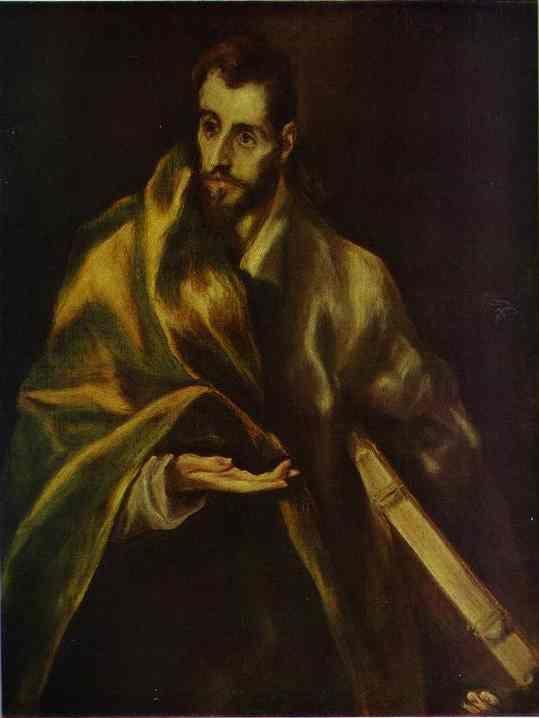
St. James the Greater
El Greco
1600s
Oil on canvas. Kunstmuseum Basel, Basel, Switzerland
20
posted on
07/25/2005 11:23:02 PM PDT
by
annalex
Disclaimer:
Opinions posted on Free Republic are those of the individual
posters and do not necessarily represent the opinion of Free Republic or its
management. All materials posted herein are protected by copyright law and the
exemption for fair use of copyrighted works.
FreeRepublic.com is powered by software copyright 2000-2008 John Robinson
