Free Republic
Browse · Search
Religion
Topics · Post Article

Skip to comments.

Catholic Caucus: Daily Mass Readings, 11-22-04, Memorial, St. Cecilia, virgin, martyr
USCCB.org/New American Bible ^ | 11-22-04 | New American Bible

Posted on 11/22/2004 6:42:25 AM PST by Salvation

November 22, 2004
Memorial of Saint Cecilia, virgin and martyr


Reading I
Rev 14:1-3, 4b-5

I, John, looked and there was the Lamb standing on Mount Zion,
and with him a hundred and forty-four thousand
who had his name and his Father's name written on their foreheads.
I heard a sound from heaven
like the sound of rushing water or a loud peal of thunder.
The sound I heard was like that of harpists playing their harps.
They were singing what seemed to be a new hymn before the throne,
before the four living creatures and the elders.
No one could learn this hymn except the hundred and forty-four thousand
who had been ransomed from the earth.
These are the ones who follow the Lamb wherever he goes.
They have been ransomed as the first fruits
of the human race for God and the Lamb.
On their lips no deceit has been found; they are unblemished.


Responsorial Psalm
24:1bc-2, 3-4ab, 5-6

R (see 6) Lord, this is the people that longs to see your face.
The LORD's are the earth and its fullness;
the world and those who dwell in it.
For he founded it upon the seas
and established it upon the rivers.
R Lord, this is the people that longs to see your face.
Who can ascend the mountain of the LORD?
or who may stand in his holy place?
He whose hands are sinless, whose heart is clean,
who desires not what is vain.
R Lord, this is the people that longs to see your face.
He shall receive a blessing from the LORD,
a reward from God his savior.
Such is the race that seeks for him,
that seeks the face of the God of Jacob.
R Lord, this is the people that longs to see your face.


Gospel
Lk 21:1-4

When Jesus looked up he saw some wealthy people
putting their offerings into the treasury
and he noticed a poor widow putting in two small coins.
He said, "I tell you truly,
this poor widow put in more than all the rest;
for those others have all made offerings from their surplus wealth,
but she, from her poverty, has offered her whole livelihood."


TOPICS: Activism; Apologetics; Catholic; Charismatic Christian; Current Events; Eastern Religions; Ecumenism; Evangelical Christian; General Discusssion; History; Humor; Islam; Judaism; Mainline Protestant; Ministry/Outreach; Moral Issues; Orthodox Christian; Other Christian; Other non-Christian; Prayer; Religion & Culture; Religion & Politics; Religion & Science; Skeptics/Seekers; Theology; Worship
KEYWORDS: catholiclist; dailymassreadings; ordinarytime; stcecilia
For your reading, reflection, faith-sharing, comments, questions, discussion.

1 posted on 11/22/2004 6:42:25 AM PST by Salvation
[ Post Reply | Private Reply | View Replies]

To: father_elijah; nickcarraway; SMEDLEYBUTLER; Siobhan; Lady In Blue; attagirl; goldenstategirl; ...
Alleluia Ping!

Please notify me via FReepmail if you would like to be added to or taken off the Alleluia Ping List.

2 posted on 11/22/2004 6:43:23 AM PST by Salvation (†With God all things are possible.†)
[ Post Reply | Private Reply | To 1 | View Replies]

To: Lady In Blue
The Life of St. Cecilia
3 posted on 11/22/2004 6:47:08 AM PST by Salvation (†With God all things are possible.†)
[ Post Reply | Private Reply | To 2 | View Replies]

To: Salvation

From: Revelation 14:1-3, 4b-5


The Lamb and His Companions


[1] Then I looked, and lo, on Mount Zion stood the Lamb, and with him a
hundred and forty-four thousand who had his name and his Father's name
written on their foreheads. [2] And I heard a voice from heaven like
the sound of many waters and like the sound of loud thunder; the voice
I heard was like the sound of harpers playing on their harps, [3] and
they sing a new song before the throne and before the four living
creatures and before the elders. No one could learn that song except
the hundred and forty-four thousand who had been redeemed from the
earth. [4] It is these who follow the Lamb wherever he goes; these have
been redeemed from mankind as first fruits for God and the Lamb,
[5] and in their mouth no lie was found, for they are spotless.


Commentary:


14:1-16:21 The book now turns to the Lamb and to divine judgment
(anticipating the victory of the Lamb). It stays with this theme up to
chapter 17 at which point the powers of evil appear again (in various
symbolic forms) and are subjected to the judgment of God. First we are
shown the Lamb and his entourage (cf. 14:l-5); immediately after this
the Last Judgment is proclaimed and a preliminary description given
(14:6-20); the glory of the Lamb is again extolled (cf. 15: 1-4) and
the unleashing of the wrath of God is further described in terms of the
pouring out of the seven bowls (cf. 15:5-16:21).


In opposition to the powers of evil and the active hostility to God and
the Church caused by the machinations of Satan stand the risen Christ
and his followers, who sing in praise of his glory and triumph. These
followers are those who have attained redemption; the salvation will
reach its climax when the Kingdom of God is fully established (the
marriage of the Lamb, and the heavenly Jerusalem: chaps. 21-22). In the
meantime, although the Church has to do battle with the forces of evil,
it can contemplate Christ "as an innocent lamb (who) merited life for
us by his blood which he freely shed. In him God reconciled us to
himself and to one another, freeing us from the bondage of the devil
and of sin, so that each one of us could say with the Apostle: the Son
of God 'loved me and gave himself for me' (Gal 2:20)" (Vatican II,
"Gaudium Et Spes", 22).


1-3. It is highly significant that the Lamb stands on Mount Zion, in
Jerusalem, which was where God dwelt among men according to the Old
Testament (cf. Ps 74:1; 132:14; etc.) and where, according to certain
Jewish traditions, the Messiah would appear, to join all his followers.
The assembly, then, is an idealization of the Church, protected by
Christ and gathered about him. It includes all those who belong to
Christ and to the Father and who therefore bear his mark, which shows
them to be children of God. They are so many that it is impossible to
count them, but their number is complete: they are given a symbolic
number which is 12 (the tribes of Israel) by 12 (the Apostles) by 1000
(a number indicating a huge scale): cf. Rev 7:3ff.


The one hundred and forty-four thousand are not yet in heaven (for the
loud noise comes from heaven); they are on earth, but they have been
rescued from the power of the beast (cf. 13:13-14). The verse from heaven
symbolizes the strength and power of God; and the heavenly voice speaks
with the gentleness of liturgical music. It is a new song, for it now
sings of the salvation wrought by Christ (cf. 15:34) in the same style as
the Old Testament chants the praises of God (cf., e.g., Ps 33:3; 40:2;
96:1). Only those who belong to Christ can join in this song and be
associated with the heavenly liturgy: "It is especially in the sacred
liturgy that our union with the heavenly Church is best realized; in the
liturgy, through the sacramental signs, the power of the Holy Spirit acts
on us, and with community rejoicing we celebrate together the praise of
the divine majesty; when all those of every tribe and tongue and people
and nation (cf. Rev 5:9) who have been redeemed by the blood of Christ and
gathered together into one Church glorify, in one common song of praise,
the one and triune God" ("Lumen Gentium", 50).


4-5. The text refers to those who are properly disposed to take part in
the marriage supper of the Lamb (cf. 19:9; 21:2) because they have not
been stained by idolatry but have kept themselves undefiled for him. St
Paul compares every Christian to a chaste virgin (cf. 2 Cor 11:2) and
describes the Church as the spouse of Christ (cf. Eph 5:21-32). The
author of the Apocalypse is referring to all the members of the Church
insofar as they are holy, that is, called to holiness; but the
symbolism he uses also draws attention to the fact that virginity and
celibacy for the sake of the Kingdom of heaven is a special expression
and clear sign of the Church as Bride of Christ. Referring to the
chastity practiced by religious, the Second Vatican Council teaches
that in this way they "recall that wonderful marriage made by God,
which will be fully manifested in the future age, and in which the
Church has Christ for her only spouse" ("Perfectae Caritatis", 12).


The one hundred and forty-four thousand are also those who have
identified themselves fully with Christ, dead and risen, by denying
themselves and devoting all their energies to apostolate (cf. Mt 10:
38). They also stand for those whom Christ, by the shedding of his
blood, has made his own and his Father's property (like Israel, the
first fruits of Yahweh: cf. Jer 2:3), that is, those who constitute a
holy people like that remnant of Israel described in Zephaniah 3:13:
"they shall do no wrong and utter no lies, nor shall there be found in
their mouth a deceitful tongue." The prophet's words refer to people
who have not invoked false gods, but the Apocalypse applies them to
those who are fully committed to Christ.


Source: "The Navarre Bible: Text and Commentaries". Biblical text
taken from the Revised Standard Version and New Vulgate. Commentaries
made by members of the Faculty of Theology of the University of
Navarre, Spain. Published by Four Courts Press, Kill Lane, Blackrock,
Co. Dublin, Ireland.


4 posted on 11/22/2004 6:48:23 AM PST by Salvation (†With God all things are possible.†)
[ Post Reply | Private Reply | To 3 | View Replies]

To: All

From: Luke 21:1-4


The Widow's Mite


[1] He (Jesus) looked up and saw the rich putting their gifts into the
treasury; [2] and He saw a poor widow put in two copper coins. [3] And
He said, "Truly I tell you, this poor widow has put in more than all of
them; [4] for they all contributed out of their abundance, but she out
of her poverty put in all the living she had."


Commentary:


1-4. Our Lord, surrounded by His disciples, watches people putting
offerings into the treasury. This was a place in the women's
courtyard, where there were various collection boxes for the offerings
of the faithful. Just then, something happens whose significance Jesus
wants His disciples to notice: a poor widow puts in two small coins, of
very little value. He describes this as the greatest offering of all,
praising the generosity of giving alms for this purpose, particularly
that of those people who give part of what they need. Our Lord is
moved by this tiny offering because in her case it implies a big
sacrifice. "The Lord does not look", St. John Chrysostom comments, "at
the amount offered but at the affection with which it is offered"
("Hom. on Heb", 1). Generosity is of the essence of almsgiving. This
woman teaches us that we can move God's heart if we give Him all we
can, which will always amount to very little even if we give our very
lives. "How little a life is to offer to God!" ([St] J. Escriva, "The Way",
42).


Source: "The Navarre Bible: Text and Commentaries". Biblical text
taken from the Revised Standard Version and New Vulgate. Commentaries
made by members of the Faculty of Theology of the University of
Navarre, Spain. Published by Four Courts Press, Kill Lane, Blackrock,
Co. Dublin, Ireland.


5 posted on 11/22/2004 6:49:11 AM PST by Salvation (†With God all things are possible.†)
[ Post Reply | Private Reply | To 4 | View Replies]

To: All
Monday, November 22, 2004
St. Cecilia, Virgin, Martyr (Memorial)
First Reading:
Psalm:
Gospel:
Revelation 14:1-5
Psalm 24:1-6
Luke 21:1-4

But a soul that does not live by the love of God suffers in a different way. It is not happy because it does not correspond generously enough to divine love; it hears a call and feels an attraction to which it does not respond. God punishes it by preventing it from being at peace in the quiet of laziness which it creates for itself. How many times is God sent away in this manner!

 -- St. Peter Emyard


6 posted on 11/22/2004 6:50:22 AM PST by Salvation (†With God all things are possible.†)
[ Post Reply | Private Reply | To 5 | View Replies]

To: All

I'll talk to all of you later this afternoon -- thre appointments/meetings today!


7 posted on 11/22/2004 6:51:20 AM PST by Salvation (†With God all things are possible.†)
[ Post Reply | Private Reply | To 6 | View Replies]

To: Salvation

Thank you for the ping.


8 posted on 11/22/2004 6:59:58 AM PST by Judith Anne (Thank you St. Jude for favors granted.)
[ Post Reply | Private Reply | To 7 | View Replies]

ROMAN MISSAL - DOUAY TEXTS


This poor widow hath cast in more than they all.

-----------------†JMJ†-----------------
Monday, 34th Week in Ordinary Time
---------------†AMDG†---------------
I confess to almighty God,
and to you, my brothers and sisters,
that I have sinned through my own fault
--strike the breast--
in my thoughts and in my words
in what I have done,
and in what I have failed to do;
and I ask blessed Mary, ever virgin,
all the angels and saints,
and you, my brothers and sisters,
to pray for me to the Lord our God.

FIRST READINGApoc 14:1-3, 4b-5
His name and his Father's name are written on their foreheads.

And I beheld, and lo a lamb stood upon mount Sion,
and with him an hundred forty-four thousand,
having his name, and the name of his Father,
written on their foreheads.

And I heard a voice from heaven,
as the noise of many waters,
and as the voice of great thunder;
and the voice which I heard, was as the voice of harpers,
harping on their harps.

And they sung as it were a new canticle,
before the throne, and before the four living creatures,
and the ancients; and no man could say the canticle,
but those hundred forty-four thousand,
who were purchased from the earth.

These are they who were not defiled with women: for they are virgins.
These follow the Lamb whithersoever he goeth.
These were purchased from among men,
the firstfruits to God and to the Lamb:
And in their mouth there was found no lie;
for they are without spot before the throne of God.

RESPONSORIAL PSALMPs 23:1bc-2, 3-4ab, 5-6
Hæc est generátio quæréntium fáciem tuam, Dómine.
This is the generation of them that seek him

The earth is the Lord's and the fulness thereof:
the world, and all they that dwell therein.
For he hath founded it upon the seas;
and hath prepared it upon the rivers.

Who shall ascend into the mountain of the Lord:
or who shall stand in his holy place?
The innocent in hands, and clean of heart,
who hath not taken his soul in vain,
nor sworn deceitfully to his neighbour.

He shall receive a blessing from the Lord,
and mercy from God his Saviour.
This is the generation of them that seek him,
of them that seek the face of the God of Jacob.


ALLELUIA
Mt 24:42a, 44

Vigiláte et estóte paráti, quia qua nescítis hora Fílius hóminus ventúrus est.
Alleluia, alleluia
Watch ye therefore,
because ye know not what hour your Lord will come.
But know this ye, that if the goodman of the house knew
at what hour the thief would come, he would certainly watch,
and would not suffer his house to be broken open.

Wherefore be you also ready,
because at what hour you know not the Son of man will come.
Alleluia, alleluia.


GOSPELLk 21:1-4
He noticed a poor widow putting in two small coins.

And looking on, he saw the rich men cast their gifts into the treasury.
And he saw also a certain poor widow casting in two brass mites.
And he said:

Verily I say to you,
that this poor widow hath cast in more than they all:
For all these have of their abundance cast into the offerings of God:
but she of her want, hath cast in all the living that she had.


9 posted on 11/22/2004 7:35:39 AM PST by Askel5 († Cooperatio voluntaria ad suicidium est legi morali contraria. †)
[ Post Reply | Private Reply | To 2 | View Replies]

To: Salvation


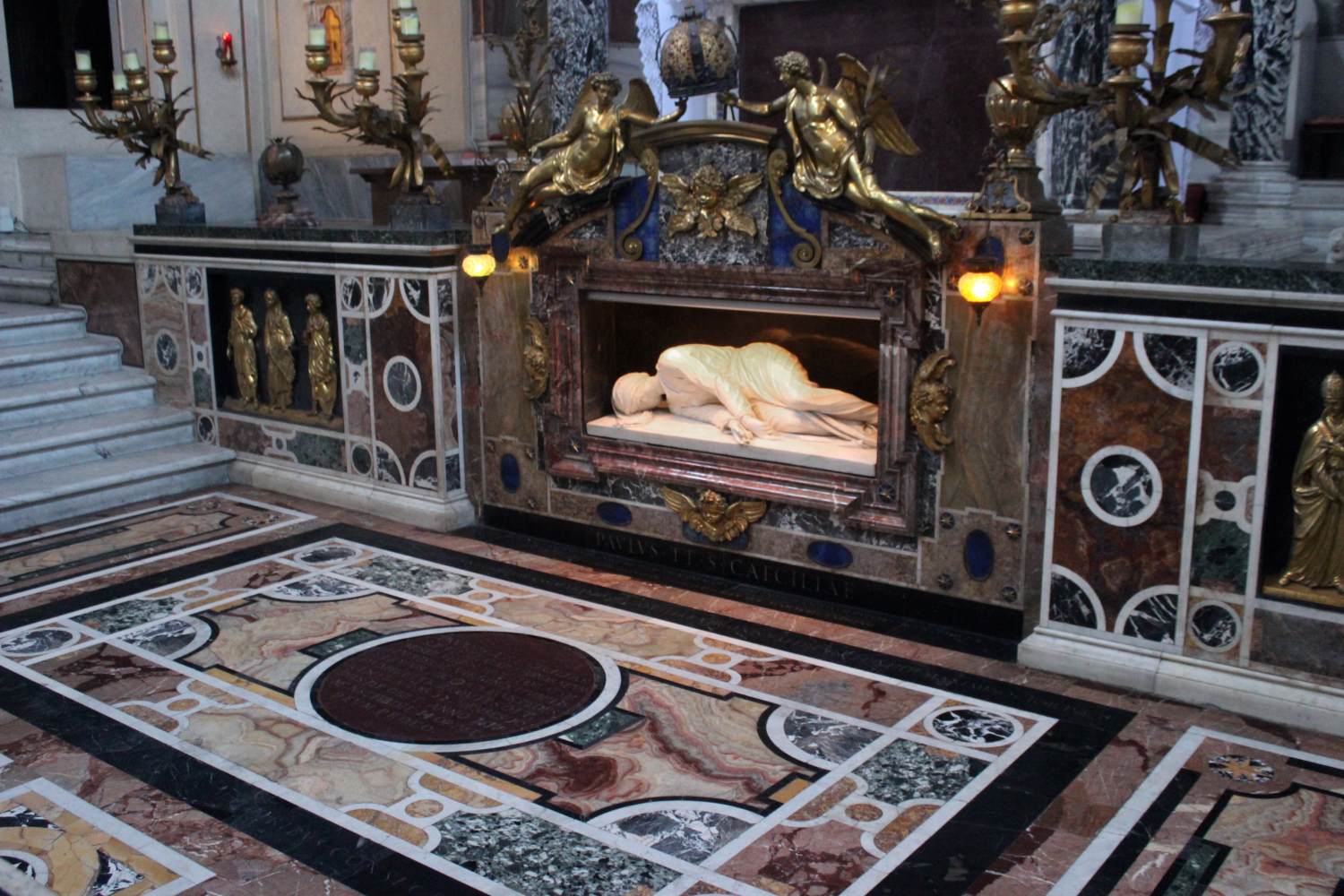
The incorrupt body of St. Cecilia, as it appeared at the exhumation of 1599
Stefano Maderno (1576-1636)

10 posted on 11/22/2004 9:42:14 AM PST by eastsider
[ Post Reply | Private Reply | To 1 | View Replies]

To: eastsider

Thanks for posting that!


11 posted on 11/22/2004 7:29:20 PM PST by Salvation (†With God all things are possible.†)
[ Post Reply | Private Reply | To 10 | View Replies]

To: eastsider
American Cathlic's Saint of the Day

November 22, 2004
St. Cecilia
(3rd century)

Although Cecilia is one of the most famous of the Roman martyrs, the familiar stories about her are apparently not founded on authentic material. There is no trace of honor being paid her in early times. A fragmentary inscription of the late fourth century refers to a church named after her, and her feast was celebrated at least in 545.

According to legend, Cecilia was a young Christian of high rank betrothed to a Roman named Valerian. Through her influence Valerian was converted, and was martyred along with his brother. The legend about Cecilia’s death says that after being struck three times on the neck with a sword, she lived for three days, and asked the pope to convert her home into a church.

Since the time of the Renaissance she has usually been portrayed with a viola or a small organ.

Comment:

Like any good Christian, Cecilia sang in her heart, and sometimes with her voice. She has become a symbol of the Church's conviction that good music is an integral part of the liturgy, of greater value to the Church than any other art. In the present confused state of Church music, it may be useful to recall some words of Vatican II (see below).

Quote:

“Liturgical action is given a more noble form when sacred rites are solemnized in song, with the assistance of sacred ministers and the active participation of the people.... Choirs must be diligently promoted, but bishops and other pastors must ensure that, whenever the sacred action is to be celebrated with song, the whole body of the faithful may be able to contribute that active participation which is rightfully theirs.... Gregorian chant, other things being equal, should be given pride of place in liturgical services. But other kinds of sacred music, especially polyphony, are by no means excluded.... Religious singing by the people is to be skillfully fostered, so that in devotions and sacred exercises, as also during liturgical services, the voices of the faithful may ring out” (Constitution on the Liturgy, 112-118).


12 posted on 11/22/2004 7:31:34 PM PST by Salvation (†With God all things are possible.†)
[ Post Reply | Private Reply | To 10 | View Replies]

To: All

FEAST OF THE DAY

St. Cecilia was a virgin who was martyred by the Roman
persecution. It is disputed what year she was executed, some
martyrologies place her death near the middle or end of the second
century, and others place her death in the third century. She was a
popular saint of the early Church and many legends sprung up
concerning her life and the manner of her death. St. Cecilia's feast
day has been celebrated by the Church from around the middle of
the sixth century and her name is included in the First Eucharistic
Prayer.

The legends that exist about St. Cecilia say that she was a young
Christian of high Roman birth at the time of her martyrdom. She was
filled with zeal for the Lord and dedicated her virginity to the Lord.
Her parents forced her to marry a nobleman named Valerian, but she
succeeded in converting him to Christianity and maintained her
promise of special dedication to the Lord.

Cecilia's dedication and holy actions helped convert several young
nobles, including the brother of her husband. When these converts
were found they were put to death and an order was sent out for the
arrest of Cecilia. When Cecilia was arrested, she was ordered to be
beheaded. The executioner struck her neck three times but was not
successful in killing her. Cecilia lived for three days after her
attempted execution and then died from the wounds she received.
St. Cecilia is the patron of sacred music and of musicians.


QUOTE OF THE DAY

Pride makes us forgetful of our eternal interests. It causes us to
neglect totally the care of our soul. -St. John Baptist de la Salle


TODAY IN HISTORY

365 Pope Felix II dies
498 Pope St Symmachus begins his reign


TODAY'S TIDBIT


The word "Eucharist" comes from Greek roots meaning thanks
giving.


INTENTION FOR THE DAY

Please pray for all grandparents.


13 posted on 11/22/2004 7:34:00 PM PST by Salvation (†With God all things are possible.†)
[ Post Reply | Private Reply | To 12 | View Replies]

To: All
The Word Among Us

Monday, November 22, 2004

Meditation
Luke 21:1-4


How do we measure success? While most would agree that money isn’t everything, our language often gives us away. “He is doing very well for himself,” we say of a friend or relative with a prestigious, highsalaried job. It is a human tendency to equate wealth with success in life. But Jesus, who gave away his wealth to become poor for us, sees it differently.

While he was watching the rich put large amounts of money into the Temple treasury, Jesus also saw a widow put in two very small coins. Jesus was deeply impressed. Others had given far more money, but they still had much left over. The widow had given all she had to live on.

While much could be accomplished on a human level with the larger contributions, this woman exhibited the kind of trust in God that could move mountains. Jesus appreciated the worth of such faith, and that’s why he said that she had given “more than all the rest” (Luke 21:3).

By giving out of her substance and not just out of her excess, this woman surrendered her entire life to God. When we do the same—when we give Jesus more than the “leftovers” of our lives—then we too become a blessing to his heart.

Jesus is asking us to have the same disposition of generosity and devotion that this woman had. Do we focus heavily on investing, saving, and sheltering money rather than in sharing a healthy portion of our surplus with the poor? Perhaps our time could be better spent caring for a lonely or sick neighbor. Maybe we could devote our energy to getting involved in our community instead of just worrying about the problems we see around us. Or maybe there is someone in our lives whom we can finally forgive. The options are endless. All Jesus is looking for is a generous, grateful heart. Then, whatever we choose to do will bless his name and build his kingdom.

“Holy Spirit, search my heart and bring to mind what you would have me do. I surrender all to you. Teach me to seek the rewards of radical faith more than earthly treasures.”


14 posted on 11/22/2004 10:30:20 PM PST by Salvation (†With God all things are possible.†)
[ Post Reply | Private Reply | To 13 | View Replies]

To: All
One Bread, One Body

One Bread, One Body


<< Monday, November 22, 2004 >> St. Cecilia
 
Revelation 14:1-3, 4-5 Psalm 24 Luke 21:1-4
View Readings
 
ALL FOR THE ONE
 
“She from her want has given what she could not afford.” —Luke 21:4
 

There’s an old joke about a man who leaves Church complaining to his son about the lousy music, the pastor’s poor homily, the stone-faced parishioners, and all the other things he dislikes about his Church. At that point, the son pipes up and says: “Gosh, Dad, I thought it was a good show for a quarter!”

One who is stingy and miserly with God “brings ruin on himself” (Sir 14:9). He or she is the real loser, not the Lord, Who has everything. In one sense, we get from our relationship with the Lord what we put into it (2 Cor 9:6).

Jesus, however, is especially interested in “all-giving.” He declares: “None of you can be My disciple if he does not renounce all his possessions” (Lk 14:33). We can’t give all until we have given up all. We don’t just give our possessions; we give our needs, our “wants,” our desires. The poor widow gave from her want (Lk 21:4). What is your “want”? Do you want wealth, financial freedom, a new car, sexual fulfillment, popularity, or vacations? Renounce these and give them all up to Jesus.

At this level of “all-giving,” we have given what we “could not afford” (Lk 21:4): our money, energy, hopes, means of support, lifestyle. When we give all, we are then empty; we “have no more” left (Jn 2:3). Jesus then fills us with a miraculous superabundance of His new life (see Jn 2:5ff) which comes only when we’ve “emptied ourselves” (see Phil 2:7). When we give it all to Jesus, He gives it all to the Father, Who fills us with new life, so through Him we “may be all in all” (1 Cor 15:28).

 
Prayer: Father, use me according to Your will. I am all Yours.
Promise: “They are pure and follow the Lamb wherever He goes.” —Rv 14:4
Praise: In following the corporal work of mercy of burying the dead, St. Cecilia buried two martyrs and eventually lost her own life as a result of that act of love.
 

15 posted on 11/22/2004 10:32:29 PM PST by Salvation (†With God all things are possible.†)
[ Post Reply | Private Reply | To 14 | View Replies]

To: Salvation
Lk 21:1-4
# Douay-Rheims Vulgate
1 And looking on, he saw the rich men cast their gifts into the treasury. respiciens autem vidit eos qui mittebant munera sua in gazofilacium divites
2 And he saw also a certain poor widow casting in two brass mites. vidit autem et quandam viduam pauperculam mittentem aera minuta duo
3 And he said: Verily, I say to you that this poor widow hath cast in more than they all. et dixit vere dico vobis quia vidua haec pauper plus quam omnes misit
4 For all these have of their abundance cast into the offerings of God: but she of her want hath cast in all the living that she had. nam omnes hii ex abundanti sibi miserunt in munera Dei haec autem ex eo quod deest illi omnem victum suum quem habuit misit

16 posted on 11/23/2004 3:02:50 PM PST by annalex
[ Post Reply | Private Reply | To 1 | View Replies]

Disclaimer: Opinions posted on Free Republic are those of the individual posters and do not necessarily represent the opinion of Free Republic or its management. All materials posted herein are protected by copyright law and the exemption for fair use of copyrighted works.

Free Republic
Browse · Search
Religion
Topics · Post Article

FreeRepublic, LLC, PO BOX 9771, FRESNO, CA 93794
FreeRepublic.com is powered by software copyright 2000-2008 John Robinson