Skip to comments.
Catholic Caucus: Daily Mass Readings, 10-16-03, Optional, St. Hedwig, St. Mary Margaret Alacoque
USCCB.org/New American Bible ^
| 10-16-03
| New American Bible
Posted on 10/16/2003 8:14:25 AM PDT by Salvation
October 16, 2003
Thursday of the Twenty-Eight Week in Ordinary Time
Psalm: Thursday 44  Reading I Responsorial Psalm Gospel
Reading I
Rom 3:21-30
Brothers and sisters:
Now the righteousness of God has been manifested apart from the law,
though testified to by the law and the prophets,
the righteousness of God through faith in Jesus Christ
for all who believe.
For there is no distinction;
all have sinned and are deprived of the glory of God.
They are justified freely by his grace
through the redemption in Christ Jesus,
whom God set forth as an expiation,
through faith, by his Blood, to prove his righteousness
because of the forgiveness of sins previously committed,
through the forbearance of God–
to prove his righteousness in the present time,
that he might be righteous
and justify the one who has faith in Jesus.
What occasion is there then for boasting? It is ruled out.
On what principle, that of works?
No, rather on the principle of faith.
For we consider that a person is justified by faith
apart from works of the law.
Does God belong to Jews alone?
Does he not belong to Gentiles, too?
Yes, also to Gentiles, for God is one
and will justify the circumcised on the basis of faith
and the uncircumcised through faith.
Responsorial Psalm
Ps 130:1b-2, 3-4, 5-6ab
R (7) With the Lord there is mercy, and fullness of redemption.
Out of the depths I cry to you, O LORD;
LORD, hear my voice!
Let your ears be attentive
to my voice in supplication.
R With the Lord there is mercy, and fullness of redemption.
If you, O LORD, mark iniquities,
Lord, who can stand?
But with you is forgiveness,
that you may be revered.
R With the Lord there is mercy, and fullness of redemption.
I trust in the LORD;
my soul trusts in his word.
My soul waits for the LORD
more than sentinels wait for the dawn.
R With the Lord there is mercy, and fullness of redemption.
Gospel
Lk 11:47-54
The Lord said:
"Woe to you who build the memorials of the prophets
whom your fathers killed.
Consequently, you bear witness and give consent
to the deeds of your ancestors,
for they killed them and you do the building.
Therefore, the wisdom of God said,
‘I will send to them prophets and Apostles;
some of them they will kill and persecute'
in order that this generation might be charged
with the blood of all the prophets
shed since the foundation of the world,
from the blood of Abel to the blood of Zechariah
who died between the altar and the temple building.
Yes, I tell you, this generation will be charged with their blood!
Woe to you, scholars of the law!
You have taken away the key of knowledge.
You yourselves did not enter and you stopped those trying to enter."
When Jesus left, the scribes and Pharisees
began to act with hostility toward him
and to interrogate him about many things,
for they were plotting to catch him at something he might say.
TOPICS: Activism; Apologetics; Catholic; Charismatic Christian; Current Events; Eastern Religions; Ecumenism; Evangelical Christian; General Discusssion; History; Humor; Islam; Judaism; Mainline Protestant; Ministry/Outreach; Moral Issues; Orthodox Christian; Other Christian; Other non-Christian; Prayer; Religion & Culture; Religion & Politics; Religion & Science; Skeptics/Seekers; Theology; Worship
KEYWORDS: alacoque; catholiclist; dailymassreadings; hedwig; marymargaret; ordinarytime
For your reading, reflection, faith-sharing, comments and discussion.
1
posted on
10/16/2003 8:14:26 AM PDT
by
Salvation
To: *Catholic_list; father_elijah; nickcarraway; SMEDLEYBUTLER; Siobhan; Lady In Blue; attagirl; ...
Alleluia Ping!
Please notify me via Freepmail if you would like to be added to or removed from the Alleluia Ping list.
2
posted on
10/16/2003 8:35:04 AM PDT
by
Salvation
(†With God all things are possible.†)
To: All
3
posted on
10/16/2003 8:39:47 AM PDT
by
Salvation
(†With God all things are possible.†)
To: Salvation; Marcellinus; oceanperch
On this day in 1917, St. Maximilian Kolbe founded the Militia Immaculata, the worldwide evangelization movement that that encourages total consecration to the Blessed Virgin Mary as a means of spiritual renewal for individuals and society.
4
posted on
10/16/2003 10:27:59 AM PDT
by
Pyro7480
(“We are all born ignorant, but one must work hard to remain stupid" - Benjamin Franklin)
Comment #5 Removed by Moderator
To: Salvation
Noon bump.
6
posted on
10/16/2003 11:39:21 AM PDT
by
oceanperch
(Just Blank)
To: sandyeggo
**I wonder how this might be interepreted as to the Jews' salvation. I think God will make sure they see the fullness of Truth before the final judgement.**
I agree.
7
posted on
10/16/2003 1:38:24 PM PDT
by
Salvation
(†With God all things are possible.†)
To: Salvation
Homily of the Day
Title: Don't Be Afraid of the Truth Author: Monsignor Dennis Clark, Ph.D. Date: Thursday, October 16, 2003
Romans 3:21-29 / Lk 11:47-54
Why did the Israelites have such a hard time with the prophets, shedding the blood of every one from Abel to Zechariah? The prophets were troublesome and irritating because they told the truth, even and especially when it made their listeners uncomfortable. And there was ample precedent in ancient times for dealing with bad news: Kill the messenger!
I doubt that killing has ever occurred to us as a serious option, but a swift counterattack is all too common when an unwanted truth is spoken to us. Of course, not all truth-tellers have our best interests in mind, which makes it all the harder to receive their message. But the biggest barrier to our hearing the truth is always the same: Our old nemesis, ego, which has to defend its foolish pose as the center of the universe and the repository of all wisdom and competence. What a joke! Yet, how often we let ego trick us into defending the indefensible.
There's a cure for ego's power over us, and that is to give ourselves thoroughly into the hands of Our Lord, with the open-hearted admission that we're far from finished works and that we never will get put together if He doesn't help us. That's the real truth, and it will set us free from ego and all its tiresome pretensions.
Why waste any more time trying to defend the indefensible. Instead, let's confront the truth - whatever it is - with the full confidence that there's nothing we can't face, and nothing we need to fear, as long as the Lord is at our side. And never doubt it, he's always there.
Words of Encouragement
Title: You Are Not Merely the Sum of What You Produce! Author: Mark Shea Date: Thursday, October 16, 2003
Hebrews 13:5-6
Keep your life free from love of money, and be content with what you have; for he has said, "I will never fail you nor forsake you." Hence we can confidently say, "The Lord is my helper, I will not be afraid; what can man do to me?"
The curse of a utilitarian culture is that it defines people by what they can produce and what they earn or produce. Defining ourselves by our income is just another word for "salvation by works of the law". That highlights the great paradox of our Catholic faith. Those who worship the god of works typically do so because they imagine they are taking an easier path by avoiding all the "negativism" of talking about sin. ("If I'm a nice person and do good things, God owes it to me to be nice to me.") Yet in fact they are getting snookered into the hopeless task of trying to barter their Niceness, or productivity, or some other "good qualities" for God's love. In contrast, the Church urges upon us the weird liberty of a God whose love burns just as brightly for us no matter how much of a jerk we've been—but we can only see that for ourselves when we frankly admit we've been jerks. When we lose our "good qualities", the god of works won't love us any more, but the God of Jesus Christ (who needs nothing from us) declares he will never, through endless eternities, love us any less, though our sins be as scarlet.
by Donald DeMarco, PhD Virtue of Justice 10/16/03
We usually think of justice in relation to our dealings with other people. Justice requires us to render each person his due. Most of us understand justice, therefore, as a personal or social virtue.
Being just to other people, however, presupposes a more fundamental order of justice in which we name things justly. We could not fulfill our obligation in justice to pay another the ten dollars we owe him if we fail to call a sawbuck a sawbuck, and instead call it ten cents. As St. Augustine writes, “Whatever is against truth cannot be just.” To be just to another person rests on our initially being just to the truth. Personal justice is based on philosophical justice.
Our understanding not only of justice but also of virtue in general is greatly impaired when we mislabel vice as virtue, and virtue as vice. Calling fair foul, as Shakespeare suggests, is a devilish enterprise. If the word is wrong, then the thought is wrong. And if the thought is wrong, then the resulting action is wrong. The correct naming of things is indispensable to correct thinking and correct acting. Before justice exists in action, it must first exist in word and thought.
There is a scene in Sir Walter Scott’s novel Anne of Geierstein that eloquently and dramatically brings to light the insidious and unjust practice of calling vice virtue.
In the story, the brave young Arthur is riding in the company of Thiebault. The latter, a grandson of troubadours and a lover of ballads, sings one with great artistry for his traveling companion.
The ballad unfolds a rather sordid saga. A certain troubadour by the name of William Cabestaing is in love with Margaret, the wife of Baron Raymond de Roussillon. When the husband learns of the affair, he kills Cabestaing, cuts out his heart, and has it cooked like an animal’s. He then serves it to his wife, but does not reveal its nature until after she has finished eating it. Margaret’s response to this ghastly deed is stoic and sacrificial. She quietly explains that the food was so precious to her that her lips “should never touch coarser nourishment.” She persists in her macabre decision and starves herself to death.
The ballad goes on to weave the rest of the story: “Every bold knight in the south of France assembled to besiege the baron’s castle, stormed it by main force, left not one stone upon another, and put the tyrant to an ignominious death.” It is clear by his manner that Thiebault approves of Margaret’s suicide and the vengeance heaped upon her husband.
Arthur takes a decidedly different view of the matter. He admonishes his companion: “Thiebault, sing me no more such lays. I have heard my father say that the readiest mode to corrupt a Christian man is to bestow upon vice the pity and the praise which are due only to virtue. Your Baron of Roussillon is a monster of cruelty; but your unfortunate lovers were not the less guilty. It is giving fair names to foul actions that those who would start at real vice are led to practice its lessons, under the disguise of virtue.”
Sir Walter Scott has his bold hero, Arthur, speak like a saint or Father of the Church. It is not just, Arthur is saying, to call vice by the name of virtue. But not only that, such philosophical injustice — a kind of injustice to being — inevitably leads to the practice of real vice. Philosophical injustice breeds personal and social injustice.
Arthur’s advice is timeless. We could use a novelist of the moral acumen of Sir Walter Scott in our own time. Consider the current penchant for giving vice fair words: Vengeance is getting even, pornography is adult entertainment, sterilization is a way of getting fixed, abortion is merely a choice, and euthanasia is an act that is replete with dignity.
Pope John Paul II, in his encyclical The Gospel of Life, affirms that when our consciences can call “evil good and good evil” (Is. 5:20), we are “already on the path to the most alarming corruption and the darkest moral blindness.”
Not long ago a particularly hard-headed business woman graced the cover of Fortune magazine. The following words ran alongside the image of her gritty and determined countenance: “The toughest Babe in Business — Darla Moore married Richard Rainwater, tripled his wealth, axed Boone Pickens, and pushed Rick Scott out at Columbia/HCA. Stay Tuned.” The message is only too clear. If you want to get ahead, and receive the enviable plaudits of Fortune magazine, you had better be tough.
The business world finds it easy to praise heartlessness as being tough. Being just is not likely to catapult a fair-minded entrepreneur to the cover of a major success magazine. Nice guys, presumably, finish last.
Philosophical justice — naming things rightly in accord with what they are — is indeed a virtue. It is as delicate, however, as it is fundamental. And this is precisely why it must be taken seriously. It is easy to ignore or distort philosophical justice, while urging people to preach social justice from the housetops. But the truth is that there can be no social justice without giving vice its due by calling it vice, and without singing the praises of virtue for the plain fact that it is virtuous.
Dr. DeMarco is a professor of philosophy at St. Jerome’s College in Waterloo, Ontario. He is the author of The Many Faces of Virtue and The Heart of Virtue
This article originally appeared in Lay Witness, a publication of Catholics United for the Faith, Inc., and is used by permission. Join Catholics United for the Faith and enjoy the many benefits of membership.
The Bishops Speak
Title: Be Not Afraid - Consistency and Courage II Author: William H. Keeler, Archbishop of Baltimore Date: Thursday, October 16, 2003
(This homily was given in the year 1995. This is one in a series of homilies from the American Bishops who have reflected on the great acts of Pope John Paul II.)
Presidential Address, National Conference of Catholic Bishops, November 13, 1995
Part 2 of 3
"Be not afraid." This antiphon of Pope John Paul's pontificate ought to inspire what we bishops do and say as public witnesses to the truth here in the United States, what we do here in our fiftieth general meeting as this conference.
"Be not afraid" to preach the truth of the full gospel of Jesus with all its power and challenge, as Pope John Paul reminded us bishops. This is the gospel which calls first of all to faith in Him who died and rose for us, who invites us to walk after him in the ways of holiness he taught in his Sermon on the Mount. So we do profess Christ as "the light of nations," and We are reminded of the central document of the Second Vatican Council, Lumen gentium, the Dogmatic Constitution on the Nature of the Church. This guides us as teachers and guides the teaching in our Catholic schools and our catechists, and is at the heart of the Catechism of the Catholic Church.
"Be not afraid" to call by name those whom the Lord is inviting to the priesthood. When the Holy Father spoke with seminarians, he challenged them to heroic virtue, reminded them of Jesus' pledge of help and offered them a personal example of persuasive pastoral love. And they cheered the message.
This past week I met with seven prospective candidates, each located and encouraged by at least one priest. I can testify that, like the young people at Denver, they are ready to consider a calling to a radical life based on gospel values. They are ready for the call to Christian heroism.
"Be not afraid" to preach the gospel of life as a breath of new life in the face of cynicism and despair. Last week, recalling the 30th anniversary of Gaudium et spes, the Pastoral Constitution on the Church in Today's World, the Holy Father pointed out that the Council's teaching "did not limit itself to fundamental questions ... it also touched upon the terrain of the immediate problems which assail" our human family.
Less than two months ago in Africa he published his Apostolic Exhortation on the Church in Africa, with many such specifics in striking parallel with our own recent statement on "Political Responsibilities."
In his visit with us, Pope John Paul witnessed in an extraordinarily personal way how the Church's commitment to the dignity and value of human life at every stage can touch and transform lives in society today. He came for lunch to Our Daily Bread, the soup kitchen next door to the historic Basilica of the Assumption in Baltimore. Here he met people who have faced difficult and sadly typical challenges: there was a young woman, a graduate of our Villa Louise Program for very young, expectant mothers. Like hundreds of others in recent years, she found in the Church support in her decision to choose life for her child and support for the education she needed to be a good mother and a good citizen. Another at the table comes daily to the soup kitchen because he is hungry and has nowhere else to turn.
A couple presented their severely developmentally disabled son, now thirty years old. For fifteen years, with Medicaid help, he has lived in a Catholic Charities group home. A single mother of three introduced her six-year old child, who has benefited so much from the Head Start Program at St.Veronica's — the little girl asked whether she could call the Holy Father "Uncle Pope." A couple from Mexico were learning English through our ministry to the Spanish speaking (he works an extra job to help their older child attend a Catholic school). To the Holy Father's right sat a couple with their two children, adopted through Catholic Charities from North Korea.
The Holy Father saw the challenges of poverty and critical need in an affluent society and appreciated how the Church stood at the side of the poor and the needy.
As he saw, and we affirm, the Catholic Church brings not only strong convictions but also broad experience to these challenges. Every day we do feed the hungry, shelter the homeless, educate the young and care for the sick and aging. We help the lonely pregnant teen and the tiny child inside her, and we welcome the refugee and the immigrant. We are called to stand by "the least" in our society, for that is to stand by Christ himself We preach and teach the importance of family, the need for sacrifice and the priority of the common good.
We urge welfare reform, a reform will bring unity and strength to the family, and care and protection for children, born and unborn.
8
posted on
10/16/2003 2:40:33 PM PDT
by
haole
(John 10 30)
From: Romans 3:21-30
Righteousness, a Free Gift through Faith in Christ
[21] But now the righteousness of God has been manifested apart from
law, although the law and the prophets bear witness to it, [22] the
righteousness of God through faith in Jesus Christ for all who believe.
For there is no distinction [23] since all have sinned and fall short
of the glory of God, [24] they are justified by his grace as a gift,
through the redemption which is in Christ Jesus, [25] whom God put
forward as an expiation by his blood, to be received by faith. This
was to show God's righteousness, because in his divine forbearance he
had passed over former sins; [26] it was to prove at the present time
that he himself is righteous and that he justifies him who has faith in
Jesus.
[27] Then what becomes of our boasting? It is excluded. On what
principle? On the principle of works? No, but on the principle of
faith. [28] For we hold that a man is justified by faith apart from
works of law. [29] 0r is God the God of Jews only? Is he not the God of
Gentiles also? Yes, of Gentiles also, [30] since God is one; and he
will justify the circumcised on the ground of their faith and the
uncircumcised through their faith.
Commentary:
21-22. The doctrinal richness of this text and of the whole passage
(vv. 21-26) is here condensed in a way very typical of St Paul's style.
He explains how justification operates: God the Father, the source of
all good, by his redemptive decree is the "efficient cause" of our
salvation; Jesus Christ, by shedding his blood on the Cross, merits
this salvation for us; faith is the instrument by which the Redemption
becomes effective in the individual person.
The righteousness of God is the action by which God makes people
righteous, or just (cf. St Augustine, "De Spiritu Et Littera", IX, 15).
This righteousness was originally proclaimed in the books of the Old
Testament--the Law and the Prophets--but it has now been made manifest
in Christ and in the Gospel. Salvation does not depend on fulfillment of
the Mosaic Law, for that Law is not sufficient to justify anyone: only
faith in Jesus Christ can work salvation.
"If anyone says that, without divine grace through Jesus Christ, man
can be justified before God by his own works, whether they were done by
his natural powers or by the light of the teaching of the Law: let him
be anathema" (Council of Trent, "De Iustificatione", can. 1).
It is not the law, then, which saves, but "faith in Jesus Christ". This
expression should be interpreted in line with the unanimous and constant
teaching of the Church, which is that "faith is the beginning of human
salvation", and a person's will must cooperate with faith to prepare the
ground for the grace of justification (cf. ibid., chap. 8 and can. 9).
23-26. The Apostle first describes the elements that go to make up the
mystery of faith (vv. 23-25): all men need to be liberated from sin;
God the Father has a redemptive plan, which is carried out by the
atoning and bloody sacrifice of Christ's death; faith is a necessary
condition for sharing in the Redemption wrought by Christ; the
sacrifice of the Cross is part and parcel of the History of Salvation:
before the Incarnation of the Word, God patiently put up with men's
sins; in the fullness of time he chose--through Christ's sacrifice--to
require full satisfaction for those sins so that men might be enabled
to become truly righteous in God's eyes and God's perfections become
more manifest.
"The Cross of Christ, on which the Son, consubstantial with the Father,
renders full justice to God, is also a radical revelation of mercy,
that is, of the love that goes against what constitutes the very root
of evil in the history of man--against sin and death" (John Paul II,
"Dives In Misericordia", 8).
23. "Fall short of the glory of God": this shows the position man is in
when he is in a state of sin. Because he has not the life of grace in
him, he is not properly orientated towards his supernatural end, is
deprived of the right to heaven that sanctifying grace confers, and
consequently does not have these divine perfections which supernatural
life gives him.
24. All have been justified, that is, all have been made "righteous"
(cf. 1 :17). This justification is the result of a gratuitous gift of
God which St Paul describes in a way which reinforces his point
("grace", "as a gift"): this identifies the source of the gift as God's
loving-kindness and it also shows the new state in which justification
places a person so important is this statement--that grace is a gift
which God gives without merit on our part--that the Council of Trent,
when using this text from St Paul, made a point of explaining what it
meant: that is, that nothing which precedes justification (whether it
be faith, or morals) merits the grace by which man is justified (cf.
Rom 11:16; Council of Trent, "De Iustificatione", chap. 8).
This new kind of life, whose motor is grace, requires free and active
cooperation on man's part; by that cooperation a person in the state of
grace obtains merit through his actions: "For such is God's goodness to
men that he wills that his gifts be our merits, and that he will grant
us an eternal reward for what he has given us" ("Indiculus", chap. 9).
The fact that grace is a gratuitous gift of God does not mean that man
does not have an obligation to respond to it: we are not justified by
keeping the Law or by a decision of our free will; however,
justification does not happen without our cooperation; grace
strengthens our will and helps it freely to keep the Law (cf. St
Augustine, "De Spiritu Et Littera", IX, 15).
Justification by grace is attained "through the redemption which is in
Jesus Christ". The Council of Trent teaches that when a sinner is
justified there is "a passing from the state in which man is born a son
of the first Adam, to the state of grace and adoption as sons of God
through the second Adam, Jesus Christ our Savior" ("De Iustificatione",
chap. 4). This has been made possible because our Lord saved us by
giving himself up as our ransom. The Greek word translated as
"redemption" refers to the ransom money paid to free a person from
slavery. Christ has freed us from the slavery of sin, paying the
necessary ransom (cf. Rom 6:23). By sacrificing himself for us, Christ
has become our master or owner, who mediates between the Father and the
whole human race: "Let us all take refuge in Christ; let us have
recourse to God to free us from sin: let us put ourselves up for sale
in order to be redeemed by his blood. For the Lord says, 'You were sold
for nothing, and you shall be redeemed without money' (Is 52:3);
without spending a penny of your inheritance, for I have paid on your
behalf. This is what the Lord says: He paid the price, not with silver
but with his blood" (St Augustine, "In Ioann. Evang.", 41, 4).
Our very creation means that we belong totally to God the Father and
therefore also to Christ, insofar as he is God, but "as man, he is also
for many reasons appropriately called 'Lord'. First, because he is our
Redeemer, who delivered us from sin, he deservedly acquired the power
by which he truly is and is called our Lord" ("St Pius V Catechism", I,
3, 11).
And so, through the Incarnation, whose climax was Christ's redemptive
sacrifice, "God gave human life the dimension that he intended man to
have from his first beginning; he has granted that dimension
definitively [...] and he has granted it also with the bounty that
enables us, in considering the original sin and the whole history of
the sins of humanity, and in considering the errors of the human
intellect, will and heart, to repeat with amazement the words of the
sacred Liturgy: 'O happy fault...which gained us so great a Redeemer!'"
(John Paul II, "Redemptor Hominis", 1).
25. The "expiation" was the cover or mercy seat of the Ark, which stood
in the center of the Holy of Holies in the Temple (cf. Exod 25:17-22).
It was made of beaten gold and had a cherub at either end, each facing
the other. It had two functions: one was to act as God's throne (cf. Ps
80:2; 99:1), from which he spoke to Moses during the time of the exodus
from Egypt (cf. Num 7:89; Exod 37:6); the other was to entreat God to
pardon sin through a rite of expiatory sacrifice on the feast of the
Day of Atonement (cf. Lev 16): on that day the High Priest sprinkled
the mercy seat with the blood of animals sacrificed as victims, to
obtain forgiveness of sins for priest and people.
St Paul asserts that God has established Jesus as the true expiation,
of which the mercy seat in the Old Testament was merely a figure.
No angel or man could ever atone for the immense evil that sin is--an
offense to the infinite majesty of God. The Blessed Trinity decided
"that the Son of God, whose power is infinite, clothed in the weakness
of our flesh, should remove the infinite weight of sin and reconcile us
to God in his Blood" ("St Pius V Catechism", I, 3, 3).
This expiatory sacrifice, prefigured in the bloody sacrificial rites of
the Old Testament (cf. Lev 16:1 ff), was announced by John the Baptist
when he pointed to Jesus as the Lamb of God (cf. Jn 1:29 and note); and
Jesus himself referred to the sacrifice of the Cross when he said that
the Son of man had come "to give his life as a ransom for many" (Mt
20:28).
This sacrifice is renewed daily in the Holy Mass, one of the purposes
of which is atonement, as the Liturgy itself states: "Lord, may this
sacrifice once offered on the cross to take away the sins of the world
now free us from our sins" ("Roman Missal", Feast of the Triumph of the
Cross, prayer over the gifts).
26. In the time prior to Christ's coming the sins of mankind remained
unatoned for: neither the rites designed by man to placate God's anger,
nor those established by God himself in the Old Law, were in any way
equal to atoning for the offense offered to God by sin. Therefore, the
just of the Old Testament were really justified by virtue of their
faith in the future Messiah, a faith which expressed itself in
observance of the rites established by God.
During all this period the Lord kept deferring punishment ("passing
over former sins"). This time of "God's forbearance" lasted until the
messianic era "the present time", that is, the period between the first
and second comings of Christ. On the righteousness of God and God as
the Justifier of man, see note on Rom 1:17.
27-31. These words are addressed to the same imaginary interlocutor as
appeared at the beginning of the chapter. Although he is Lord of all
nations, God showed special preference for the people of Israel.
Relying on this, the Jews wrongly thought that only they could attain
blessedness because only they enjoyed God's favor. This led them to
look down on other peoples. After the coming of Christ, they no longer
have any basis for this pride: St John Chrysostom explains that it had
simply become outdated, superseded (cf. "Hom. On Rom", 7), for God had
set up a single way of salvation for all men--the "principle of faith"
which the Apostle refers to. This new way means that Jews must forget
their ancient pride and become humble, for God has opened the gates of
salvation to all mankind.
Consequently, no one--not even the Jew--is justified by works of the
Law. What justifies a person is faith: not faith alone, as Luther
wrongly argued, but the faith which works through charity (cf. Gal
5:6); faith which is not presumptuous self-confidence in one's own
merits, but a firm and ready acceptance of all that God has revealed,
faith which moves one to place one's hope in Christ's merits and to
repent of one's sins. Therefore it will be "by faith"--not by
circumcision--that the Jews will be justified, and it will be "through
their faith" that the uncircumcised will attain salvation. From this it
might appear as though the Law had been revoked; but that is not the
case: faith ratifies the Law gives it its true meaning and raises it to
perfection. For, through being a preparation for the Gospel, the Mosaic
Law receives from Christ the fullness it was lacking: the precept of
charity reveals the meaning which God gave the law but which lay hidden
until Christ made it manifest, for "love is the fulfilling of the law"
(Rom 13:10). St Paul in a way summarizes all this teaching in v. 28,
which is the key statement in the passage.
Source: "The Navarre Bible: Text and Commentaries". Biblical text
taken from the Revised Standard Version and New Vulgate. Commentaries
made by members of the Faculty of Theology of the University of
Navarre, Spain. Published by Four Courts Press, Kill Lane, Blackrock,
Co. Dublin, Ireland.
9
posted on
10/16/2003 2:59:05 PM PDT
by
Salvation
(†With God all things are possible.†)
To: All
Luke 11:47-54:
The Hypocrisy of the Scribes and Pharisees (Continuation)
(Jesus said to the Pharisees,) [47] "Woe to you! for you build the tombs
of the prophets whom your fathers killed. [48] So you are witnesses
and consent to the deeds of your fathers; for they killed them, and you
build their tombs. [49] Therefore also the Wisdom of God said, `I will
send them prophets and apostles, some of whom they will kill and
persecute,' [50] that the blood of all the prophets, shed from the
foundation of the world, may be required of this generation, [51] from
the blood of Abel to the blood of Zechariah, who perished between the
altar and the sanctuary. Yes, I tell you, it shall be required of this
generation. [52] Woe to you lawyers! for you have taken away the key of
knowledge; you did not enter yourselves, and you hindered those who
were entering."
[53] As He went away from there, the scribes and the Pharisees began to
press Him hard, and to provoke Him to speak of many things, [54] lying
in wait for Him, to catch at something He might say.
Commentary:
51. Zechariah was a prophet who died by being stoned in the temple of
Jerusalem around the year 800 B.C. because he accused the people of
Israel of being unfaithful to God's law (cf. 2 Chronicles 24:20-22).
The murder of Abel (Genesis 4:8) and that of Zechariah were,
respectively, the first and last murders reported in these books which
the Jews regarded as Sacred Scripture. Jesus refers to a Jewish
tradition which, in His own time and even later, pointed out the stain
of the blood of Zechariah.
The altar referred to here was the altar of holocausts, located
outside, in the courtyard of the priests, in front of the temple
proper.
52. Jesus severely reproaches these doctors of the Law who, given their
study and meditation on Scripture, were the very ones who should have
recognized Jesus as the Messiah, since His coming had been foretold in
the sacred books. However, as we learn from the Gospel, the exact
opposite happened. Not only did they not accept Jesus: they
obstinately opposed Him. As teachers of the Law they should have
taught the people to follow Jesus; instead, they blocked the way.
53-54. St. Luke frequently records this attitude of our Lord's enemies
(cf. 6:11; 19:47-48; 20:19-20; 22:2). The people followed Jesus and
were enthusiastic about His preaching and miracles, whereas the
Pharisees and scribes would not accept Him and would not allow the
people to follow Him; they tried in every way to discredit Him in the
eyes of the people (cf. John 11:48).
Source: "The Navarre Bible: Text and Commentaries". Biblical text
taken from the Revised Standard Version and New Vulgate. Commentaries
made by members of the Faculty of Theology of the University of
Navarre, Spain. Published by Four Courts Press, Kill Lane, Blackrock,
Co. Dublin, Ireland.
10
posted on
10/16/2003 3:00:37 PM PDT
by
Salvation
(†With God all things are possible.†)
To: Salvation
FEAST OF THE DAY
St. Hedwig was noblewoman born near the end of the twelfth
century. She married Henry the Duke of Silesia at the age of twelve.
After this marriage produced six children, Hedwig and Henry both
vowed to live as brother and sister. In addition to her motherly duties,
Hedwig used the influence of her position and her wealth to build
monasteries, and hospitals in her husband's realm. After her
husband died, Hedwig retired to the Cistercian convent at Trebnitz
where she spent the rest of her life. She died in 1243 and was buried
in that town.
St. Margaret Mary Alacoque was born around the year 1647 in the
province of Burgundy, France. At the age of 10, Margaret Mary
developed rheumatic fever, which she battled until she was fifteen.
During this time, she developed a love of the Blessed Sacrament
and deepened her prayer life. After considering marriage for some
time, Margaret Mary decided to join the Visitation convent. She
professed her vows at the age of 25 consecrating herself to the life of
a Visitation nun, a life "not to be extraordinary except by being
ordinary." This maxim which was to rule Margaret Mary's life proved
not to be wholly true.
On December 27, 1674, Margaret Mary received the first of her
revelations of Christ. In this and later experiences, Jesus expressed
His plan for her. Through the revelations she received, Margaret
Mary began to formulate a devotion to the Sacred Heart of Jesus.
She encouraged this devotion by her own example. St. Margaret
Mary had a special first Friday devotion to the Eucharist and made a
special hour vigil every Thursday night to remember Christ's
suffering in Gethsemane.
Margaret Mary experienced much adversity to her devotion during
her lifetime. She died in 1690, and 75 years later Pope Clement XIII
officially recognized and approved the devotion to the Sacred Heart
that she had encouraged.
QUOTE OF THE DAY
Behold this Heart which has so loved men that it has spared nothing,
even to exhausting and consuming itself, in order to testify its love. In
return, I receive from the greater part only ingratitude, by their
irreverence and sacrileges, and by the coldness and contempt they
have for me in this Sacrament of love... I come into the heart I have
given you in order that through your fervor you may atone for the
offenses which I have received from lukewarm and slothful hearts
that dishonor me in the Blessed Sacrament. -Third apparition of
Jesus to St. Margaret Mary Alacoque
TODAY IN HISTORY
1311 Council of Vienne convened by Pope Clement V
1978 Karol Wojtyla elected Pope and takes the name John Paul II
TODAY'S TIDBIT
During Margaret Mary's life Jansenism was a heresy causing serious
problems in several countries, especially France. This heresy
believed that human nature was radically and intrinsically corrupted
by original sin and that those who will gain the rewards of eternal life
are only those who are predestined for that reward. Jansenism
advocated an extremely rigorous moral code. The Church
condemned Jansenism because of its views concerning Original Sin
and predestination. Many scholars believe that the devotion to the
Sacred Heart advocated by St. Margaret Mary was one of the
contributing factors to the end of Jansenism.
INTENTION FOR THE DAY
Please pray for the health and the intentions of Pope John Paul II on
this anniversary of his election.
11
posted on
10/16/2003 3:02:09 PM PDT
by
Salvation
(†With God all things are possible.†)
To: Salvation
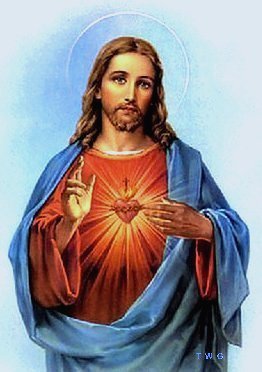
Behold this Heart which has so loved men that it has spared nothing, even to exhausting and consuming itself, in order to testify its love. In return, I receive from the greater part only ingratitude, by their irreverence and sacrileges, and by the coldness and contempt they have for me in this Sacrament of love... I come into the heart I have given you in order that through your fervor you may atone for the offenses which I have received from lukewarm and slothful hearts that dishonor me in the Blessed Sacrament.
-Third apparition of Jesus to St. Margaret Mary Alacoque
12
posted on
10/16/2003 3:07:38 PM PDT
by
Salvation
(†With God all things are possible.†)
To: All
The Word Among Us
Thursday, October 16, 2003
Meditation
Romans 3:21-30
From a meditation by Fr. Raniero Cantalamessa, Preacher to the Papal Household:
St. Paul’s teaching on justification by faith begins with a temporal adverb: “now.” The adverb “now” has three different levels of meaning: historical, sacramental, and moral. It refers first of all to the time when Christ died on the cross for us, that is, to the historic event when our redemption was accomplished. Secondly, it refers to the moment of baptism when the Christian was “washed, sanctified, and justified” (1 Corinthians 6:11). Finally, it refers to the present moment, to this day of our existence. This latter significance is the one the apostle is emphasizing when he exclaims to the Corinthians: “Behold, now is the acceptable time; behold, now is the day of salvation” (2 Corinthians 6:2).
There is something that must be done now, at once; something that I, and not another in my place, must do and without which all the best and deepest considerations on this problem would be left hanging in the air. Justification by faith is the beginning of the supernatural life, but it is not a beginning quickly succeeded by other things. It is a beginning that is always timely and that must constantly be remade and resecured. We are here at this present time precisely for this reason: not only in order to understand what took place in us one day through baptism but to relive it, so that our faith may grow by leaps and bounds. All of this can happen to us, if we so wish. I can again place my sins in the arms of Christ on the cross and then present myself to the Father and say: “Now look upon me, Father, look upon me because I am your Jesus! His justice is upon me; ‘He has clothed me with the robe of righteousness’ (Isaiah 61:10). As Christ ‘has put on my iniquity,’ I have put on his sanctity, I have put on Christ!” (Galatians 3:27).
“Father, we thank and praise you for clothing us in Christ. Jesus, all glory be to your name for taking our former lives with you to the cross. Holy Spirit, we adore you for the freedom you give to all who place their faith in Christ!” |
 |
13
posted on
10/16/2003 5:15:18 PM PDT
by
Salvation
(†With God all things are possible.†)
To: All
One Bread, One Body
| << Thursday, October 16, 2003 >> |
St. Hedwig
St. Margaret Mary Alacoque |
|
| |
| Romans 3:21-29 |
Psalm 130 |
Luke 11:47-54 |
| View Readings |
| |
|
| |
| “All men are now undeservedly justified by the gift of God, through the redemption wrought in Christ Jesus.” —Romans 3:24 |
| |
“You were dead because of your sins and offenses” (Eph 2:1). You “sinned and [were] deprived of the glory of God” (Rm 3:23). Because you sinned, even if it were but one sin, you have “become guilty on all counts” as a transgressor of God’s law (Jas 2:10). When you sinned, you turned away from God’s integrated plan of holiness and bought into the system of sin. You were then connected into the fabric of sin, plugged into sin rather than God, joined to all sins ever committed (see Lk 11:50). This is what Jesus means when He says our “guilt stretches from the blood of Abel to the blood of Zechariah” (Lk 11:51). He says, in effect, that when we join in sin, we sin from A to Z. The good news is that Jesus is the new A to Z, “the Alpha and the Omega, the First and the Last, the Beginning and the End!” (Rv 22:13) Through His blood, Jesus expiates and forgives sins from A to Z (Rm 3:25). If we believe in Jesus and repent sincerely of sin, He justifies us in the sight of God (Rm 3:24, 26). Accept Jesus as your Redeemer, Savior, and Lord. Be a new creation —from A to Z. |
| |
| Prayer: Jesus, I want to belong to You with all my heart. I abandon myself to You. Use me according to Your will. |
| Promise: “If You, O Lord, mark iniquities, Lord, who can stand? But with You is forgiveness.”—Ps 130:3-4 |
| Praise: St. Margaret Mary was used by God to help others understand the mercy and love Christ had for all, especially through the manifestation of His Sacred Heart. |
| |
|
14
posted on
10/16/2003 5:17:00 PM PDT
by
Salvation
(†With God all things are possible.†)
To: Lady In Blue
Catholic Online Saints
St. Hedwig
d. 1174-1243 Feastday: October 16
Duchess and widow, the patroness of Silesia, a region of eastern Europe. Also called Jadwiga in some lists, she died in a Cistercain convent, having taken vows. Hedwig was born in Andechs, Bavaria, Germany, the daughter of the Duke of Croatia and Dalmatia. She was the aunt of St. Elizabeth of Hungary. At the age of twelve, Hedwig was marrie to Duke Henry of Silesia, the head of the Polish Royal family. She bore him seven children, and they had a happy marriage. Henry founded a Cistercain convent at Trebnitz, as well as hospitals and monasteries.
Henry died in 1238 and Hedwig became a Cistercain at Trebnitz. She had to leave her prayers to make peace among her offspring, and she buried a child who was killed fighting against the Mongols. She died in the convent on October 15.Many miracles were reported after her death, and she was canonized in 1266.
15
posted on
10/16/2003 5:39:58 PM PDT
by
Salvation
(†With God all things are possible.†)
To: Salvation
Thanks,Salvation!


Disclaimer:
Opinions posted on Free Republic are those of the individual
posters and do not necessarily represent the opinion of Free Republic or its
management. All materials posted herein are protected by copyright law and the
exemption for fair use of copyrighted works.
FreeRepublic.com is powered by software copyright 2000-2008 John Robinson