
Posted on 03/09/2026 10:29:21 AM PDT by SeekAndFind
Death is supposed to clarify a life, not distort it.
Obituaries are meant to record history, not rewrite it.
But in today’s corporate media, even death cannot escape ideological spin.
Consider the recent coverage of Ayatollah Ali Khameini, Iran’s Supreme Leader for more than three decades.
In the Washington Post, readers were introduced to a man with a “bushy white beard and easy smile,” an “avuncular figure” fond of Persian poetry and Victor Hugo’s Les Misérables. Some acquaintances described him as a “closet moderate.”
Image: AI illustration
A closet moderate? That description might surprise the regime’s political prisoners — and its victims.
For more than three decades, this “moderate” presided over a regime that funded Hezb'allah and Hamas, armed militias across the Middle East, imprisoned dissidents, executed protesters, brutalized women for dress-code violations, and has American blood on its hands through decades of proxy warfare.
Yet the obituary’s opening emphasis focused on literary sensibilities and grandfatherly optics.
The New York Times struck a similarly soft chord. With “spectacles, Palestinian kaffiyeh, long robes and silver beard,” Khamenei “cast himself as a religious scholar,” affecting “an avuncular and magnanimous aloofness.” He ran the country, we are told, from “a perch above the jousting of daily politics.”
Above the jousting, perhaps. But not above repression.
Yes, both papers documented the regime’s brutality. But framing matters. Lead paragraphs shape perception. When tyrants are introduced through imagery of scholarship and avuncular charm, the moral edges blur.
The pattern is not new. When ISIS leader Abu Bakr al-Baghdadi was killed in 2019, the Washington Post initially described him as an “austere religious scholar.” Not a mass murderer. Not a genocidal terrorist. An austere scholar... /p>
(Excerpt) Read more at americanthinker.com ...
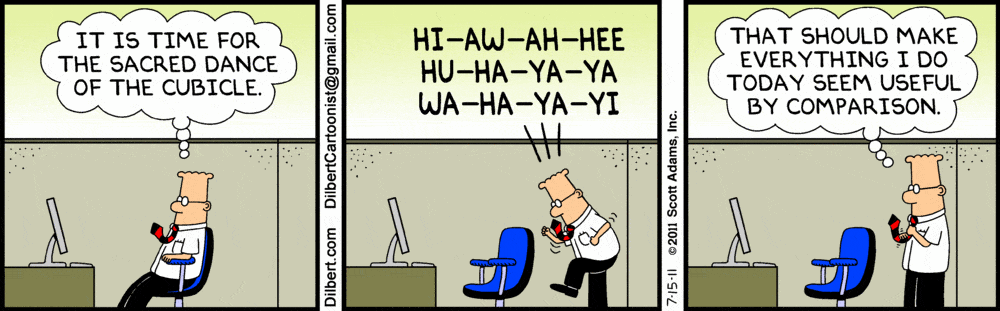
Now contrast that with coverage of Dilbert creator Scott Adams.
Adams was undeniably controversial. In a 2023 podcast, discussing a Rasmussen poll finding that only half of black Americans agreed that “It’s O.K. to be white,” he reacted harshly, suggesting that if the poll numbers were accurate, white Americans should “get the hell away from Black people.” It was blunt, inflammatory, and widely condemned. Newspapers were right to report it.
But in his obituary coverage, particularly in the New York Times, those comments loomed large. The New York Times detailed the podcast remarks at length, contextualizing the phrase’s alleged association with white supremacists and underscoring the backlash. The Washington Post prominently labeled him “far right,” after highlighting what it called his “racist comments” about the Rasmussen poll.
Consider the media’s contrast.
A ruler who funded terrorism and crushed dissent: “avuncular.”
A Jihadist responsible for genocide: an “austere religious scholar.”
A cartoonist with controversial political views: “far right.”
The pattern is hard to miss.
The Washington Post obituary of Khamenei took the cake as beyond parody. Seriously. Layers and layers of editors and fact checkers had to approve focusing the obituary of the architect of a world terrorist network and mass murder of tens of thousands of his own people on his “bushy white beard and easy smile” as if Santa Claus had died.
Our MSM is trash.
Mostly pro liberal trash, but a little conservative trash thrown in there.
Light on facts, heavy on feelings and opinions presented as analysis, massive repetition, lots of fallacies. Trash.
The main stream media has decayed into a collection of front organizations for Islamic Imperialism.
ping
The pattern is hard to miss... yes, for those of us willing to notice reality.
Like so many industries, the media is dominated by a small number of mega-organizations. Not a friendly environment for the entrepreneurial spirit.
Disclaimer: Opinions posted on Free Republic are those of the individual posters and do not necessarily represent the opinion of Free Republic or its management. All materials posted herein are protected by copyright law and the exemption for fair use of copyrighted works.