Skip to comments.
International Law? What’s That?
Powerline ^
| 03/08/2026
| John Hinderaker
Posted on 03/08/2026 8:53:23 PM PDT by SeekAndFind
Following our bombing of Iran, we are hearing the usual caterwauling from the Left about international law. Of course, no one invokes international law when Iran kills our servicemen, or when Hamas massacres Israelis, or when Iran launches missiles against the United Arab Emirates, and so on. There is a certain asymmetry in the invocation of international law.
I took a course in international law when I was in law school. It was taught by a distinguished scholar in that field. As I recall, the first section of the course was devoted to the question, is there such a thing as international law? The answer was, sort of. My own answer would be no: absent any mechanism for enforcement, it is more International Suggestions than International Law. And purported law that can never be invoked in a useful way against the forces of evil, like Iran’s regime, is useless.
I agree with this:
Also this:
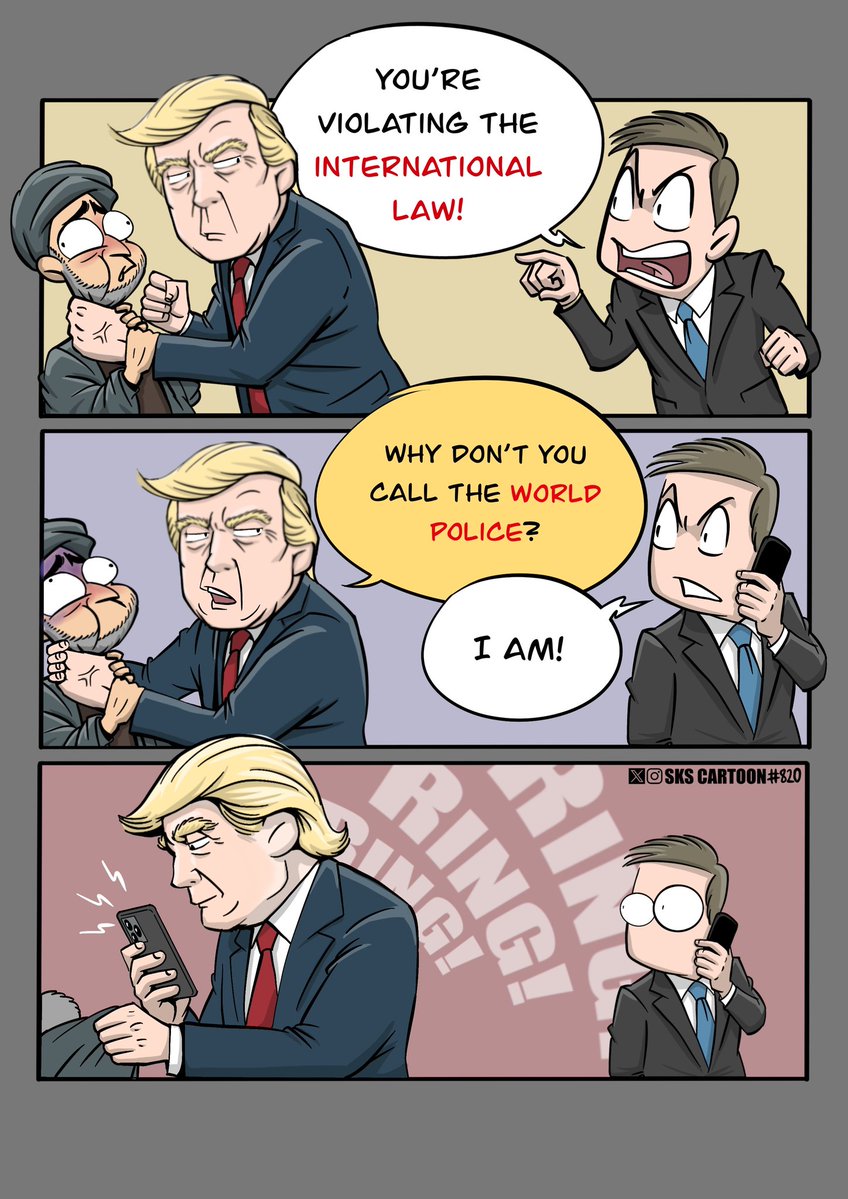
It is striking that in the current debate over our giving the mullahs their long-overdue deserts, there has been virtually no mention of the United Nations. Even 30 or 40 years ago, the U.N. would have been deemed relevant to the situation. No longer. The demise of the U.N. exposes, I think, the illusory nature of international law.
For a somewhat more positive view of international law, check out law professor Ilan Wurman’s comments on the rationally BASED podcast. This episode puts Ilan in an unusual position, i.e., somewhat to my left. But it is well worth a listen:
CLICK ABOVE ARTICLE LINK FOR THE VIDEO
TOPICS: Canada; European Union; Foreign Affairs; France; Hamas; Hezbollah; Iran; Israel; News/Current Events; United Kingdom; War on Terror; Yemen
KEYWORDS: antonioguterres; bahrain; canada; europeanunion; france; francescaalbanese; hamas; hezbollah; internationallaw; iran; israel; itsatreaty; johnhinderaker; lawtruth; powerline; saudiarabia; uae; unitedarabemirates; unitedkingdom; unitednations; untiednations; war; waronterror; yemen
To: SeekAndFind
The big “secret” of modern international law is that it is now designed to cripple the West, make wars impossible to win, and keep us trapped in hostile quagmires. That’s the end game.
It’s the great “equalizer,” the pinnacle of post-liberal equality. Under international law, bad actors have the privilege of acting with impunity while Western forces that respond get chastised by various Singham-funded NGOs and the Atlantic. Trump is the first president to buck this nonsense.
To: SeekAndFind
Nice article, and my International Law professor admitted about the same thing.
3
posted on
03/08/2026 9:12:45 PM PDT
by
ConservativeMind
(Trump: Befuddling Democrats, Republicans, and the Media for the benefit of the US and all mankind.)
To: AdmSmith; AnonymousConservative; Arthur Wildfire! March; Berosus; Bockscar; BraveMan; cardinal4; ...
4
posted on
03/08/2026 9:15:10 PM PDT
by
SunkenCiv
(TDS -- it's not just for DNC shills anymore -- oh, wait, yeah it is.)
To: SeekAndFind
We ARE the international law!
To: SeekAndFind
Why hasn’t Putin annihilated the Z guy?
6
posted on
03/08/2026 9:32:43 PM PDT
by
algore
( )
To: Terry L Smith
7
posted on
03/08/2026 9:38:13 PM PDT
by
Mariner
(War Criminal #18)
To: SeekAndFind
It’s also no problem if a DemonRat president bombs somebody. Bubba Krinton bombed Kosovo in the late 1990s for 6 months and authorized all kinds of extracurricular activities for about 3 years of this conflict. He never justified himself. The media never took him to task. Mr. Wonderful can do anything he wants with the military, same with Buttcrack Hussein.
8
posted on
03/08/2026 9:46:28 PM PDT
by
Excuse_My_Bellicosity
(♪It's a long way, to the shop, if you wanna sausage roll.♪ -- not Angus Young )
To: SeekAndFind
International law is an agreement amongst the powerful. Like mob families. When someone breaks the agreement the powerful decide amongst themselves if they are going to do something about it or not. There is no policeman. Its closer to mob families.
9
posted on
03/09/2026 1:23:56 AM PDT
by
poinq
To: SeekAndFind
Its a fantasy engaged in by Europeans due to their military impotence. In reality, there is no such thing as “international law”. There are treaties between sovereign countries. That’s it. There is nothing else. Countries can of course, withdraw from treaties anytime they wish to. There is no enforcement mechanism for “international law” and a country is bound by it only to the extent that it agrees to be bound by it.
10
posted on
03/09/2026 2:21:34 AM PDT
by
FLT-bird
To: SeekAndFind
It is a pathetic attempt by the weak (ie Europeans) to tie down the strong (ie the US) Gulliver-like in a web of “law” and obligations.
By making the strong weak, the weak hope to make themselves more powerful in relative terms. But like always throughout human history, all that really matters in the end is hard power.....how much money do you have? How many resources? How good is your technology? and of course the ultimate trump card - How powerful are your military forces?
11
posted on
03/09/2026 2:24:42 AM PDT
by
FLT-bird
To: SeekAndFind
International law has always meant that the weak need to listen to the strong.
This was apparent in the Suez crisis and also in Grenada, etc.
12
posted on
03/09/2026 2:34:37 AM PDT
by
Cronos
To: SeekAndFind
I love this post.
I agree 110%!
There is no International law up there, only some suggestions.
And what is there is designed to cripple West!
It just protects terrorists, evil dictators, pirates, drug smugglers, etc.
Some of the suggestions are totally ridiculous.
Lots of the treaties US never signed.
And there is no enforcement!
13
posted on
03/09/2026 2:35:30 AM PDT
by
AZJeep
(sane )
To: SeekAndFind
Iran supplies money and harmful stuff to Hezbollah.
Hezbollah attacks Israel.
Israel has the legal right to take military action against Iran. The US has the legal right to militarily help out.
To: SeekAndFind
Iran has supplied drones to Russia which has used them to attack Ukraine.
Iran supplied missiles to Houthis which have shot them at ships transiting the Red Sea.
To: SeekAndFind
Law requires a lawgiver, and a judge.
In the United States, the People have granted a limited set of legislative powers to a Congress (”all legislative powers herein granted”), and the People and the States have retained anything not granted.
Therefore, all pretended “international” laws have no force or validity as regards the US government or US officials.
16
posted on
03/09/2026 6:10:06 AM PDT
by
Jim Noble
(Assez de mensonges et des phrases)
To: SeekAndFind
International law is whatever the U.S. says it is.
17
posted on
03/09/2026 7:44:06 AM PDT
by
MNnice
To: SeekAndFind
International Vigilantism.
To: SeekAndFind
"International Law? What’s That?" A myth.
To: SeekAndFind
International law? What's that?
In international affairs, International Law is the Supreme law of the United States, established as such by the U.S. Constitution, Article 1, Section 8, Clause 10: "The Congress thall have the power ... [10] To define and punish ... Offenses against the Law of Nations." See also Article 6, Section 2: "This Constitution, and the laws of the United States which shall be made in pursuance thereof; and all treaties made, or which shall be made, under the authority of the United States, shall be the supreme law of the land; and the judges in every state shall be bound thereby, anything in the Constitution or laws of any State to the contrary notwithstanding."
"The Law of Nations" is the now-archaic term for "International Law." The terms are interchangeable.
Black's Law Dictionary, 6th ed., complete definition:
Law of nations. See International law.
11th ed. precisely the same.
The United Nations Charter and the Geneva Conventions are examples of treaties made under the authority of the United States to which the United States is a signatory.
https://www.asser.nl/knowledge-hub/core-legal-texts/international-humanitarian-law/customary-ihl/
Customary IHL Both treaty law and customary international law are sources of international law. Treaties, such as the four Geneva Conventions of 1949, are binding only on those states that have expressed their consent to be bound by them (ratified them). In contrast, customary international law binds all states, irrespective of which conventions they have ratified or not. The ICRC notes that '[i]t is generally agreed that the existence of a rule of customary international law requires the presence of two elements, namely state practice (usus) and a belief that such practice is required, prohibited or allowed, depending on the nature of the rule, as a matter of law (opinio juris sive necessitatis)'. As such, customary IHL derives from analysis of multiple sources: military manuals, national legislation, case law, and other official documents.
As part of their mission to promote IHL, the ICRC maintains a compilation of customary IHL, condensing the established practices into rules accompanied by commentary as well as a collection of related practices. While much debate on the customary status of specific prohibitions and regulations is ongoing, the ICRC Customary IHL database is often referred to as the most authoritative and exhaustive study on customary IHL.
https://www.law.cornell.edu/wex/customary_international_law
Customary International Law Customary international law refers to international obligations arising from established international practices, as opposed to obligations arising from formal written conventions and treaties. Customary international law results from a general and consistent practice of states that they follow from a sense of legal obligation. Two examples of customary international laws are the doctrine of non-refoulement and the granting of immunity for visiting heads of state.
The International Court of Justice (ICJ) is the main judicial body of the United Nations, and it settles disagreements between member states of the United Nations. Under Chapter II, Article 38 of the Statute of the International Court of Justice, international customs and general practices of nations shall be one of the court's sources of customary international law is one of the sources of international law. Customary international law can be established by showing (1) state practice and (2) opinio juris.
The authority of international law was invoked to authorize the Nuremberg trials.
Disclaimer:
Opinions posted on Free Republic are those of the individual
posters and do not necessarily represent the opinion of Free Republic or its
management. All materials posted herein are protected by copyright law and the
exemption for fair use of copyrighted works.
FreeRepublic.com is powered by software copyright 2000-2008 John Robinson