
Posted on 12/26/2025 4:24:48 PM PST by SeekAndFind
While the so-called Santa Claus rally delivered year-end gains for stocks and precious metals, the U.S. dollar received a lump of coal to finish a not particularly strong 2025.
The U.S. dollar index, a measure of the greenback against a weighted basket of currencies, is on track for its largest annual decline since 2003.
This year, the index has dropped 10 percent, with nearly all of the damage occurring in the first half of 2025, when it tanked almost 11 percent. The alternative trade-weighted dollar index—a measure created by the Federal Reserve that monitors the greenback against major trading partners—has declined about 7 percent.
The greenback has steadied in recent months, with ING strategists noting that “the dollar is proving surprisingly resilient” amid various data points.
Still, analysts are divided on whether the worst has passed or further weakness awaits in 2026.
Over the past 12 months, the dollar’s downward pressure has been driven by a broad array of headwinds, including global diversification, geopolitical tensions, and Federal Reserve easing.
Global private investors and central banks have engaged in a balancing act: bolstering their appetite for non-dollar assets—gold or alternative currencies—and increasing their exposure to high-yield U.S. Treasury securities.
Foreign holdings of U.S. debt, for example, rose 6 percent year over year in October to $9.242 trillion, according to Treasury data released earlier this month.
In the year ahead, similar trends could play out, say ING strategists. “This year has shown that the private sector is more than willing to buy Treasuries and our call for a weaker dollar in 2026 is based on foreign investors increasing their hedge ratios on U.S. assets rather than selling them outright,” they wrote in a Dec. 19 note.
Geopolitics and fiscal concerns are likely supporting the continued diversification, say UBS economists.
Washington registered a $1.8 trillion budget deficit in fiscal year 2025. The federal shortfall is already $439 billion in the first two months of fiscal year 2026, and the deficit could be on track for another $2 trillion.
Persistent fiscal worries continue to keep long-term Treasury yields above 4 percent. As the U.S. administration embarks on a rebalancing of international trade through tariffs and efforts to end multiple conflicts, geopolitical tensions could remain elevated.
Monetary policymakers have penciled in a single rate action next year. However, new CME FedWatch Tool data show that investors are forecasting two or three cuts beginning in the spring.
In addition, once Chair Jerome Powell’s term expires in May, uncertainty looms in the back half of 2026, as President Donald Trump’s pick is widely expected to advocate for aggressive rate cuts.
Predictive markets say Powell’s successor likely will be either National Economic Council Director Kevin Hassett or former Fed Governor Kevin Warsh—with the odds in Hassett’s favor.
Conversely, there is a monetary divergence among other major central banks that could add further pressure to the greenback.
The Bank of Japan, for example, recently raised its policy rate to the highest level in 30 years. If above-trend inflation persists, Japanese monetary policymakers expect more rate hikes next year, sending long-term yields on government bonds to 2–3 percent.
Central bank interventions have allowed the Japanese yen to strengthen against the U.S. dollar, rising about 0.5 percent year to date.
Since 2023, the European Central Bank has been engaged in an ongoing easing cycle. However, officials have closed the door to further rate cuts this month, having upgraded their inflation and growth outlook. Investors are betting on a 30 percent chance of rate hikes in the latter half of 2026, a move that would widen the gap between the euro and the dollar.
“With the Fed expected to ease further into 2026, this is eroding the U.S. interest rate premium versus global peers and looks likely to add pressure on the U.S. dollar,” UBS economists wrote in a Dec. 22 note.
The dollar index ticked up 0.05 percent during the quiet Boxing Day trading session, hovering around 98.00.
Reuters contributed to this report.
BWWWWAAAAAAAHAHAHAHAHA
It’s almost as if huge budget and trade deficits have gutted the alue of the dollar. Who woulda thought?
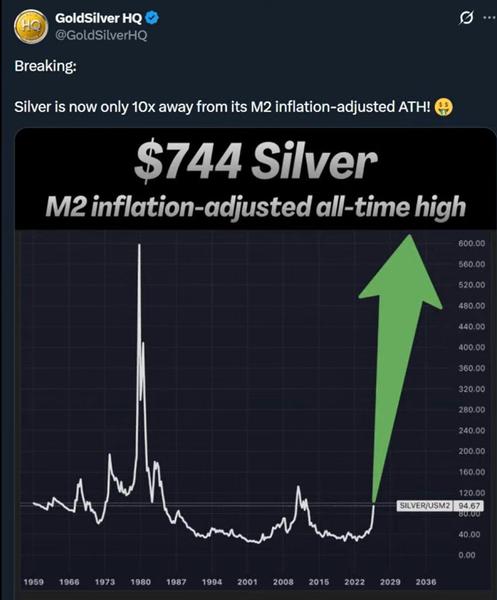
With Trump jaw-boning interest rates lower, the dollar will continue to lose value. Just another reason that gold and silver are sky rocketing .
Silver @ almost 80.00 dollars an ounce... KABOOM..!!!
A weak dollar strongly boosts exports of American-made goods. The timing is ideal, as it encourages Europe to purchase more U.S. weapons (and many other things, like American energy) than ever before.
At the same time, Americans are more likely to spend domestically and buy U.S.-made products. It will also boost tourism in America.
That is the exact opposite reaction you would expect to see with a 10%-12% value decline in the US Dollar.
US Treasury 28 Day Interest Rate in 2025...
4.3% to 3.6%
US Treasury 10 Year Interest Rate in 2025...
4.8% to 4.13%
Well, if there is a devaluation of the dollar, doesn’t that mean that we who are dependent on the dollar’s value are left in the lurch? Remember, there is a lot of us on S.S. or not quite making it due to other reasons, and we can’t afford to invest in gold or silver.
A weak dollar.....
not scard- i bought several wheelbarrows to carry my worhtless cash in once it hits
Wife showing me a gold coin she got as a present from her mom in 2001. Along with a receipt, her mom paid under $300 for the proof coin. Now going for $5,000 at Walmart, same year exact coin. Yes, the dollar lost value since 2001. Silver eagles selling way over spot, and are said to go to $100 soon, then $200/oz, possibly to $500 within a year or two. Holding dollars is a losing proposition.
Resident Trump wants a weaker Dollar.
.
<
“Blah, blah, blah, basic fact: a weak dollar only increases the price Americans have to pay for foreign, imported goods.....duh”
>>>>>>>>>>>>>>
Well, let’s not forget that what you just said is what Trump wants though. And he’s right!
It encourages Americans to buy MADE IN AMERICA products, instead of Chinese imported stuff. It will revitalize the American industry.
Excellent news for America’s exports and for its economy.
Heck, let’s just really accelerate the dollar depreciation even more, put it on steroids,,,,,,,,and really get the economic party started!
For times like now, it’s a win-win.
Make goods at home, sell abroad.
Make goods at home, sell/buy at home.
I want policies that take care of the worker living on Main Street. Let the Wall Street investors invest wisely - or get a job.
Your 401k, IRA? Let a professional handle it, based on your age.
More factories, more businesses, more jobs, lower interest rates, fairly priced mortgages, less inflation.
“Heck, let’s just really accelerate the dollar depreciation even more, put it on steroids,,,,,,,,and really get the economic party started!”
>>>>>>>>>>>>
We have to be careful, though. Too much of a “good thing” can actually backfire. You know the saying: one apple a day keeps the doctor away… but eat ten apples, and suddenly your stomach isn’t happy. Managing this is a delicate balance. I’m not a specialist, but if the dollar falls too far, it could have serious consequences.
On top of that, the new tariffs make things even trickier for American consumers. The timing of tariffs alongside a weaker dollar isn’t ideal.
Personally, like Musk —and going back a while, Trump— I’ve always supported zero tariffs between allies, keeping them only on China and its partners. That approach seems to make the most sense. And it would have made the burden of the low value of the dollar much easier to cope with for the general American consumer.
>>>>>>>>>><
Anecdote:
Winston Churchill once said:
“One apple a day keeps the doctor away... if you aim well!”
It’s actually good. We have minimal inflation. It helps the trade deficit and lowers the national debt in real terms.
Disclaimer: Opinions posted on Free Republic are those of the individual posters and do not necessarily represent the opinion of Free Republic or its management. All materials posted herein are protected by copyright law and the exemption for fair use of copyrighted works.