Posted on 02/13/2022 6:36:54 PM PST by blam
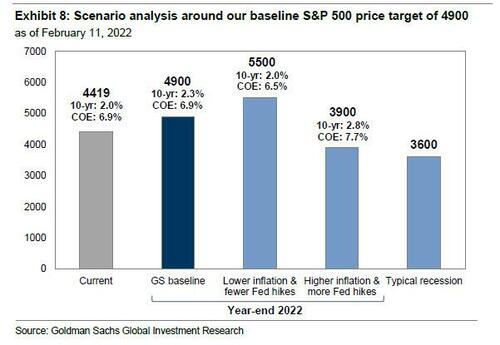
Last week, for the first time since the current tightening frenzy began, Goldman warned that the Fed’s aggressive tightening may could to a hard landing. Not surprisingly, just a few days later, the bank slashed its year-end S&P target and now warns that in a recession the S&P could tumble to 3,600.
Now, it’s Morgan Stanley’s turn as the following Sunday Start note by the bank’s Chief US Economist Seth Carpenter, reveals.
Rising Inflation, Rising Risks
Over the past half year, we and many central banks have serially revised our inflation forecasts higher. As inflation has continued to surprise to the upside, markets have priced in more rate hikes and an earlier onset of hiking by many DM central banks. How much is too much? That question needs to be asked for both market pricing and the economy.
Last week’s US CPI print was the most recent of these upside surprises. Of course, auto prices softened amid mounting evidence that supply chains are slowly normalizing, but on the heels of the CPI report, our US team revised up its inflation forecast for three reasons:
•The first is a simple mark-to-market of an upside surprise.
•Second, the annual revision to the weights for the price index means that our forecast for the components of inflation will result in a higher index.
•And finally, rent inflation has stayed high, and in our forecast we have extended the timeline for that pressure. This third reason is particularly important because it reflects macro, cyclical inflation that will not recede with healing supply chains.
The upside surprise to CPI means the risks to our Fed call are even more skewed to further hiking. The US team’s baseline call is for four 25bp hikes and the initiation of quantitative tightening (QT) around mid-year. So why not build in more hikes? Our central bank forecasts result from overlaying our reading of the policy reaction function on our economic forecasts – especially for inflation. Consider the typically hawkish Esther George, who said that QT should allow for a flatter path of rate hikes. The market is pricing an even chance of a 50bp hike at the March meeting, a view that we have resisted. Front-loading the tightening has appeal with inflation risks skewed to the upside, but much Fed communication has tilted away from such a move, echoing the cautious tone that Chair Powell struck at the last press conference.
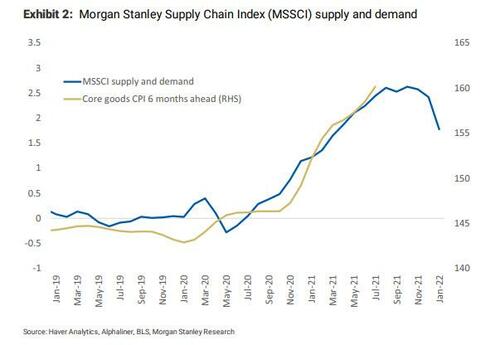
The Bank of England has already hiked twice and initiated its QT, but markets still expect more hiking than we do. The markets have priced in roughly 85bp of hikes over the next 12 months, while we expect somewhat less. Of course, we could be wrong, and markets could continue to be right. But most of the excess inflation in the UK remains in core goods, and if supply chains are normalizing as our index implies, inflation should underperform market expectations later in the year. The BoE appears to share our view, as its latest inflation expectations based on market pricing show inflation undershooting its target. The uncertainty surrounding inflation, however, skews the risks to more hiking rather than less.
The ECB was the last of this group to execute a hawkish pivot. Our European economics team revised its ECB call last week, forecasting an end to QE by September and rate hikes starting in December that bring the deposit rate to zero in 1Q23. The persistence of the inflation overshoot drove the pivot, and while continued upside surprises could lead to more, for the ECB there is another consideration. Negative rates in the eurozone impose costs on banks and are politically unpopular. Hiking from negative to zero has a lower threshold than hiking above zero, so getting to zero could happen faster than we expect. Regardless, we expect the ECB to pause at zero as the uncertainty settles down. If our forecast for goods inflation proves right, and if oil and gas prices stabilize, that pause in 2023 could last for some time.

It is hard to argue that risks are not still skewed to the upside. Even if market pricing has not gone too far, before long we will have to confront the risk I noted in the Sunday Start two weeks ago. The amount of hiking needed to bring inflation down will soon approach the amount that stalls the economy.
They say that like they don’t know it’s intentional.
Stall vs DESTROY... decisions decisions
On kudlow, the 10 year needs to be 9% ?.
I don’t think 2 percent or 3 percent interest rates would kill the economy - but they sure would do a lot of damage to the stock market!
Don’t hike, inflation goes nuclear, hike and WallStreet and housing implode.
Welcome back, stagflation. Nominal rates should be 7, 8, 9 percent right now, but they’re not because the Fed won’t/can’t turn off the spigot. At what point are we headed to Weimar Republic territory? We’ll see...
As they say, “elections have consequences.”
We are so screwed. I chose the wrong time to retire.
Interest rates should be determined by the market, not set by some unelected bureaucrats looking out for their own self interest and that of their friends
W.I.N.
Are we all gonna get WIN buttons this go round?
No one ever mentions “Stop Feeding the Monster”
Cut government spending.
What is causing the inflation?
Out of control Government Spending; social programs and military adventurism. All of which spends ungodly amounts of money that is created out of whole cloth.
But, this not possible, inflation is only temporary, Biden said so, along with 15 other great minds./s
25% rates on 30yr loans are right around the corner! Thank you, Democrats!
“The Biden administration’s regulatory agenda virtually ensures that the post-pandemic economy will be nothing like it was before. The mounting regulatory burden of Mr. Biden’s executive orders, his regulators’ open hostility toward America’s economic system, and the return to Progressive-era antitrust enforcement will stifle growth. All the ingredients will be present to turn the current inflation into stagflation”.....
Biden’s regulatory agenda is openly hostile to the industries they regulate and to the American economic system. They seek not to protect investors and consumers but to make business serve government goals.
Through Biden’s executive orders and regulatory policy the American economy has been and is being transformed from the great colossus of world capitalism into a subservient Vichy capitalism, whose master is government and not the consumer.
(December 13, 2021
By Phil Gramm and Mike Solon. Gramm is a former chairman of the Senate Banking Committee)
No law prevents you from resuming your old career or starting out on a new and better one.
I went hiking today with the grandchildren!
The puppet masters will choose inflation.
what about pensions with a 2% (or whatever) cap on increases, and not connected to state government general funds?
this seems like criminal theft in some form from a pension perspective.
I’ll take a stalled economy over hyperinflation.
Disclaimer: Opinions posted on Free Republic are those of the individual posters and do not necessarily represent the opinion of Free Republic or its management. All materials posted herein are protected by copyright law and the exemption for fair use of copyrighted works.