Skip to comments.
The Food Shock Of 2011
The Daily Reckoning ^
| 10-26-2010
| Addison Wiggin
Posted on 10/26/2010 9:03:10 PM PDT by blam
The Food Shock Of 2011
By Addison Wiggin
10/26/10 Baltimore, Maryland – Every month, JP Morgan Chase dispatches a researcher to several supermarkets in Virginia. The task – to comparison shop for 31 items.
In July, the firm’s personal shopper came back with a stunning report: Wal-Mart had raised its prices 5.8% during the previous month. More significantly, its prices were approaching the levels of competing stores run by Kroger and Safeway. The “low-price leader” still holds its title, but by a noticeably slimmer margin.
Within this tale lie several lessons you can put to work to make money. And it’s best to get started soon…because if you think your grocery bill is already high, you ain’t seen nothing yet. In fact, we could be just one supply shock away from a full-blown food crisis that would make the price spikes of 2008 look like a happy memory.
Fact is; the food crisis of 2008 never really went away.
True, food riots didn’t break out in poor countries during 2009 and warehouse stores like Costco didn’t ration 20-pound bags of rice…but supply remained tight.
Prices for basic foodstuffs like corn and wheat remain below their 2008 highs. But they’re a lot higher than they were before “the food crisis of 2008” took hold. Here’s what’s happened to some key farm commodities so far in 2010…
* Corn: Up 63%
* Wheat: Up 84%
* Soybeans: Up 24%
* Sugar: Up 55%
What was a slow and steady increase much of the year has gone into overdrive since late summer. Blame it on two factors…
* Aug. 5: A failed wheat harvest prompted Russia to ban grain exports through the end of the year. Later in August, the ban was extended through the end of 2011.
Drought has wrecked the harvest in Russia, Ukraine and Kazakhstan – home to a quarter of world production
* Oct. 8: For a second month running, the Agriculture Department cut its forecast for US corn production. The USDA predicts a 3.4% decline from last year. Damage done by Midwestern floods in June was made worse by hot, dry weather in August.
America’s been blessed with year after year of “record harvests,” depending on how you measure it. So when crisis hits elsewhere in the world, the burden of keeping the world fed falls on America’s shoulders.
According to Soren Schroder, CEO of the food conglomerate Bunge North America, US grain production has filled critical gaps in world supply three times in the last five years, including this summer…
* In 2010, when drought hit Russian wheat
* In 2009, when drought hit Argentine soybeans
* In 2007–08, when drought hit Australian wheat
So what happens when those “record harvests” no longer materialize?
In September, the US Department of Agriculture estimated that global grain “carryover stocks” – the amount in the world’s silos and stockpiles when the next harvest begins – totaled 432 million tons.
That translates to 70 days of consumption. A month earlier, it was 71 days. The month before that, 72. At this rate, come next spring, we’ll be down to just 64 days – the figure reached in 2007 that touched off the food crisis of 2008.
But what happens if the US scenario is worse than a “nonrecord” harvest? What if there’s a Russia-scale crop failure here at home?
“When we have the first serious crop failure, which will happen,” says farm commodity expert Don Coxe, “we will then have a full-blown food crisis” – one far worse than 2008.
Coxe has studied the sector for more than 35 years as a strategist for BMO Financial Group. He says it didn’t have to come to this. “We’ve got a situation where there has been no incentive to allocate significant new capital to agriculture or to develop new technologies to dramatically expand crop output.”
“We’ve got complacency,” he sums up. “So for those reasons, I believe the next food crisis – when it comes – will be a bigger shock than $150 oil.”
A recent report from HSBC isn’t quite so alarming…unless you read between the lines. “World agricultural markets,” it says, “have become so finely balanced between supply and demand that local disruptions can have a major impact on the global prices of the affected commodities and then reverberate throughout the entire food chain.”
That was the story in 2008. It’s becoming the story again now. It may go away in a few weeks or a few months. But it won’t go away for good. It’ll keep coming back…for decades.
There’s nothing you or I can do to change it. So we might as well “hedge” our rising food costs by investing in the very commodities whose prices are rising now…and will keep rising for years to come.
“While investor eyes are focused on the gold price as it touches new highs,” reads a report from Japan’s Nomura Securities, “the acceleration in global food price is unrestrained. We continue to believe that soft commodities will outperform base and precious metals in the future.”
So how do you do it? As recently as 2006, the only way Main Street investors could play the trend was to buy commodity futures. It was complicated. It involved swimming in the same pool with the trading desks of the big commercial banks.
And it usually involved buying on margin – that is, borrowing money from the brokerage. If the market went against you, you’d lose even more than your initial investment.
Nowadays, an exchange-traded fund can do the heavy lifting for you, no margin required. The name of the fund is the PowerShares DB Agriculture ETF (DBA).
There are at least a half-dozen ETFs that aim to profit when grain prices rise. We like DBA the best because it’s easy to understand. It’s based on the performance of the Deutsche Bank Agriculture Index, which is composed of the following:
* Corn 12.5%
* Soybeans 12.5%
* Wheat 12.5%
* Cocoa 11.1%
* Coffee 11.1%
* Cotton 2.8%
* Live Cattle 12.5%
* Feeder Cattle 4.2%
* Lean Hogs 8.3%
So you have a mix here of 50% America’s staple crops of corn, beans, wheat and sugar…25% beef and pork…and 25% cocoa, coffee and cotton. It might not be a balanced diet (especially the cotton), but it makes for a good balance of assets within your first foray into “ag” investing.
The meat weighting in here looks especially attractive compared to some of DBA’s competitors, which are more geared to the grains. It takes about six months for higher grain prices to translate to higher cattle and hog prices.
You can capture that potential upside right now…and you’ll be glad you did when you sit down to a good steak dinner a few months down the line. After all, it’s going to cost you more.
TOPICS: News/Current Events
KEYWORDS: commodities; food; inflation; ntsa; prices; wheat; wheatcrop; wheatproduction
Navigation: use the links below to view more comments.
first 1-20, 21-40, 41-59 next last
1
posted on
10/26/2010 9:03:12 PM PDT
by
blam
To: blam
2
posted on
10/26/2010 9:04:46 PM PDT
by
Lakeshark
(Thank a member of the US armed forces for their sacrifice)
To: blam
3
posted on
10/26/2010 9:06:21 PM PDT
by
blam
To: blam
And cotton is up more than it has been in 140 YEARS!
4
posted on
10/26/2010 9:07:13 PM PDT
by
Freddd
(CNN is down to Three Hundred Thousand viewers. But they worked for it.)
To: blam
My experience is that Wal-Mart isn’t competitive on grocery items in Iowa. Are their prices low compared to other big chains, or are shoppers just reflexively shopping for groceries at a place they’re at anyway?
5
posted on
10/26/2010 9:07:42 PM PDT
by
jjotto
("Ya could look it up!")
To: blam
“Cattle futures!”
—Hillary Clinton
6
posted on
10/26/2010 9:10:13 PM PDT
by
LibFreeOrDie
(Obama promised a gold mine, but will give us the shaft.)
To: blam
I’m gettin real close to puttin another 10 lbs of java in the larder.
And another 40-50 lbs of canned goods.
And another 20-30 lbs of egg noodles, rice, beans...
Oh well, you get the idea!!
7
posted on
10/26/2010 9:11:09 PM PDT
by
djf
(OK, so you got milk. Got Tula???)
To: blam
Yep - anyone who buys groceries on a regular basis knows this. Even at Wally World groceries are way up and going higher every week. Chopped ham from Wally deli sold for 2.48 less than a year ago, now 3.18. (yes, only someone from Pittsburgh would care about the price of chopped ham, but it illustrates the point.....)
8
posted on
10/26/2010 9:11:29 PM PDT
by
Some Fat Guy in L.A.
(Wanna learn humility? Become a Pittsburgh Pirates fan!)
To: blam
To: blam
The End Of Cheap Food By Eric Fry
10/26/10 Laguna Beach, California – Food is the ultimate regressive tax, which is why it might offer some of the most compelling investment opportunities of the next ten years.
The prince dispenses the same number of tuppence for his crumpet as the pauper. But as a percentage of their respective incomes, the crumpet is much more costly for the pauper. This contrast is obvious, but the implications of this contrast for global food prices may be less obvious.
The poor spend as much as they possibly can to nourish themselves. The wealthy spend as much as they wish. In fact, because the cost of food does not rise commensurately with incomes, the cost of food becomes so trivial to the wealthy that they end up tossing the stuff into trashcans.
For perspective, consider the econo-caloric history of the United States, as it progressed from “Emerging Market” to Superpower. According to the Federal Reserve Bank of Dallas, the average American in 1919 had to work two hours and 38 minutes to buy a 3-pound chicken. Nowadays, it takes just 15 minutes.
In statistical terms, Addison Wiggin observes in the latest edition of Apogee Advisory, “Americans spent 23.4% of their disposable income on food in 1929. By 1950 this number had dropped to 20.6%. By 1975, 13.8%. The number finally cracked single digits in 2000. And that figure includes meals eaten both at home and away from home.
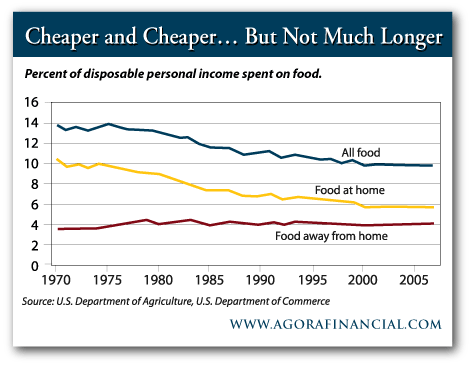
“Compare that to Germans,” Addison continues. “They spend 11.4% of disposable income just on meals eaten at home. The French, Japanese and South Koreans spend about 14-15%. Brazilians? 24.6%. And the Chinese spend 39.4% of their disposable income on meals eaten at home.
“Even Canadians, with a much smaller population and their vast productive prairies, aren’t as lucky as we are. They spend 9.2% of their disposable income on meals at home. That’s nearly as much as Americans spend both home and away.”
Therefore, imagine a world in which the global population is rapidly increasing, and in which a growing percentage of that growing population is progressing from mere sustenance levels of existence to conditions of relatively greater prosperity.
You don’t need to imagine such a world; it has arrived.
As the major Emerging Markets of the world like Brazil, India and China continue their progression from chronic underachievers to periodic overachievers, their national wealth will increase. And as this wealth increases, the recipients of it will certainly increase the quantity and/or quality of their diets.
Even if the quantity does not increase much, improving the quality of diet would be sufficient to drive food prices much higher. Replacing one meal of beans and rice, for example, with a meal of chicken and rice may not seem very significant.
But it requires 6 pounds of grain to produce one pound of chicken meat, according to the USDA. Therefore, if hundreds of millions of individuals begin opting for chicken over beans, the global grain markets would certainly feel the effects…and these effects would not be limited to the grain markets.
As the organic food website, www.opes.biz points out, “It requires 700 gallons of water to produce one pound of chicken. Instead, farmers could produce 16 pounds of broccoli, or up to 20 pounds of other grains and vegetables… Also, it takes 8 times the amount of gasoline/fossil fuel for production of one pound of chicken as compared to one pound of protein from tofu.”
Therefore, forward-looking investors cannot afford to avert their gaze from global dietary trends. As the Emerging Markets continue to emerge, demand for the world’s finite supplies of grain, water and energy will increased commensurately…and that means much higher prices.
“Americans have become accustomed to cheap and abundant food,” Addison winds up. “Probe the psyche of the average American and he’d probably tell you it’s a birthright. Amber waves of grain and all that.
They’re about to get a rude surprise. After a century in which Americans have spent less and less of their incomes on food, the trend is about to reverse.”
10
posted on
10/26/2010 9:14:49 PM PDT
by
blam
To: FromLori
11
posted on
10/26/2010 9:18:13 PM PDT
by
blam
To: jjotto
My experience is that Wal-Mart isn’t competitive on grocery items in Iowa. Mine too in another state. Wal-Mart is an all-in-one shopping place, which I believe is the incentive for shoppers to go there. I'd rather make the effort and shop at stores less likely to be helping support China's military and government.
To: blam
Perhaps the weak dollar is also causing commodity prices to skyrocket. The Government can only manipulate the markets for a few short months before the fecal matter hits the rotary airfoil air movement device.
On a more positive note, watch fuel prices go through the roof even with much lower demand. Like I said before, we have only seen the first hair of that 1000 pound Gorilla hiding behind the couch! (Positive in the sense that we will put a bounty on Democrats before this mess is all settled and done.)
13
posted on
10/26/2010 9:28:19 PM PDT
by
PSYCHO-FREEP
( Give me Liberty, or give me an M-24A2!)
To: PSYCHO-FREEP
" Perhaps the weak dollar is also causing commodity prices to skyrocket."The most likley cause. Print more money without anything to back it and this is what happens.
14
posted on
10/26/2010 9:36:34 PM PDT
by
blackbart.223
(I live in Northern Nevada. Reid doesn't represent me.)
To: PSYCHO-FREEP
“The Government can only manipulate the markets for a few short months before the fecal matter hits the rotary airfoil air movement device.”
Could eat the politicians, but they are so damn greasy and give a person bad wind. Also, they are impossible to clean properly.
To: Some Fat Guy in L.A.
The prices are already shocking me; I don’t have to wait til 2011 - both groceries and fast food.
16
posted on
10/26/2010 9:38:51 PM PDT
by
GnuHere
To: blam
In my humble opinion there are some world shortages of isolated food items because of weather variability (due to sunspot cycle). We have known that weather is more variable during sunspot minimums and maximums for almost 100 years. Some correlations to wheat production were made 200 years ago.
But in my opinion a bigger factor is that the speculators are looking for a way to hold value in a weak stock market, weak dollar and weak exchange rate. The U.S. was the worlds backup food supplier and the farmers can still produce far more than we could ever dream of consuming, but wheat and grain marketing is done by 3 major companies (ADM, Continental and Cargill).
They control grain marketing.
That and the input costs (fuel, seed (due to PVPA), chemicals and labor) sweeze the producers mercilessly. The only time the marketers do not control is when there is no supply.
17
posted on
10/26/2010 9:42:58 PM PDT
by
Texas Fossil
(Government, even in its best state is but a necessary evil; in its worst state an intolerable one.)
To: GnuHere
"The prices are already shocking me; I don’t have to wait til 2011 - both groceries and fast food."Not to worry. Obama and the First "lady" are off to India just after the election. They won't worry about food prices. They have the rest of us footing the bill for it.
18
posted on
10/26/2010 9:45:17 PM PDT
by
blackbart.223
(I live in Northern Nevada. Reid doesn't represent me.)
To: blackbart.223
I am afraid we will soon need wheelbarrows of money to buy a loaf of bread like they had in the Wiemar Republic....it is very frightening. Germany just printed a bunch of money like the wun is doing and made it worthless.
To: blam
I rarely ever shop for food at WalMart anymore, as I have found their prices and limited selection of food products dismal.
Kroger is my first choice, as I have found their prices to be pretty good, especially if you learn to buy when it is on sale or there is a manager special, and their vast selection is amazing. I like variety and WalMart does not offer such.
20
posted on
10/26/2010 9:53:35 PM PDT
by
rawhide
Navigation: use the links below to view more comments.
first 1-20, 21-40, 41-59 next last
Disclaimer:
Opinions posted on Free Republic are those of the individual
posters and do not necessarily represent the opinion of Free Republic or its
management. All materials posted herein are protected by copyright law and the
exemption for fair use of copyrighted works.
FreeRepublic.com is powered by software copyright 2000-2008 John Robinson
