Thanks,
--Alter

Okay.
Posted on 08/16/2006 8:25:06 AM PDT by Moonman62
UC Davis researchers today described in unprecedented biochemical and anatomical detail how cigarette smoke damages the lungs of unborn and newborn children.
The findings illustrate with increased urgency the dangers that smokers' families and friends face, said UC Davis Professor Kent Pinkerton, and should give family doctors helpful new insight into the precise hidden physical changes occurring in their young patients' lungs.
"Smoke exposure causes significant damage and lasting consequences in newborns," Pinkerton said. "This research has a message for every parent: Do not smoke or breathe secondhand smoke while you are pregnant. Do not let your children breathe secondhand smoke after they are born."
Pinkerton added that the results from this study are further proof that secondhand smoke's effects on children are not minor, temporary or reversible. "This is the missed message about secondhand smoke and children," he said. "Parents need to understand that these effects will not go away. If children do not grow healthy lungs when they are supposed to, they will likely never recover. The process is not forgiving and the children are not going to be able to make up this loss later in life."
The 2006 Surgeon General's Report on secondhand smoke estimates that more than 126 million residents of the United States age 3 or older are exposed to secondhand smoke. Among children younger than 18 years of age, an estimated 22 percent are exposed to secondhand smoke in their home; estimates range from 11.7 percent in Utah to 34.2 percent in Kentucky.
To get the word out to parents about the dangers of secondhand smoke, two states (Arkansas and Louisiana) have made it illegal to smoke in a car with young passengers. In California, a similar bill, AB 379, is currently under consideration in the state Legislature.
The new UC Davis research is reported in today's issue of the American Journal of Respiratory and Critical Care Medicine. The lead author is Cai-Yun Zhong, a former UC Davis graduate student now working at ArQule Biomedical Institute in Boston; the co-authors are Ya Mei Zhou, also a former UC Davis graduate student and now investigating breast cancer signaling pathways at Buck Research Institute in Novato, Calif.; Jesse Joad, a UC Davis pediatrician who studies children's lung development and cares for sick children in the UC Davis Health System; and Pinkerton, a UC Davis professor of pediatric medicine and director of the UC Davis Center for Health and the Environment.
The Pinkerton research group is one of the few groups in the nation capable of studying the effects of environmental contaminants on unborn and newborn animals. Their 15 years of studies on mice and rats have yielded greater understanding of how air pollution affects human lungs and health through experiments that attempt to reproduce true exposure conditions to environmental air pollutants.
The new study was done with rhesus macaque monkeys, in order to obtain the best possible understanding of what happens in people. Pregnant macaques were exposed to smoke levels equal to those that a pregnant woman would breathe if someone in her home or workplace smoked. Newborn macaques were exposed to secondhand smoke levels similar to those a human baby would breathe if it was cared for by a moderate-to-heavy smoker.
What the researchers found is that environmental tobacco smoke wreaks havoc in babies at a critical time in the development of lungs -- when millions of tiny cells called alveoli (pronounced al-VEE-o-lye) are being formed.
Alveoli are the place where oxygen passes from the lungs into the bloodstream. Human infants are born with only about one-fifth of the 300 million alveoli they will need as adults. They construct almost all those 300 million alveoli between birth and age 8.
Pinkerton's group had previously shown that rats exposed to secondhand smoke while in the womb and after birth developed hyper-reactive, or "ticklish," airways, which typically occurs in children and adults with asthma. The airways in those rodents remained hyper-reactive even when the secondhand smoke exposure stopped. Thus, this early exposure to environmental tobacco smoke created a long-lasting and perhaps permanent asthma-like condition.
In the new study, the researchers analyzed step-by-step how the alveolar cells' inner workings reacted to cigarette smoke. They found the normal orderly process of cell housecleaning had gone haywire.
In healthy people, cells live and die on a schedule. Programmed cell death, called apoptosis (a-pop-TOE-sis), is regulated by genes that increase or decrease various chemical reactions in the cell.
But in this study, when baby monkeys were exposed to cigarette smoke before and after birth, apoptosis went awry. Critical cellular controls regulating cell death turned off. Alveolar cells died twice as fast as they should have.
"If you are killing cells at a higher rate during a critical developmental stage, when they are supposed to be proliferating in order to create new alveoli, the lungs may never be able to recover," Pinkerton said.
Funding for the study, "Environmental Tobacco Smoke Suppresses Nuclear Factor Kappa B Signaling to Increase Apoptosis in Infant Monkey Lungs," was included in a five-year, $1.5 million research grant from the National Institute of Environmental Health Sciences and $450,000 from taxes on sales of tobacco products in California.
Media contact(s): • Kent Pinkerton, Center for Health and the Environment, (530) 752-8334, kepinkerton@ucdavis.edu • Jesse Joad, Department of Pediatrics, (916) 734-3189, jpjoad@ucdavis.edu • Sylvia Wright, UC Davis News Service, (530) 752-7704, swright@ucdavis.edu
Probably not. The anthropologists theorize the age by going by found skeletons and their average age. I doubt any of those "smokin" cavemen lived beyond their thirties... partly due to their smokin' caves!
Please stick to the topic at hand.
Thanks,
--Alter
Thanks for the ping. :-)
He lit a Camel as his feet hit the floor from bed, and that was the last match he used all day.
He lit a Camel as his feet hit the floor from bed, and that was the last match he used all day.
Maybe so, but when you consider that in the 40s and 50s everybody smoked, and that many of us lived in the conditions of proximity I experienced the numbers of deaths for non smokers like myself and my wife does not seem to bear out the claims of the fatal consequences of second hand smoke. Though I admit to suffering frequent bouts with bronchitis as a kid which subsided after we moved out of the apartment to a six room colonial.
Thanks,
--Alter
Okay.
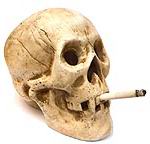

OK, you're too lazy to do your own work? Here we go. I discounted any studies that had to do with first hand smoking. That's not what this discussion is about.
Active and passive smoking and the risk of subarachnoid hemorrhage: an international population-based case-control study - Compared with never smokers not exposed to passive smoking, the adjusted odds ratio for SAH among current smokers was 5.0 (95% confidence interval [CI], 3.1 to 8.1); for past smokers, 1.2 (95% CI, 0.8 to 2.0); and for passive smokers, 0.9 (95% CI, 0.6 to 1.5).
Not statistically significant
Active smoking, household passive smoking, and breast cancer: evidence from the California Teachers Study - Irrespective of whether we included passive smokers in the reference category, the incidence of breast cancer among current smokers was higher than that among never smokers (HR = 1.32, 95% confidence interval [CI] = 1.10 to 1.57 relative to all never smokers; HR = 1.25, 95% CI = 1.02 to 1.53 relative to only those never smokers who were unexposed to household passive smoking).
Once again, not staistically significant.
Cohort study of exposure to environmental tobacco smoke and risk of first ischemic stroke and transient ischemic attack - No significant associations were found between ETS exposure outside home and ischemic stroke or between exposure to ETS at home or out of home and the risk of transient ischemic attack. Although potentially important confounders (such as dietary habits) were not included in the analysis (a sloppy study to begin with)
Effects of passive smoking on outcome in pregnancy - The multiple logistic regression analyses showed that ETS exposure during pregnancy was significantly associated with a higher risk of small-for-gestation babies (OR 2.10; 95% CI: 1.27- 3.48).
Barely statistically significant.
Environmental tobacco smoke exposure among pregnant women: impact on fetal biometry at 20-24 weeks of gestation and newborn child's birth weight - ETS exposure (passive smoking) was assumed to occur when the level of serum cotinine ranged from 2-10 ng/ml.
Another sloppy study.
Passive cigarette smoking is a risk factor in cervical neoplasia - The adjusted relative risk and 95% confidence limits for passive smoking was 2.1 (1.3, 3.3) in the 1963 cohort and 1.4 (0.8, 2.4) in the 1975 cohort.
Barely significant in the first cohort, not statistically significant in the second cohort. Call it a draw.
Passive smoking and breast cancer risk among non-smoking Chinese women - Overall, there was no apparent association between any passive smoke exposure or exposure to a husband's smoke and breast cancer risk. There was some evidence of an elevated breast cancer risk associated with passive smoking exposure of 5 hr or more per day in the workplace (OR = 1.6, 95% confidence interval 1.0-2.4
Not statistically significant.
Passive smoking and risk of coronary heart disease and stroke: prospective study with cotinine measurement - Relative hazards (95% confidence intervals) for coronary heart disease in the second (0.8-1.4 ng/ml), third (1.5-2.7 ng/ml), and fourth (2.8-14.0 ng/ml) quarters of cotinine concentration compared with the first ( 0.7 ng/ml) were 1.45 (1.01 to 2.08), 1.49 (1.03 to 2.14), and 1.57 (1.08 to 2.28), respectively…….. There was no consistent association between cotinine concentration and risk of stroke.
No statistical significance
Secondhand smoke exposure in adulthood and risk of lung cancer among never smokers: a pooled analysis of two large studies - The OR for ever exposure to spousal smoking was 1.18 (95% CI = 1.01-1.37) and for long-term exposure was 1.23 (95% CI = 1.01-1.51). After exclusion of proxy interviews, the OR for ever exposure from the workplace was 1.16 (95% CI = 0.99-1.36) and for long-term exposure was 1.27 (95% CI = 1.03-1.57). Similar results were obtained for exposure from social settings and for exposure from combined sources. A dose-response
NO STATISTICAL SIGNIFICANCE
Do you really want me to go on?
There is no preponderance, even majority, even large minority, of evidence that ETS will harm anyone that doesn't have a preexisting medical condition.
Ajenda driven reports.
Fine, but why focus only on the lungs and not other areas such as the nervous system or cardiovascular system? The way this was written made it sound like the unborn baby was breathing in smoke, and it didn't do much to clarify that. For instance, one of the main irritants in smoke is tar, which clogs the alveoli and gums up the cillia--mentioned in the article as the most effected areas--perfectly understandable for babies, but the unborn?
I am not defending the right to blow smoke in a pregnant woman's face, especially since I am one. I just think it's a poorly written article which gives the impression it was written by an alarmist (perhaps looking to further a broader nanny-state agenda).
"CHEMICALS ARE IRRITANTS
Can you identify anything coursing through your body right now that is not a chemical?"
Ha! I'd like to know if there's anything coursing through Quix's body right now that's not an irritant....
More like 85% of lung cancers in the 25% of the population which smokes.
Specifically, how does this study protect life?
= = = =
I happen to have the bias . . . some might consider it blind faith . . . that not all individuals likely to read the study are as thoroughly in denial, self-justification, rationalization addiction; chronic selfishness; chronic rebellion etc. as some are in some communities.
Therefore, when they read such a study, they will likely earnestly adjust their behaviors toward enhancing and protecting the lives of their unborn and young children much more than they otherwise would have.
I think that's a pretty good outcome for the study's costs and bother. Much better than the outcome for many tax dollars spent.
LOL.
No /sar tag?
As long as they are contributing constructively to the ride, fine with me.
imho,
The unnecessary willful destruction, hindrance and/or degredation of life--especially of essentially defenseless children
is rarely to never justified.
--Personal selfishness of the controlling adult is not an adequate justification, to me.
--Personal arrogance of the controlling adult is not an adequate justification, to me.
--Personal rebellion of the controlling adult is not an adequate justification, to me.
--So called personal freedoms of the controlling adult are not an adequate justification to me. This same group of controlling adults pontificate ad naseum and loudly about how they are free to do anything as long as it doesn't hurt anyone else . . . they even tend to give lip service to the notion that person "A's" freedoms stop at person "B's" nose. EXCEPT when it comes to smoking.
Hypocrisy is such a brazen, glaring thing, sometimes.
Not my quote.
Therefore, the justification, reason for the personal insult and attack on me is unclear.
Smoke is not food. If you eat a carcinogenic food next to me I am not harmed. You smoke next to me I breathe in the smoke and stink.
You have presented a false argument.
Disclaimer: Opinions posted on Free Republic are those of the individual posters and do not necessarily represent the opinion of Free Republic or its management. All materials posted herein are protected by copyright law and the exemption for fair use of copyrighted works.