Astronomy Picture of the Day
Discover the cosmos! Each day a different image or photograph of our fascinating universe is featured, along with a brief explanation written by a professional astronomer.
2002 August 21 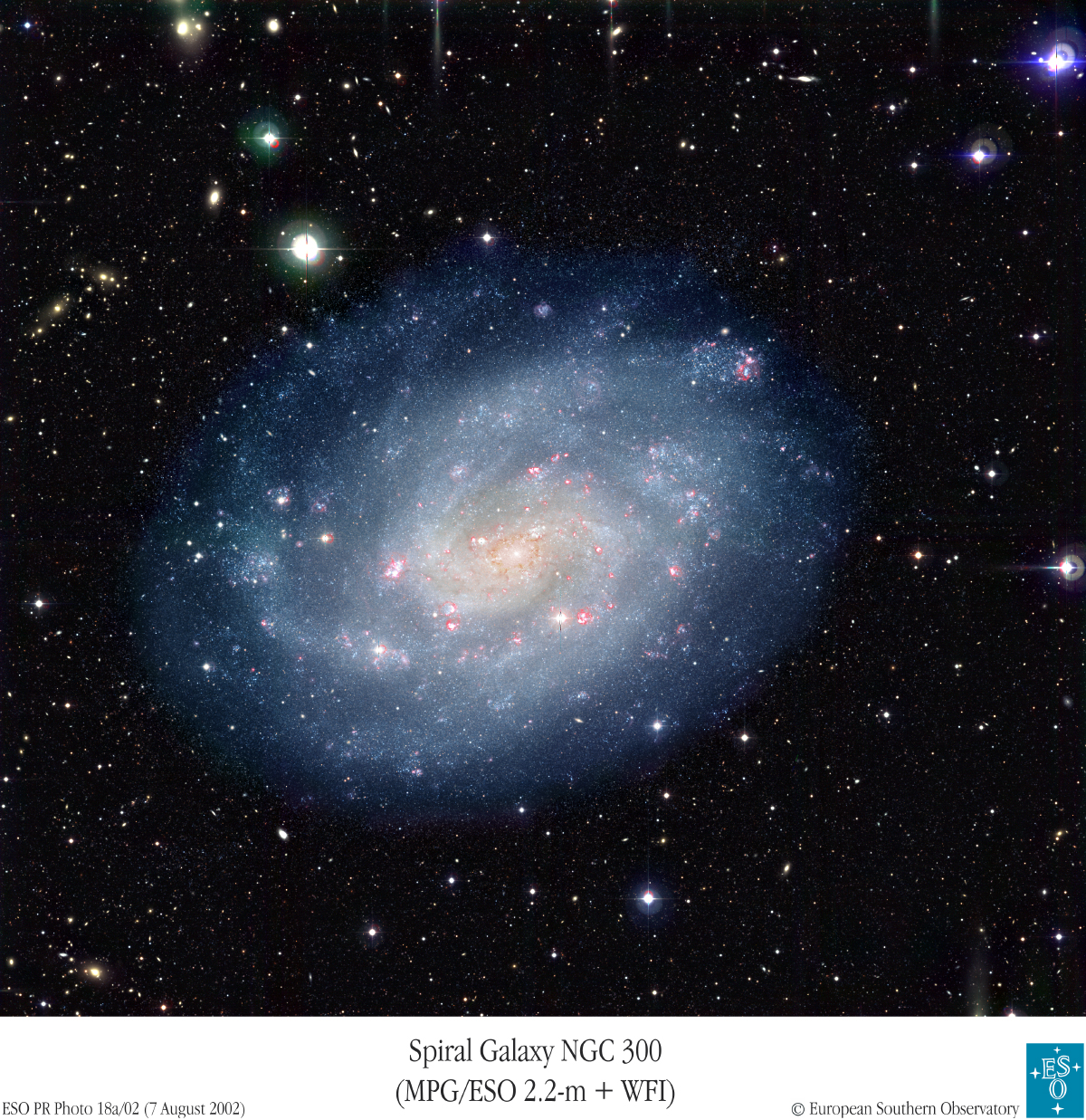
Posted on 08/20/2002 9:44:54 PM PDT by petuniasevan
Discover the cosmos! Each day a different image or photograph of our fascinating universe is featured, along with a brief explanation written by a professional astronomer.
2002 August 21
Explanation: NGC 300 is so interesting because it is so normal. An Sc-type spiral galaxy in the nearby Sculptor group of galaxies, NGC 300 shows typical flowing blue spiral arms, an expected compact nucleus, and the requisite amount of stars, star clusters, and nebulae. Therefore, studying NGC 300 should indicate how, exactly, a normal spiral galaxy works. Toward this goal, NGC 300 and the surrounding area were studied in exquisite detail, creating and combining a series of high-resolution images to create the above conglomerate picture. NGC 300 lies only 7 million light years away, spans nearly the same amount of sky as the full moon, and is visible with a small telescope toward the constellation of Sculptor.
Estimated distances to nearby galaxies such as NGC 300 seem to be fairly accurate. This is because astronomers measure using "standard candles" called Cepheid Variable Stars. This is a class of giant stars which are periodic variables, with very regular fluctuations. The periodicity depends on the brightness (which depends on mass). Brighter equals slower. Thus if we know how BRIGHT the star is at, say, a standard distance (absolute magnitude), we can determine a distant Cepheid's brightness (apparent magnitude) and so figure the galaxy's distance. We know how bright the Cepheid SHOULD be by its period of variability.
The fly in the ointment, so to speak, is the presence of intergalactic dust which will absorb some light. Measurements at various wavelengths on the electromagnetic spectrum may help to determine the amount of absorption.

Get on the  list!
list!
Does the above graphic work as a PING or should I also type "PING"? Any confusion?
All that's missing is the sign "Building Materials In Use"!
I have the milky way as my wallpaper. Now I'll have to alternate.
Disclaimer: Opinions posted on Free Republic are those of the individual posters and do not necessarily represent the opinion of Free Republic or its management. All materials posted herein are protected by copyright law and the exemption for fair use of copyrighted works.