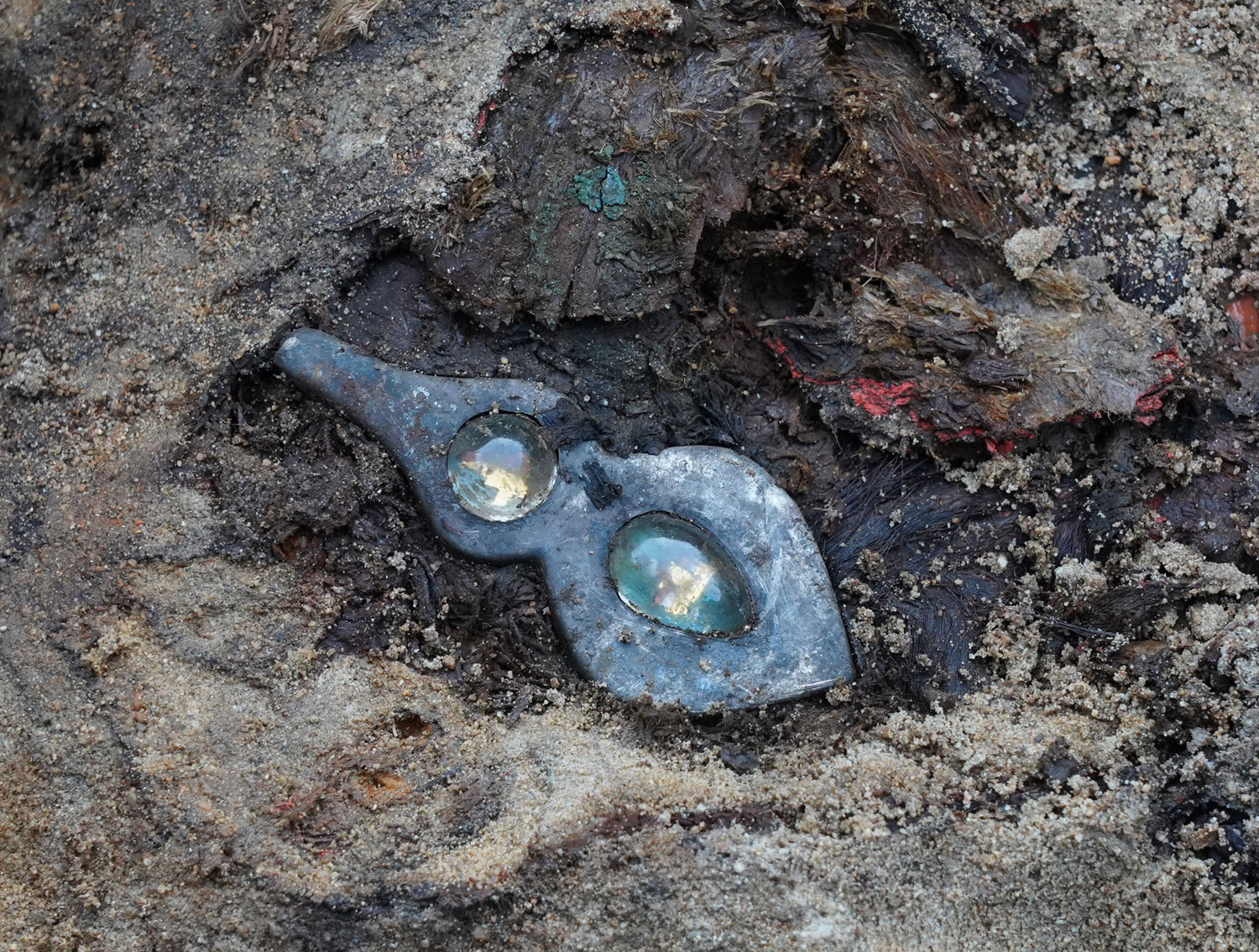
Silver ornament inlaid with rock crystal, Duurlig Nars, MongoliaNational Museum of Korea
Posted on 11/18/2026 11:12:06 AM PST by SunkenCiv
Artifacts discovered in a monumental tomb in the Duurlig Nars cemetery in eastern Mongolia suggest that the nomadic people of the Xiongnu Empire had trade contact with people from Rome and the Korean Peninsula, La Brújula Verde reports. Researchers from the National Museum of Korea, the Mongolian Academy of Sciences, and the National Museum of Mongolia found that the 240-foot-long tomb featured a small burial chamber inside two nested wooden structures. A lacquer-coated carriage was placed above the central burial. The tomb was then been covered with nine layers of stacked stones measuring more than 45 feet deep. A transparent glass vessel with a handle recovered from the tomb is thought to have originated in the Roman Empire. Chemical analysis of the glass could help scientists confirm where the vessel was made. Fifteen jade objects placed in the wooden coffin in the tomb resemble ceremonial disks often found in burials from China's Han Dynasty, but have irregular shapes and detailed decorations. The differences between these jade objects and those unearthed in China could reflect how the people of Xiongnu adapted Chinese customs. A silver, gourd-shaped pendant with a piece of rock crystal set in its center, similar to those found in ancient tombs in what is now North Korea, would have been used to adorn a horse harness. A round gold ornament decorated with red and blue materials set beneath transparent crystal was found next to the silver ornament. It is said to be the first of its type recovered from a Xiongnu tomb. To read about two other lavish Xiongnu burials unearthed in north-central Mongolia, go to "Tomb of the Silver Dragons," one of ARCHAEOLOGY's Top 10 Discoveries of 2019.
(Excerpt) Read more at archaeology.org ...
Dear FRiends,
We need your continuing support to keep FR funded. Your donations are our sole source of funding. No sugar daddies, no advertisers, no paid memberships, no commercial sales, no gimmicks, no tax subsidies. No spam, no pop-ups, no ad trackers.
If you enjoy using FR and agree it's a worthwhile endeavor, please consider making a contribution today:
Click here: to donate by Credit Card
Or here: to donate by PayPal
Or by mail to: Free Republic, LLC - PO Box 9771 - Fresno, CA 93794
Thank you very much and God bless you,
Jim
Silver ornament inlaid with rock crystal, Duurlig Nars, MongoliaNational Museum of Korea
Third century BC to first century AD…
One wonders if the Romans ever came into contact with China civilization…
The Chinese and Romans knew about each other, and a Chinese mission to the Persian Gulf arrived just after Hadrian withdrew from Trajan's province of Mesopotamia.
Roman seagoing trade with India was quite substantial and there will have been middleman-type trade connections, and the Silk Route is quite old. The route itself is prehistoric, two way, but with the earlier trade items being stuff like lapis lazuli, obsidian, etc.
Later Han court records contain a reference to a trade delegation (probably a freelancer, but they often got treated like a diplomatic mission) from the time of Marcus Aurelius.
Still later, the Chinese wanted to join forces with the Romans to put the Parthians in a vise. That fell apart due to the Eurasian pandemic of that period, which probably contributed to the downfall of Han China, but had an impact on the Roman Empire (Crisis of the Third Century), Parthia, India, and the various barbarian ethnic groups.
Disclaimer: Opinions posted on Free Republic are those of the individual posters and do not necessarily represent the opinion of Free Republic or its management. All materials posted herein are protected by copyright law and the exemption for fair use of copyrighted works.