Untold War Stories
@UntoldWarFacts
22 seconds.
That is how long it took for a 23 year old staff sergeant from Alabama to save the lives of his entire B-29 crew on a mission to Japan in 1945.
He had to carry a burning phosphorus bomb 25 feet through the aircraft.
He held it against his body while it burned through to the bone.
This is the story of Red Erwin...🧵1/5
Untold War Stories
@UntoldWarFacts
·
Sep 26
Replying to
@UntoldWarFacts
🧵 2/5
Henry Eugene Erwin was born on May 8 1921 in Adamsville, Alabama. A small coal mining town outside Birmingham. His father was a coal miner who died when Henry was 10 years old. His mother was left to raise a large family alone.
Henry took a job at the local coal mine commissary to help feed his younger brothers and sisters. He dropped out of high school. He worked for the Civilian Conservation Corps. He worked in a steel mill. He grew tall with a head of bright auburn hair that earned him the nickname Red.
In July 1942, six months after Pearl Harbor, he enlisted in the Army Reserve. He was called to active duty in February 1943 as an aviation cadet. He wanted to be a pilot.
He washed out of pilot training in Ocala, Florida for what the Army called flying deficiency. They sent him to radio operator and mechanic school instead.
He graduated in 1944. He married a woman named Betty in December. Two months later he was on his way to the Pacific to serve as a B-29 radio operator with the 52nd Bombardment Squadron based at North Field on the island of Guam.
He flew his first combat missions over Japan in February and March of 1945. He earned two Air Medals and was promoted to Staff Sergeant.
One of his early combat missions was on April 12 1945.
Untold War Stories
@UntoldWarFacts
·
Sep 26
Replying to
@UntoldWarFacts
🧵 3/5
That morning 85 B-29 Superfortresses took off from Guam to bomb the Hodogaya Chemical Plant at Koriyama, 120 miles north of Tokyo. The factory produced an additive used in aviation fuel. The Twentieth Air Force wanted it destroyed.
Red Erwin's B-29 was named the City of Los Angeles. She was the lead aircraft. Her crew was responsible for marking the assembly point for the rest of the bomber formation. Erwin had an extra job that day. When the aircraft commander gave him the signal, he had to drop a white phosphorus signal flare through a chute in the floor near his feet.
The flare was a 20 pound canister with a six second fuse. The phosphorus inside burned at over 1,300 degrees.
The B-29 reached the assembly point off the south coast of Japan. Anti-aircraft fire opened up. Japanese fighters appeared. Captain George Simeral gave Erwin the signal.
Erwin pulled the pin on the flare. He dropped it into the chute.
The flare ignited inside the chute. It bounced back up and exploded in his face.
The burning phosphorus melted his nose. It blinded him completely. It set his clothing on fire. The bomber's interior filled instantly with thick white smoke. The pilot in the cockpit could no longer see his instruments. The City of Los Angeles lurched into a dive.
A full bomb load sat in the bay below him.
Untold War Stories
@UntoldWarFacts
🧵 4/5
Red Erwin was blind, on fire, and in unimaginable pain.
He could feel the phosphorus burning through his clothing and into his skin. He knew the flare was about to detonate the bombs beneath him. He knew his crew was about to die.
He reached down and picked up the burning phosphorus canister with his bare hands.
He turned and crawled toward the cockpit. His skin was on fire. The smoke was so thick he could not have seen even if he still had his sight. He could only feel his way forward through the narrow fuselage of the B-29.
A folding navigator's table blocked his path. He could not get past it with both hands holding the flare. He clamped the burning phosphorus between his right forearm and his ribcage. The flare burned through his flight suit and into his body.
He used his free hand to unlatch the table. He continued crawling.
He reached the cockpit. He found the copilot's window with his hand. He threw the flare out.
He collapsed between the pilot's seats.
The smoke cleared enough for Captain Simeral to pull the B-29 out of its dive at 300 feet above the Pacific Ocean.
The entire incident had taken 22 seconds.
Untold War Stories
@UntoldWarFacts
·
Sep 26
Replying to
@UntoldWarFacts
🧵 5/5
The City of Los Angeles diverted to the recently captured island of Iwo Jima. The crew extinguished what was left of Red Erwin's burning uniform. The medics at the field hospital examined him and did not believe he would survive.
He was conscious the entire time. He only asked about his crew.
General Curtis LeMay heard what had happened. He wanted Red to receive the Medal of Honor before he died. The only available Medal of Honor in the entire Pacific Theater was in a display case at US Army headquarters in Hawaii. LeMay sent a B-29 crew to retrieve it. They arrived at the office and found the commanding general was not there. They broke open the display case and took the medal.
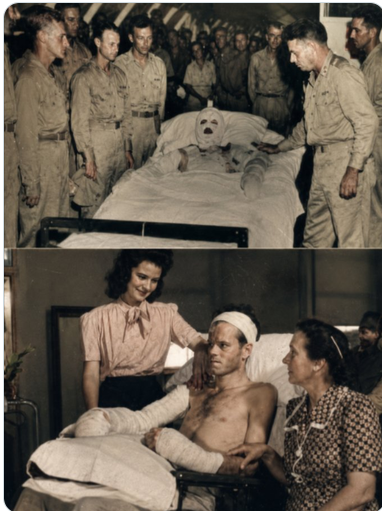
On April 19 1945, exactly one week after the incident, Major General Willis Hale pinned the Medal of Honor on Red Erwin's bandaged chest in a hospital bed on Guam after LeMay pushed for the award to be rushed.
LeMay said: "Your effort to save the lives of your fellow airmen is the most extraordinary kind of heroism I know."
General Hap Arnold wrote that the act was "one of the bravest in the records of the war."
Red Erwin did not die.
He spent 30 months in military hospitals. He underwent 41 surgical procedures. The phosphorus particles in his body continued smoldering for months. He lost an eye, an ear, his nose, and several fingers. Doctors eventually rebuilt his face. They restored his sight in one eye. He regained the use of his left arm.
He was discharged in October 1947. He went home to Alabama. He raised four children with Betty. He worked for the next 37 years as a benefits counselor for the Department of Veterans Affairs in Birmingham, helping other wounded American servicemen receive their care.
He died on January 16 2002 at the age of 80.
He was the only B-29 crew member in the entire Second World War to receive the Medal of Honor.
September 26, 2026